

Asuras — The Necessary Shadow of the Gods
They are called demons now.
Enemies of the gods. Titans. Anti-gods. Figures of excess and violence carved with bulging eyes and flared nostrils along the causeways of Angkor. To encounter the asuras in stone is to feel tension before one understands meaning.
Yet this was not always their name.
In the oldest hymns of the Rig Veda, asura meant something closer to lord or powerful being. An asura was not yet a demon, but a holder of vital force, a figure of potency and authority. The word carried weight, not condemnation. Only later, as cosmologies sharpened and moral boundaries hardened, did the term slide into opposition.
The asuras did not fall from heaven.
They were reclassified.
In later Hindu and Khmer mythology, asuras become the archetypal adversaries of the devas, locked in perpetual struggle for supremacy. Where the gods represent order, clarity, and alignment with cosmic law, the asuras embody desire, ambition, and unrestrained will. They are not weak. They are not foolish. They are dangerous precisely because they possess power without submission.
This distinction matters.
Asuras are not chaos incarnate. They are excess incarnate.
Driven by rajas—the quality of passion and activity—they seek dominance, recognition, and immortality. Many achieve extraordinary strength through severe ascetic practices, forcing the gods themselves to acknowledge their power. In this, they expose a central anxiety of the mythic world: that discipline without humility can rival divinity itself.
The universe does not punish the asuras for striving.
It punishes them for refusing balance.
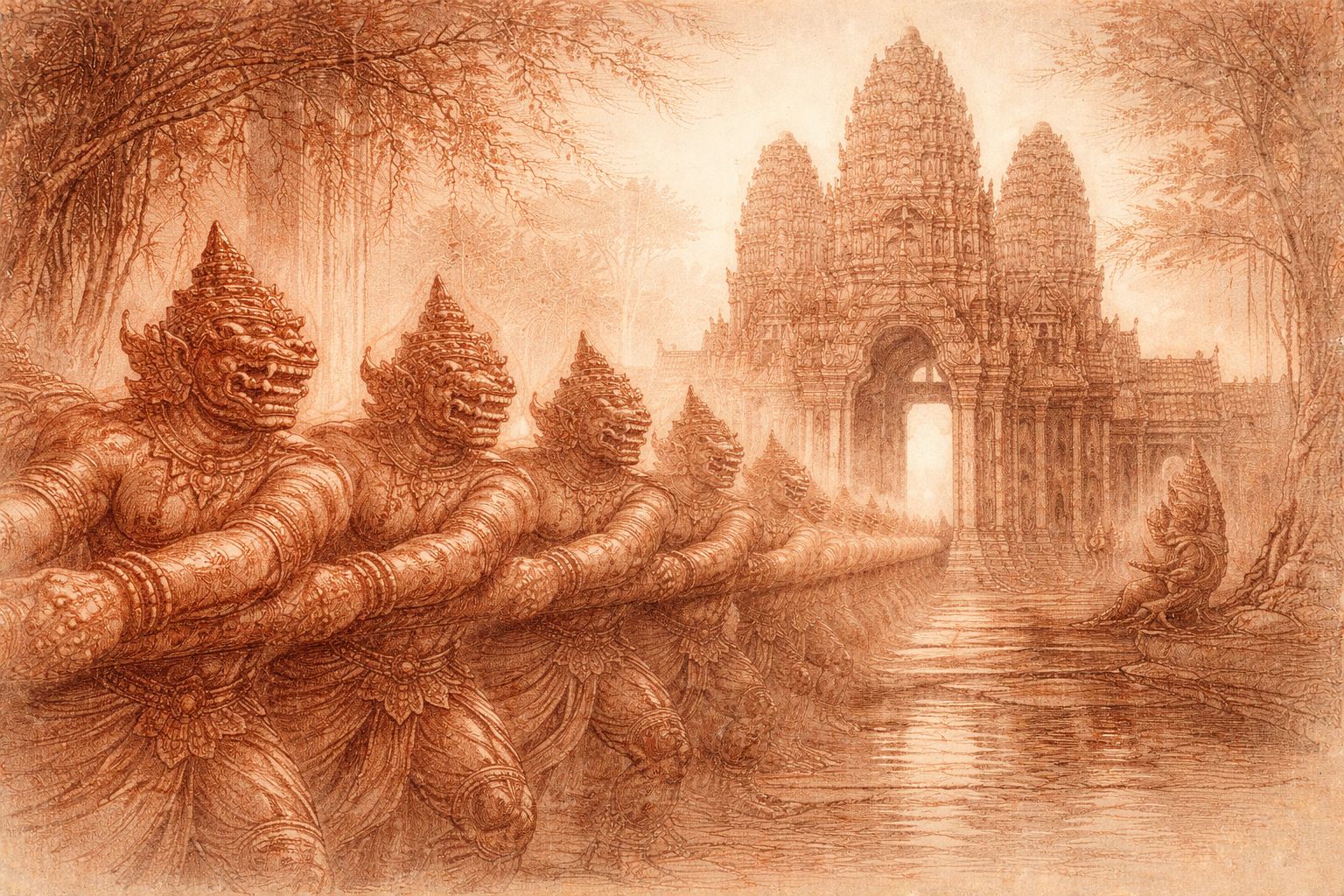
Nowhere is this tension more clearly expressed than in the great myth of the Churning of the Ocean of Milk. Here, gods and asuras act together, bound by necessity rather than trust. The cosmic task is too vast for either side alone. A truce is declared. Mount Mandara becomes the pivot. The naga Vasuki is pulled taut as rope. The ocean is churned.
Creation emerges from opposition.
The asuras grip the serpent’s head, enduring poison and fire. The gods take the tail. Treasures rise from the depths: the moon, the elephant Airavata, the apsaras, and finally amrita, the elixir of immortality. For a moment, rivalry is suspended. The universe itself depends on cooperation between enemies.
But the truce does not hold.
When immortality appears, deception follows. The gods secure the amrita. The asuras are outwitted. Conflict resumes, now sharpened by loss. The myth insists on an uncomfortable truth: even when darkness labours for creation, it will not be allowed to rule it.
In Angkor, this cosmology is made architectural.
At the gates of Angkor Thom, long lines of gods and asuras strain against one another, pulling the naga in opposite directions. Fifty-four devas. Fifty-four asuras. One hundred and eight figures in total—a number dense with cosmological meaning. They do not face each other. They face inward, toward the city they protect.
The asuras are guardians as much as enemies.
Their snarling faces and crested helmets do not signal exclusion, but containment. Disorder is stationed at the threshold, harnessed to defend order rather than destroy it. The Khmer understood that chaos cannot be eliminated—only bound, directed, and given a place.
Politically, the symbolism was unmistakable. Khmer kings aligned themselves with the gods, casting external enemies and internal rebellion in the role of asuras. Victory became the restoration of dharma. Defeat threatened cosmic imbalance. The battlefield echoed the heavens.
Yet the deeper lesson is quieter.
The asuras are not foreign invaders of the cosmos. They are its counterweight. Without them, there is no descent of Vishnu, no renewal of ages, no movement from one yuga to the next. Each time asuric power grows too great, the universe responds—not by annihilation, but by incarnation.
Balance is restored, not erased.
To walk among the asuras at Angkor is to confront the truth that order requires resistance, and light defines itself only against shadow. The gods need adversaries to remain gods. The city needs its demons to remain awake.
The asuras remind us that power without restraint is not evil because it is strong, but because it refuses to listen.
And Angkor, above all, was built to listen.
—
Receive the next work
Subscribe free to receive new work from the Lucas Varro Library by email.
More from the Library


See Also
A concise and impartial dictionary of absence, promises, quarrels, ordinary objects, and the troublesome instability of words.

The City of Service
The temple we inherit is a building from which almost all necessity has been removed. Nothing must be brought for it to continue being what we call a temple. The sanctuary asks nothing of us. Stone is good at this kind of independence.
A living temple was otherwise.
Water had to come in. So did grain, cloth, oil, aromatic substances, fuel. The things required for worship arrived because someone carried them across a threshold.

Houses of Wood, Light, and Smoke
Some of Angkor’s most intimate ruins do not rise above the ground at all. They are postholes, low mounds, hearths and ponds: durable traces of a domestic city built largely from things that decay. To restore that city is to see Angkor not only as stone, but as wood, smoke, water, repair, and people living within calling distance.