

Ananta — The Serpent Who Remembers the World
Before the world has a shape, it has a support.
Before the first mountain rises, before the first name is spoken, something remains—coiled, patient, awake in the deep. The old texts call him Ananta, the Endless One. They also call him Shesha, the Remainder: that which is left when all forms have dissolved and nothing seems to endure.
He is the serpent who does not end.
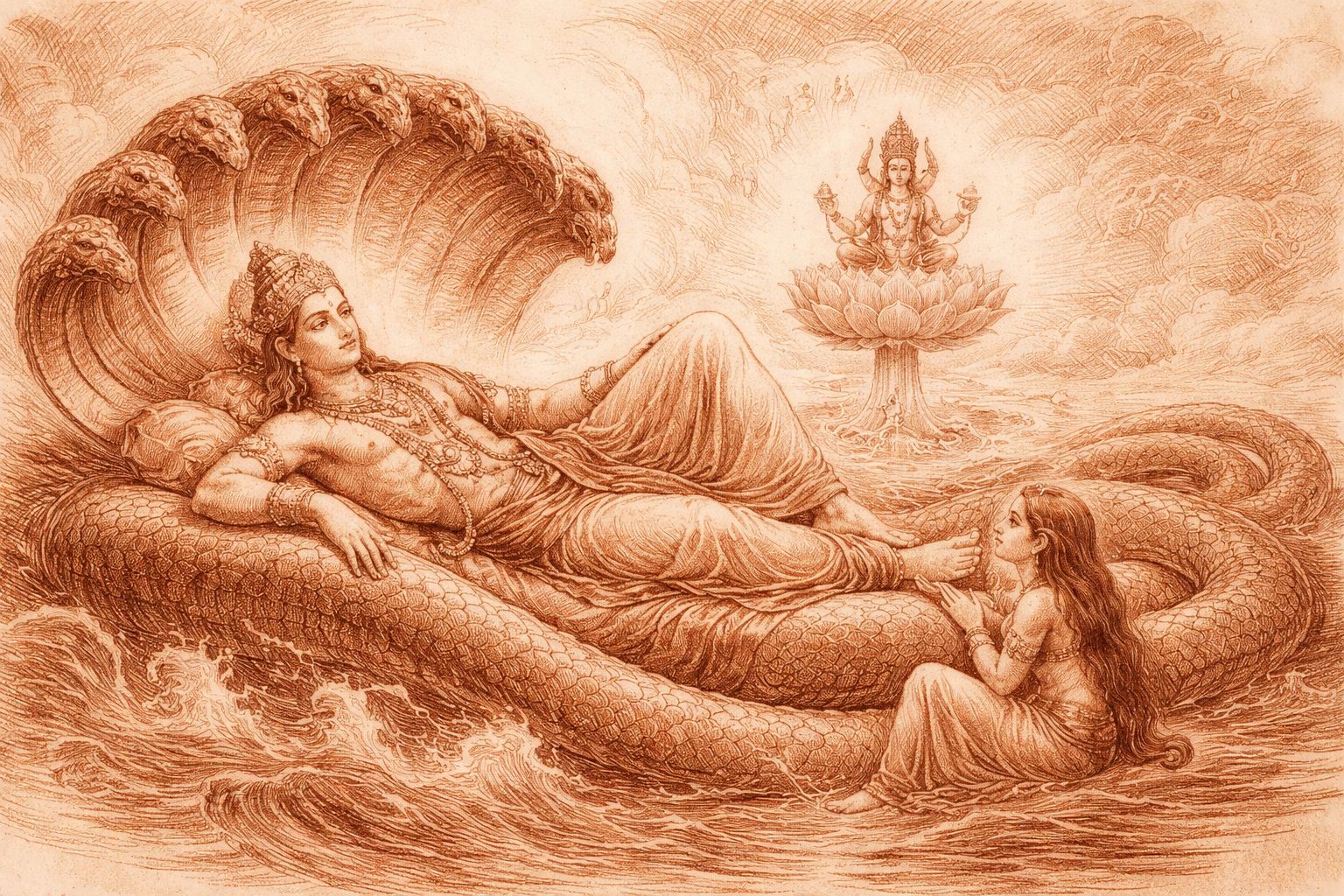
Ananta floats upon the primordial sea, not as chaos but as continuity. His vast coils form a living ground beneath the cosmos, a residue of divine order carried forward from one age to the next. When the worlds are withdrawn, when fire, water, and wind return to silence, Ananta remains—holding memory itself in suspension. He is not creation, nor destruction, but the interval that makes both possible.
In this sense, Ananta is not merely infinite in size. He is infinite in patience.
Upon his body reclines Vishnu, the preserver of worlds, entering the great stillness known as yoganidra. This is not sleep as absence, but sleep as concentration—the inward turning of divine awareness during the Night of Brahma, when time loosens its grip and the universe is held only in potential. Vishnu does not fall into the ocean; he is supported. The serpent’s coils become a couch, a cradle, a geometry of rest.
From Vishnu’s navel rises the lotus, and upon that lotus appears Brahma, ready to shape once more what has already been dreamed. The myth is precise: creation does not arise from nothing, but from remembrance. The serpent remembers what the world has been, so that it may become again.
This triad—serpent, sleeper, sea—is not a hierarchy but a unity. Ocean, naga, and god are three expressions of the same eternal substance, arranged into a moment of perfect balance. Ananta does not command Vishnu, nor serve him in subjugation. He supports him because support is his nature. Endurance is his offering.
Iconographically, Ananta is shown as a many-headed naga, his hoods unfurling like a fan above Vishnu’s head. The number varies—seven, nine, sometimes more—but the meaning remains consistent: vigilance without aggression, protection without force. In the Angkorian imagination, the naga evolves into something closer to a dragon, the reachisey, bearing leonine features and terrestrial power. The serpent becomes not only cosmic but architectural, bridging heaven and earth through stone.
At Vishnu’s feet kneels Lakshmi, massaging the god’s legs with calm devotion. Wealth, here, is not accumulation but continuity—the prosperity of cycles that do not break. The image is domestic and cosmic at once: the universe at rest, cared for, waiting.
The Khmer kings understood this image instinctively. At West Mebon, a colossal bronze Vishnu once reclined upon Ananta at the centre of a vast baray, the artificial ocean mirroring the cosmic one. Water flowed, light shifted, and the god slept in the heart of the kingdom. At Kbal Spean and across Phnom Kulen, riverbeds were carved with Vishnu and his serpent couch so that the waters themselves would pass over creation’s blueprint, sanctifying land and people alike.
Ananta’s coils have also been read in the sky. Some traditions see in them the Milky Way, others the celestial equator—a reminder that the serpent is not confined to myth or temple, but extends into astronomy. Opposed to him is Garuda, the solar bird, carrier of Vishnu through the heavens. Between naga and bird, water and fire, moon and sun, the cosmos breathes.
And yet Ananta remains still.
His brother Vasuki is the serpent of action, stretched taut during the Churning of the Sea of Milk. Ananta, by contrast, is the serpent of rest. He does not strain; he sustains. Where Vasuki enables transformation through tension, Ananta ensures that something survives the transformation intact.
This is why Shesha means “that which is left.” Not debris, but essence. Not ruin, but remainder.
To contemplate Ananta is to contemplate what holds when nothing else does. He is the silent assurance beneath collapse, the cosmic safety net that ensures the universe can afford to forget itself—because something, somewhere, remembers. When the world dissolves into ocean, it does not sink. It is received.
And so the serpent floats, endless and awake, carrying not weight but possibility, waiting for the moment when the dream stirs, the lotus opens, and the world remembers how to begin.
—
Receive the next work
Subscribe free to receive new work from the Lucas Varro Library by email.
More from the Library

See Also
A concise and impartial dictionary of absence, promises, quarrels, ordinary objects, and the troublesome instability of words.

The City of Service
The temple we inherit is a building from which almost all necessity has been removed. Nothing must be brought for it to continue being what we call a temple. The sanctuary asks nothing of us. Stone is good at this kind of independence.
A living temple was otherwise.
Water had to come in. So did grain, cloth, oil, aromatic substances, fuel. The things required for worship arrived because someone carried them across a threshold.

Houses of Wood, Light, and Smoke
Some of Angkor’s most intimate ruins do not rise above the ground at all. They are postholes, low mounds, hearths and ponds: durable traces of a domestic city built largely from things that decay. To restore that city is to see Angkor not only as stone, but as wood, smoke, water, repair, and people living within calling distance.