
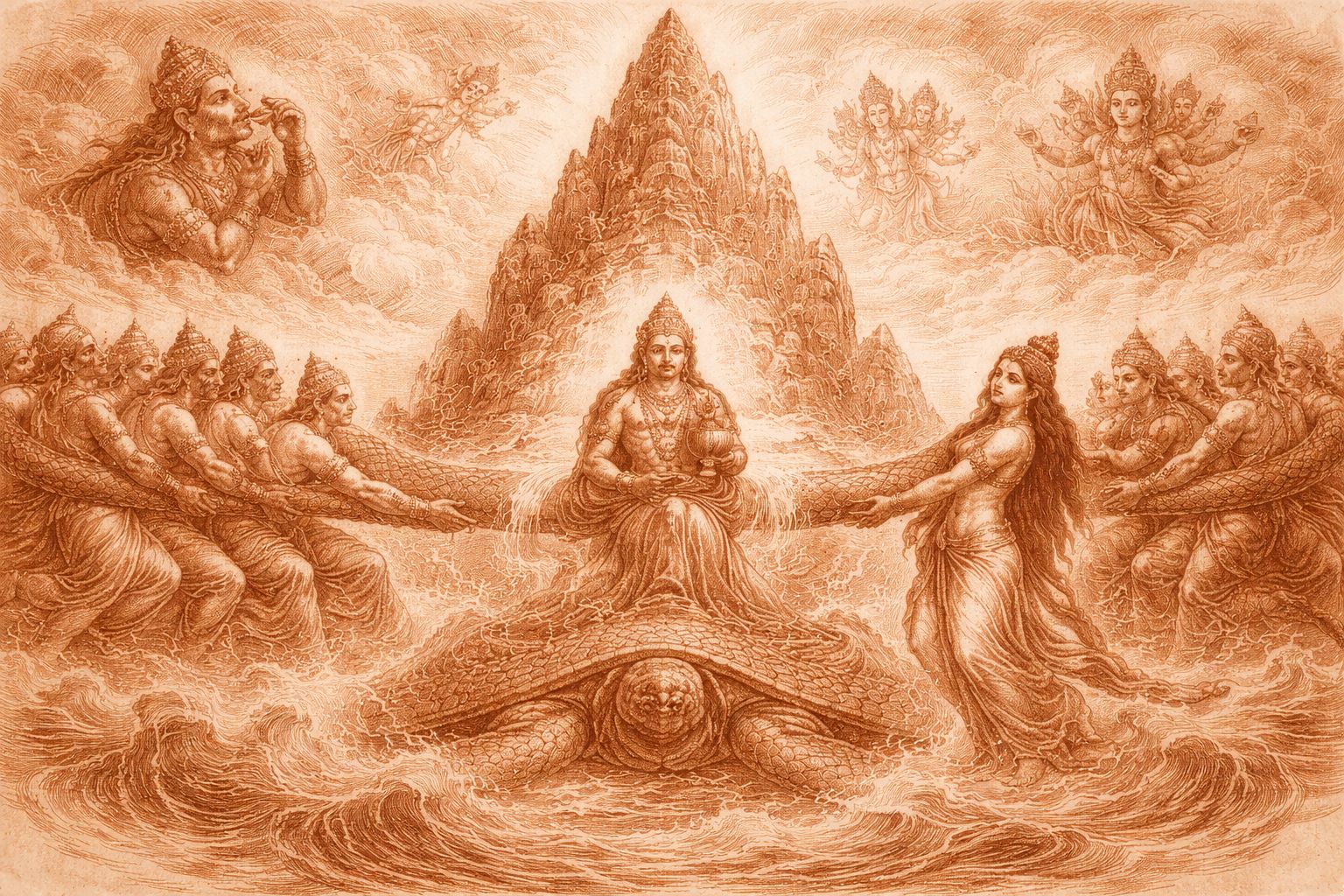

Amrita — The Nectar That Must Be Earned
Immortality, in the ancient imagination, is never given freely.
It is drawn out—slowly, violently, and at great cost—from the depths of the cosmic sea. The texts name it Amrita, the “non-dead,” that which resists decay. It is nectar, elixir, ambrosia: a substance whose promise is not merely long life, but release from disease, exhaustion, and the slow erosion of form. In its earliest appearances in the Rig Veda, amrita is almost indistinguishable from soma, the radiant drink of the gods, a fluid embodiment of vitality itself.
Yet amrita does not belong naturally to the heavens. It must be made.
Its birth occurs during the primordial event known as the Churning of the Ocean of Milk—a moment when creation itself is treated as a problem to be solved through effort, alliance, and risk. The gods, weakened and mortal, are forced into an uneasy truce with their ancient enemies, the demons. Order and chaos grasp the same rope, knowing in advance that the cooperation will not last.
The mechanism is exact and symbolic. Mount Mandara is torn from the earth to serve as the pivot. The naga king Vasuki is wrapped around it as a living rope, his body stretched between opposing forces. As the mountain begins to sink beneath the churned waters, Vishnu intervenes—not as king or warrior, but as Kurma, the tortoise, offering his shell as a foundation. Stability, the myth insists, must precede reward.
The ocean itself transforms under this strain. Salt water becomes milk; milk becomes butter; butter becomes essence. Time stretches—some texts say a thousand years—before the sea yields its treasures. Before amrita appears, the cosmos releases its excess: Lakshmi rises as fortune incarnate; Airavata the elephant; celestial dancers; the moon itself. Even poison emerges first, a lethal residue so potent that only Shiva can contain it, holding death in his throat to spare the universe.
Only then does amrita surface, carried by Dhanvantari, physician of the gods, in a simple vessel. The object is small; the desire it awakens is not.
The truce collapses instantly. The demons seize the nectar, and the cosmos tilts once more toward conflict. Vishnu answers not with force, but with illusion, assuming the form of Mohini, beauty so persuasive that order is restored through distraction rather than violence. Even then, the myth allows for fracture: Rahu, tasting amrita illicitly, becomes immortal only in part—his severed head forever pursuing the sun and moon, turning desire into eclipse.
The lesson is unmistakable. Immortality without alignment produces imbalance. Amrita preserves life, but it does not purify intent.
In the Angkorian world, this myth was not treated as distant cosmology but as living political theology. The vast bas-relief at Angkor Wat transforms the Churning into stone ritual: devas and asuras pulling the naga across the galleries, the entire temple functioning as a machine for prosperity. At the gates of Angkor Thom, the same drama unfolds in three dimensions, with gods and demons frozen in perpetual effort. At the centre rises the Bayon, a mountain-temple echoing Mandara itself.
Here, amrita is no longer merely immortality of the body. It becomes abundance, stability, rain, rice, and continuity of kingship. The Khmer ruler positions himself as the mediator of the churn—the one who ensures that cosmic labour yields benefit rather than collapse. Prosperity, like nectar, must be extracted, guarded, and correctly distributed.
At a deeper level, amrita represents the paradox at the heart of existence: that life is sustained not by ease, but by tension rightly held. The ocean must be disturbed. The mountain must turn. Poison must be endured before sweetness can be drawn forth. Even the gods must risk failure.
Amrita does not abolish death so much as it reminds the cosmos how to survive it.
It is the fluid memory of renewal—proof that when the world is agitated to its depths, something luminous can still be coaxed into being, if the axis holds and the hands do not let go.
—
Receive the next work
Subscribe free to receive new work from the Lucas Varro Library by email.
More from the Library


See Also
A concise and impartial dictionary of absence, promises, quarrels, ordinary objects, and the troublesome instability of words.
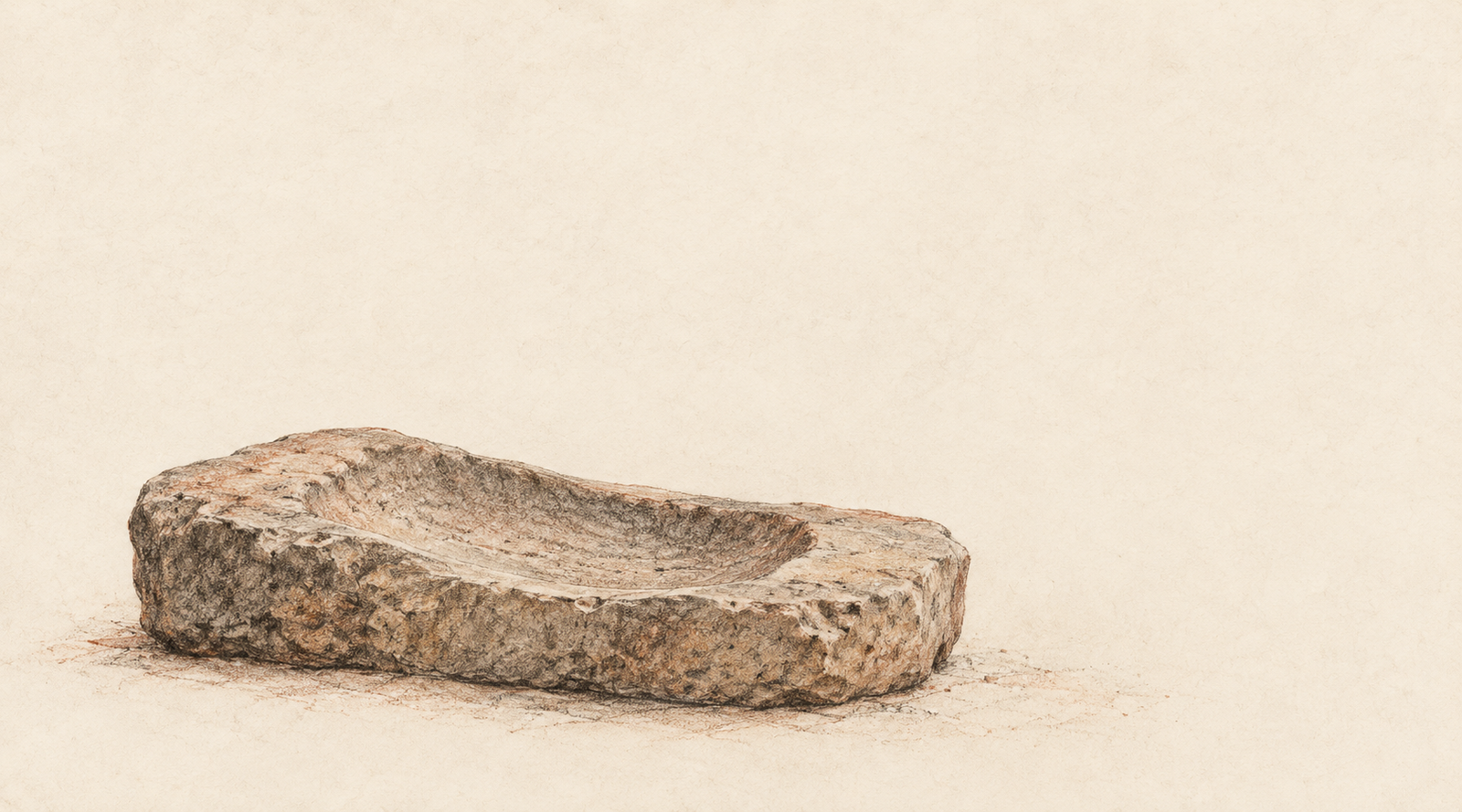

The City of Service
The temple we inherit is a building from which almost all necessity has been removed. Nothing must be brought for it to continue being what we call a temple. The sanctuary asks nothing of us. Stone is good at this kind of independence.
A living temple was otherwise.
Water had to come in. So did grain, cloth, oil, aromatic substances, fuel. The things required for worship arrived because someone carried them across a threshold.
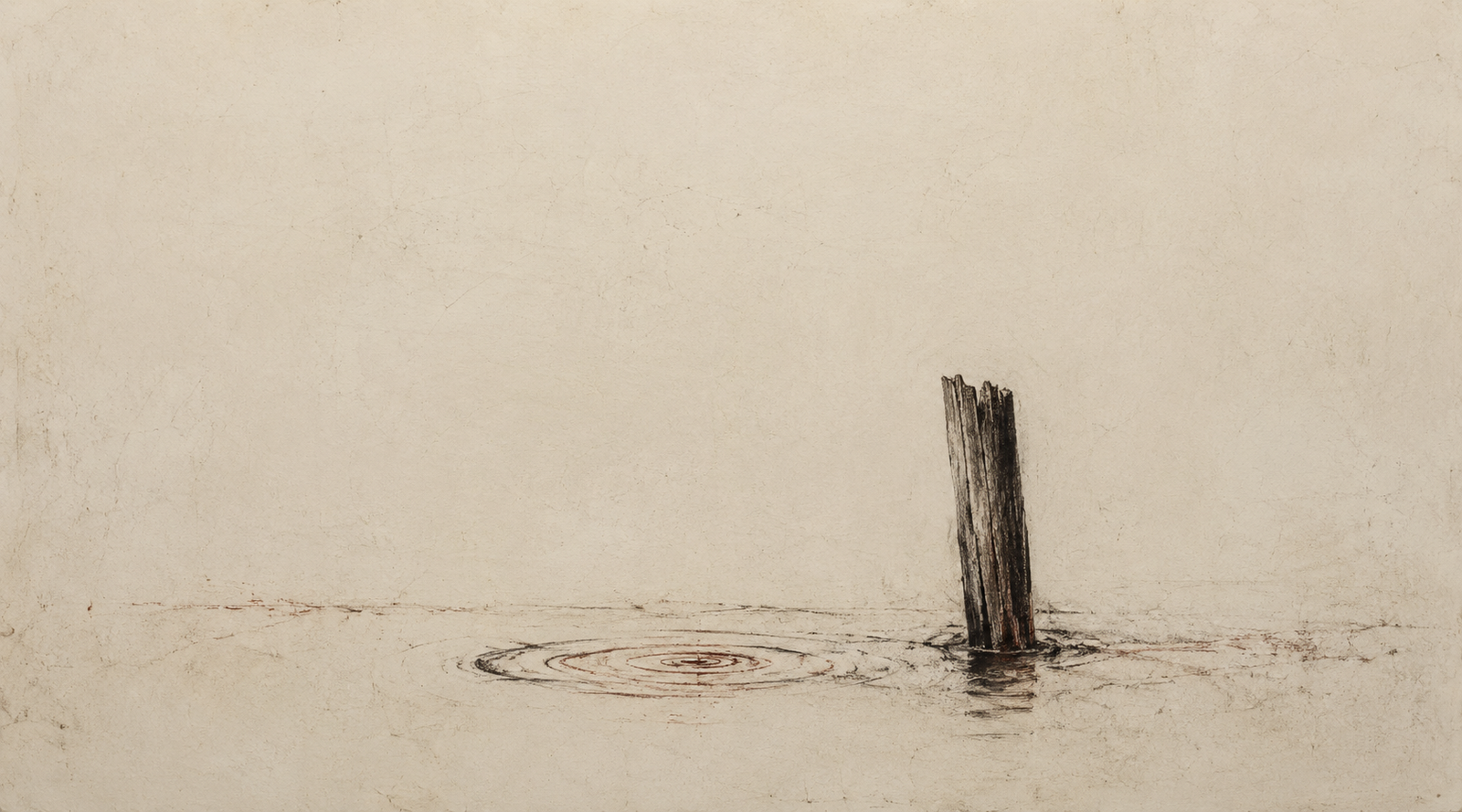

Houses of Wood, Light, and Smoke
Some of Angkor’s most intimate ruins do not rise above the ground at all. They are postholes, low mounds, hearths and ponds: durable traces of a domestic city built largely from things that decay. To restore that city is to see Angkor not only as stone, but as wood, smoke, water, repair, and people living within calling distance.