
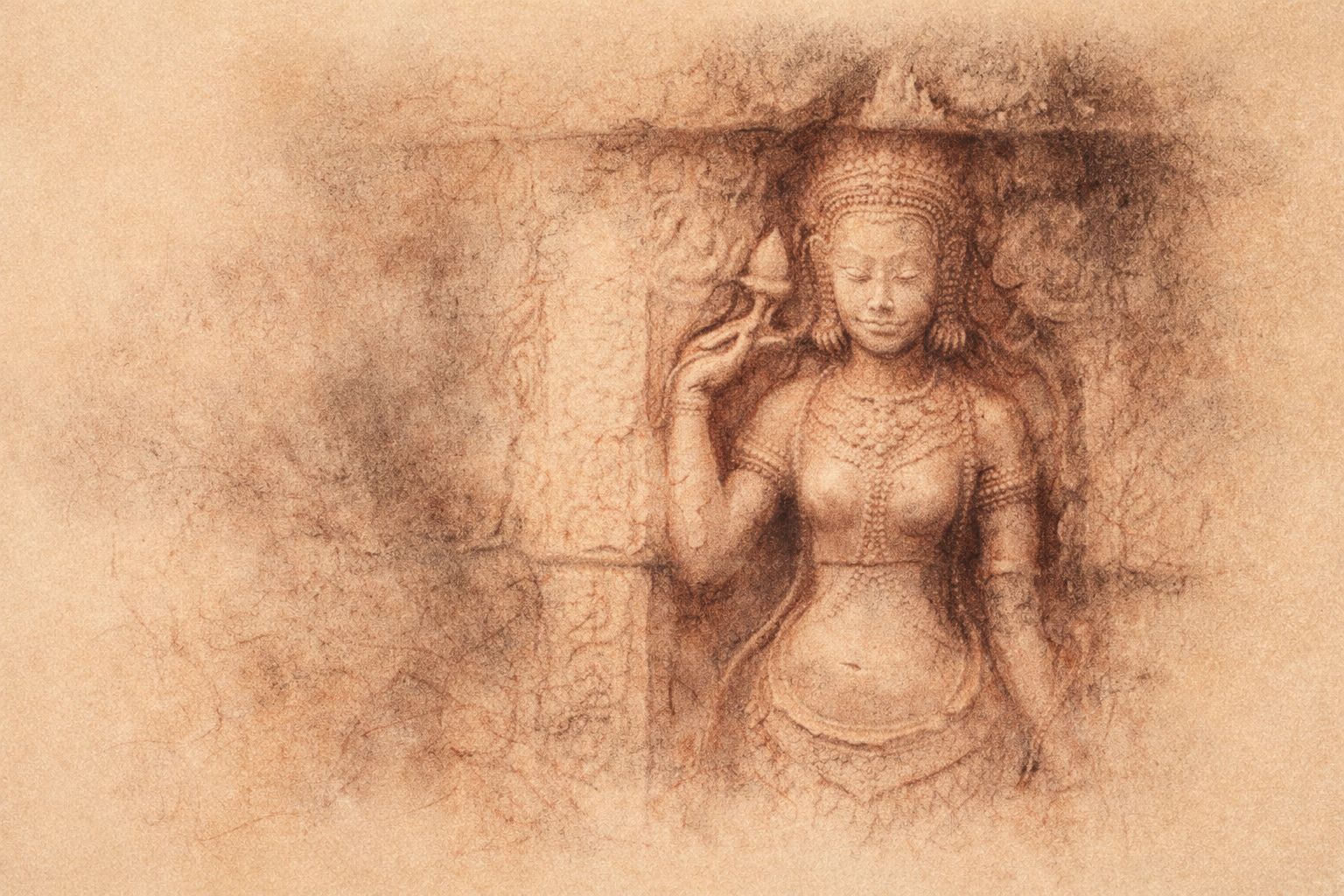

The Devata at First Light
A morning at Banteay Kdei, where sketching and prose become acts of return
I arrived at Banteay Kdei before the day had fully entered itself.
The light was not yet light in the ordinary sense. It lay low in the courtyards and galleries like a thought not yet spoken. The temple still held the coolness of night in its stones. Leaves moved somewhere beyond the walls. A bird gave a brief, uncertain call. Then even that was gone.
I entered slowly.
At that hour Banteay Kdei does not appear. It receives. The halls take the body in and begin at once to undo its haste. Sandstone underfoot. Shadow held between pillars. Doorways opening into dimmer chambers, then into pale rectangles of early sky. Nothing declares itself. Nothing asks to be understood. One walks, and the mind begins to loosen from its own insistence.
I passed through the galleries as though moving through the inner chambers of a long, unfinished prayer.
Here a broken lintel. There a devata half revealed by angle and shadow. A wall darkened by age. A corridor narrowing just enough to quiet thought. The temple was doing what it always does when entered without demand: reducing the self to breath, footstep, gaze. By the time I came into the courtyard, I had already become simpler.
She was there on the wall beside me.

A devata, bejewelled and still, as though she had been waiting in the stone for the morning to find her.
Her adornments remained, though time had laid its hand upon them. Necklaces descended in softened rhythm across her breast. Her headdress, worn yet composed, gathered the face into a stillness no weather had broken. She did not gleam. She did not dazzle. She stood in that rarer condition—beauty made inward by duration.
I sat before her and let the silence do its work.
The courtyard was open to the whitening sky. A few leaves shifted overhead. Somewhere in the temple a bird moved through stone-shadow and vanished again. The air held that early coolness which feels less like temperature than mercy. I did not think of drawing. I did not think of writing. I looked at her until looking ceased to feel like an act and became a form of remaining.
Then, when the inward restlessness had quieted enough, I took out the paper.
It was textured paper, thick and fibrous, with a roughness that resisted the hand. Smooth paper would have lied. Nothing in Banteay Kdei is smooth. The stone keeps its grain. The walls keep their wounds. The carvings keep the abrasion of centuries. I wanted a surface that would refuse fluency, that would make each line earned, caught slightly on the tooth of the page.
I chose sanguine first.
The red chalk carries earth inside it. It is closer to clay, laterite, dust, and the hidden warmth of old walls than to any decorative colour. Banteay Kdei rises from a world of root, soil, red ground, and darkened sandstone. Sanguine could answer her through that deeper body of the temple—not by imitating stone, but by recalling what stone comes from.
The first marks were tentative. The line of the shoulder. The turn of the torso. The slight equilibrium of the hips. The chalk caught on the paper and broke where the grain required it to break. Good. I did not want obedience. I wanted friction.
Then I took up the black chalk.
Black was not there to outline. It was there to remember shadow. To carry the inwardness the red could not hold by itself. Beneath the chin. Within the fall of the hair. Between the jewelled forms where light no longer entered. The red gave warmth. The black gave silence. Slowly, between them, a small answer began to emerge.
I looked up from the page.
She had changed.
Not in the wall, of course. In me. The first seeing had been admiration. Now I began to sense her gravity. The jewellery mattered less than the stillness carrying it. The poise of the body mattered less than the strange inwardness of her presence, as though she were not displaying herself to the courtyard but listening beyond it.
I put down the chalk and opened the notebook.
The first draft came quickly, too quickly, driven by feeling before form had ripened enough to bear it.
She stands in the morning light like a queen of silence, still adorned after centuries of weather and loss. Her jewels shine softly in the stone. I feel as though she has been waiting for me, not personally, but with the long patience of the temple itself. Looking at her, I think of the sculptor who made her, of all the lives she has watched pass, and of the beauty that remains even when time has taken so much away.
I read it once.
Then again.
At once I felt the wound of it. The words had arrived before the seeing was complete. “Queen of silence” was too pleased with itself. “Her jewels shine softly in the stone” said almost nothing. “Waiting for me” bent the moment back towards my own importance. Even the final line, though sincere, flattened what should have remained luminous and difficult.
I closed the notebook.
I rose and left the courtyard.
The temple received my frustration without interest. A corridor. A threshold. A darkened chamber where the air cooled again. I walked slowly through the inner halls, and the false phrases walked with me. A wrong line does not stay on the page. One carries it under the ribs.
Yet the walk was not wasted. Banteay Kdei has a way of thinning language until only what is necessary remains. By the time I had circled through the galleries and come back towards the courtyard, I knew that what had failed in the first draft was not feeling but insistence. I had reached too quickly for beauty instead of letting beauty arrive by pressure and omission.
When I returned to her, the light had shifted.
The cheek was softer than I had first seen. The necklaces held less brilliance, more tenderness. I took up the chalk again and altered the drawing accordingly. A darker inward line at the neck. Less insistence along the ornaments. More space left breathing around the body. The hand was learning what the eye had not first known.
Then I opened the notebook once more.
In the quiet courtyard she remains in her jewellery and stillness, as though time had refined rather than diminished her. The sculptor who shaped her must have known that grace lives in balance, not display. She has looked out on centuries of rain, worship, neglect, return. Yet nothing in her asks for pity. She stands with the composure of something that has outlived the need to be admired.
Better. But not enough.
I could feel where it tightened around its own thought. “Grace lives in balance, not display” was true, but it sounded concluded rather than discovered. “Rain, worship, neglect, return” reduced centuries to a sequence when what I felt from her was not chronology but presence.
Again I closed the notebook.
Again I sat.
The courtyard had grown brighter. Morning had entered the stones. A small movement of air passed through the open space and touched the page. I looked at her without trying to write her. After a while I found myself thinking of the sculptor—not as an abstraction, but as another solitary labourer before resistant material. He too must have known hesitation. Must have cut too sharply once or twice. Must have stood back from the wall and wondered whether the mouth was too severe, whether the ornament was overworked, whether the life had gone out of the figure because the hand had insisted where it should have listened.
That thought steadied me.
I returned to the sketch. Sanguine along the contour of the torso. Black deepened beneath the lower necklaces. A little less detail in the jewellery, because detail was beginning to obscure the larger grace. The drawing came nearer by becoming simpler.
So would the prose.
On my third return I crossed out almost everything I had previously tried to preserve. I cut the ornamental phrases. I cut the summary of centuries. I cut every sentence that seemed to stand between her and her own quiet force.
What remained began to breathe.
She stands in her old adornments with a calm no weather has undone. Time has softened the stone, but not her presence. The hand that made her understood that stillness could be more radiant than display. She has watched centuries pass through this courtyard and remains without demand, entirely herself.
Closer.
So close that the nearness hurt.
“Old adornments” was too heavy. “The hand that made her understood” had a slight stiffness. “Watched centuries pass” still placed too much emphasis on narrative time, too little on the immediate fact of her remaining. Yet now the prose had entered the right chamber. It had ceased trying to impress. It had begun to serve.
I left once more and walked again through Banteay Kdei.
A blocked doorway teaches removal. A corridor teaches pacing. A half-seen relief teaches restraint. Everywhere the lesson was the same: do not force completion where the deeper truth lies in patient incompleteness.
When I came back to the courtyard for the fourth time, there was no triumph in me, only readiness.
I looked at her.
The jewels. The softened edge of the face. The composure. The patience. The complete absence of demand.
And at last the right words came quietly, with no flourish around them.
She remains in her jewels, not as ornament, but as memory of devotion made visible. Time has passed its patient hand over her, softening edge and detail, yet nothing essential has been lost. The sculptor who brought her from stone understood that grace need not declare itself. For centuries she has stood in this quiet court, receiving rain, light, absence, return. What endures in her is not splendour, but presence.
I did not alter it.
The page had grown still.
I made one final adjustment to the sketch. A softening at the cheek. A darker hush beneath the ornaments. Then I put the chalk away. To continue would have been distrust.
When I rose at last, the temple was awake. Light lay more openly in the halls. Birds sounded from beyond the walls. Warmth had begun to gather in the stone. Yet something of the first hour remained in the courtyard, and in me.
I passed back through Banteay Kdei carrying the paper and the notebook, though what they held did not feel wholly mine. The drawing had been made through return. The prose had been made through return. Even the morning itself had seemed to arrive by return—light touching stone, withdrawing into shadow, then touching it again more fully.
At the outer halls I paused and looked back only once.
She was still there in the quiet court, wearing her centuries lightly.
The chalk dust remained on my fingers. The final lines remained in the notebook. Between them lay the whole morning: the first false sentence, the crossings-out, the small corrections of hand and eye, the long patience of the wall, the mercy of having been made to return until language gave up its vanity and grew clear.
Then I walked on.
—
Receive the next work
Subscribe free to receive new work from the Lucas Varro Library by email.
More from the Library

See Also
A concise and impartial dictionary of absence, promises, quarrels, ordinary objects, and the troublesome instability of words.
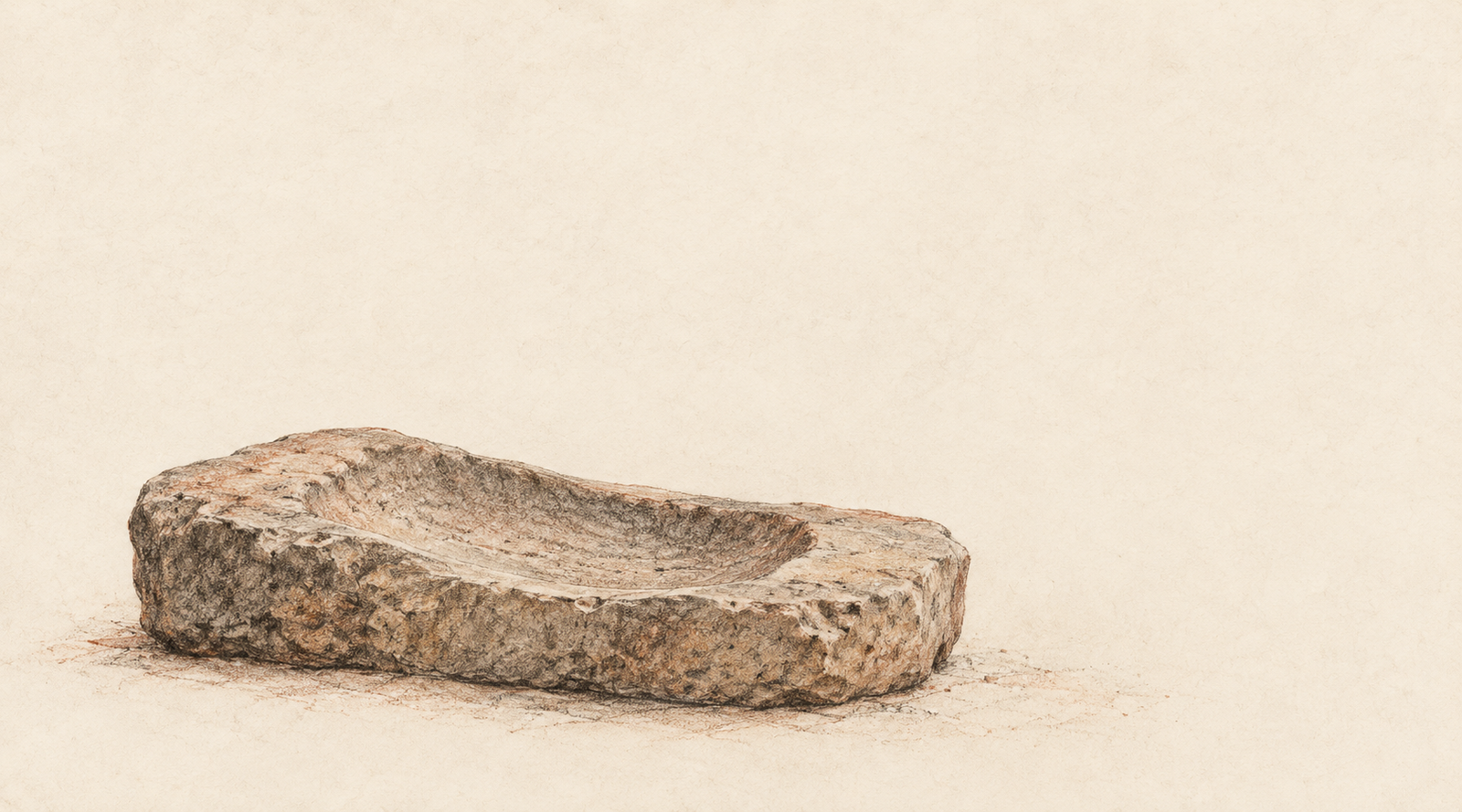

The City of Service
The temple we inherit is a building from which almost all necessity has been removed. Nothing must be brought for it to continue being what we call a temple. The sanctuary asks nothing of us. Stone is good at this kind of independence.
A living temple was otherwise.
Water had to come in. So did grain, cloth, oil, aromatic substances, fuel. The things required for worship arrived because someone carried them across a threshold.
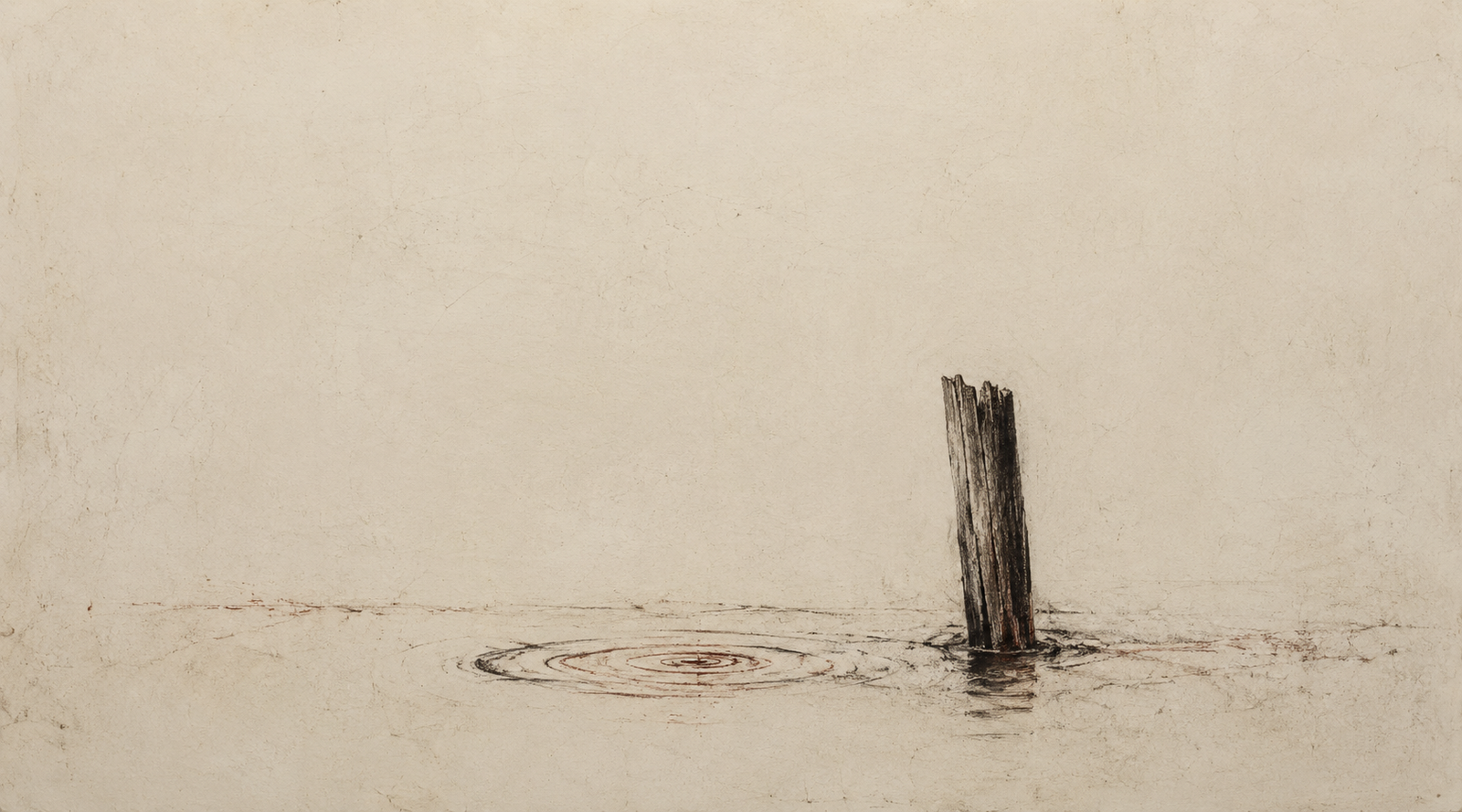

Houses of Wood, Light, and Smoke
Some of Angkor’s most intimate ruins do not rise above the ground at all. They are postholes, low mounds, hearths and ponds: durable traces of a domestic city built largely from things that decay. To restore that city is to see Angkor not only as stone, but as wood, smoke, water, repair, and people living within calling distance.