
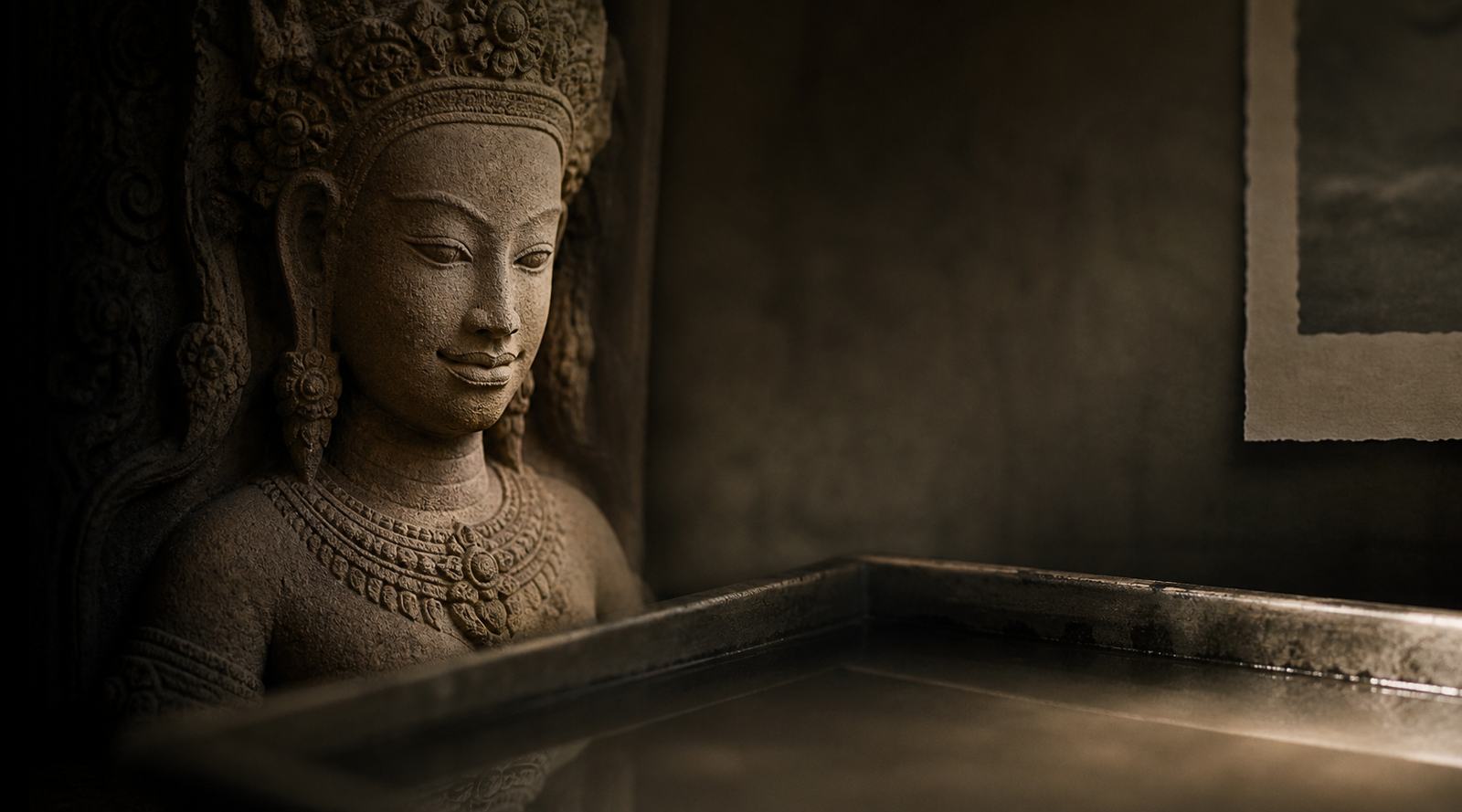

The Apsara Against the Assembly Line
On slowness, repetition, and the hand’s refusal to disappear
The print rises slowly in the tray.
At first there is almost nothing: a pale sheet beneath the liquid, a milky veil, a silence. Then silver begins to darken into shadow. A highlight lifts. Stone gathers itself from blankness. The image arrives not all at once, but by degrees, as if remembering the world.
My hands hover just above the surface of the water, waiting.
It is a small miracle every time — the patience of paper, light, silver, and chemistry deciding when the photograph will reveal itself. There is no rushing this. Not in the darkroom. Not in any place where an image is allowed to become more than a surface.
A photograph, in my darkroom at least, insists on its own tempo.
Sometimes the image emerges with unexpected grace: the tones balanced, the shadows breathing, the light falling in quiet harmony. Other times, after hours of effort, the print collapses into murk. Highlights flare into emptiness. Shadows thicken without depth. The spirit of the place disappears into grey confusion.
Failure is as common as success.
Often I return the next night and remake the same image, not because the previous print was technically unusable, but because something in it has not yet become true. What looked finished one evening seems inadequate the next. The photograph appears almost alive, resisting my attempt to pin it down.
The air in the darkroom is thick with chemical scent: developer, fixer, the faint metallic tang of silver. My fingertips wrinkle from hours in water trays. A clock ticks faintly beyond the sealed door, but in here time stretches, warps, pools.
Every gesture slows down: the wave of a brush across the paper, the rocking of a tray, the patient lift of a print toward the light. Even mistakes require attention. To hurry is to ruin the image.
The darkroom is not a factory.
It is a negotiation with light.
Years ago, I set aside a negative I had come to hate. The exposure seemed flawed: the temple stones too flat, the shadows lifeless, the whole image refusing depth. I tried to print it, failed, and abandoned it in frustration.
Months later, I returned to it almost out of stubbornness. I reprinted, failed again, adjusted the exposure, burned the shadows, dodged the highlights. Still lifeless. Another year passed. When I returned once more, something shifted. In the deep grey of the stone, I found a breath of light I had missed before, a subtle curve of shadow that gave the image its hidden structure.
It had taken years for me to see the photograph.
The negative had not changed.
I had.
The rhythm of the darkroom teaches this: seeing is not instantaneous. It is earned. To linger, to repeat, to fail, to return — this is how presence slowly emerges.
The assembly line wants the opposite.
It despises delay. It despises failure. Its law is speed.
I think of the dancers in the stone.
Thousands of apsaras are carved along the galleries of Angkor: processions of hair, headdresses, jewellery, lowered eyelids, and arms bent in rhythmic poise. From a distance, they appear almost identical — an assembly of celestial women repeating a cosmic pattern.
But when you move closer, when you press your attention toward the sandstone, difference begins to appear.
One smiles faintly. Another frowns. A mouth curves with mischief. An eyebrow lifts. A shoulder softens. The chisel wavers. Ornament shifts. No two faces are exactly the same.
The ancient sculptors worked within an exacting formula, yet human hands and time interrupted repetition with difference.
The apsaras are not decoration. In the Indic cosmological imagination that shaped much of Angkor’s sacred art, they are celestial dancers, beings of grace and radiance, associated with abundance, music, fertility, pleasure, and the turning of worlds. They belong to thresholds: between heaven and earth, presence and vanishing, stone and movement, form and breath.
At Angkor, they stand in endless procession and yet never become merely repeated.
When I walk the galleries, I often watch tourists hurry past them toward the more famous images: sunrise between towers, strangler fig roots, the serene faces of Bayon. The apsaras are absorbed into the background. They become part of the temple’s visual weather — seen, but not truly encountered.
Yet when I pause — five minutes, ten, an hour — something shifts.
Their differences accumulate.
One dancer leans with a hidden tilt. Another holds in the corner of her mouth a sadness almost too slight to name. Another seems to have just heard music no one else can hear.
I sometimes sketch them, sitting cross-legged with chalk while the heat presses against my skin. Cicadas drone. Dust gathers on my fingers. A gecko calls from somewhere inside the stone. With each line, the apsara grows more distinct, more alive. What had seemed repeated becomes particular.
Slowness restores individuality.
The apsaras whisper an older rhythm:
eternity does not require sameness.
The assembly line dreamed of something else.
In 1913, at Ford’s Highland Park plant, the moving assembly line transformed industrial production. Instead of a craftsman making an object from beginning to end, each worker performed a single repetitive task as the product moved past. Efficiency increased dramatically. Costs fell. Output accelerated.
But individuality disappeared.
The worker became an interchangeable part in a larger mechanism. The old trace of the hand — the flourish, the hesitation, the signature pressure of a particular maker — was no longer virtue but inefficiency.
The logic was ruthless: speed above all, variation as error.
A craftsman might once have carved his initials into a beam, shaped a curve more lovingly than required, left behind some small evidence of human presence. The assembly line abolished flourish. It abolished deviation. It abolished the trace of the hand.
It also restructured time.
The worker no longer owned his rhythm. The machine dictated the gesture. Those who could not keep pace were broken by the pace. The body was asked to become mechanical.
Two decades later, Walter Benjamin would diagnose the crisis of art in the age of mechanical reproduction. Photography and film, infinitely reproducible, seemed to strip the artwork of its aura — that singular presence that clings to the original, to the unrepeatable encounter, to the object shaped by time, place, and touch.
A hand-carved apsara has aura. You can stand before her and feel the chisel marks, the weathering, the slight asymmetry of her mouth, the centuries darkened in the stone. She is one among thousands, but she is not interchangeable.
A photograph reproduced endlessly on a screen risks losing that presence.
Yet I do not believe aura vanishes from photography itself. I have seen it return in the handmade print — in the print shaped slowly, imperfectly, by hand; in the print where exposure, paper, chemistry, water, patience, and failure leave their quiet trace.
The apsaras resist Ford’s logic.
They are repeated thousands of times, yet each one remains singular. The formula is present, but so is difference. Order does not erase presence. Pattern does not abolish the soul.
The modern assembly line is no longer built only from conveyor belts.
It is built from screens.
Where once workers repeated motions to make cars, now we repeat gestures with our thumbs: swipe, like, scroll, post. Swipe, like, scroll, post. The logic is familiar. Uniformity. Interchangeability. Acceleration. The gradual erasure of sustained attention.
Jonathan Crary describes our world as “24/7” — a system that abolishes rest, erases night, and demands continuous availability. Byung-Chul Han writes of a burnout society, in which the self becomes both worker and overseer, driven by performance, acceleration, and exhaustion.
We live, increasingly, on an assembly line of cognition.
Nowhere is this clearer than in our relationship to images.
Online, images arrive in floods — hundreds, thousands, each demanding only a second or two of attention before the next one replaces it. Swipe. Glance. Forget. The assembly line of content does not want us to linger. It wants us to consume and move on until every image collapses into the same blur.
One afternoon, I sat in a café near the temples, surrounded by travellers bent over their phones. Their thumbs flickered in nearly identical motions. Photographs appeared and vanished so quickly that none seemed to settle. Faces, landscapes, meals, towers, sunsets — each erased by the next.
I realised that the gesture itself, not the image, had become the product.
The body was being trained to repeat, not to dwell.
And yet that same morning I had stood for three hours in the forest with my camera, waiting for the slow fall of light through the leaves at Ta Prohm. One frame. One exposure. The shutter open as cicadas rose and fell, as the smell of damp earth thickened, as the temple breathed.
The contrast was almost absurd: hours given to one image, while hundreds of images vanished in seconds on a screen.
But perhaps this is where resistance begins.
Not in refusal alone, but in attention.
The darkroom teaches this contrast with almost monastic severity. Test strips line the wall like a small procession: one too light, one too dark, one almost there. I dodge a corner, burn a sky, brush warmth into the shadows. Each attempt is slightly different. None is perfect. Each carries the trace of time spent.
Failure is part of the rhythm.
A negative that once seemed lifeless may, after days or years of persistence, yield a print with unexpected depth: a whisper of radiance in stone, a breath of air inside darkness.
To linger with a single image for hours is not inefficiency.
It is devotion.
The assembly line despises failure because failure slows production. But in the darkroom, failure is necessary. It interrupts certainty. It humbles the eye. It teaches the hand to listen.
I sometimes line the finished prints side by side. They are like the apsaras: similar in form, obedient to the same negative, yet none identical. One leans warmer. One holds its shadows more deeply. One allows the light to rise more gently through the stone.
Each carries its own presence.
There is a cruelty in speed.
The assembly line turns the world into product, and product into background noise. It trains us to pass over things before they have had time to speak. It persuades us that the measure of value is output, velocity, reach, reaction.
But slowness restores individuality.
To linger before one apsara for ten minutes is to let her step forward from anonymity. To linger with one print for half an hour is to see its hidden weather appear. To stay with one breath, one face, one stone, one image, is to refuse the flattening force that makes everything equivalent.
We live in an economy of attention.
Every second we linger is monetised, contested, accelerated.
To be slow is not merely to move less quickly.
It is to reclaim the conditions under which anything can become fully present.
The apsara survives not because she is repeated, but because she is attended to. The darkroom survives not because it is efficient, but because it makes time visible.
When I lift a finished print from the water and hang it to dry, I think of the dancers.
Thousands in procession.
Each waiting to be seen.
The assembly line wants sameness. The apsara teaches otherwise. Difference is the soul’s signature. To linger with one print, one dancer, one breath — this, too, is an act of freedom.
—
Receive the next work
Subscribe free to receive new work from the Lucas Varro Library by email.
More from the Library

Houses of Wood, Light, and Smoke
Some of Angkor’s most intimate ruins do not rise above the ground at all. They are postholes, low mounds, hearths and ponds: durable traces of a domestic city built largely from things that decay. To restore that city is to see Angkor not only as stone, but as wood, smoke, water, repair, and people living within calling distance.

What Stone Brings Forth
I had mistaken a gift for something being expelled.
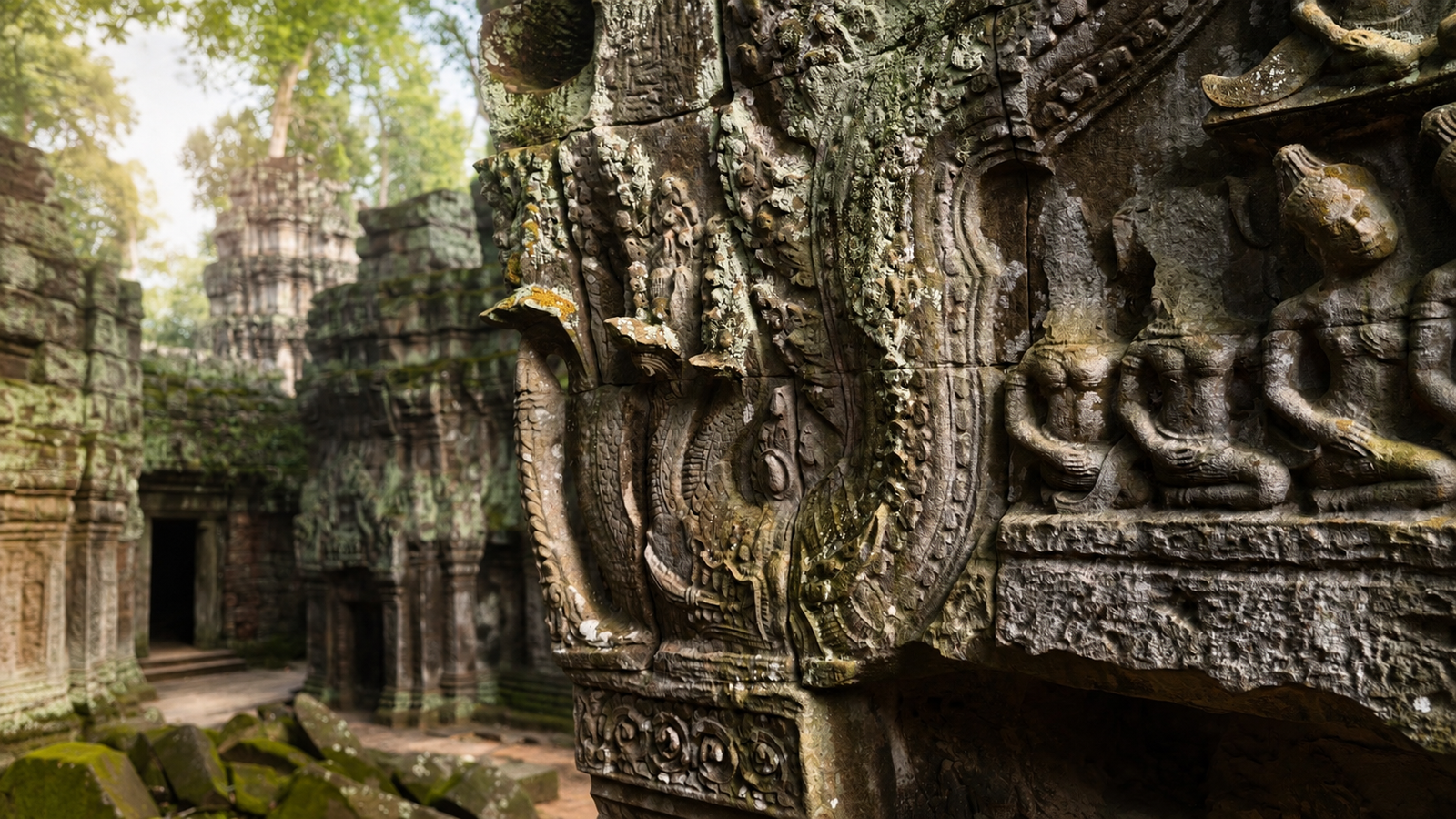
Beneath the nāga's mouth, a stone garland descended bead by bead. Nearby, a makara opened its jaws and another form emerged. Looking closer, the whole temple began to change: serpent became ornament, ornament became architecture, architecture became foliage.
The forest did not introduce this language.
It answered it.

The Eighth Daughter
Seven daughters have already been taken by Yamata-no-Orochi when Susanoo reaches the River Hi. Only Kushinada-hime remains. The Eighth Daughter retells the Kojiki episode through a family’s waiting, a girl transformed into a comb, and the patient preparation for the serpent’s return.