
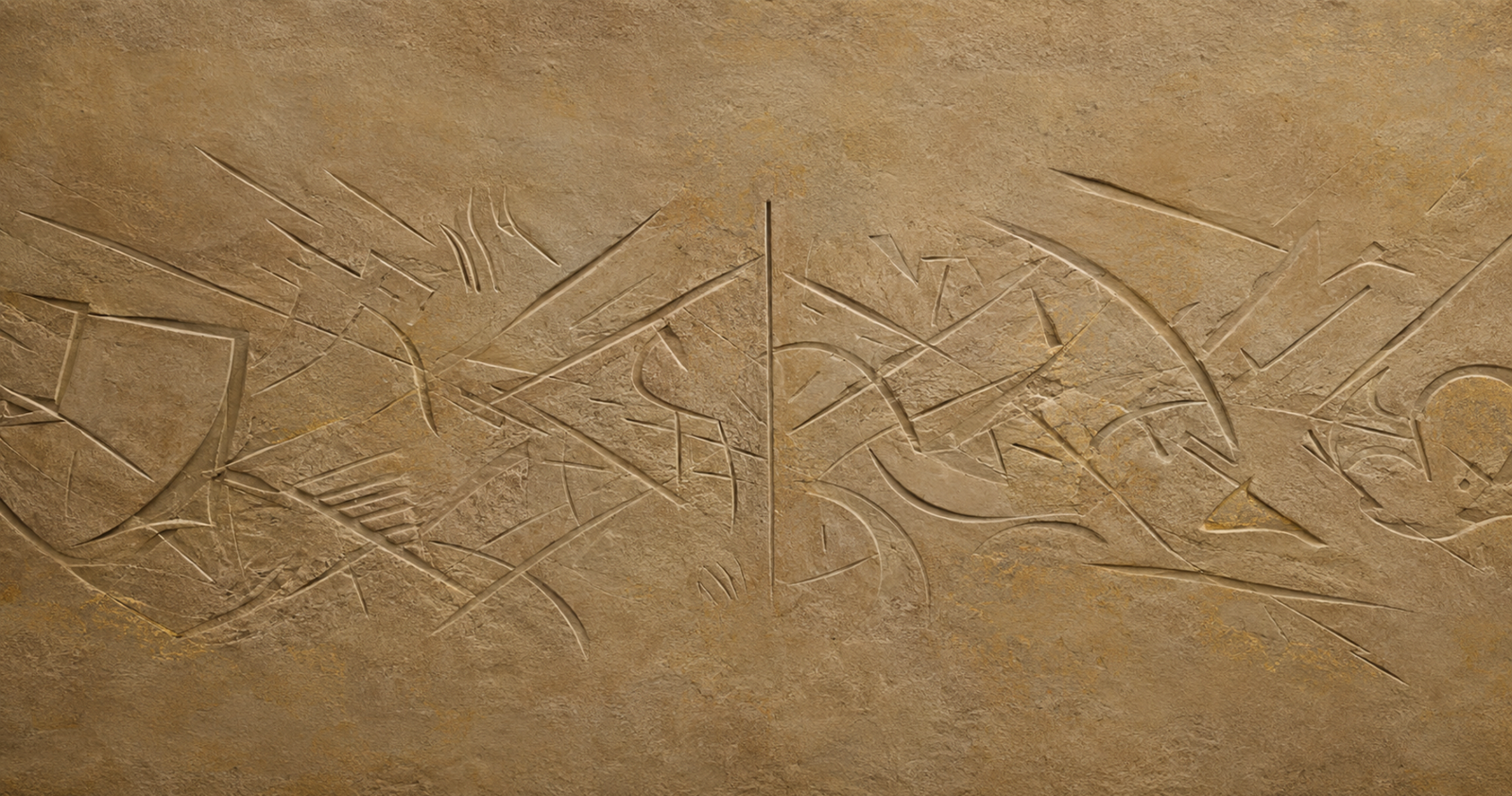

The Story on the Wall
At Angkor Wat, the Ramayana is monumental. The history that made it possible is not.
PROLOGUE
At Angkor Wat, armies of monkeys and demons fill more than fifty metres of a gallery wall. Rama is present, but he must be found. The closer the relief is examined, the less completely it explains how his story came to be there.
At the opening where the north-west corner pavilion gives into the northern wing of Angkor Wat’s west gallery, the carved wall runs south towards the central western entrance. A roof covers the passage. A colonnade stands opposite the relief. Between them, the sandstone extends farther than a single look can organise. The first impression is not of one figure or one episode. It is of a surface under pressure: bodies overlapping bodies, limbs crossing weapons, tails curving through ranks, branches and standards forcing the eye in different directions.
Nothing here behaves like a framed picture. The relief belongs to the architecture, and the architecture requires movement. From the threshold, its full length can be understood only as extension. Closer to it, the whole gives way to local encounters: an arm lifted above a shield; a wheel turning beneath a crowded vehicle; a monkey leaning into the space occupied by an armed opponent. Step back in attention and those parts close again into an army. Look for the army and the individual contests begin to disappear.
The figures do not divide themselves neatly into equal forces. On one side, the monkeys are mostly on foot. They carry rocks and branches, reach with long arms, twist their bodies and drive their tails through the composition’s repeated curves. On the other, the demon army arrives with a more formal equipment of war: bows, blades, shields, standards, chariots and teams of animals. The contrast is visible. Its meaning is not yet settled. Improvised force and organised weaponry occupy the same field without supplying their own moral explanation.
The eye’s route through this pressure is compositional, not chronological. The war is not divided into a row of labelled moments that can simply be read from one end to the other. A cluster may hold a contest that scholarship associates with a particular combatant, while the adjacent movement answers a different need of balance or momentum. The safest first reading follows what the carving makes visible—direction, repetition, contrast and scale—before asking a written tradition to supply proper names.
This is the Battle of Lanka, one of the great conflicts of the Ramayana. For a reader unfamiliar with the story, the necessary orientation is brief. Rama and his allies, an army of monkeys, are fighting the forces of Ravana, ruler of Lanka. The relief offers neither the whole epic nor even the whole war. It takes the moment of conflict and expands it until the famous names become only a few points within a much larger action.
Rama is not the first figure the composition gives up. He has to be found. Near the central opposition, he appears with bow and arrow, standing or braced upon the large monkey conventionally identified as Hanuman. The monkey beneath him pitches into the surrounding movement. Rama’s own figure is more upright and contained. That relative stability makes him legible, but it should not be confused with inactivity, serenity or certainty. It is a relation produced by stance, scale and the restless diagonals around him.
Across from him, Ravana is easier to recognise by multiplication. Heads rise above heads; arms repeat around his upper body; his enlarged figure occupies a chariot drawn by stylised, lion-like animals. The attributes separate him from the surrounding soldiers and make the opposition visible even within the crowd. Yet Rama and Ravana do not command the entire wall simply because they command the story. They anchor a portion of it. Beyond them, the armies continue, and the field refuses to collapse into a portrait of two enemies.
Even Rama’s bow keeps the description from becoming a contrast between movement and perfect repose. He is armed and engaged in the conflict. What differs is the organisation of his figure: a comparatively stable vertical held above the larger monkey body, set against the many slanting limbs and weapons around it. The effect may be described. Its intention cannot be assumed. Nothing in that arrangement, by itself, establishes what an Angkorian viewer believed about Rama’s character or rule.
That refusal matters. A familiar account of the Ramayana might direct every eye towards its hero. The Angkorian relief gives much of its energy to those around him. Monkeys climb, spring, carry and grapple. Chariots press forward. Shields interrupt bodies. Standards rise above tightly packed ranks. No single viewpoint holds all of these actions together. The wall offers the assurance of a complete material object and the experience of an image that cannot be mastered at once.
Modern descriptions attach names to a number of the subsidiary combats. Some identifications are persuasive; others depend on matching an indistinct or unlabelled figure to an episode known from a textual tradition. No list of names now accompanies the relief. Here the honest description is often the simpler one: a monkey commander, a demon warrior, an armed figure, a contest whose exact identity remains uncertain. Ambiguity is not a defect to be repaired by confident prose. It belongs to the limits of the available evidence.
The same restraint applies to damage and condition. Available documentation does not support a current, panel-wide condition statement. Without a dated field record or a technical survey of this precise wing, individual losses, repairs and changes should not be assigned causes. A softened contour proves no history of repeated touching. A darkened passage reveals no ancient rite. The carved surface and the history of its condition are related questions, not interchangeable ones.
The scale changes the terms of the encounter. The Battle of Lanka occupies approximately 51.25 metres of the north wing; the narrative band is about two metres high.1 It is one continuous field rather than a sequence of separately framed scenes. The measurements turn the first impression into a historical fact: this was not a marginal image tucked into an architectural remainder. An enormous extent of Angkor Wat’s gallery was given to a war from the Ramayana.
At close range, the relief also changes the relation between narrative and architecture. A figure may occupy the eye for a moment, but the passage continues and another grouping takes its place. The carved band never detaches itself from the wall to offer a single ideal view. Its length makes looking cumulative. Recognition is built successively, while the knowledge that more action lies beyond the present view keeps every local reading incomplete.
The approach taken here—from the north-west pavilion, looking and moving south—is a present narrative choice. It corresponds to a common modern circuit in which this panel is encountered near the end of the long gallery sequence. It cannot recover an ancient instruction. The evidence leaves unknown whether every visitor to Angkor Wat could enter these galleries, whether access was restricted, or whether an ancient viewer was expected to move clockwise, counter-clockwise or by more than one route.2 The wall fixes a location, not the conduct of everyone who once came before it.
Nor can the surrounding architecture be populated by inference. It is tempting to imagine a reciter explaining the battle, a court moving in procession, or an audience recognising each combat as readily as a modern reader might recognise a familiar scene from a book. None of those possibilities is established for this panel. The relief may have served purposes that are no longer recoverable, but possibility is not recovered practice. The ancient gallery must remain unoccupied in the prose unless evidence can place someone there.
The panel belongs to Angkor Wat’s original twelfth-century programme, made during the reign of Suryavarman II, who ruled from 1113 until about 1150.3 That chronology is secure enough for the Prologue. The exact year in which this part of the wall was carved remains unknown. Its designers and sculptors are unnamed, and the instructions that governed the selection and arrangement of the scene have not been recovered. The king’s reign provides historical context; it does not turn Rama into Suryavarman’s portrait or Ravana into a named political enemy.
Older habits of interpretation have often wanted such equations. A victorious hero and a royal temple seem to invite an allegory of kingship. A demon army seems available for identification with an enemy. But the tempting clarity of those readings exceeds the evidence. No known or surviving inscription or other evidence establishes that Rama is the king, that Ravana is Champa, or that the monkeys stand for Khmer forces. The relief can sustain questions about war, rule and the construction of enemies. It cannot answer them in advance. Those questions must wait until the battle is examined more fully.
For now, the more immediate historical fact is already large enough. By the twelfth century, the Ramayana possessed a monumental visual life at Angkor. The story is not present as a stray name or an isolated emblem. It has become an extended composition involving scale, hierarchy, bodily invention, military order and architectural placement. The relief demonstrates confidence. It also demonstrates selection. No workshop could carve an epic without deciding what to include, whom to enlarge, where to concentrate action and how to make recognition possible across a crowded surface.
Selection is not the same as copying. The wall is not a page enlarged into sandstone. It is a visual argument made through bodies, intervals, repetitions and pressure. Its artists may have worked with texts, oral accounts, earlier images, established conventions or some combination of these. The exact relationship cannot now be recovered. The broad Lanka-war tradition is recognisable; the precise recension or intermediary behind this composition is not.4 A secure name for the episode should not be mistaken for a secure account of how the episode reached the workshop.
This is the point at which seeing begins to produce a different question. At first, the problem was where to find Rama. Once found, he seemed to promise an intelligible centre. But the longer wall surrounds that centre with decisions: which bodies would move, which would remain more contained, which weapons would repeat, which forces would be given the greater variety of action. The question shifts from identification to formation. What had to happen before the story could be imagined on this scale, in this place, with this distribution of attention?
The answer is not preserved in the relief. The wall shows the story after it had already acquired value, institutional support and makers. It shows the result of historical processes omitted from the image. Before the first line was cut, people had to know the conflict. Someone had to recognise Rama and Ravana as figures worth distinguishing. Choices had to pass between telling, design, labour and institution. The finished image contains the consequence of those choices, not their itinerary.
Recognition can therefore mislead as easily as it can guide. To recognise Rama is to place the scene within a great narrative tradition; it is not to recover the particular telling available to the designers. To recognise Ravana is to identify the opposing ruler; it is not to know what political analogy, if any, the workshop or patron entertained. Proper names provide orientation. They do not provide provenance, intention or an unbroken history of reception.
Far from diminishing the object, that limit gives the relief its particular historical force. A fragile record might leave only a name. Here there is abundance: armies, vehicles, gestures, hierarchies and more than fifty metres of organised action. Yet abundance is not the same as completeness. The panel can preserve a world of representation while withholding the sequence by which that world came into being. What survives is both more and less than an explanation.
The Ramayana belongs to a wide family of texts, tellings and images. Angkor Wat’s Battle of Lanka is one historical formulation within it, not an illustration that can be silently renamed as the later Middle Khmer Ramakerti or modern Cambodian Reamker. Relationships across those forms must be demonstrated through gaps and changes, not assumed from familiar names.
The wall marks a moment when the story could perform monumental work in an Angkorian setting. It records neither a first arrival nor an unbroken inheritance. The language, form and intermediaries through which earlier episodes became available here remain unknown.
Still, the historical question has become unavoidable. A narrative whose earliest textual histories lie beyond Cambodia now occupies a Cambodian temple wall at extraordinary scale. The transformation is visible even though its stages are not. The Battle of Lanka has been selected, organised and made architecturally consequential at Angkor. Before that could occur, the story had to become available here: not merely transported, but known, valued and capable of being remade. The relief leaves the beginning of that process undated.
Nor does it identify where inquiry should turn first. Monumental art can make the past appear more complete than it is because the completed composition is visible while the choices behind it are not. Historical inquiry must reverse that confidence. It must leave the completed composition and attend to earlier traces that are smaller, less explicit and more difficult to join. It must accept that the first secure appearance in a record may come long after the first telling.
Before the history leaves the gallery, the eye returns once more to the relief: Rama’s bow held above Hanuman’s larger body; Ravana’s repeated heads and arms rising from the chariot; branches, shields, tails and wheels continuing around them. The central opponents can be named, but the action exceeds them in both directions. More than fifty metres of figures remain the physical measure of the question. At close range, one grouping again displaces another; farther back, the figures close into the same extended contest. The act of looking repeats the problem with which the Prologue began: a centre can be located without containing the whole, and a name can secure recognition without securing the history that produced it.
Those figures establish the scale of what must be explained. By the time this relief was made, the story was fully available to Angkorian acts of selection. The earlier history must account for that availability without inventing a single decisive beginning.
The gallery cannot provide that account. It preserves the story at a moment of monumental confidence, after the choices that made the image possible had already been made. To follow those choices, the history must turn away from the completed wall and towards an earlier record whose available traces answer different questions. The relief remains where it is. The history must begin elsewhere, and earlier.
—
For paid subscribers, I have added a Workroom note on why this book begins at Angkor Wat, what the wall refused to disclose, and how the Prologue was revised to point backwards into history.
Enter the Workroom: Author’s Note — The Story on the Wall
—
This essay forms part of The Story That Became Cambodia, a serial history of the Ramayana, the Reamker, and the Khmer imagination.
Start with the series introduction · View all instalments
Previous: Series Introduction — The Story That Became Cambodia
Next: Chapter 1 — The Story That Crossed the Black Water
—
Sources and Notes
1
Maurice Glaize, The Monuments of the Angkor Group, digital English ed. (2005), pp. 66, 70–72; Vittorio Roveda, Sacred Angkor: The Carved Reliefs of Angkor Wat (2002), p. 77; Nep Chanleaksmy, “The Battle of Lanka,” Angkor National Museum Bulletin, pp. 4–8.
2
Vittorio Roveda, “Narrative Reliefs from the SW and NW Corner Pavilions of Angkor Wat,” PhD thesis, SOAS, University of London (1998), pp. 138–40. Roveda stresses that ancient access and direction of circulation are not securely established.
3
Roveda, “Narrative Reliefs,” pp. 138–40. The Battle of Lanka belongs to the original twelfth-century programme, unlike the two north-eastern gallery panels completed later.
4
Vittorio Roveda, Sacred Angkor: The Carved Reliefs of Angkor Wat (Bangkok: River Books, 2002), p. 77; Judith M. Jacob, with the assistance of Kuoch Haksrea, Reamker (Rāmakerti): The Cambodian Version of the Rāmāyaṇa, Oriental Translation Fund, New Series 45 (London: Royal Asiatic Society, 1986), introduction, pp. ix–xii; Saveros Pou, Rāmakerti (XVIe–XVIIe siècles), Publications de l’École française d’Extrême-Orient 110 (Paris: EFEO, 1977), and Études sur le Rāmakerti (XVIe–XVIIe siècles), PEFEO 111 (Paris: EFEO, 1977). These sources identify the Angkorian scene and establish the later Reamker’s distinct, composite textual history; they do not establish a direct textual line between them.
—
Receive the next work
Subscribe free to receive new work from the Lucas Varro Library by email.
More from the Library


See Also
A concise and impartial dictionary of absence, promises, quarrels, ordinary objects, and the troublesome instability of words.

The City of Service
The temple we inherit is a building from which almost all necessity has been removed. Nothing must be brought for it to continue being what we call a temple. The sanctuary asks nothing of us. Stone is good at this kind of independence.
A living temple was otherwise.
Water had to come in. So did grain, cloth, oil, aromatic substances, fuel. The things required for worship arrived because someone carried them across a threshold.

Houses of Wood, Light, and Smoke
Some of Angkor’s most intimate ruins do not rise above the ground at all. They are postholes, low mounds, hearths and ponds: durable traces of a domestic city built largely from things that decay. To restore that city is to see Angkor not only as stone, but as wood, smoke, water, repair, and people living within calling distance.