

The Work We Return To
On devotion, discipline, and the quiet cost of loving what we do.
A sentence can remain wrong for days.
Not disastrously wrong. Not even noticeably wrong to anyone else. But wrong enough that the writer cannot leave it alone.
A word is changed, then changed back. The sentence is read aloud. The page is put aside. Tomorrow, it will be taken up again.
We are inclined to call this discipline. We admire the patience, the persistence, the willingness to endure frustration for the sake of a distant result.
But what if the result is never assured? What if no one has asked for the sentence, no one is waiting to read it, and its eventual perfection, should such a thing exist, will pass almost unnoticed?
There may be pride in this, or ambition, or fear of a wasted day. But sometimes the sentence itself has begun to matter, quite apart from what it might bring.
Something closer to love keeps the writer there.
We have made a virtue of discipline, and not without reason. Much of what is worthwhile in life requires us to do things we would rather avoid. We must get out of bed when we are tired, keep promises when they have become inconvenient, finish difficult work, attend to people whose needs do not wait upon our enthusiasm.
There is dignity in this. A life governed entirely by appetite and inclination would be a poor life indeed.
But somewhere along the way, discipline has become more than a virtue. It has become a measure of character, almost an end in itself. We admire those who rise earliest, work longest, endure most. We mark the days on calendars, count the hours, celebrate the unbroken chain. A missed morning can begin to feel like a moral failure, regardless of what those mornings were for.
We have become very good at measuring persistence, and less good at asking what deserves it.
A musician plays the same passage for the hundredth time. From outside the room, the repetition may seem almost punishing. Her fingers ache. The notes refuse to settle. There are easier ways to spend an afternoon.
Yet she hears something in the music that is not quite there. A phrase that rushes where it should breathe. A note whose weight is wrong. She begins again because she can hear the difference, and because the difference matters to her.
Discipline may bring her to the instrument. Devotion keeps her listening.
Love does not make difficult things easy. This is one of the consoling falsehoods we tell ourselves about finding our calling: that when we discover what we truly love, effort will become pleasure, resistance will disappear, and work will acquire the effortless quality of play.
Sometimes it does. There are extraordinary hours when attention seems to deepen of its own accord, when the hand follows the eye without hesitation, when a sentence arrives whole and requires nothing further. Time passes unnoticed. We emerge from the work astonished by how little it has cost us.
But there are other hours when nothing comes. The drawing will not resolve. The photograph disappoints. A passage that once seemed beautiful reveals itself as contrived. The familiar delight has vanished, leaving only the stubborn material and our own inadequacy before it.
These hours belong to devotion too. Devotion is not always what makes us want to work. Perhaps it is what brings us back when wanting has gone.
I have walked among the temples of Angkor for years. There are walls and carved figures I have visited hundreds of times, returning through different seasons, in changing weather, beneath light that never falls quite the same way twice.
At Banteay Kdei, on the outside wall of the Hall of Dancers, there is a devata to whom I have returned. Some mornings the light lies flat upon the stone, and her familiar face remains simply familiar. Nothing offers itself to the camera. I look for a while, perhaps longer than I intended, and leave without having made anything.
There is no great disappointment in this, or not always. Nor is there necessarily a discovery. I have simply spent another morning in the presence of something I care about.
Still, I return.
I cannot entirely explain why. Angkor has become part of the way I pay attention to the world, and my attention has been altered by the years I have given it. I still want to make photographs and drawings. But what once demanded a photograph may now ask only to be looked at.
There is a humility in this that ambition rarely teaches.
Ambition asks what we might achieve. Devotion asks what deserves our care.
The two need not be enemies. A person may hope to make a beautiful book, become a fine musician, or leave behind work that matters. Such hopes can sustain us through difficult years. But achievement is an uncertain reward, and the world’s recognition is more uncertain still. If these are our only reasons for working, the hours may eventually become an argument with everything we have not yet received.
Devotion offers no guarantee of success. It changes our understanding of what we are giving.
And what we give, above all, is time.
We speak easily of making sacrifices for our work. Money, comfort, leisure, opportunity. The journeys not taken, the evenings surrendered, the other lives we might have lived. There is a temptation to regard these losses as evidence of seriousness, as though the depth of our devotion could be measured by the extent of our deprivation.
But suffering is not proof of love.
Nor does a sacrifice cease to hurt because it has been freely chosen. We may give something up willingly and still grieve its absence. We may follow a beloved path and sometimes wonder about the roads we have abandoned.
A life has limits. To give sustained attention to one thing is necessarily to give less to another. Devotion requires us to acknowledge this, not to pretend that the things forgone were worthless.
And there is a danger here. Work can become a respectable name for avoidance. A person may sacrifice friendship, tenderness, health, even the ordinary obligations of love, and congratulate themselves upon their dedication. The language of devotion can conceal a hunger for recognition just as easily as the language of discipline can conceal a fear of failure.
Not everything we are willing to sacrifice is something we ought to surrender. A craft may deserve much of our lives. It cannot, simply by being loved, lay claim to all of them.
The difficulty is often painfully ordinary. Someone calls from the next room just as a thought begins to come clear. We know how easily such moments can be lost. Sometimes we must ask for another hour, protecting the concentration without which serious work cannot happen. But there are other times when the person calling needs us now, and we put the work aside knowing that the thought may not return.
What felt like an interruption was another claim of love.
There is no reliable rule for choosing between them. Yet we should become uneasy if devotion to our craft makes us less able to listen to anyone beyond it. The work may deserve our deepest attention, but it cannot absolve us of the attention we owe elsewhere. We remain answerable for what we choose, and for those who must live with our choices.
A photograph may be more dramatic than the encounter deserves. A sentence may be beautiful but untrue. A drawing may ask us to stop before we have demonstrated everything our hand can do.
At such moments, devotion requires a different kind of sacrifice. Not another hour, another comfort, another opportunity surrendered, but something more intimate: the relinquishing of what we wanted the work to be.
We must allow it to correct us.
We begin by giving ourselves to the work. Gradually, if we are attentive, we discover that the work asks something of us in return. Our confidence may have to yield to what the material reveals. The image we imagined may have to make way for the one we have actually seen.
A sentence does not become true because we have worked hard upon it. It becomes true, if we are fortunate, because we have finally listened closely enough to hear what it needs.
And sometimes what it needs is to be removed.
There is no triumph in this. Only the small, private satisfaction of having been faithful to the work rather than to ourselves.
Something similar happens when we sit beside a person we love and listen to a sorrow we cannot mend. We may have to abandon the answer we came prepared to offer. Our wish to be useful must give way to the quieter, more difficult business of being present.
The attention is different, but the surrender is recognisable. We allow something beyond our own wishes to make a claim upon us.
There will still be mornings when we dread beginning, disappointments that linger for months, periods when the work seems to offer little in exchange for what we give it. We may grow weary of our limitations or find that an old delight has quietly disappeared.
And sometimes faithfulness will require us to stop. To rest, to turn towards another person, to recognise that the shape of a life must remain larger than any single thing within it. Love that cannot allow us to leave, even for a little while, has begun to resemble captivity.
Devotion changes as we change. What we owe the work at twenty may not be what we owe it at sixty. There are things we must learn to pursue, and things we must learn to release. Neither decision is made for us by the intensity of our feelings.
The book may remain unfinished. The music may never find an audience. A lifetime’s photographs may end in boxes that no one opens.
We cannot know what will endure of what we make.
Tomorrow, the writer returns to the sentence.
It is still wrong. The page lies where it was left, holding a difficulty that no one else can see.
There is no audience for this small act of faithfulness. No promise that the work will be better by evening.
The writer sits down, reads the sentence once more, and listens.
—
Receive the next work
Subscribe free to receive new work from the Lucas Varro Library by email.
More from the Library

The Leaf and the Pencil
A leaf holds my attention. Then I remember that I can draw. The pencil reveals things I had never noticed, but introduces its own demands: proportion, shading, the desire to make something beautiful. When I try to describe the encounter, language presents another difficulty. An essay about the uncertain distance between looking at something, understanding it, and being present with it.

Under the Gallery
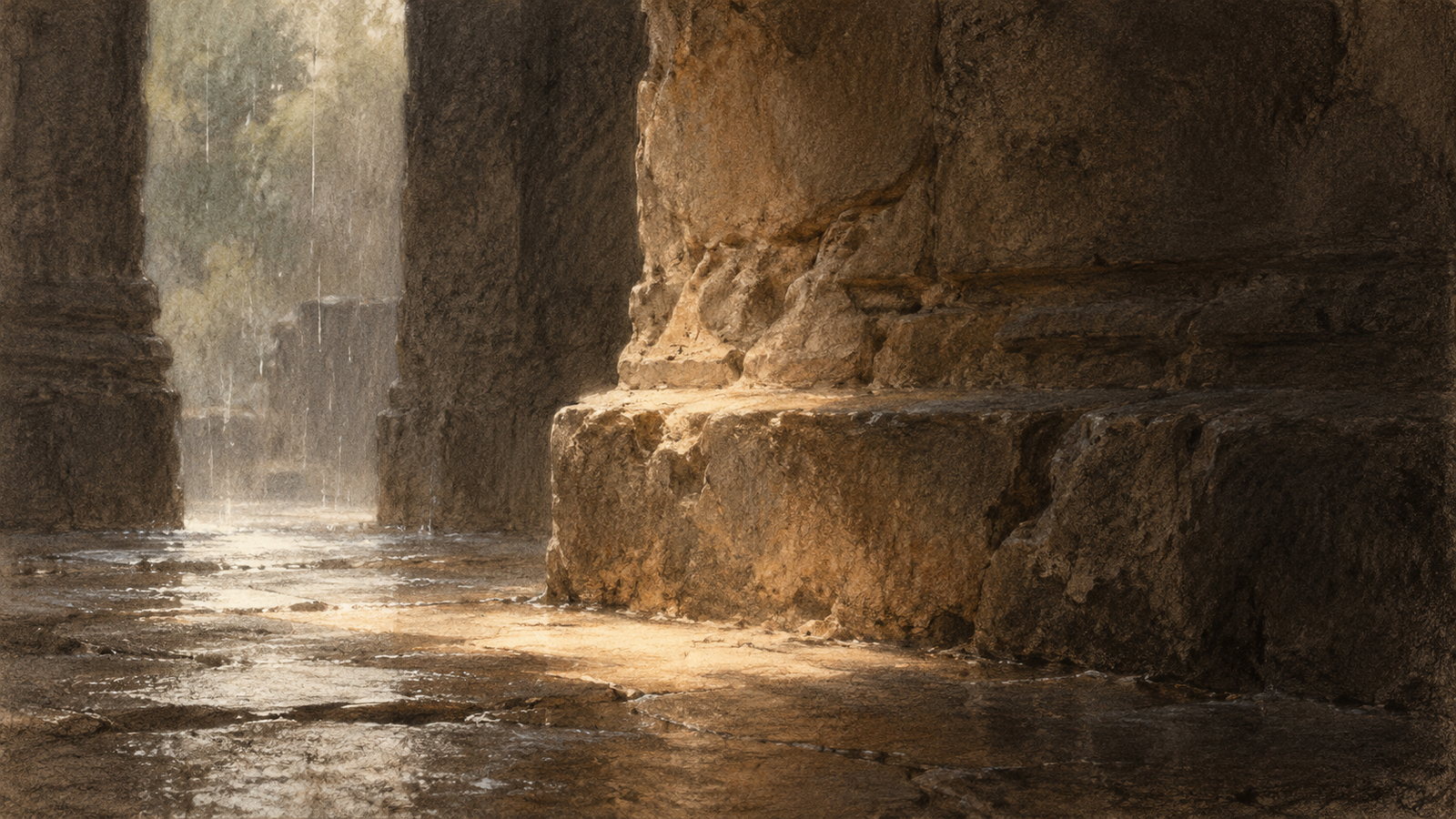
Rain, a carved hand, and the small movements of lives separated by centuries. A new literary piece from The Vow.

The Test of Agreement
Scientific consensus is not, in its proper form, an agreement to stop asking questions. It is the provisional agreement that emerges because questions have been asked repeatedly, competing explanations have been tested, and conclusions have survived sustained attempts to discover where they fail.