
The Water Must Be Drawn
The village found a song beneath its well. No one wanted to be the first to silence it.
Nell had almost reached the water when she heard it.
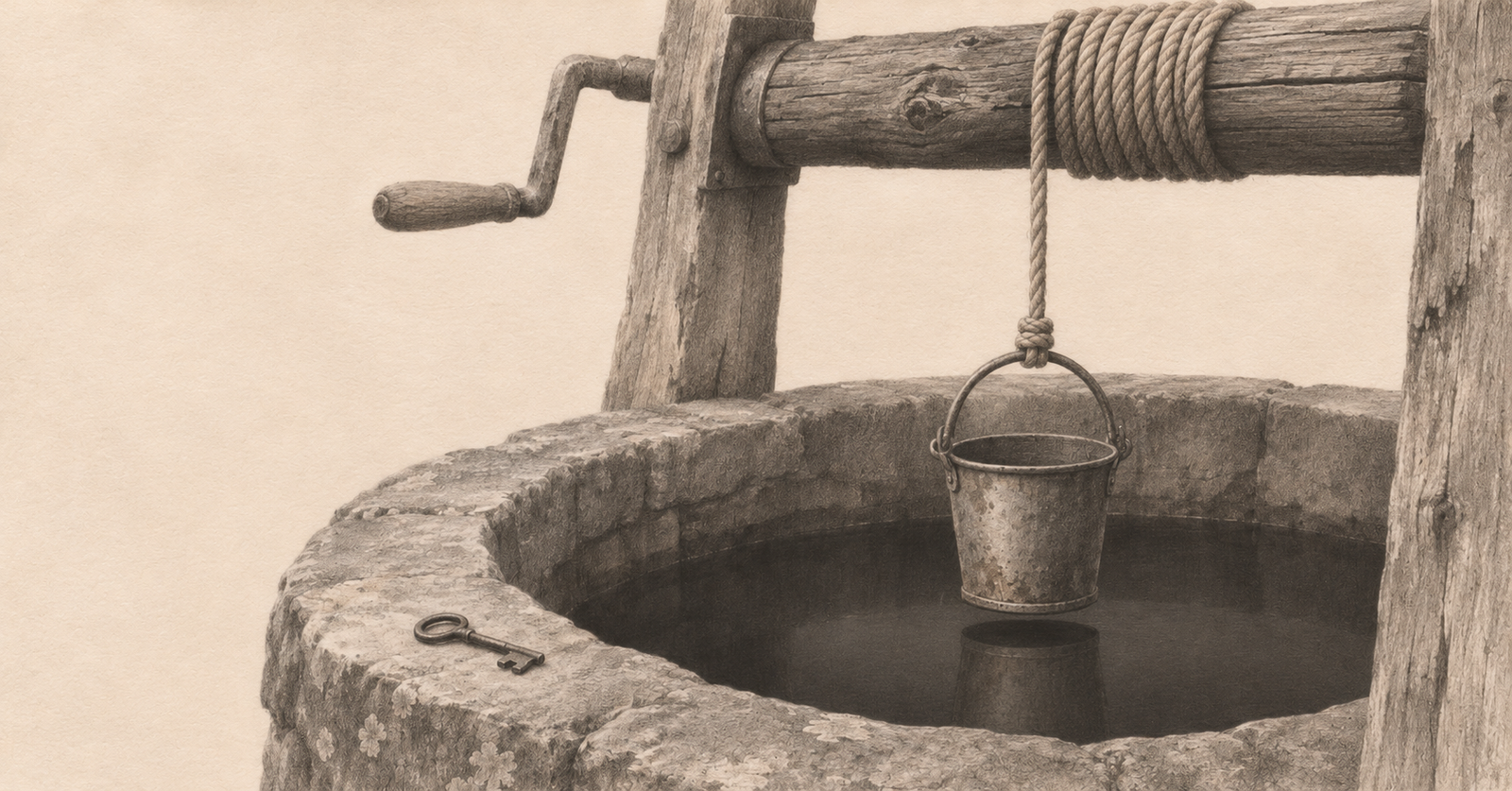
The bucket hung at the end of its rope, a little way above the surface. She had been lowering it by the windlass, watching the last of the evening light withdraw from the stones, when something rose from the darkness beneath her.
She stopped turning the handle.
At first she thought someone was singing in a neighbouring house. But there were no words, and the sound was coming from below. It had the sweetness of a child's voice, though no child could have held such notes, and beneath it was something deeper, moving slowly, as though several instruments were answering one another at a great distance.
Nell leaned over the well.
The water lay far beneath her, perfectly still. She could see a small piece of the evening sky reflected in it, pale between the dark walls. Nothing moved there.
The music continued.
She listened until the church clock struck seven. Then eight. Once, a moth struck her cheek, and she brushed it away without taking her eyes from the water.
There were melodies, or something sufficiently like melodies that she found herself anticipating their return. But whenever she thought she had understood one, another entered beneath it, changing everything she had heard before. Some passages were so quiet that she leaned forward, afraid of missing them. Others seemed to rise through the stones themselves.
Nell kept the village bakehouse. She rose every morning before five, measured flour, tended fires and made sure people received the bread they had paid for. She had buried her father, survived two bad winters and once pulled a small boy from the millpond. She knew that extraordinary things sometimes happened, but had never considered that they might happen without bringing trouble.
The church clock struck nine. The music grew quieter, until Nell could no longer tell whether she was hearing it or remembering what she had just heard.
At last she carefully wound the bucket back into its place beneath the windlass and went home.
She had forgotten the water.
The following morning, while she was shaping loaves, she told Joan what had happened.
Joan did the washing for several households and came to the bakehouse twice a week for yesterday's bread. She listened while Nell described the sound, then asked whether someone might have been playing a flute in the bottom of the well.
"There was more than one instrument," Nell said.
"Perhaps two flutes."
"Come this evening."
"I've got Mrs Vale's sheets to finish."
"Afterwards, then."
Joan looked at her. Nell had flour on her elbows and was pressing a lump of dough into a tin.
"Was it really so lovely?"
Nell considered this.
"I don't know how to tell you."
That evening Joan came, bringing a shawl against the cold. They sat together on the low wall surrounding the well.
Nothing happened.
After half an hour Joan began talking about Mrs Vale's sheets, which had been left outdoors in the rain. They were about to leave when the sound began.
Joan stopped speaking.
This time the music seemed slower, with long intervals in which a single note remained suspended above the well. Then another entered, and another, until the space between the houses appeared to have filled with sound.
Joan took Nell's hand.
They sat until nearly midnight.
Afterwards, Joan said she thought she might have heard something like it once before, when she was very young. But she could not remember where.
The following evening they brought Ivo, who carried goods between the village and the farms beyond the ridge. He was a large, cheerful man who had lost the top joint of one finger beneath a cartwheel. He listened for a long time, his cap resting on his knees.
When the music stopped, he shook his head.
"Well," he said.
Within a week almost everyone in the village had heard the singing.
People brought stools and blankets. Children sat on the stones with their legs dangling towards the well. An old man who had quarrelled with his brother over a boundary fence found himself sitting beside him one evening. They had not spoken for six years. Neither thought to move away, and when the brother rose to leave, the old man held out his hand and helped him to his feet.
The schoolmistress tried to write the music down. She filled three pages with notes, crossed them out and began again. Afterwards she said that she had captured the intervals correctly but not the music itself.
A little girl brought her wooden whistle and attempted to join in. Her mother took it gently from her.
Once, when rain came suddenly, the listeners crowded together beneath the eaves of the nearest houses. A few ran home for coats. Most remained where they were, their faces wet, listening through the rain.
The music did not make everyone happy in the same way. Some laughed quietly, without knowing why. Some wept. Others sat very still, as though listening required all the strength they possessed. One evening the blacksmith's wife fell asleep with her head upon her husband's shoulder and woke embarrassed to find him smiling down at her.
Nell was happiest when she saw people arriving.
She liked the scrape of stools across the stones, the small courtesies of making room, the sight of neighbours who ordinarily had little to say to one another sitting together in perfect contentment. It pleased her that she had been the first to hear the music, though she would have been ashamed to admit how much.
Sometimes she stood at the bakehouse door after supper, watching people cross the square with their coats over their arms, and felt such a rush of affection for them that she hardly knew what to do with it.
She began putting out a tray of small buns for the children. When the buns were gone, she made more.
The music came on some evenings and not on others. No one could discover why. Sometimes it began before sunset, sometimes long after dark. Once it continued until the first light appeared above the roofs, and the listeners went home in the dawn, pale and silent.
No one tried very hard to account for it.
They were too glad it had come.
The first silence occurred on a Thursday.
The music was in full voice when Joan arrived with an empty pail. She had worked late and had not yet drawn the water she needed for the following morning.
She stood beside the well, listening. A low note sounded beneath the others, followed by a succession of higher notes so clear that several people lifted their heads. Joan waited for a pause, but none came. At last she took the handle of the windlass and began lowering the bucket.
The music continued as the rope unwound.
Then the bucket touched the water.
Every note ceased at once.
Joan stood with one hand on the handle. The bucket knocked against the wall of the well, making a small, hollow sound.
"I'm sorry," she said. "I thought it would go on."
Nell came to her.
"You needed water."
But she looked into the well too.
The people remained for some time, hoping the music might begin again. When it did not, they collected their belongings and went home.
There was no music the following evening, nor the next. On Sunday people gathered in the square without having arranged to do so. They sat beside the well, speaking softly, as though someone were ill in a nearby room.
By Tuesday, several villagers had begun to wonder whether the music was gone for good.
On Wednesday, just as Nell was closing the bakehouse, she heard it again.
A single high note rose from the well, trembling slightly, and then the deeper voices gathered beneath it. Within minutes the square was full.
The following morning, Nell suggested that they draw their water from the spring beyond the orchard, on the far side of the ridge.
"Only until we understand it better," she said.
The schoolmistress pointed out that they had drawn water from the well almost every morning since the singing began, yet the music had continued to return.
"But none of those buckets was lowered while it was singing," Nell said. "After Joan did, we waited six days."
"That may have been chance."
"Then we ought to find out before we risk it again."
The villagers were willing to try. The spring was a good one, though the path was steep. They already used it when the well ran low during dry weather.
The blacksmith fitted a chain and padlock to the windlass. Its rope was long enough to reach the water, and the village owned no other of equal length. With the windlass secured, no one could lower the communal bucket by accident.
Nell was given the key.
"You found it," the blacksmith said.
She laughed.
"I didn't make it."
"All the same."
She put the key in her apron pocket.
At first the new arrangements were almost enjoyable.
The villagers organised a rota. Each household would send someone to the spring in turn, bringing back enough water for several neighbours. People joked about the unusual pleasure of carrying water, and the children competed to see who could bring back the fullest pail without spilling any.
Nell went twice in the first week. She found the climb tiring, but the spring ran clear between its stones, and the path through the orchard was pleasant in the mornings.
The rota lasted three weeks.
One wet morning Joan came to the bakehouse carrying the sheet on which Nell had written the names. Several had been crossed out. She spread it on the floury counter.
"Four journeys this week."
"I thought you had two."
"So did I. Mrs Bell can't manage the hill, and the Harpers have six children. Two journeys won't give them enough."
Nell studied the paper. The same names appeared repeatedly among those who had offered to help.
"I'll go this afternoon."
"You've got the baking."
"Then tomorrow."
Joan shook her head.
"The water's needed today."
Nell rearranged the turns, allowing for those who could not manage the hill. Within a week the same difficulties had returned. The spring was no nearer for those who made the journey more often.
She proposed a common fund. Those who could afford it would contribute money to pay Ivo and two other men to carry water. Households without sufficient money would receive their water without charge.
This worked considerably better.
Ivo bought a second carrying yoke and fitted his cart with larger wheels. The carriers received regular wages, and Nell kept the accounts at the bakehouse in a notebook she had previously used for flour deliveries.
The arguments diminished. People were pleased. The music continued to visit the well.
But the water sometimes arrived late. The carriers could bring only so much in a day, and those who needed more had to wait or make their own arrangements.
The well stood in the middle of the village, full of water that nobody was permitted to draw.
One afternoon Joan came to the bakehouse with a basket of wet linen.
"I need some water," she said.
Nell looked up from her accounts.
"Hasn't yours arrived?"
"Not yet."
"Ivo's cart broke a wheel. He's gone to the spring with the yoke."
"Yes, I know."
"Then it shouldn't be long."
Joan set down her basket.
"I've got the washing soaking. I need to rinse it before dark."
Nell's hand moved towards her apron pocket.
The key was there.
She looked at Joan's red hands, at the heavy basket, and then towards the square. The music had not sounded for two evenings. It might begin at any moment.
"I could give you some of ours," she said.
"You need yours for the bread."
"I can manage."
"It's more than a bucket."
"I'll pay for another delivery."
"Ivo's still on the hill."
"Then perhaps it will have to wait until morning."
Joan rubbed her hands together. The skin was cracked where the soap had dried it.
"The well's right there, Nell."
Nell closed her fingers around the key.
"We don't know what would happen if we disturbed it again."
Joan picked up the basket.
"I'll manage somehow."
After she had gone, Nell found a mark from the wet linen upon the counter. She wiped it away with her sleeve.
That evening the music returned.
It began with three clear notes, so far apart that each seemed to stand alone. They sounded again, but this time something moved beneath them, giving each a different weight, as though a simple tune had opened to reveal a larger one within it. A long, low phrase followed, and Nell felt the familiar pleasure of hearing something she could neither anticipate nor retain.
The boy sitting beside his grandmother had lifted a cup of milk towards his mouth. He held it there, forgotten, while the notes passed overhead.
Nell thought of Joan's hands.
She listened until the music ended.
In the following days Nell arranged for two younger men to relieve Ivo on certain evenings. They managed it twice, but other work soon prevented them from keeping to the arrangement.
One evening Nell saw Ivo arrive in the square just as the music was ending. He stood beside his cart, his cap in his hand, listening to the last few notes.
"You missed it again," Nell said.
"Most of it."
"You ought to have an evening off."
"I had one last week."
"Then another."
He smiled.
"Who'll bring the water?"
"We'll find someone."
"You're welcome to try."
He turned to unharness his cart.
"You still like the music?" she asked.
"Of course. It was a wonderful thing."
"And now?"
Ivo considered.
"I expect it still is."
He picked up a bucket and carried it into the nearest house.
The next morning Nell went to the spring.
She had not been there for several weeks. Ivo offered to take her water himself, but she said she wanted the walk.
She carried two pails suspended from a wooden yoke.
The path seemed longer than she remembered. Recent rain had softened the earth, and the cartwheels had cut deep channels into the steepest part. Nell followed them slowly, stopping whenever the pails began to swing.
At the spring she rested on a stone. Water came from beneath the roots of an ash tree, gathering in a shallow basin before running down towards the fields. She watched it for a while, then filled her pails.
The return was much harder.
By the time she reached the orchard, the yoke had begun to bruise her shoulders. She changed its position several times but could not find a comfortable place for it to rest.
Ivo came up the path behind her with his cart.
"You're carrying it badly."
"I know."
"Keep your shoulders level."
She tried.
"Like this?"
"A little."
He settled one of the pails more evenly beneath the yoke.
"You'll spill less."
They walked together as far as the ridge. From there they could see the village below them, its roofs gathered about the square. The well stood in the centre, no larger than a little dark mark.
Ivo turned towards the next farm. Nell continued down the hill alone.
It was almost evening when she reached the bakehouse. She set the water inside, washed her hands and crossed the square.
The music had already begun.
She stood at the edge of the gathering, too tired to fetch a stool, and listened. A high, clear phrase hovered above the deeper notes, returning again and again with some small difference that made her long to hear it once more.
She shut her eyes.
For a little while she forgot her aching shoulders.
After that, Nell sometimes helped with the deliveries. She could not go every day; the bakehouse required her attention, and the spring was as far away as ever. When she carried water to Joan, Joan thanked her and took the pails inside.
The well remained locked.
One evening, after the first cold rain of November, Joan came to the square with an empty pail.
The music was sounding.
Perhaps twenty people had gathered about the well. Some sat upon stools; others leaned against the wall. Nell stood beside the windlass, listening to a passage she had never heard before.
Joan crossed the square and set her pail upon the stones.
"Hasn't yours arrived?" Nell asked.
"No."
"I thought Ivo had finished the deliveries."
"He has."
"Then perhaps—"
"I need water, Nell."
The people nearest the well began to watch them.
Nell put her hand into her apron pocket. The key was there, as always. It had grown smooth from being carried among her other belongings, and she knew its shape without looking.
"There's some at the bakehouse," she said.
"I know."
"You may have it."
Joan looked down into the well.
The music changed. A low note entered beneath the others, so tender and unexpected that several listeners drew breath.
Joan closed her eyes.
Nell could see the pleasure in her face, the same astonishment that had filled her on the evening they first sat together upon the stones. She remembered Joan reaching for her hand when the first notes sounded.
Then Joan opened her eyes.
"I would like to draw my water here."
A man behind Nell said, "Couldn't it wait until morning?"
Joan did not turn.
Nell took the key from her pocket.
It was a small iron key, with a plain round bow. The blacksmith had made it quickly, and there was a rough edge on one side that had never been filed smooth.
She held it in her palm.
The music was sounding as clearly as it ever had. Nell could hear the little answering voices beneath the melody, each seeming to rise from farther away than the last.
She went to the windlass.
The padlock was stiff from the damp. She turned the key once, then again. At last the shackle came free.
She unwound the chain.
Someone said her name.
Nell placed the chain upon the stones and took hold of the handle.
Joan stood beside her, holding her empty pail.
The music continued.
Nell began to turn the windlass.
The rope unwound slowly from the wooden drum, dark with age and polished where generations of hands had touched it. The bucket descended into the well.
For an instant it hung above the water. Nell could see its faint reflection waiting beneath it.
She turned the handle again.
The bucket touched the surface.
The music stopped.
There was a small splash, and the sound of the rope moving over wood.
Nell lowered the bucket until it filled. Then she drew it up again, feeling the weight increase as the rope wound about the drum.
Joan reached out to steady it.
Together they poured the water into her pail. A little spilled across the stones.
"Thank you," Joan said.
Nell nodded.
Joan lifted the pail and carried it away.
The little boy who had been sitting beside his grandmother asked whether the music would come back.
No one knew.
The villagers went home slowly that evening. Some were angry. Others said nothing. A few remained beside the well, listening to the silence as though it might contain something they had overlooked.
The following morning Nell removed the chain from the windlass altogether.
People began drawing water again.
At first they did so cautiously, lowering their buckets with unusual care and listening after each splash. But the old movements soon returned. The handle turned; the rope descended; water was carried away.
There were arguments. Some villagers said Nell had acted without consulting anyone. Others insisted that the well belonged to everybody and should never have been locked. Several people who had supported the arrangements from the beginning now claimed to have opposed them all along.
Ivo came to the bakehouse three days later.
He had lost much of his regular work. Two households still wanted spring water, and the farms beyond the ridge continued to use his cart, but the common fund was no longer needed.
Nell paid him what remained owing and returned the money contributed for the following week.
He counted the coins carefully.
"It's a pity," he said.
"Yes."
"I'd just got everything working properly."
"I know."
He put the money into his pocket.
"I liked it."
Nell thought he meant the work.
"So did I."
But Ivo looked towards the square.
"The music."
He picked up his cap.
"Well. There's no bringing it back by talking."
That evening Nell went to Joan's house.
Joan was folding sheets beside the fire. She put them down when Nell entered and offered her a chair.
They spoke of the weather, of the price of soap, of a neighbour who had been ill. At length Nell asked whether Joan missed the music.
"Of course I do."
"I sometimes wish—"
Joan waited, but Nell did not finish.
After a while Joan picked up a sheet and shook it out across her knees.
"I was glad you heard it first," she said.
Nell looked down at her hands. They were rough from flour and hot water, with a small burn across one knuckle.
She stayed until the sheets were folded.
Winter came.
The well remained open. People drew water throughout the day, and the old stones grew dark where it spilled.
A few villagers still gathered beside it in the evenings. At first there were several, then only two or three, and eventually none.
Nell sometimes went there herself, carrying a shawl against the cold. She would sit for half an hour, perhaps longer, looking down at the water.
That winter she heard no music.
She could not remember it properly, though she tried. Sometimes a phrase came to her while she was kneading dough, or lying awake in the dark, and she would stop what she was doing to follow it. But the notes slipped away, leaving only ordinary tunes she had known all her life.
Once she tried humming what she remembered to Joan.
Joan listened, then shook her head.
"No. That wasn't it."
Nell tried again.
"No," Joan said more softly.
Neither could recall how it had gone.
One morning, very early, Nell went to the well for water.
The village was still asleep. Frost lay upon the roofs, and a little ice had gathered in the cracks between the stones. She wore her thick coat and carried two empty pails.
She fastened the first beneath the windlass and took hold of the handle.
The water lay far below her, dark and still.
Her hands rested upon the worn wood.
She listened.
Somewhere a door closed.
She waited a little longer.
Then she began to turn the handle.
The rope passed slowly over the wood, and the bucket descended into the darkness.
She did not stop it.
—
Receive the next work
Subscribe free to receive new work from the Lucas Varro Library by email.
More from the Library

The Weight of a Lotus
He asked for no more earth than he could cross in three steps. Beneath the foot that has crossed the ocean, Lakshmi holds up a lotus.


The Sky Among the Stones
We look up to find the sky. Among the fallen stones, there is another place to look.