

The Weight of Old Stones
On antiquity, the perception of time, and the feeling of belonging.
I
There is a change in the air as one passes beneath the stone gateways of Ta Prohm. Even on a hot morning, the few feet of shade beneath a lintel are sufficient to make the skin aware of itself again. The eyes take a moment to adjust. One walks a little more cautiously over the uneven stones, and the voice, without any agreement having been made to lower it, seems unnecessarily loud.
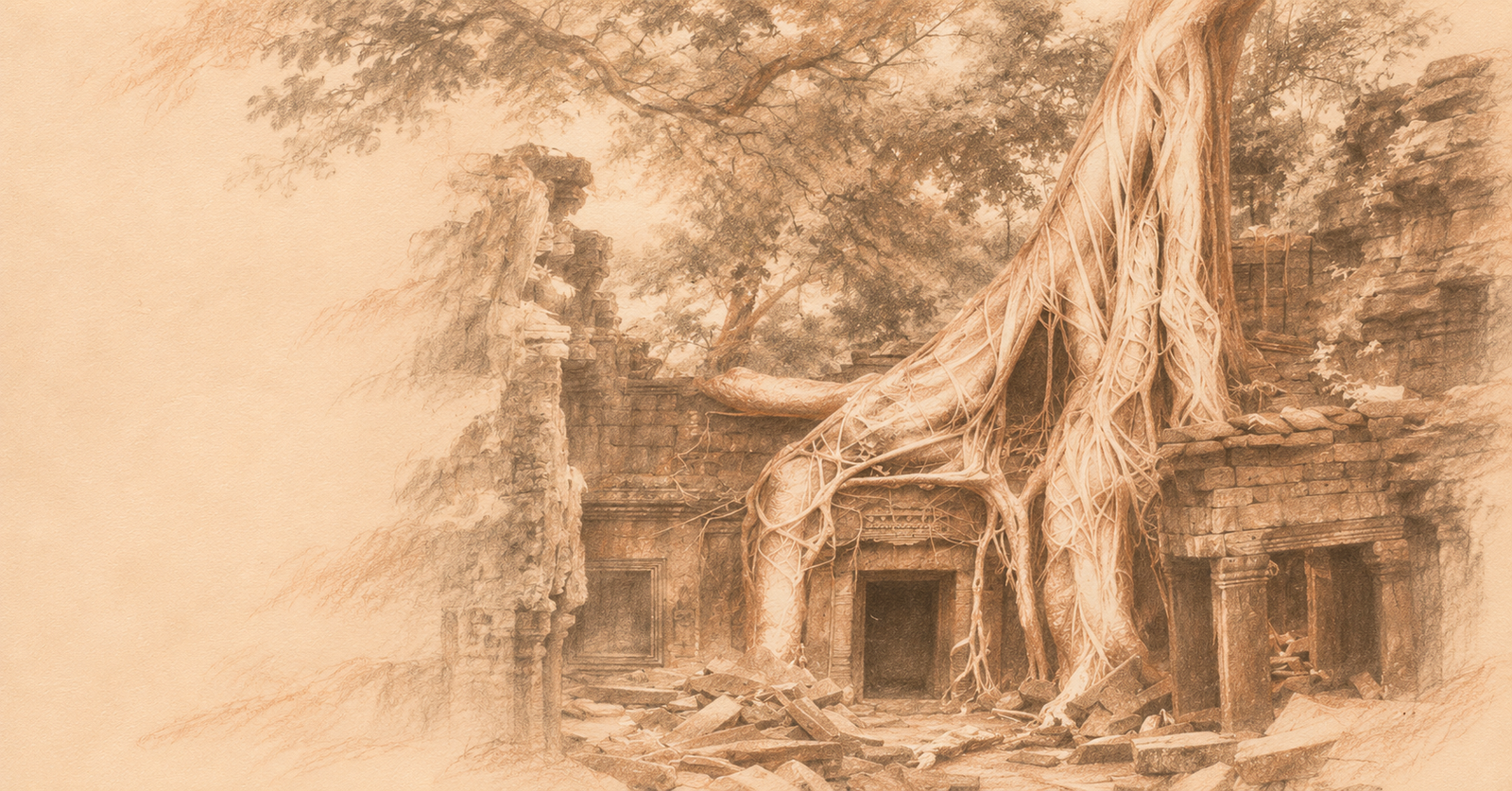
I have been coming to this temple for many years. I am drawn, even now, to a particular tree whose roots descend over a doorway in the inner part of the temple, enveloping the worked stone. There is much else at Ta Prohm, and much that I know less well. But I gravitate towards that tree.
The doorway keeps something of its original shape beneath the roots. One can still discern the work of the men who made it, the upright members and the lintel, the careful articulation of the mouldings. The tree has had to accommodate the shape of the masonry, just as the stone, with considerably less success, has had to accommodate the tree.
Neither is particularly remarkable in isolation. Angkor has finer doorways; the forests of Cambodia have greater trees. And yet I find it difficult to leave.
There is a curious alteration in the quality of time when I stand before something like this. A few minutes may be sufficient to induce it. The ordinary preoccupations of the morning diminish, the anxious little projections into the afternoon and the following day grow less insistent, and I become aware of the remarkable number of things taking place in what I had previously thought of as a single moment.
Light is moving across the stone. The tree is drawing water from the earth. Within the sandstone itself, changes are taking place too slowly for the eye to apprehend. And I am standing there, breathing, another living thing whose passage through this place is of a different order of duration altogether.
We are accustomed to thinking of the present as something very narrow, an almost vanishing interval between what has happened and what is about to happen. But here the present seems to have acquired depth. Much that happened before I was born is still materially present, still exerting a pressure upon the arrangement of things. The past has not entirely withdrawn.
I have sometimes heard this described as a feeling of connectedness, of being at one with something greater than oneself, even with the universe. I understand the temptation to speak in such terms, although the words trouble me a little. They suggest a certainty about the nature of the experience that I do not possess.
Something has happened. I am less certain what.
II
The towers of Angkor Wat are visible from a long way off. From across the water the eye can encompass them quite comfortably. At the foot of the temple, one must raise the head to see what one had previously been able to take in at a glance.
The same building has become a different magnitude.
There is a sensation in the back of the neck, a slight inclination of the body; one becomes aware of the distance between the feet and the summit towards which the eyes are directed.
The psychologists Dacher Keltner and Jonathan Haidt, in their study of awe, suggest that the experience has two principal characteristics: an apprehension of vastness and a difficulty in accommodating what is encountered within our existing understanding of the world. The unfamiliar magnitude may be physical, but it need not be. An idea can be vast. So can an act of human courage, or the implications of something we have only just understood.
Kant was concerned with a related difficulty more than two centuries ago. In his account of the sublime, the imagination struggles to comprehend a magnitude that surpasses its powers of sensible representation. Reason, in Kant's account, allows us to conceive of what the imagination cannot adequately contain; part of the pleasure of the sublime resides in the recognition of this power.
I wonder whether, in the presence of antiquity, it is time rather than space that occasions the greater failure of the imagination.
I can walk the length of a gallery and acquire, in doing so, some sense of its dimensions. But how am I to comprehend the nine centuries through which Angkor Wat has stood?
I know what a year is. I have lived through a good many of them, and they have left their effects upon me. I know something of the duration of a human life and of the slowness with which a child becomes an adult. Yet when I multiply that span until I reach the age of the temple, the arithmetic carries me somewhere my experience cannot follow.
Even the span of the temple's existence is negligible beside the age of the material of which it is made. The sandstone, formed from sediment long before there were human beings to quarry it, had already participated in an almost inconceivably long history of the earth before the first mason laid a tool against it.
What we call ancient in Angkor is exceedingly recent in the life of the stone.
It is an odd thing to consider whilst looking up at a tower built to endure. The human ambition embodied in it was immense, and remains impressive. Set against the history of its constituent matter, it is momentary. And yet the comparatively brief act of shaping that matter has been sufficient to distinguish these particular stones, to give them consequence in the lives of generations of people who had no part in their making.
There is some evidence from psychological experiments that awe diminishes the prominence of our own concerns and may even alter our sense of how much time is available to us. The experiments are modest beside the experience they seek to illuminate, and do not tell us what a person comes to understand in those minutes.
Perhaps some of our habitual sense of haste arises from the disproportionate amount of attention we give to our own small affairs. As these affairs recede from the foreground, there may be more of the world available to us within precisely the same number of minutes.
And the pleasure of feeling small?
It is a very different smallness from that imposed upon us by humiliation or neglect. Nothing has been taken from us. The world has simply become larger.
III
There is a small opening above the entrance to the passage tomb at Newgrange, in Ireland.
For most of the year, direct sunlight does not penetrate the long passage to the inner chamber through this opening. But on the mornings around the winter solstice, if the skies are clear, the rising sun sends a shaft of light deep into the mound. For a few minutes, the interior is illuminated.
The monument is more than five thousand years old.
What the people who built it understood this occurrence to mean, in the fullness of their religious and imaginative lives, is something we cannot recover. But they had observed the heavens with sufficient care to make an opening in a mass of earth and stone through which an event in the sky could enter a chamber.
At Stonehenge, the principal orientation of the monument likewise corresponds with the rising sun at midsummer and the setting sun at midwinter. The sky above the stones is integral to their arrangement.
There is a related phenomenon here in Angkor. Around the equinoxes, from particular positions on the western approach to Angkor Wat, the rising sun appears in alignment with the summit of the central tower. The temple's cardinal orientation and the movement of the sun briefly produce an extraordinary conjunction.
Angkor Wat belongs, of course, to a very different religious and intellectual world from that of the Neolithic peoples of Ireland and Britain. The comparison must not tempt us into constructing some universal religion of ancient peoples. Even at Angkor, where we know vastly more about the religious traditions within which a monument was conceived, the precise significance of every proposed astronomical alignment remains a matter of interpretation.
Angkor Wat, originally dedicated to Vishnu, embodies the sacred geography of Mount Meru and the surrounding world.
I can follow the mathematics of the earth’s movement around the sun, but I find it difficult to sustain an awareness of that movement in the course of an ordinary day. I think of the year as something that passes, rather than as the time taken to go somewhere and come round again.
The builders of Newgrange made the recurrence of the year visible through the modest dimensions of an aperture. They built something into which the earth’s annual journey could bring light. The interval for which the opening admits the winter sun is brief in the life of a single year. And yet the alignment itself belongs to a structure built long before any of the buildings at Angkor were raised.
The astronomical explanation makes the phenomenon no less beautiful.
If anything, it allows one to appreciate more fully the extent to which a movement so immense can have consequences of such delicacy: a little light moving across stone in an otherwise dark chamber.
We speak rather easily of our place in the universe, as though it were something we might ascertain through contemplation. But we possess a place in the universe already, a physical and quite unambiguous one. We are held to the surface of a turning body, warmed by a star, and live according to rhythms that preceded the emergence of life itself.
IV
At Ta Prohm, there are places where fallen masonry lies close beside the structures of which it was once a part. One can examine a block of sandstone at something approaching the distance from which the man who worked upon it must have examined it.
The fall of a wall or roof can expose surfaces that were never intended to be seen. On some stones, the marks of tools are still discernible.
I find these unfinished and concealed surfaces as compelling as some of the finest carvings at Angkor. They seem to belong to a different order of intimacy.
The finished ornament presents the achievement of the sculptor. A tool mark, left where there was no need to remove it, preserves something of the activity itself. One can imagine the hand holding the tool, the angle of the blow, the small dislodgement of stone. Repeated thousands of times, such movements brought something into existence that the individual movement in no way resembles.
For those of us who draw or make things with our hands, there is a particular pleasure in recognising the physical intelligence of someone working in another medium. The mark tells us something about the resistance that was encountered and about the exercise of judgement in overcoming it. We recognise the innumerable small decisions that making demands.
In drawing a carved figure, a devata perhaps, one must look repeatedly at the same small area of stone, becoming familiar with the relationships of forms that give the figure her character. What the eye had initially taken to be a single line resolves itself into a succession of decisions about the direction and extent of a cut.
In doing so, one retraces, however imperfectly, some of the decisions of another pair of hands.
Much about the person responsible for such a carving is inaccessible to me. I do not know how the work was apportioned, who determined the details, how much freedom was permitted in the execution, or whether the person who made the face was also responsible for the fingers or the folds of the garment. It is exceedingly difficult to resist the temptation to invent a life for such a person.
But there is evidence for a life. It is there in the stone.
The founding inscription of Ta Prohm, dated to 1186, offers a rather different intimacy with the people who inhabited its world. Alongside its account of the deeds and benefactions of Jayavarman VII, and the installation of an image of the king's mother in the form of Prajnaparamita, it records some of the material necessities of the religious establishment.
There are quantities of provisions recorded for each day of worship. Rice, sesame, mung beans, millet.
I find these details moving in a way that is difficult to explain entirely through their historical importance. They restore to the temple something of the daily business of being alive. Grain had to be grown and harvested, transported and measured; someone had to see to the replenishment of what had been used the previous day.
Whatever the magnificence of the religious and royal conception, the temple depended upon the regular performance of a great many unremarkable tasks. What was required once in the building of the temple was required over and over again in the maintenance of its religious life.
And there are the worn stones of Angkor.
A shallow depression in a step may be the cumulative effect of a number of different agents, human passage among them. The feet of those who came before us made their contribution almost imperceptibly. None of those people could have seen the full extent of the change of which their own passing was a part.
In a step so worn, the very shape of the stone depends in part upon the existence of bodies rather like our own. Unlike the work of the sculptor, the change was not, in all probability, something any of the people who contributed to it had intended to bring about.
The distance between the lives involved and ours is immense. The distance between their physical necessities and ours is sometimes very small.
We have never met these people. But we have inherited some of the consequences of their smallest actions.
V
The broken buildings at Ta Prohm demand a different kind of looking. The eye continually attempts to make associations between things that have become separated. One recognises a piece of carving, follows the direction of a fallen architectural member, looks from the masonry on the ground to the opening in a wall.
The mind seems predisposed to put things back together.
This is one of the pleasures of looking at ancient architecture, particularly when one has acquired some familiarity with its forms. A fragment can suggest something of the whole to which it belonged. A little knowledge of the structure of a corbelled roof allows one to appreciate a scattered mass of stones as something other than an obstruction.
The German philosopher and sociologist Georg Simmel, in his essay on the ruin, considered the relation between the forces by which human beings raise a structure from the earth and those by which its material is gradually brought down again.
For Simmel, the ruin possesses an aesthetic character of its own. The original human conception of the building, subjected to the subsequent action of natural forces, constitutes part of a new and unintended form.
At Ta Prohm, the growth of the trees has become a part of the form of the broken buildings.
But Simmel's thought takes me only so far. The attraction of the broken building also resides, I suspect, in the opportunity it affords the imagination to become active.
The ruin withholds much.
Its fragmentary nature invites an imaginative participation remarkably akin to that required by poetry. A few words, properly placed, can occasion in the mind an image of far greater extent than the words themselves. A piece of fallen cornice can occasion the apprehension of a vanished building whose actual appearance we may never establish with certainty.
Here lies a difficulty. The more powerfully we respond to the incomplete thing, the more readily we may confuse the consequences of our imaginative activity with properties inherent in the object. We may fall in love with a state of destruction that would have been incomprehensible or distressing to the people responsible for the original work.
It is instructive to consider the process of restoring one of the fallen gateways at Ta Prohm.
The Cambodian and Indian teams working to restore the southern gate of the outermost enclosure have had to identify and document the blocks of stone, examine and strengthen the foundations, and establish, through archaeological and architectural study, the positions to which the stones should be returned. Where damaged or missing elements require replacement for the stability of the structure, new stone may have to be introduced.
The task is rather like that undertaken by the imagination when looking at a fallen building, but with vastly more stringent obligations to evidence. And the reconstructed structure must stand.
I have grown accustomed to the presence of restoration work in Angkor, to the scaffolding and the temporary coverings that are so often thought to intrude upon the beauty of the temples. There is a tendency to regard these things as blemishes upon the ancient world, something to be excluded from our photographs.
But I wonder what exactly we would wish to preserve at Ta Prohm. The state of the temple twenty years ago? Its appearance when the first photographs were taken? That of a century earlier, or a century before that?
The particular arrangement of antiquity and destruction to which we have become attached was itself a moment in a continuing history.
It would be a strange expression of our regard for the place if, in wishing to preserve the appearance of its great age, we were to begrudge the people whose work might enable it to grow older.
VI
There is something else to consider about the duration of a religious act. The pilgrim who has undertaken a long journey may spend only a few minutes before the image for which the journey was made. In this instance the time spent in approaching a place belongs to the act itself. The arrangements of sacred buildings may give form to such passages through time, though they do not tell us what a pilgrim felt, or entitle us to ascribe our own experience to those who made them.
Some of my affinity with these buildings, I think, resides in the activity that brought them into being. A mason could understand how the weight of a roof would be borne by a wall whose upper courses had yet to be laid. He worked on something which, for the time being, existed partly in his mind. In trying to make sense of those courses when they lie scattered on the ground, I exercise something of the capacity he exercised, though in the reverse direction.
I am able to recognise a sanctuary as something other than a particularly elaborate shelter. I understand the impulse to make a place for what is held to be sacred, even if I do not share the particular terms in which its sacredness was understood.
A bird can make remarkably beautiful use of an ancient building. It can find shelter in the interstices of the stone, or build a nest in some recess left by the builders. Its occupation of the temple is as real and consequential as ours.
But I bring to the building the peculiar disposition of a creature that makes temples.
It is a limited kinship. The limits deserve to be respected. The meanings we attach to sanctuaries, to death, to the heavens, and to the nature of consciousness are formed within histories and traditions that render them profoundly various.
Yet the existence of the questions, and the astonishing human inclination to give them material form, constitute something we can recognise in one another.
VII
Of course, it is possible to arrive at one of these temples and experience very little of what I have described.
There may have been a long wait for a ticket. The morning may be uncomfortably hot. The courtyard may be full of people, or the place one was particularly anxious to see may be inaccessible. One's companion may be tired, one's thoughts elsewhere.
And there are people to whom the evidence of great age is of little emotional consequence. They are no less human for it.
It may be worth asking how much of the experience of antiquity depends upon our knowing about the antiquity of the thing before us. Would a temple of extraordinary fidelity, built last year, induce quite the same sensations if we were ignorant of its recent construction? And what would happen to those sensations the moment the deception was disclosed?
I suspect that much of the experience would survive. The proportions, the arrangement of the light, the elaboration of the carving and the sheer mass of the building might remain as impressive as before. But something central to the feeling would have been removed.
For my sense of the object's survival through time depends in part upon what I know of it. Looking at the stone at Ta Prohm, I cannot see eight hundred years in its face. I can see some of the effects of weathering, and I can interpret them in the light of other things I know about the stone and its history.
If I learn that a block is a recent replacement, the surface of the stone has not altered in the moment of my learning it. Yet my relation to it has changed. And if I mistakenly take it to be original, the feeling of antiquity may be as strong as it would have been before an old block. The feeling itself furnishes me with no means of detecting the mistake.
There is also a long cultural history behind our pleasure in ruins, our appreciation of buildings entwined with vegetation, and our inclination to associate antiquity with spiritual depth. I arrive at these places with a sensibility already cultivated by books and images of ancient buildings, many of them charged with meanings that are not indigenous to the places depicted.
And I am uneasy about some of the assumptions behind the modern appreciation of Angkor. We speak of ancient wisdom, of lost worlds, of the quietness and remoteness of the temples. We sometimes seem to regard their present appearance as being somehow representative of the civilisations responsible for their construction.
But these buildings were once new.
The stone had sharper edges. The doors, roofs and furnishings that are now absent were present. These were places of great activity, involved in the distribution and exercise of wealth, authority and religious prestige. The splendour of a temple also constituted a very visible expression of the power by which so much human labour could be brought to bear upon a single conception.
There were those who performed the labour. We should be wary of imagining that the grandness of the undertaking was experienced in quite the same way by everyone involved.
Nor did Cambodian history come to an end with the great period of temple building. A person making an offering at Ta Prohm today may have concerns quite independent of the age of the building or my pleasure in its antiquity. The feeling that I have something in common with this person does not tell me what that something is.
The sceptic need not deny any of the feelings I have described. It is quite sufficient to question what, if anything, they disclose. A feeling of intimacy with the man who made a carving does not make me privy to his thoughts. Why should a feeling of intimacy with the universe give me knowledge of its nature?
I am nevertheless inclined to distrust the idea that to explain the conditions under which an experience arises is to dismiss it. The apprehension of colour requires a certain sort of eye and nervous system, and the world is full of creatures whose visual lives differ astonishingly from ours.
The colour of a flower arises from the relationship between its physical properties, the light falling upon it, and the constitution of the living thing that sees it. Remove any of these participants and the particular experience of colour disappears.
Perhaps our experience of antiquity has something of this relational character. The history of the stone has a part in the experience, as does my knowledge of it. But it is one thing to establish that a feeling arises out of a real relation, another to establish the truth of the account I give myself of that relation.
VIII
When I stand again before that tree at Ta Prohm, I can see that the root has had to grow according to the disposition of stones laid down by men long since dead. Their work has had consequences of which they can have known nothing, even for the shape of a living thing that is not human.
We cannot in any useful sense return to the world in which the doorway was new. But we are in the physical company of something that was there. Matter worked upon in one century is acting upon matter that acquired its present form in another, and both have entered the experience of someone living in yet another century.
The presence of the dead in our lives is in many respects a quite ordinary thing. We live in houses we did not build, use words we did not devise, and inhabit worlds of thought whose formation began long before our birth. Some of the most intimate aspects of our lives have been furnished for us by people whose names we have never known.
We are able, for much of our lives, to sustain a rather exclusive interest in a short interval of time surrounding our own existence. The past beyond that interval becomes progressively less real to us, the future beyond it increasingly abstract.
Standing before these old things, one begins to appreciate that much of the world was the future of somebody else's life.
And that the world will go on being made, altered and inhabited after the circumstances of our own departure have been forgotten.
I wonder if the sense of kinship experienced in such places is an intimation of this much larger participation in existence. Or whether we have simply found, in the beauty and incompleteness of ancient things, the materials with which to make a particularly persuasive poem about ourselves.
And if, after all, it is a poem, what would it mean to say that it was true?
Even whilst we stand contemplating the immense age of these temples, the smallest new addition is being made to their history. Beneath the trees, amongst the fallen stones, there are places where a little soil has gathered.
Enough, sometimes, for the root of a seedling.
—
Receive the next work
Subscribe free to receive new work from the Lucas Varro Library by email.
More from the Library

The Water Must Be Drawn
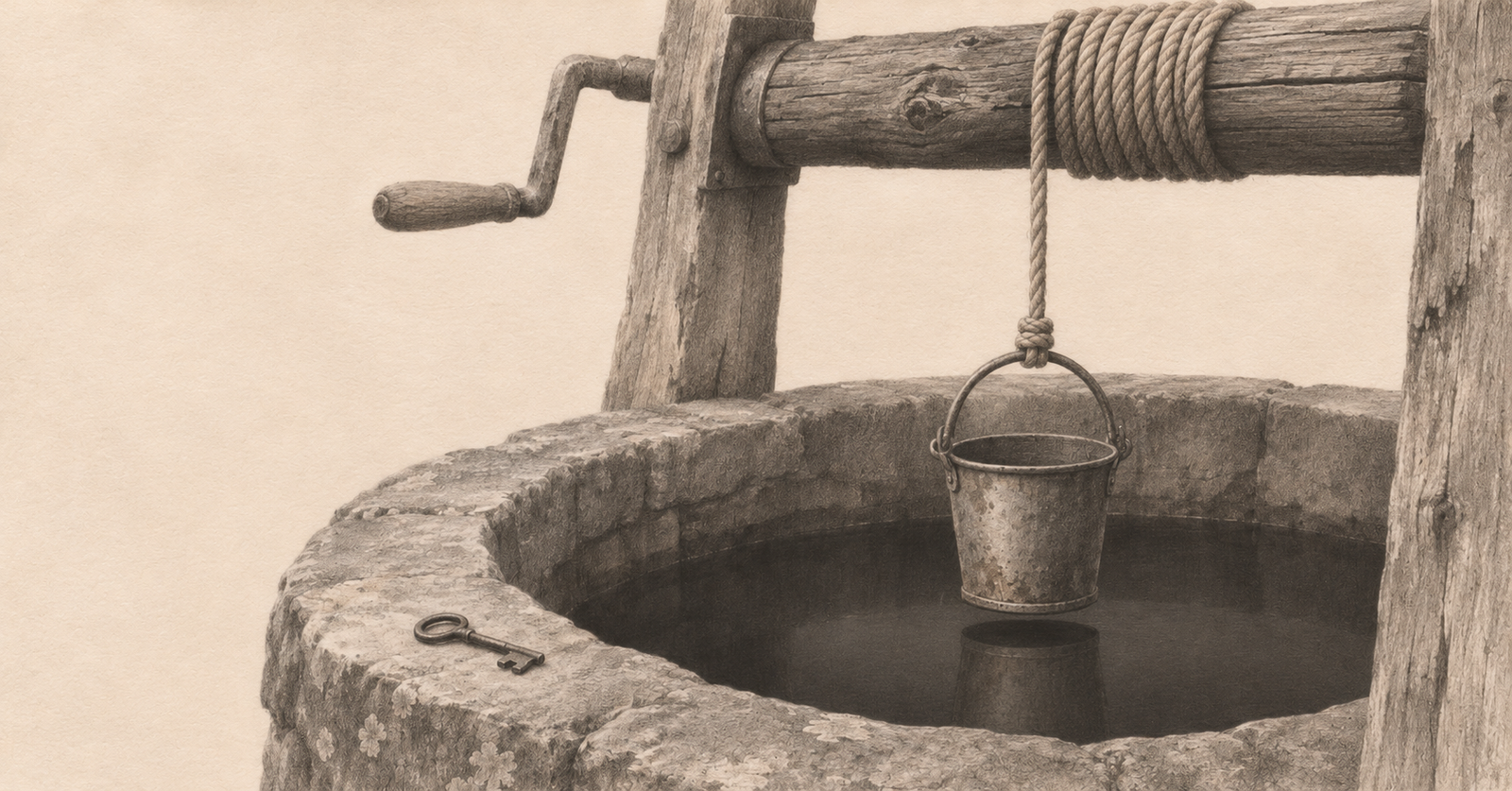
At dusk, Nell hears music rising from the village well. Soon everyone gathers to listen, and a simple decision—to leave the water undisturbed—changes village life. An original fairy tale about a gift no one wants to lose, and the people who must help preserve it.

The Weight of a Lotus
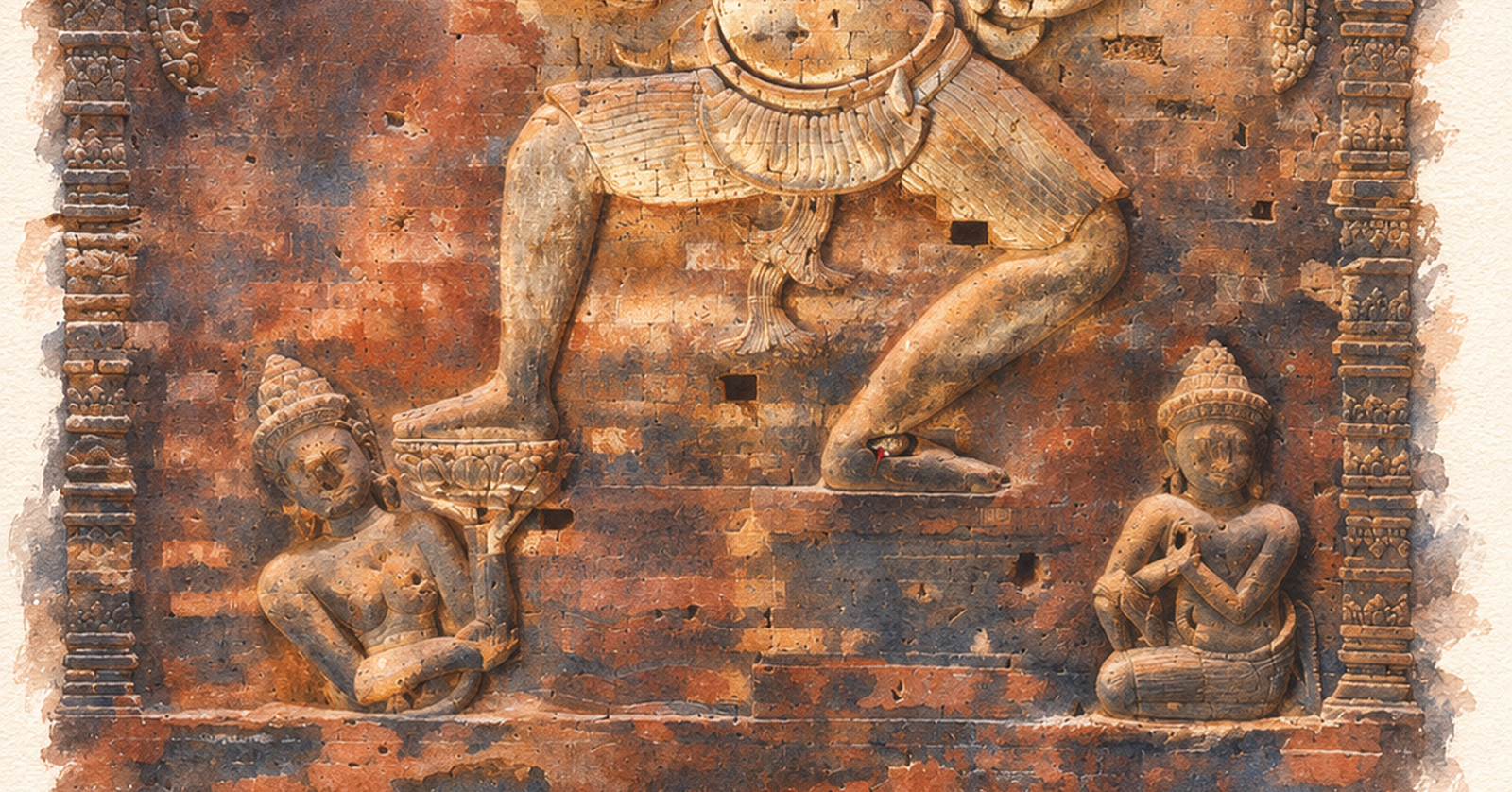
He asked for no more earth than he could cross in three steps. Beneath the foot that has crossed the ocean, Lakshmi holds up a lotus.

The Sky Among the Stones
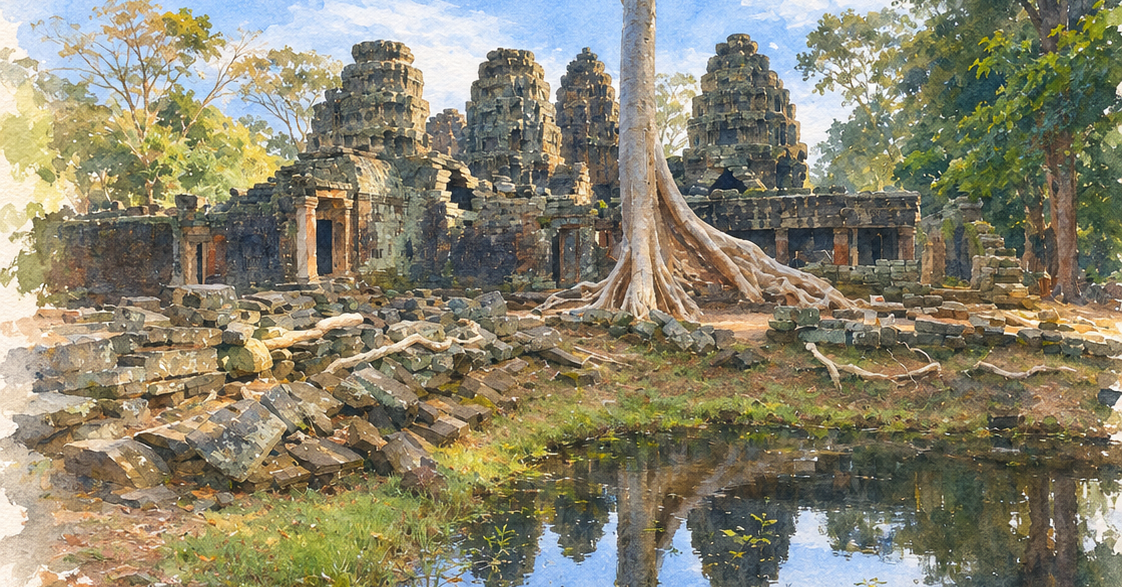
We look up to find the sky. Among the fallen stones, there is another place to look.