

Under the Gallery
Water runs down the wall.
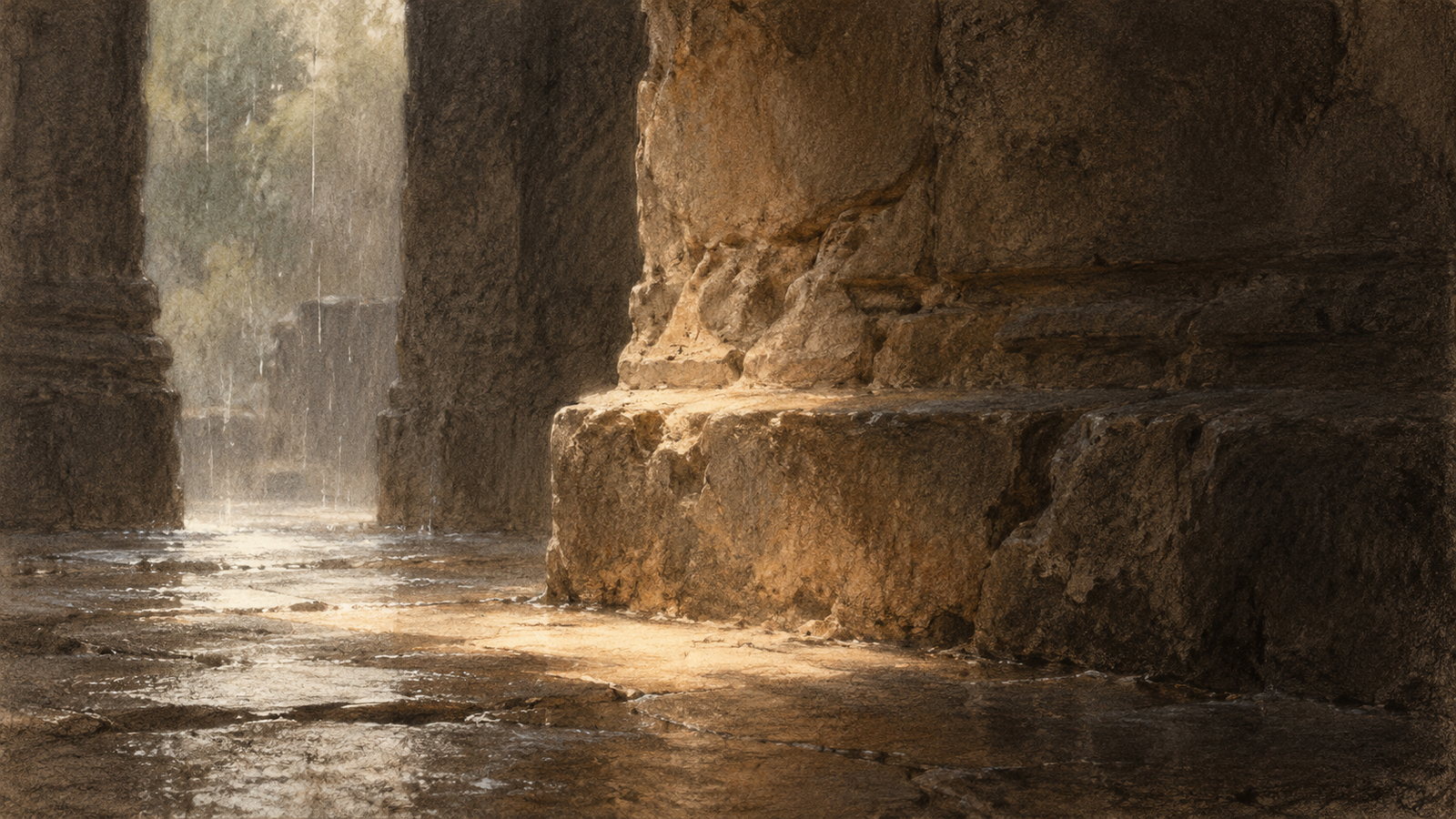
It comes from a break in the roof, gathers along a narrow ledge, and falls upon the shoulder of a woman carved into the sandstone. One stream follows the fold of her clothing. Another crosses her arm and enters the shallow groove beneath her bracelet. There it slows. A drop grows heavy beneath her wrist, hangs for a moment, and falls.
Another takes its place.
At the foot of the wall, a brown leaf has lodged between two paving stones. Water lifts one corner, passes beneath it, lets it settle. The leaf rises again. Beyond the gallery, rain falls steadily among the trees; here, under the remaining roof, its sounds are separate, with a little silence between one drop and the next.
The chisel enters the narrow space between two fingers.
A small flake of sandstone falls upon the carver’s knee. He turns the point, removes another, and pauses to examine the slender shadow appearing beneath the woman’s raised hand. Her face is finished, her bracelet almost complete. Only the fingers remain a little heavy in their outlines, still too close to the stone from which they are emerging.
He leans aside to see them against the afternoon light.
Beyond the doorway, sunlight lies across the courtyard.
He returns to the wrist, where a pale vein crosses the sandstone. The chisel catches there and leaves a slight rise in the groove. He brushes away the dust, changes the angle of his tool, and carries the line onwards.
Water runs down the wall.
Footsteps approach beneath the roof.
A man carries a folded umbrella at his side. He walks carefully over the wet paving, stepping around the hollows and testing the stones that seem loose beneath him. His umbrella knocks lightly against his leg. At the doorway he pauses, looking out towards the courtyard.
The farther trees are scarcely visible through the rain.
He loosens the strap around his umbrella. The wet cloth has caught beneath one of the ribs. He draws a fold aside, turns the handle, and tries to open it. The metal moves a little and catches again.
He slips his thumb beneath the cloth.
A drop falls from the roof.
His fingers turn the handle.
Another drop follows.
The chisel travels around the curve of a finger. Beneath its point a narrow hollow deepens, and a little more of the afternoon enters the space between the fingers. The carver works towards the knuckle, lifting his tool after each small cut. The line grows finer. He turns his wrist, takes away one last roughness, and blows gently across the carving.
A pale cloud of sandstone dust rises into the light.
The heavier grains settle almost at once upon his sleeve. The others remain suspended above the woman’s hand, moving so slowly that for a moment they seem scarcely to move at all. Then a breath of air comes through the gallery, and the little cloud begins to travel.
A drop falls beneath the broken wrist.
Another is gathering.
The dust crosses the first band of sunlight and enters the shadow beyond it. For an instant the grains disappear. Then they emerge in the next band, bright again, rising and falling upon movements of air too slight to feel. The little cloud lengthens. Some grains drift towards the paving; others travel higher, past the edge of a pillar, where the afternoon light reaches farther into the gallery. There the faint current divides them. A few turn back towards the wall. A few continue outwards, scattering as they go, until each has become a solitary brightness moving through the warm air. One passes beyond the doorway. Another follows a little higher. The last appears briefly against the dark stone of the opposite pier, turns in the light, and is gone.
The carver lowers his hand.
There is still dust along the woman’s fingers.
He brushes it away with his thumb and takes up the chisel again.
Water runs down the wall.
At the doorway, the traveller frees another fold of cloth. One rib rises, then another. Between them a pale opening appears, admitting a narrow view of the rain. He turns the handle, but the last rib remains caught.
The carver follows the delicate ridge between two fingers. He has almost reached the tip. His tool moves more slowly now, taking away so little stone that the powder scarcely falls.
Rain crosses the woman’s bracelet and gathers at the pale vein. Another stream arrives from her shoulder. The water rises against the little unevenness, passes over it, and follows the groove towards her damaged hand.
The traveller presses against the metal joint.
The chisel lifts.
A drop falls.
The traveller changes his grip. The carver turns his point. Water enters the bracelet again.
Below, the leaf rises upon the current, turns, catches against the stone.
The traveller frees a fold.
The carver deepens a hollow.
The leaf lifts again.
Rain is running faster now, travelling across the woman’s shoulder in bright, uneven threads. One follows the fold beneath her arm; another enters the bracelet, gathers against the pale vein and spills across it. The first drop is falling while the next is already travelling along the wrist. Beneath the gallery the little channel fills, and the leaf turns slowly from side to side.
The carver moves along the narrow ridge between the fingers. The traveller draws the umbrella cloth outward, feels the rib catch, eases it back. A drop falls from the woman’s hand, and another takes the same passage. The chisel follows a curve, lifts, returns; the umbrella rises a little, catches, rises farther.
Water runs down the wall.
The carver steadies his wrist.
The traveller turns the handle.
A drop gathers beneath the broken fingers. The leaf lifts in the channel. The chisel crosses the finer grain of sandstone and comes to rest at the fingertip. The traveller’s thumb finds the joint and holds it.
The rain comes more quickly, from shoulder to wrist, from wrist to finger, from finger to floor. The carver takes away a little stone, then another fine flake, and the light travels farther into the hollow he has made. At the doorway the umbrella cloth begins to unfold, one rib lifting after another, while the water fills the groove around the bracelet, passes the pale vein, gathers beneath the broken fingers and falls. Another drop follows, and another. The chisel lifts, turns, settles; the traveller draws back the cloth, changes his grip, presses once more. The leaf rises and turns in the channel. Rain reaches the carved shoulder in glistening threads. The carver follows the last fine curve towards the fingertip, and in the hollow beneath it a narrow brightness appears. The traveller feels the metal slide beneath his thumb. The cloth draws upward. A drop falls. The chisel lifts from the stone. The last rib springs free.
The umbrella opens.
Its ribs settle into place with a small, hollow sound.
The man looks up.
For a moment he stands beneath the roof, holding the open umbrella above his head.
Then he steps into the courtyard.
Rain strikes the stretched cloth, making a softer, fuller sound than the separate drops beneath the gallery. His footsteps move across the paving, slowly where the stones are broken, more quickly where the surface is sound.
He passes the far wall.
Between the trees a little pale shape moves away from the gallery. It disappears behind a trunk, appears farther on, then crosses a narrow opening in the leaves. For a moment the light catches it, small and almost white against the dark branches. It passes into shadow, emerges once more beyond the trees, and is lost.
The chisel rests upon the carver’s knee.
He examines the woman’s hand. The afternoon light has shifted, and the hollows between the fingers have grown darker. He turns his own hand beneath the carving, feeling for the rough places that the shadows conceal.
At the bracelet, his thumb encounters the little rise where the pale vein crosses the groove.
He considers it, takes up his tool, and smooths the edge with two light strokes.
The unevenness remains, scarcely enough to feel.
He leaves it.
He gathers his tools and walks out beneath the roof. Beyond the doorway, late sunlight lies across the courtyard.
The carved hand remains in the shade.
Water runs down the wall.
The rain is passing. A few drops still fall from the broken roof, but the intervals between them have grown longer.
At the foot of the wall, the stream carries the leaf across the threshold. It catches briefly against the edge of a paving stone, lifts, and travels on. A little sunlight has reached the courtyard. The leaf turns once in the brightness, passes into shadow, and is carried beyond the stones.
A little of that sunlight reaches beneath the gallery.
It falls across the woman’s shoulder, touches the bracelet, and enters the narrow hollow between her broken fingers.
A drop travels along the groove.
At the pale vein it slows. Another arrives, and the two pass over the little rise in the stone. They gather beneath the wrist, lengthen, and fall.
The water strikes the paving below.
Another drop is gathering at the wrist.
Water runs down the wall.
—
Receive the next work
Subscribe free to receive new work from the Lucas Varro Library by email.
More from the Library

The Leaf and the Pencil
A leaf holds my attention. Then I remember that I can draw. The pencil reveals things I had never noticed, but introduces its own demands: proportion, shading, the desire to make something beautiful. When I try to describe the encounter, language presents another difficulty. An essay about the uncertain distance between looking at something, understanding it, and being present with it.

The Work We Return To
We have become very good at measuring persistence, and less good at asking what deserves it.
A musician begins the same passage again. A writer returns to an unfinished sentence. Someone stands before a familiar face carved in stone, with nothing new to photograph.
What brings us back when enthusiasm has gone? And how do we distinguish devotion from the demands that quietly consume the rest of our lives?

The Test of Agreement
Scientific consensus is not, in its proper form, an agreement to stop asking questions. It is the provisional agreement that emerges because questions have been asked repeatedly, competing explanations have been tested, and conclusions have survived sustained attempts to discover where they fail.