
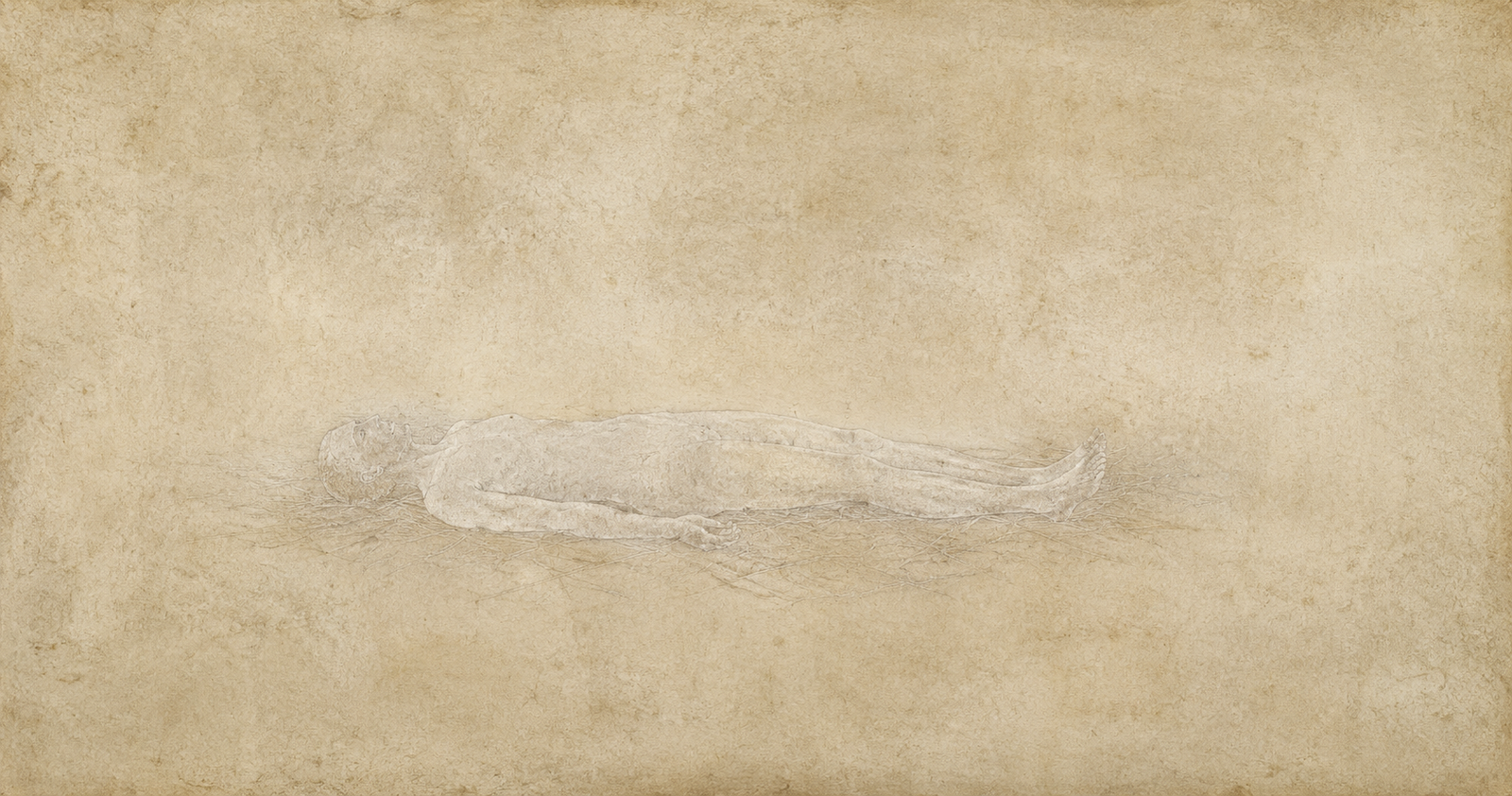

The Body on the Sacred Grass: A Vedic Myth Retelling
Purusha, primordial sacrifice, and the world made through division.
Purusha had a thousand heads,
a thousand eyes,
a thousand feet.
He covered the earth on every side and still stood ten fingers’ breadth beyond it.
All that had been was Purusha.
All that would be was Purusha.
He was lord of immortality, growing beyond through food. Yet all beings were only one quarter of him. Three quarters remained beyond them, deathless in the heights.
Three quarters rose above.
One quarter entered the world.
From that quarter he spread into what eats and what does not eat, behind and before, across all the earth.
From Purusha came Viraj.
From Viraj, Purusha came again.
The one brought forth the other, and the other returned him to the beginning. Neither stood wholly before the other. Birth circled back upon itself.
Then the gods prepared the sacrifice.
Spring became the clarified butter.
Summer became the fuel.
Autumn became the offering.
The sacred grass was spread upon the ground.
Upon it they laid Purusha, born at the beginning.
The gods gathered around him. With them came the ancient powers and the seers. They sprinkled the offering and made ready the rite.
The earth lay beneath him, though the earth was within him.
The sky waited above him, though the sky had not yet been shaped.
The fire that would receive the offering had come from the one who was offered.
The gods sacrificed Purusha.
From the complete offering, abundance gathered.
From it came the creatures of the air, lifting themselves above the earth. From it came the animals of the forest, moving beyond the boundaries of fire and dwelling. From it came the animals that remained near human beings, sleeping beside the fence and feeding within sight of the hearth.
Horses came from the sacrifice.
Cattle came from it.
Goats and sheep came from it.
What had been held within one body now went forth in many bodies: hoof and horn, feather and hide, breath passing from creature to creature beneath the same sky.
From the offering came the verses of the Rig.
From it came the chants of the Saman.
From it came the metres that gave sacred speech its measure.
From it arose the formulas of the Yajus.
The first sacrifice brought forth the words by which sacrifice would be remembered and performed again.
Then the gods divided Purusha.
Into how many portions did they divide him?
What did they call his mouth?
What did they call his arms?
What did they call his thighs?
What did they call his feet?
His mouth became the Brahmana.
His arms became the Rajanya.
His thighs became the Vaishya.
From his feet the Shudra was born.
The division continued.
From his mind came the moon.
From his eye came the sun.
From his mouth came Indra and Agni.
From his breath came the wind.
From his navel the middle air opened, from his head the sky lifted, from his feet the earth settled beneath all that lived, and from his ears the directions went outward until the world stood open on every side.
Nothing was brought from elsewhere.
Mind became moon.
Eye became sun.
Breath became wind.
Head became heaven.
Feet became earth.
Hearing became the distances by which the world extended beyond sight.
Where Purusha had been one, the world became many.
Creature stood apart from creature. Earth lay beneath sky. Wind crossed between them. Sun and moon travelled their appointed paths. The directions opened. Sacred speech entered the mouths of those who would remember it.
Yet the sacrifice had not only made the world.
It had made the pattern by which the world would answer what had been done.
Seven were the enclosing pieces.
Three times seven were the sticks of fuel.
Within that first enclosure, the gods bound Purusha as the sacrificial victim.
With sacrifice, they sacrificed to sacrifice.
These were the first ordinances.
By them the powers rose into the heights, to the ancient dwelling where the gods and those who had gone before them remained.
Below, the earth received what had been made.
Animals moved across it.
Fire consumed the offering.
Wind travelled over the grasses.
The sun crossed the sky born from Purusha’s head. The moon returned when the sun had gone. Human beings spoke, ruled, tended, traded, served, and sacrificed within the order drawn from his body.
All that lived below had come through division.
Yet the divided world had received only one quarter of Purusha.
Beyond the earth formed from his feet, beyond the sky fashioned from his head, beyond the sun born from his eye and the moon born from his mind, three quarters remained.
Deathless.
Unmeasured.
The world was one quarter of him.
The rest was still beyond.
—
Source Note
This literary rendering follows the Purusha Sukta, Rigveda 10.90, principally in dialogue with the translation of Stephanie W. Jamison and Joel P. Brereton. It preserves the hymn’s movement from the immeasurable Purusha through the primordial sacrifice to the emergence of animals, ritual speech, the social orders, and the cosmos. Restrained connective and image-led prose has been added where necessary, but no later identification of Purusha with a particular deity or philosophical absolute has been imported. This is a literary rendering, not a translation.
Contextual Note
The Purusha Sukta is commonly regarded as belonging to a relatively late layer of the Rigveda. Verse 12 derives four social orders—the Brahmana, Rajanya, Vaishya, and Shudra—from Purusha’s mouth, arms, thighs, and feet. The later caste system became substantially more elaborate and rigid than the social ordering visible in the Rigvedic period. Scholars disagree over whether this verse was inserted into an earlier hymn or formed part of the composition from the beginning. The rendering preserves the passage without harmonising its hierarchy.
—
For paid subscribers, I have added a Workroom note on the making of this retelling: the beautiful explanations that had to go, the difficult verse that could not be softened, and the line that taught me where invention ends and fidelity begins.
Enter the Workroom: Author’s Note: The Body on the Sacred Grass
—
Receive the next work
Subscribe free to receive new work from the Mytharium Library by email.
More from the Library

See Also
A concise and impartial dictionary of absence, promises, quarrels, ordinary objects, and the troublesome instability of words.
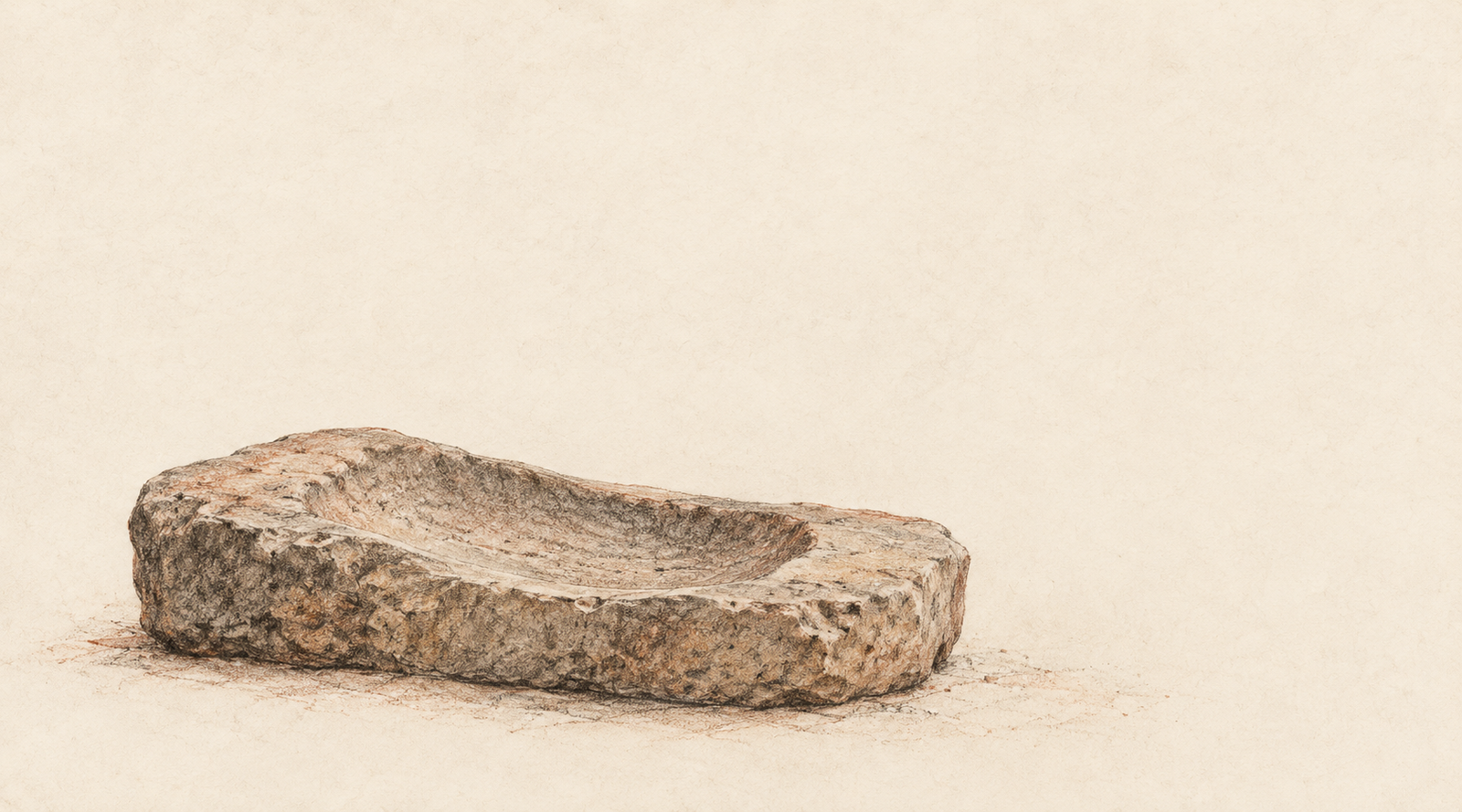

The City of Service
The temple we inherit is a building from which almost all necessity has been removed. Nothing must be brought for it to continue being what we call a temple. The sanctuary asks nothing of us. Stone is good at this kind of independence.
A living temple was otherwise.
Water had to come in. So did grain, cloth, oil, aromatic substances, fuel. The things required for worship arrived because someone carried them across a threshold.
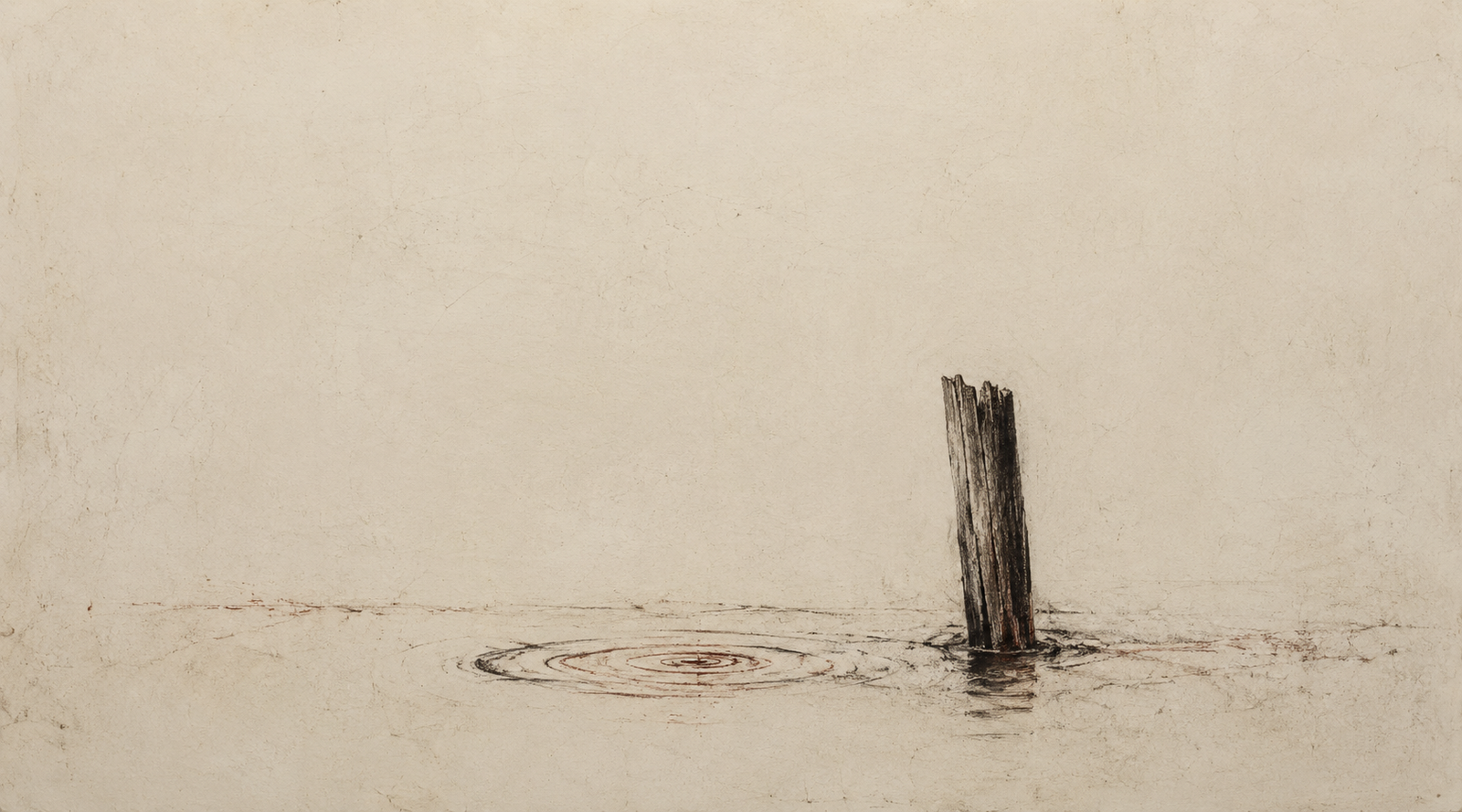

Houses of Wood, Light, and Smoke
Some of Angkor’s most intimate ruins do not rise above the ground at all. They are postholes, low mounds, hearths and ponds: durable traces of a domestic city built largely from things that decay. To restore that city is to see Angkor not only as stone, but as wood, smoke, water, repair, and people living within calling distance.