
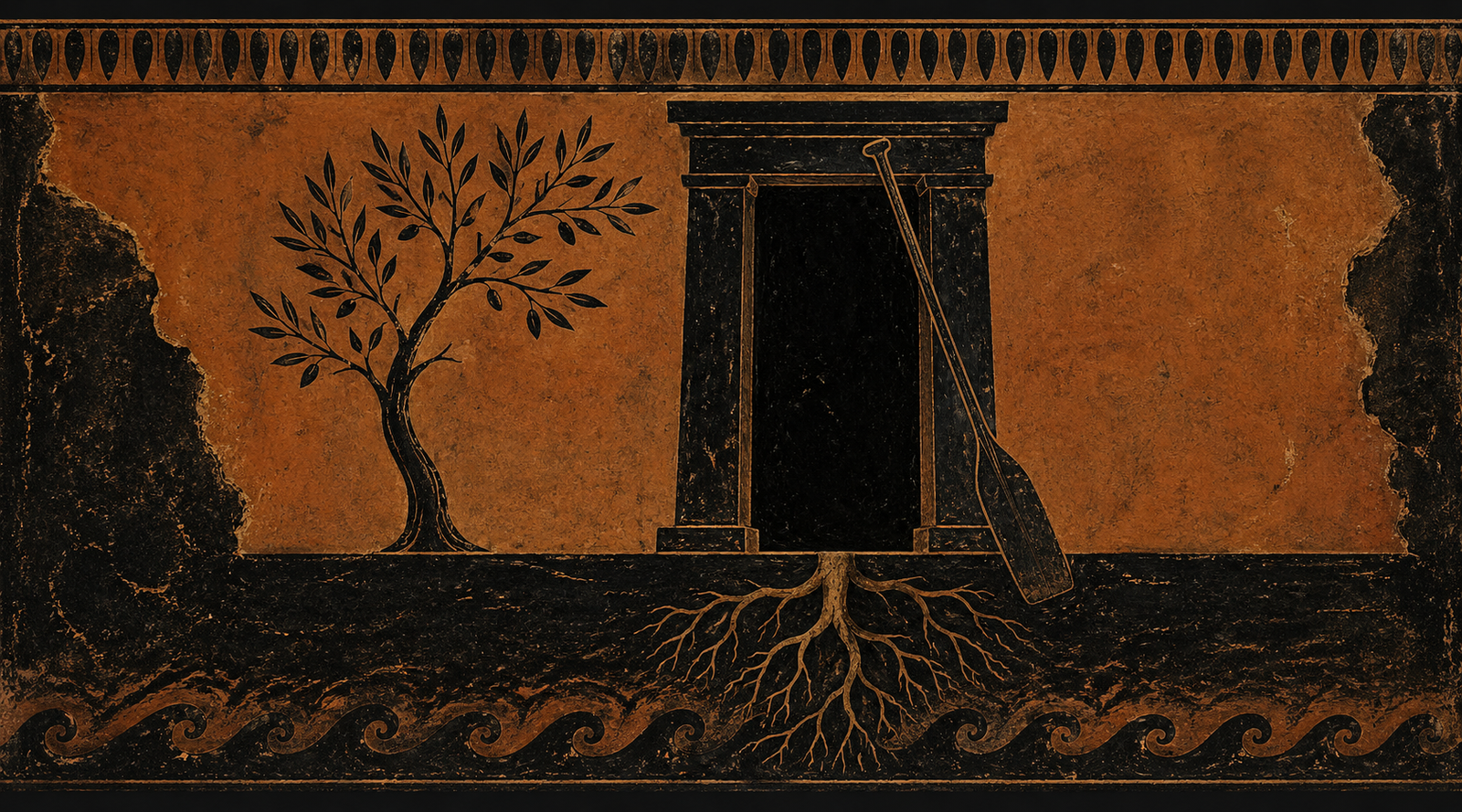

No Man Comes Home X — The Hall Reveals Itself
Odysseus enters his own hall as a beggar, and the house is forced to show what it has become.
The dog knew first.
That was the judgement.
Before the hall, before the wife, before the old nurse’s hand found the scar, before the bow remembered its master in the silence of men who could not string it, Argos lifted his head from the place where neglect had laid him down.
He had been a swift dog once.
Men had praised him. Boys had followed him. His body had known the old joy of pursuit, the sudden law of scent, the leap, the turn, the mastery of ground beneath the feet. Before Troy, before the long absence, before suitors ate under another man’s roof, Argos had belonged to motion.
Now he lay outside the palace on refuse.
No one had kept him as a sign of the house. No one had said: this creature knew the king before fame made him large. No one had honoured the old body because it had once run in the fields of a man now spoken of as rumour. Servants passed. Men laughed. Waste gathered. Time did what time does when love is not renewed by care.
Then the beggar came.
Argos smelled what the house had not yet seen.
The disguise meant nothing to him. Rags did not matter. Bent back, altered skin, greyed hair, poverty’s garment, the lowered shape of power waiting to rise: none of these could persuade the old witness. Scent went beneath strategy. The body knew the body.
His ears moved.
His tail answered as far as death allowed.
Odysseus saw.
He could not go to him.
This was the cruelty of the hour: to be recognised truly and be forbidden tenderness. The dog had done what men and women, servants and suitors, wife and son, palace and island could not yet safely do. He had received the returning man without proof.
Odysseus turned his face away.
A tear is sometimes all strategy permits the heart.
Argos died.
No speech followed him.
That was mercy.
The beggar went on to his own door.
Inside, the hall had not improved.
It had only continued long enough for wrong to imagine itself permanent. The benches stood where men had made leisure into trespass. Tables bore the evidence of appetite. Cups moved from hand to hand. Flesh, wine, smoke, laughter, song: the same abundance that should have declared a living house now declared a house being consumed.
Odysseus entered as need.
That was the test.
A king at the threshold produces caution. A beggar produces truth. Men reveal themselves most clearly before those from whom they expect no consequence.
Eumaeus led him in.
The faithful servant had brought his lord home without knowing it. That ignorance preserved the purity of the act. He did not guide Odysseus because the man was Odysseus. He guided him because a stranger required passage through a dangerous house. Fidelity, at its highest, does not need recognition before it acts.
Telemachus saw.
He knew and did not rise.
This was obedience.
The son had received the father in the hut. Now he had to watch him enter the hall as something lower than the lowest man there. He had to hold his face while insult prepared itself. He had to let strategy stand where instinct wanted revolt. Youth finds such stillness almost unbearable. His hands knew the absence of weapons before the hour did.
Odysseus moved through the room.
Some men looked.
Some did not.
The ones who did not were revealing themselves too. A beggar can be refused by contempt or by not being seen. The second is often the more perfect violence. It allows the comfortable to remain innocent in their own account, because they have not struck what they have not admitted exists.
He stretched out his hand.
The gesture was small.
That made it larger.
A man who has crossed storm, resisted song, entered death, escaped the cave, refused immortality, and returned through divine concealment now held out his palm for scraps beneath his own roof. This was not degradation alone. It was measurement. Each gift, each refusal, each insult, each glance became part of the house’s final testimony.
Some gave.
A few from habit. A few because custom had not died in them entirely. A few because even among corrupt men the old laws twitch when touched. Bread fell into the hand that had strung councils together and driven stakes into darkness.
Then Antinous spoke.
There are men who become most themselves in the presence of the defenceless. They feel their own size increase when no answer is expected. Antinous had that gift. He knew how to turn another’s need into public entertainment. He saw the beggar not as hunger, but as opportunity: a low body upon which high insolence could display itself.
He asked why such a man had come.
He asked as if the house were his.
Odysseus answered.
Carefully.
Always carefully.
He gave another life. Old wealth. Fall. Wandering. Misfortune. A man brought low by gods and sea and the long instability of mortal things. He spoke as one asking not for honour, but for the portion owed by the law of the table.
The suitors listened.
Not to understand.
To decide whether mockery would ripen better now or later.
Antinous chose now.
He took a stool and struck him.
No great wound opened.
That is not the point.
Violence does not need splendour to become revelation. The blow landed because Antinous believed the body before him had no future in which to answer. That belief was the deepest mistake in the room.
Odysseus endured.
The body that had strained against ropes under the Sirens’ song, clung to wreckage, gripped the ram’s fleece beneath the blinded giant, reached three times for the mother who could not be held, now had to receive insult without becoming itself. He held still because violence delayed is sometimes more terrible than violence spent.
The hall watched.
Even some suitors rebuked Antinous.
Not from goodness.
From fear of form. What if the beggar were a god? What if outrage had witnesses? What if the old law, mocked daily, chose this poor body in which to return? Men who have broken reverence often retain superstition. They fear punishment more than wrong.
Odysseus heard.
He stored that too.
Then came Irus.
The beggar of the house had a kingdom also: the crumbs, the door, the low privilege of being the known poor man among rich corrupters. He saw Odysseus and felt his little territory invaded. Poverty does not always make men merciful. Sometimes it teaches them the manners of those above them in smaller, meaner forms.
Irus threatened.
The suitors delighted in this.
Power enjoys watching the powerless imitate it. It confirms the world as power has arranged it: cruelty descending in ranks, each man seeking a lower body upon which to rehearse the violence done to him.
Odysseus did not want the contest.
Or rather, the beggar did not.
The man beneath had other uses for it.
The hall demanded sport. The suitors promised food. The two poor men were made spectacle by those who had never earned the right to judge either. Telemachus watched. Eumaeus watched. The women heard perhaps from within. The house, already full of violated forms, accepted one more.
Then Odysseus showed a little of the body.
Not enough to reveal.
Enough to warn.
He gathered the rags, and the thighs appeared, the shoulders, the hard remainder of a man not made by beggary. The room altered. Laughter did not cease, but it changed its foot. Irus saw too late that he had challenged poverty and found concealment.
The blow was brief.
Enough.
Irus fell.
The suitors laughed again, relieved to keep the event as entertainment. They did not understand that the hall had just been shown a sign and chosen amusement over fear.
That was their habit.
Signs had been passing through the house for years.
They had eaten through all of them.
Penelope came down.
Not fully into the story yet.
Never fully until she chose.
But she came far enough to change the air. The hall, which could misread a beggar and enjoy a poor man’s humiliation, could not wholly misread her. Even the suitors, in their appetite, understood that something in the house still had centre because she had not yielded it.
She stood before them veiled.
The veil mattered.
Not because she was hidden in weakness, but because concealment in her had become sovereignty. Men looked and did not possess what they saw. She had survived by controlling degrees of revelation: face, word, decision, cloth, grief, hope. No one in the hall had received all of her. That, too, was how the house still stood.
She spoke to Telemachus first.
Her words struck him for allowing the stranger to be abused. Or seemed to. A mother may rebuke a son publicly and still speak to the room behind him. The beggar had been struck. The house had failed. The son had not prevented it. Yet beneath the rebuke moved another question: what kind of man are you becoming in a house where wrong has learned to speak loudly?
Telemachus answered with restraint newly acquired and not yet gentle.
He could not tell her why he had allowed it.
This was another cost of concealment.
The truth had entered between mother and son as a wall neither could name. Penelope saw a change in him. Perhaps she did not know what change. The boy who had once been wounded by helplessness now carried an obedience he could not explain.
Her eyes moved to the beggar.
Odysseus kept the shape.
No flinch of husband.
No claim.
No relief.
The wife stood before the hidden man and spoke of him as stranger.
This was almost more than endurance.
She asked that he be brought later, that she might question him about her husband. Always the same wound. Always approached indirectly. News of Odysseus had become the only form in which Odysseus could safely come near her.
The suitors watched her.
Their desire did what desire does when disciplined by nothing: it mistook continued refusal for a challenge to be renewed. Penelope turned that appetite back upon itself. Gifts, she said. It was not fitting that suitors eat a house and bring nothing. Let them prove their courtship by offerings worthy of the claim they made.
This was not yielding.
It was exposure.
The men sent for gifts because vanity can be made useful if touched in the right place. Gold, brooches, necklaces, cloth, bright things brought under the illusion of advancement. Penelope received them without granting the future they purchased in the minds of men.
Odysseus watched his wife take wealth from those who had consumed his house.
He admired her.
He feared her perhaps.
Love is altered when one sees the beloved surviving by arts one did not teach and cannot govern.
Night thickened.
The women moved through the hall.
Some were faithful. Some had crossed inwardly to the suitors long before any body followed. A house under pressure divides in hidden rooms first. Melantho spoke sharply to the beggar. She had been raised under Penelope’s care and had answered care with contempt. Such betrayals are among the bitterest because they make nurture seem foolish after the fact.
Odysseus heard her.
He answered as a beggar, but the warning beneath the rags was not a beggar’s warning.
She did not understand.
Few do, before consequence.
Later, in the washing, truth came too early.
Eurycleia brought the basin.
The old nurse had held him when he was small. She had known the first body before it became name, before war, before marriage, before ships, before the scar became story. Age had taken much from her, but not the memory stored in hands. Hands remember what eyes can doubt.
Odysseus tried to avoid the light.
It was not enough.
Water. Skin. The old woman’s fingers. The scar.
The body spoke.
Not with voice.
With history.
She knew him.
Joy rose in her faster than caution. The name came towards her mouth. Years, grief, nursing, loyalty, hope, and age gathered in one breath. She would have cried out and restored him to the house before the house was ready to survive the truth.
Odysseus moved.
His hand closed on her throat.
Not brutally.
Not gently.
Necessarily, which is often the most frightening word.
The hand that had once been helpless in her care now silenced the woman who had cared for it. That was the compression. Tenderness and force in one gesture. Recognition and concealment at war inside the space between breath and speech.
He spoke low.
He warned her.
If you love me, silence.
That was what return required of her.
Not embrace. Not proclamation. Not the clean joy of an old servant receiving the child grown into legend and ruin. Silence. To know and not tell. To let the truth sit inside the body like hot metal until the hour came.
Eurycleia obeyed.
Her tears did not.
They moved where speech could not.
The water held the scar’s answer.
Penelope did not see.
Or did not see enough.
The wife remained withheld from the proof the nurse now carried. That is how the night arranged itself: one woman knew by touch; the other would refuse knowledge until it came by the only test equal to her endurance.
Odysseus sat again near the fire.
The old nurse moved around him differently now.
Not visibly enough for the room.
Enough for him.
Knowledge changes service even when service repeats the same motions. A bowl placed down becomes reverent. A cloth lifted becomes an oath. Silence acquires posture.
Penelope spoke with the stranger.
Now the hall narrowed to two people and the distance between truth and timing.
She asked of Odysseus.
He gave her a story.
Not the whole truth.
Never the whole truth.
He told of meeting him elsewhere, of clothing seen, of signs by which a wife might know the report was not empty. He described garments, brooch, cloak, tunic, the visible things that memory could test. Penelope listened as one who has been wounded too often by news to receive it without armour.
Then she wept.
Not because she believed simply.
Because even guarded hope can break the body.
Odysseus watched his wife grieve for him while he sat before her.
This was the harshest form of concealment the house had yet required.
He could not go to her. He could not end it. He could not say, The man you mourn is here. Strategy held him back. Safety held him back. The hour held him back. Perhaps fear did too. For if he spoke, concealment would end, and with it the form in which he had survived long enough to reach her.
So he did not speak.
His eyes remained dry by force.
Inside, something answered.
Not enough to move.
Enough to wound.
Penelope spoke of dreams. Of a bird, an eagle, geese, interpretation arriving with the cruelty of symbolic clarity. She spoke of the contest she would set: the bow, the axes, the task no suitor could complete unless the house itself had chosen him. She did not yet know whether she was surrendering, testing, ending, beginning, or drawing the noose of the hall tighter around its own hunger.
Perhaps she knew more than she said.
Penelope usually did.
Odysseus encouraged her.
Carefully.
He told her the trial would not be completed before her lord returned.
A truth under a lie.
The sentence entered the room and waited.
Morning came towards them slowly.
Before it, he slept little.
How could he? The house breathed around him with all its divided knowledge. Argos was dead. Eurycleia knew. Telemachus knew. Eumaeus did not. Penelope had spoken to him and not received him. The suitors slept or plotted or dreamed the shallow dreams of men who believe tomorrow owes them continuation.
Athena strengthened him.
Not by removing the burden.
By making him able to carry it.
Dawn opened.
The day of the bow arrived.
The hall gathered itself for what it thought was a contest.
That was its last innocence.
Penelope brought out the bow.
Or had it brought.
The object entered the room with more authority than most men in it. It had hung through the years, silent, curved, unpersuaded. It had not feasted. It had not listened to speeches. It had not aged into compromise. It remembered the hand for which it had been made useful.
The axes stood in line.
The suitors looked at them as men look at a difficulty they expect to become flattering once overcome. They saw prize, wife, kingship, public proof. They did not see witness.
Telemachus tried first.
That mattered.
The son approached the bow before the father. He nearly strung it. Nearly. The room watched the boy come close to the force that had made his father feared and necessary. Odysseus stopped him with a sign before success could alter the order of things.
The son obeyed.
Again.
To be almost ready and be commanded to wait is another education.
Then the suitors tried.
One by one.
Strength failed.
Confidence became irritation. Irritation became excuse. Hands softened by feasting met the curve of a weapon that did not care for lineage, wealth, threat, youth, number, or hunger. Oil was brought. Heat applied. Words spoken. Shoulders strained. The bow remained itself.
This was the first clean judgement the hall had received.
The suitors could occupy the benches.
They could not inhabit the sign.
Then the beggar asked.
Laughter, outrage, insult, fear disguised as propriety. How could such a man touch the bow? How could poverty enter the contest for a queen? How could need presume to handle what better men had failed to master?
Better men.
The phrase did not need to be spoken to fill the room.
Penelope intervened, or Telemachus did, or both according to the necessary order of the hour. The bow came to Odysseus.
Eumaeus and Philoetius had already been drawn into the circle of knowledge, faithful men gathered by proof and promise. Doors were fastened. Weapons had been removed. The room had become what strategy had made from patience.
The beggar took the bow.
The hall watched.
A man can reveal himself before he names himself.
The hands did it.
They turned the weapon, tested it, recognised condition, measured tension, all without display. The body had returned to an old grammar. The bow knew.
He strung it easily.
Not carelessly.
Ease is not always lightness. Sometimes it is the visible form of long union between body and object. The sound moved through the hall.
A clear note.
Some heard only danger.
The arrow passed through the axes.
The impossible had happened with almost no noise.
Then Odysseus stood.
The disguise fell away before the rags did.
There are moments when a room understands before speech instructs it. The hall saw too late that the beggar had never been what their contempt required him to be. Poverty had been mask. Endurance had been measurement. Insult had been stored. The powerless body had been judging them all.
He spoke his name now where the name could not call a storm from the sea.
It called death into the hall.
The first arrow found Antinous.
No speech of repentance preceded it.
That was fitting.
Some men do not receive a final argument because their lives have already made it.
The hall broke.
Not into battle at first.
Into comprehension.
The suitors looked for weapons that were gone. They looked to one another for the safety of number. They looked to the doors. They looked to the man they had struck, mocked, fed poorly, dismissed, misread. The masks of leisure fell from them. What remained was fear, and the late knowledge that fear had been waiting beneath appetite all along.
Eurymachus spoke.
Of course he spoke.
Speech is the last refuge of men who have lived by arrangement. He placed blame on the dead man. He offered recompense. He tried to separate himself from the appetite he had shared. He tried to make the room believe that guilt could be distributed conveniently after consequence had entered.
Odysseus refused.
There would be no purchase now.
No gift enough to uneat the cattle, undrink the wine, unshame the son, unbesiege the wife, uncorrupt the servants, unteach the house what it had endured. The time for settlement had passed long before the bow sounded.
The violence began in full.
Do not make splendour of it.
The hall was not a battlefield under open sky. It was a room where consequence had closed the doors. Arrows moved. Men fell. Telemachus stood beside his father. Eumaeus and Philoetius held their places. The suitors, who had consumed the house as if no answer would ever take form, found form at last in shaft, blade, command, and the narrow failure of escape.
Some fought.
Some begged.
Some learned in their final moments that being many is not the same as being justified.
The house saw.
Tables overturned. Cups emptied. The feast ended by becoming what it had concealed: a violence delayed through years of eating.
No death should be loved here.
Yet neither should the logic be denied.
The hall had revealed itself to the powerless king.
Now the king revealed what power had been withholding.
When it was done, sound did not return at once.
Rooms after violence have their own silence. Not peace. Not judgement completed. A charged absence in which every object has become witness. The benches. The cups. The floor. The bow. The doors. The thresholds. The air itself altered by what could no longer be postponed.
Odysseus stood among the dead.
The son stood beside him.
Not boy now.
Not free of childhood either.
Something had been burned out of delay and replaced by knowledge no voyage could have given him.
The faithful servants breathed.
The unfaithful would be judged.
The nurse would be summoned.
The women would come.
The work of the house was not finished because the suitors were dead. Violence clears certain rooms. It does not cleanse them.
But the hall knew now.
That was the terrible gift.
It had asked the beggar what he was.
The bow had answered.
The answer had entered every man who refused it until refusal was no longer possible.
Now the house possessed knowledge.
Too late to call it mercy.
—
No Man Comes Home is a twelve-canto literary retelling of The Odyssey within The House of Cadmus: a poem of return, concealment, recognition, and the cost of surviving long enough to come home.
—
Receive the next work
Subscribe free to receive new work from the House of Cadmus Library by email.
More from the Library

See Also
A concise and impartial dictionary of absence, promises, quarrels, ordinary objects, and the troublesome instability of words.

The City of Service
The temple we inherit is a building from which almost all necessity has been removed. Nothing must be brought for it to continue being what we call a temple. The sanctuary asks nothing of us. Stone is good at this kind of independence.
A living temple was otherwise.
Water had to come in. So did grain, cloth, oil, aromatic substances, fuel. The things required for worship arrived because someone carried them across a threshold.

Houses of Wood, Light, and Smoke
Some of Angkor’s most intimate ruins do not rise above the ground at all. They are postholes, low mounds, hearths and ponds: durable traces of a domestic city built largely from things that decay. To restore that city is to see Angkor not only as stone, but as wood, smoke, water, repair, and people living within calling distance.