

The Wall That Still Holds Them
They are not alone.
That is why the wall still breathes.
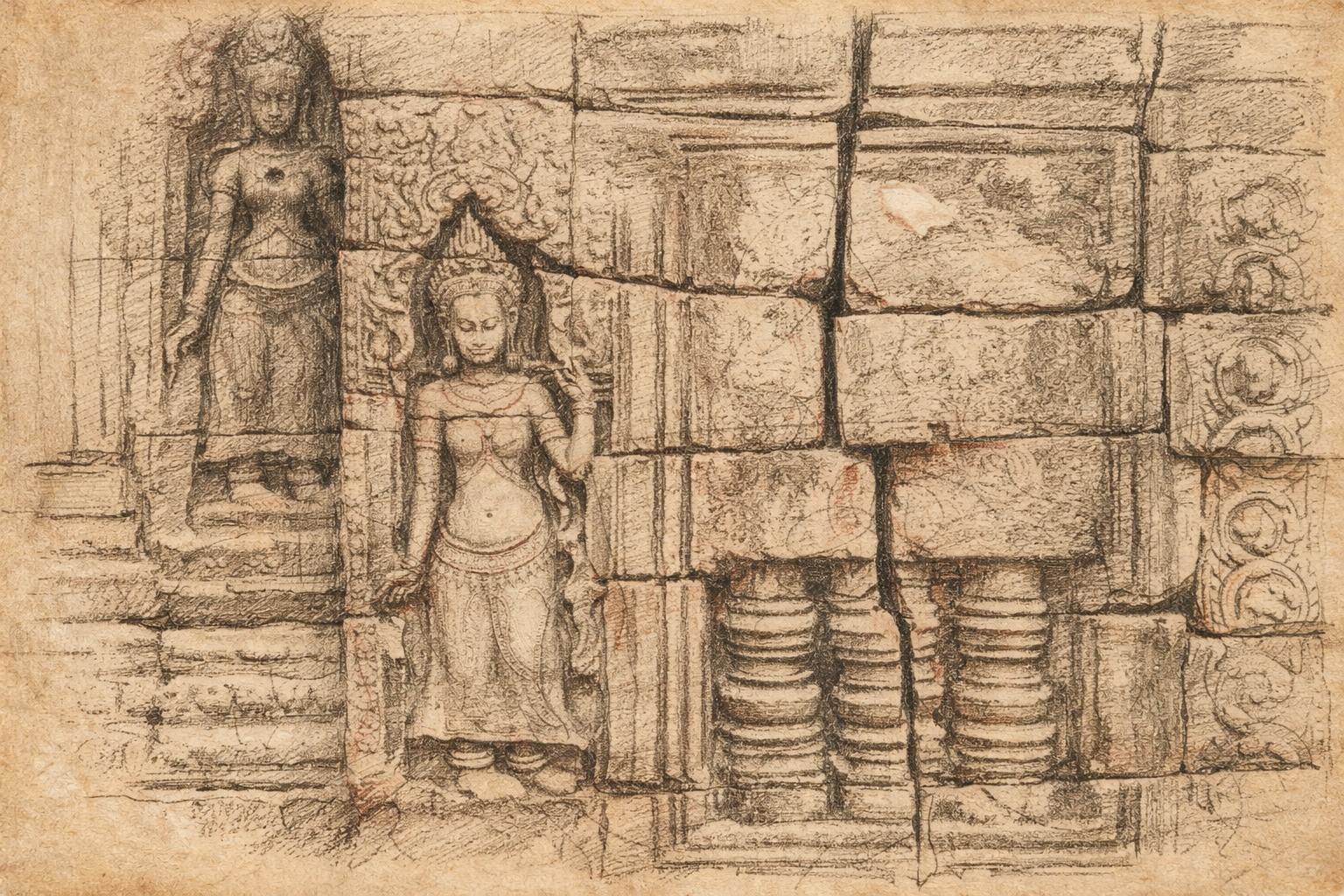
Two devata presences remain within a wall that has shifted out of wholeness. In this sketch and its companion prose, fracture does not erase grace; it becomes the condition under which relation, silence, and sacred endurance are most clearly felt.

One stands higher, darker, more withdrawn into the stone’s inward weather, as though shadow had kept her nearest to itself. The other comes further into legibility: torso pale against the roughened field, face lowered in a composure less posed than preserved. Around them the masonry has shifted out of alignment. Courses no longer meet. Blocks have slipped from their first obedience. A black fracture descends through the right-hand wall like a sentence time could not complete.
And still they remain.
Not untouched. Not restored. Not flattered back into wholeness. They remain as Angkor remains: through breakage, through weathering, through the patient correction of rain. The wall has lost its seamlessness. The figures have entered another kind of certainty, one that no longer depends on completion.
What survives here is relation.
The upper presence keeps her distance. She does not advance. She abides. Her darkness is not absence but depth: the depth of stone that has gone on listening after names, vows, and dynasties have thinned into dust. Below, the lighter figure is given more openly to the eye. Not more alive, only more available. Her outline, still held and still surrendering, carries that peculiar Angkorian tenderness by which ruin does not diminish grace, but reveals the conditions under which grace endures.
Nothing in the wall is merely setting. The carved borders, the broken colonettes, the displaced blocks, the passages of ornament half-lost and half-returning: all belong to the same field of attention. Holiness does not reside in the figures alone, but in the interval between presence and damage, contour and collapse, intention and its long unmaking.
This is one of Angkor’s quiet laws: beauty does not gather only at the point of perfection. Sometimes it gathers where form has been tested. Sometimes it deepens where continuity fails. Sometimes the truest radiance appears not in the intact body, but in what the body continues to offer after rain, heat, lichen, silence, and centuries have passed over it.
These two presences do not ask to be admired. They ask for a finer kind of nearness.
A lowered face. A torso still bearing the memory of breath. A hand not fully recovered from the wall. A crown rising through abrasion. Stone darkened by monsoon after monsoon. The solemn misalignment of blocks. The vertical wound in the masonry. The breathing field around the sketch where the drawing loosens and lets silence complete what line should not.
Nothing here clamours. The image opens by restraint.
Before such a wall, one begins to understand that ruin is sometimes only the visible form of endurance. Not survival as defiance, but survival as stillness. Not the refusal to perish, but the refusal to cease bearing presence. The upper figure keeps her inward reserve. The lower offers her measured clarity. Together they create a rhythm more moving than symmetry: withdrawn and revealed, shadowed and given, hidden and almost-known. A companionship of survivals.
Because they remain together, the broken wall does not read as damage alone. It reads as custody.
The stones have shifted, but they still hold them.
The cracks have opened, but they have not cast them out.
Loss has entered the image, but not emptiness.
What lingers is not sorrow, and not praise, but a more difficult reverence: the kind that rises when one sees how grace consents to inhabit what time has broken. Not above it. Not beyond it. Within it.
So the sketch does not restore the temple. It listens to what the temple has become. It honours the fact that the sacred is sometimes most legible where the world has ceased pretending to permanence. Here, incompletion is not failure. It is atmosphere. It is truth. It is the condition under which these presences have learned to speak without speech.
One dark as remembered depth.
One pale as a breath returned.
And between them the broken wall, holding its silence like prayer.
—
Receive the next work
Subscribe free to receive new work from the Lucas Varro Library by email.
More from the Library


See Also
A concise and impartial dictionary of absence, promises, quarrels, ordinary objects, and the troublesome instability of words.

The City of Service
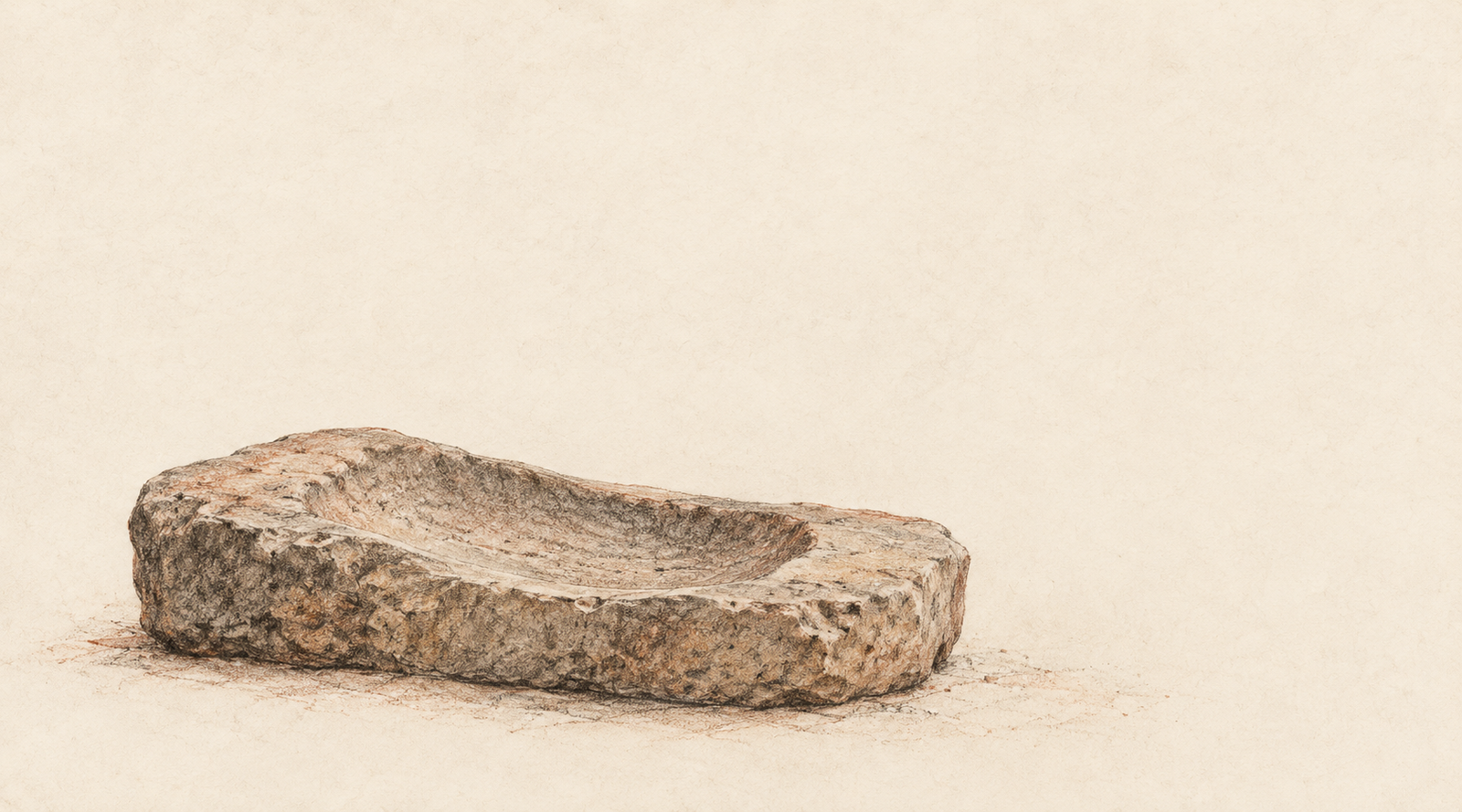
The temple we inherit is a building from which almost all necessity has been removed. Nothing must be brought for it to continue being what we call a temple. The sanctuary asks nothing of us. Stone is good at this kind of independence.
A living temple was otherwise.
Water had to come in. So did grain, cloth, oil, aromatic substances, fuel. The things required for worship arrived because someone carried them across a threshold.

Houses of Wood, Light, and Smoke
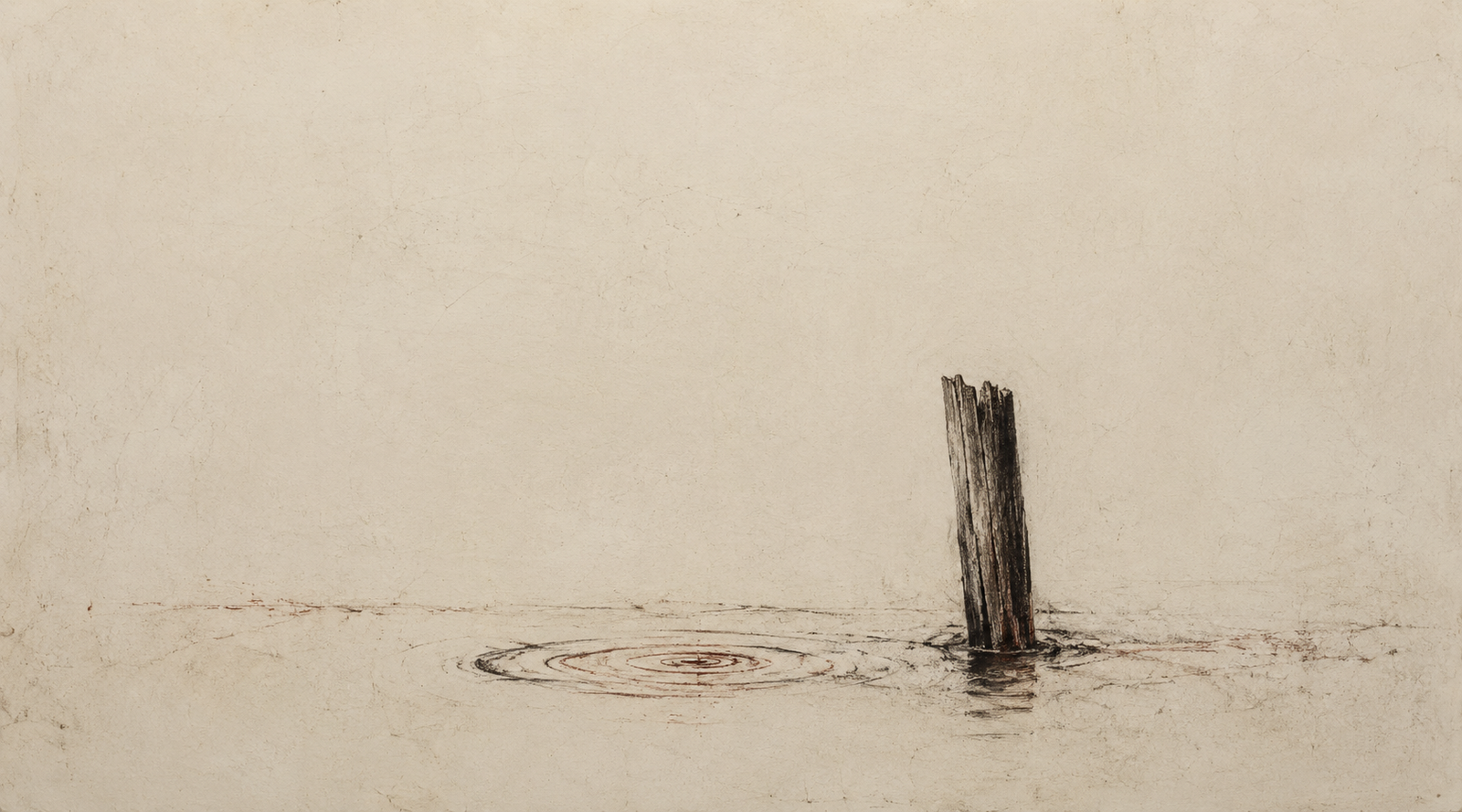
Some of Angkor’s most intimate ruins do not rise above the ground at all. They are postholes, low mounds, hearths and ponds: durable traces of a domestic city built largely from things that decay. To restore that city is to see Angkor not only as stone, but as wood, smoke, water, repair, and people living within calling distance.