
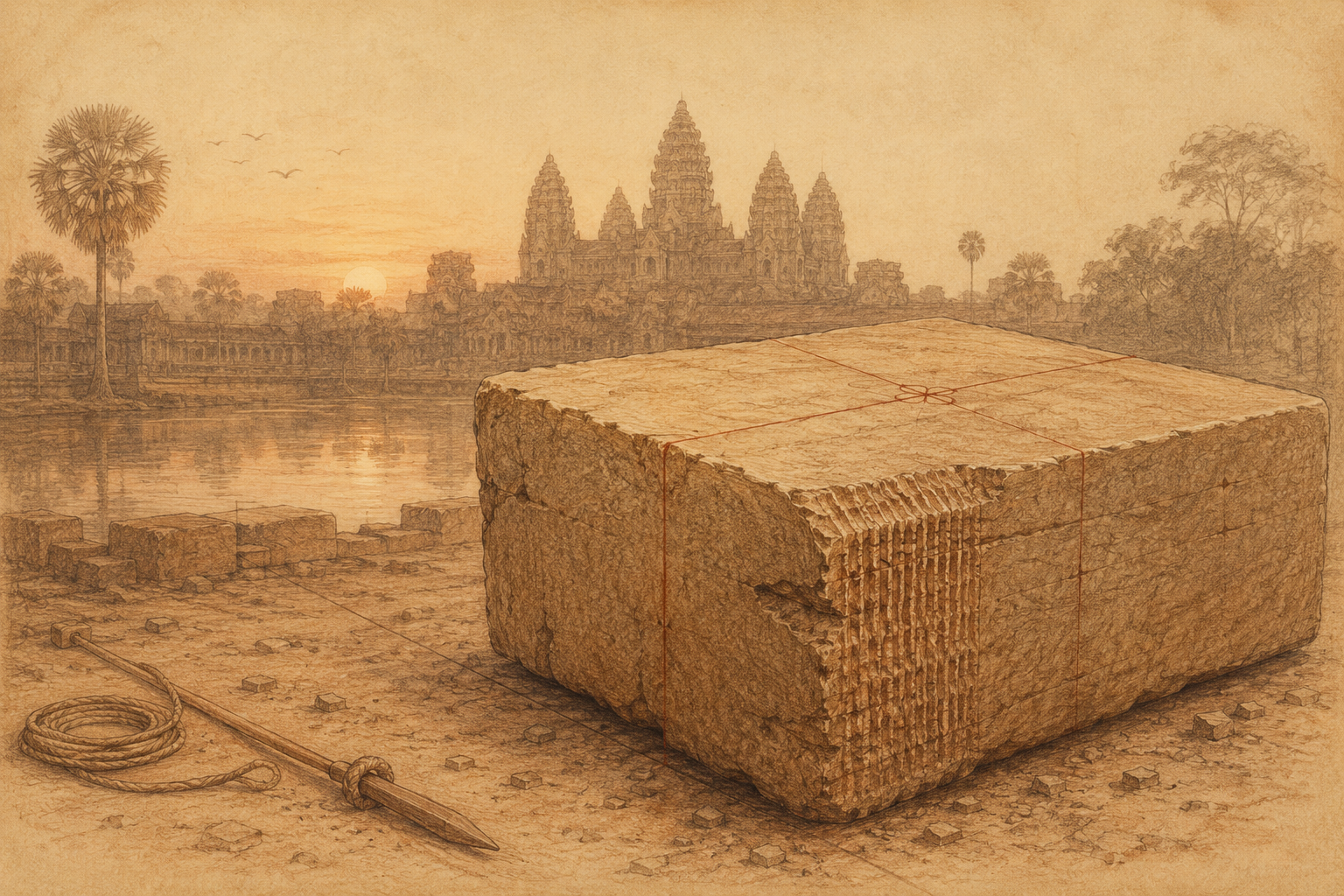

Where a Name Could Not Follow
A story of an unnamed Angkorean stone-master, the mountain he helped move, and the temple that remembered everything except his name.
Somewhere beneath the long shoulder of Phnom Kulen, before the sun has lifted clear of the trees, a boy kneels beside a block of sandstone and learns to listen.
His father does not speak at first.
There is no need. The stone is speaking already, though not in any language the boy yet understands. It gives back the dull warmth of the night. It holds the damp of the hill in its pores. Along one edge the surface is sound, close-grained, obedient. Along another, almost invisible beneath the quarry dust, a pale line runs like a hidden fault in a bone.
The boy touches it.
His father watches.
Then the boy lifts the small iron chisel he has been allowed to carry, sets its point against the wrong place, and feels his father’s hand close around his wrist.
Not there.
Only two words. Quietly spoken.
The boy looks again.
The stone lies before him, mute as an animal pretending not to breathe. He cannot yet see what his father sees. He cannot yet feel the difference between the face that will receive the blow and the face that will betray it. To him the block is only stone: heavy, waiting, cut from the hill by men whose backs shine with sweat in the first light.
To his father it is already many things.
A threshold.
A stair.
A god’s ankle.
The shoulder of a demon in a battle that has not yet been carved.
A stone must be known before it is struck. This is the first lesson.
Not strength. Not speed.
Attention.
So the boy waits. He lowers the chisel. He runs his fingers again across the pale line. The quarry is waking around him. Men move between the blocks with baskets, ropes, wedges, hammers. Somewhere farther down the slope an elephant gives a low complaint. Smoke rises from cooking fires. The hill smells of wet leaves, iron, ash, and opened earth.
At last his father takes the chisel from him and sets it not on the line, but beside it.
Here.
He taps once.
The sound is clear.
The boy feels it in his teeth.
For years afterwards, he will remember that morning as the beginning of his life, though he had already been born twelve monsoons before. Childhood had been the time before stone answered. Everything after belongs to the mountain.
He learns slowly.
He learns that sandstone has moods. Some blocks yield as though they had long been waiting for the hand. Some resist and must be persuaded by patient blows. Some are false: smooth-faced, promising, secretly riven. He learns to read colour, weight, damp, grain, the small bright cry of iron against a good edge, the dead sound of a block that should be rejected. He learns to judge whether a stone should become a lower course, hidden beneath pressure and shadow, or whether it may bear the honour of a visible surface.
For a long time, no one asks him to carve.
He carries.
He sweeps.
He sharpens.
He watches the older men set wedges into the quarry face, pour water into the cracks, wait for heat, pressure, and patience to widen what force alone would ruin. He watches rough blocks pulled free of the hill and lowered with ropes onto sledges. He watches men mark surfaces with red lines that seem, to his young eye, too slight to govern so much weight.
The lines are never slight.
A mark made in dust may decide what will stand for centuries.
When he is older, perhaps fifteen, perhaps sixteen — years are counted less by age than by permission — he is allowed to dress the underside of a block that will never be seen. This is not an insult. Hidden work is where the hand is judged most honestly. A visible flaw may be softened by ornament. A hidden error may bring down a gallery.
His father gives him a heavier chisel.
The boy is taller now. His shoulders have widened. His palms are thickened with old blisters. He has begun to understand that a tool is not held only by the fingers. It is held by the breath, the back, the sole of the foot, the measured pause before descent.
Strike too hard and the stone remembers your anger.
Strike too lightly and it remembers your fear.
Strike rightly and the mark belongs only to the stone.
By the time he first travels from the quarries to the plain, he has already spent years making stones ready for a world he has never seen.
The journey begins with noise.
Ropes creak. Men shout. Bamboo poles bend under load. Elephants lean their foreheads into harness. Blocks are eased downward from the quarry ground toward the water routes that will carry them south and west, toward the great building fields of the king. The boy, now nearly a man, walks beside the stone he helped cut. He keeps one hand on it when the path narrows, as if touch alone might steady its enormous patience.
The water receives the blocks one by one.
They do not look like a temple yet.
They look like labour.
Like danger.
Like too much weight entrusted to floating wood and human command.
For days the stones move through green country. Forest presses close. Birds lift white from the banks. The water darkens under passing cloud. Villages appear and vanish. Children run beside the tow lines for a while, then fall away. At night the men sleep near the cargo, because stone destined for a god cannot be abandoned to chance.
The young man lies awake beneath a sky hot with stars.
He has heard of the temple since before he understood the word. A mountain on the plain. A world made again. A house for Vishnu, say some. A royal work of such scale that men speak of it in lowered voices, as if describing weather sent by the gods. His father has said little. Men who know stone do not praise what has not yet stood.
Then, one morning, the trees open.
The plain appears.
And beyond the haze, beyond the palms, beyond the movement of thousands of bodies, the unfinished towers rise.
He stops walking.
For the first time in his life he understands that the mountain has been cut apart in order to be reassembled as heaven.
Nothing in the quarry prepared him for this.
The site is not a place. It is a weather of human purpose.
There are men everywhere: cutters, haulers, polishers, water-carriers, cooks, priests, scribes, overseers, boys younger than he was when he first touched stone. There are elephants dark with wet dust. There are oxen turning under loads. There are cords stretched across cleared ground, stakes driven into earth, plumb lines hanging motionless in morning heat. Bamboo scaffolds climb the walls like a second forest. Blocks wait in ordered ranks, each marked, each destined. Fires burn. Hammers sound. Voices rise and fold into one another until the whole plain seems to breathe through labour.
And above it all, the temple.
Not completed. Not yet.
But already more than a building.
The lower galleries hold shadow. The causeway reaches outward like an intention made straight. The central mass climbs toward a form his eye recognises before his mind can name it: mountain, axis, centre, summit, the place where earth remembers heaven.
He feels fear then.
Not fear of height or stone or overseer.
Fear of being too small for what has called him.
His father, standing beside him, does not comfort him.
Good, he says.
The young man turns.
If you were not afraid, you would ruin it.
For several years he works where he is placed.
No one asks whether he wishes to carve gods or set foundations. Wanting is not the measure. Fitness is. At first he dresses joining faces, the secret planes by which one stone will trust another. He learns the Angkorian precision of contact: not mortar as a generous bed, not softness forgiving the hand, but surface meeting surface so closely that weight itself becomes the bond.
He learns that the most important spaces are sometimes invisible.
The underside of a lintel.
The back of a block.
The line where one course leans into another.
In time he is moved upward.
He works on galleries where the air is hotter and the ground far below begins to seem less real. Bamboo bends under his feet. It creaks, but does not break. The older men trust it because they understand its yielding. A rigid thing snaps. Bamboo receives, answers, returns.
From the scaffold he sees the temple differently.
At ground level it is weight.
From above it is measure.
Cords cross open space. Axes align. Doorways answer doorways. Towers emerge not as heaps of stone but as decisions repeated with such discipline that stone begins to resemble thought. He watches the master of measure walk the site with assistants carrying cords and rods. The man rarely raises his voice. He does not need to. A single correction from him travels farther than shouting. A stake moved by the width of a thumb changes the obedience of an entire wall.
The young stone-worker learns to fear the cord as much as the hammer.
A bad blow can break one block.
A bad measure can wound the world.
The priests come at intervals. Brahmins in white, men whose bodies seem made for stillness rather than labour. They confer with royal officials. They consult manuscripts, shadows, auspicious hours, directions. Offerings are made before foundations are sealed. Grains, metals, flowers, water, words. The young man does not understand everything they say, but he understands enough.
The temple is not being built merely to stand.
It is being built to correspond.
To the mountain at the centre.
To the god.
To the king’s merit.
To the order that must be renewed because disorder is always waiting at the edge of things.
This knowledge alters his hand.
A stone is no longer only stone. A joint is no longer only a joint. The line he cuts participates in a pattern larger than sight. Yet the work itself remains brutally exact. Sacredness does not soften labour. It sharpens it. If anything, the god demands a truer edge than any man.
He marries late.
A woman from a family attached to the service settlements near the works. Her brother polishes ornament. Her uncle once carved lotus bands on a shrine farther north. She has lived all her life among stone dust and ritual smoke. She does not ask him what he feels when he comes home silent. She knows that some days the body returns before the spirit descends from the scaffold.
At night she washes the dust from the cuts across his knuckles.
The water clouds grey.
They have a son.
The boy’s first toy is a broken measuring cord.
His father laughs when he sees it in the child’s fist, then grows quiet.
One does not choose what a child will inherit. One can only place the tools nearby.
By then the stone-worker is no longer young. Men come to him with questions. Not the greatest questions. Not the setting of the axis, not the choice of icon, not the royal command. But the questions that decide whether the command survives contact with matter.
This block is too damp.
This face will not hold.
Turn it.
Reject that one.
Leave more depth before the flower.
Do not chase the crack.
He can hear weakness in a stone before the apprentice sees it. He can read fatigue in a man’s wrist. He can tell when a boy is striking from pride and when from fear. He corrects without cruelty. Cruelty wastes time. So does praise. The stone gives both in its own way.
He is eventually permitted to work on a devata.
Not the face. Not at first.
He carves the fall of cloth along one hip, the narrow rhythm of pleats, the small pressure where fabric gathers beneath a belt. The master-carver has already drawn the line. The sacred form has already been set. The figure belongs to an order greater than any hand. Yet within the given law there is still breath.
A curve may be dead.
Or it may live.
He spends a whole day on the turn of one carved flower.
No passer-by will ever know.
The figure stands among many. Hundreds, then more. Divine women on pilasters and walls, bearing flowers, jewels, elaborate crowns, faces composed in a stillness neither human nor remote. Some are alike because sacred order requires likeness. Some differ because no hand repeats the world exactly. He works among them until he begins to dream in headdress, earring, wrist, lotus stem.
Once, alone near evening, he places his hand flat against the wall beside a finished figure.
The stone is warm.
For a moment he feels an almost unbearable tenderness. Not for the goddess. Not for himself. For the fact that something so still could have required so many living hands.
Then he hears footsteps and lowers his hand.
Years pass.
The temple rises.
Men fall.
This is not spoken of often. The work is too large to stop for every body injured by its ascent. A rope slips. A platform gives. A man misjudges the reach between one bamboo spar and another. There is shouting, then silence, then the hurried descent of those above. The stone pavement below receives what the height returns.
The stone-worker has known two men who did not rise.
One was older and had taught him how to sharpen an edge so that it sang.
One was seventeen.
For several days after the younger one falls, the scaffold seems less trustworthy beneath his feet. Then the body learns again what the mind resists. Step. Balance. Bend. Strike. Pass the tool. Receive the next block.
The building asks for height.
So men go up.
At the summit, where air and sun are harsher, he works with narrowed eyes and cracked lips. The plain stretches outward in all directions, green and wet and shining. From there the moat becomes a band of sky laid on earth. The causeway becomes a thought walking westward. People below become moving marks. Even the king, if he stood there, would seem small.
Only the tower refuses smallness.
The central mass rises beneath his hands, course upon course, not as a mountain copied but as mountain remembered. He understands then why the old men speak less with age. There is less to say when the world has already made its demand.
His son comes to the works at twelve.
The boy is thinner than he was, quicker, less patient. He wants the visible surface too soon. All boys do. The father takes him to a rejected block near the edge of the yard and lets him ruin it.
The crack runs bright through the stone.
The boy’s face changes.
Good, his father says.
The word is not kind. It is better than kind.
That night the boy does not eat much. The father lets him sit with the shame. Shame, if not deepened into humiliation, is a useful teacher. By morning the boy returns to the block and studies the fracture as though reading a warning sent specifically to him.
The father watches from a distance.
He feels pride then, and something darker than pride.
Watching his son, he feels the old chain tighten and tremble.
He knows, though he cannot yet say how, that the world which made him is not eternal. No world is. The priests still come. The offerings are still made. The king’s works still demand labour, stone, obedience. Yet elsewhere, other forms of holiness begin to gather with the quiet persistence of water. Monks move through old sanctuaries. Robes the colour of flame pass beneath lintels carved for older gods. Some images are honoured differently. Some are altered. Some are left standing, not rejected, but re-understood.
The stone does not object.
It receives the new prayers as it received the old smoke.
At first these changes seem no more than weather. A shrine used differently. A phrase heard from a traveller. A royal death. A court’s attention turning elsewhere for a season. But seasons, repeated long enough, become history. The great works do not cease in a single breath. They diminish by command withheld, by quarry teams not summoned, by young hands given other tasks, by repair replacing foundation, by timber and plaster taking the place where sandstone once would have been ordered.
A man trained to set stone for towers can turn his hand to other work. Of course he can. Hands do not forget strength because the court desires something smaller.
But knowledge has a shape.
Some knowledge only remains alive when the world continues to ask its question.
How do you build a mountain for a god?
If no one asks, the answer begins to die.
Not at once.
Never at once.
It dies in small omissions. The son learns three methods instead of seven. The grandson knows the gesture but not the reason. A cord is kept, then used for something else. A rule becomes a habit. A habit becomes ornament. Ornament loses its necessity and becomes style.
The old stone-master sees only the beginning of this.
He is not a prophet. He is a man with painful knees and scarred hands. He worries about rainwater in joints, about careless apprentices, about whether his son listens closely enough when told to reject a block that could still be made useful if one were foolish. He worries about rice, fever, iron, rope. The future does not arrive wearing a name.
It arrives as a day when fewer men are called.
As a season when the quarry is quieter.
As a shrine roofed in wood where once stone would have been raised.
As silence in a yard where hammers used to begin before dawn.
Once, passing the yard at first light, he hears his son correct a younger boy.
Not loudly.
Not cruelly.
With two words only.
Not there.
The old man keeps walking.
In old age he returns once more to the great temple.
He walks slowly now. The causeway seems longer than it did when he first saw it, or perhaps the body measures distance differently when it has spent itself. The moat holds the sky. Children pass him without knowing who he is. Pilgrims move through the galleries. Monks’ robes make brief flames of colour in the shadowed stone.
He does not tell anyone where his hand was.
There, on the hidden face of a block.
There, in the pleat of a divine skirt.
There, under a course no eye can reach.
There, where a stone still bears the angle he gave it before the boy who carried water nearby had grown a beard.
His name is not cut anywhere.
This does not surprise him. Names belong to donors, kings, gods, sometimes officials, sometimes priests. A maker’s name belongs to his family while the family remembers. After that, it belongs to the air.
He stands before one of the devata.
Her face is calm, almost amused. Time has softened nothing essential. The flower in her hand remains fresh because stone does not know how to wilt. Around her, the wall is alive with marks made by men who are gone.
The old man raises his hand, then stops.
Touch is not forbidden. But he does not need it.
For a moment he sees everything at once: the hill before dawn, his father’s hand closing over his wrist, the first clear sound of iron, the water heavy with blocks, the scaffold bending underfoot, the boy falling, the cord drawn taut across earth, his son’s shame before the fractured stone, the tower rising, rising, rising, until the plain itself seemed to kneel beneath it.
He had thought, when young, that the mountain was being moved from Kulen to Angkor.
Now, standing in the evening gallery, he understands that this had never been wholly true.
The mountain had passed through bodies.
Through his father’s wrist guiding his own. Through the men in the quarry, the men at the ropes, the men who slept beside the stones in the wet season and woke before dawn to move them again. Through the boy who fell. Through his son, who now corrects younger hands with the same quiet severity he had once resented.
The stone does not keep names. It keeps pressure. It keeps measure. It keeps the angle of a blow delivered rightly by a man who will not be remembered for delivering it.
A monk passes behind him, bare feet soundless on the gallery floor. The old gods remain in the walls. New prayers move through their house.
The old man lowers his eyes.
Outside, the moat holds the last light. The towers darken into a single shape, less like something built than something that had always been waiting to appear.
He does not touch the devata.
He does not need to.
In the cooling stone, in the hidden joints, in the long obedience of weight upon weight, his life has already gone where a name could not follow.
By morning, no one will know he came.
The temple will go on standing.
—
Receive the next work
Subscribe free to receive new work from the Lucas Varro Library by email.
More from the Library

See Also
A concise and impartial dictionary of absence, promises, quarrels, ordinary objects, and the troublesome instability of words.

The City of Service
The temple we inherit is a building from which almost all necessity has been removed. Nothing must be brought for it to continue being what we call a temple. The sanctuary asks nothing of us. Stone is good at this kind of independence.
A living temple was otherwise.
Water had to come in. So did grain, cloth, oil, aromatic substances, fuel. The things required for worship arrived because someone carried them across a threshold.

Houses of Wood, Light, and Smoke
Some of Angkor’s most intimate ruins do not rise above the ground at all. They are postholes, low mounds, hearths and ponds: durable traces of a domestic city built largely from things that decay. To restore that city is to see Angkor not only as stone, but as wood, smoke, water, repair, and people living within calling distance.