

The Serpent Beneath the Kingdom
The Naga, Water, and the Hidden Life of Angkor
At Angkor, the first creature you meet is often not a god.
It is a serpent.
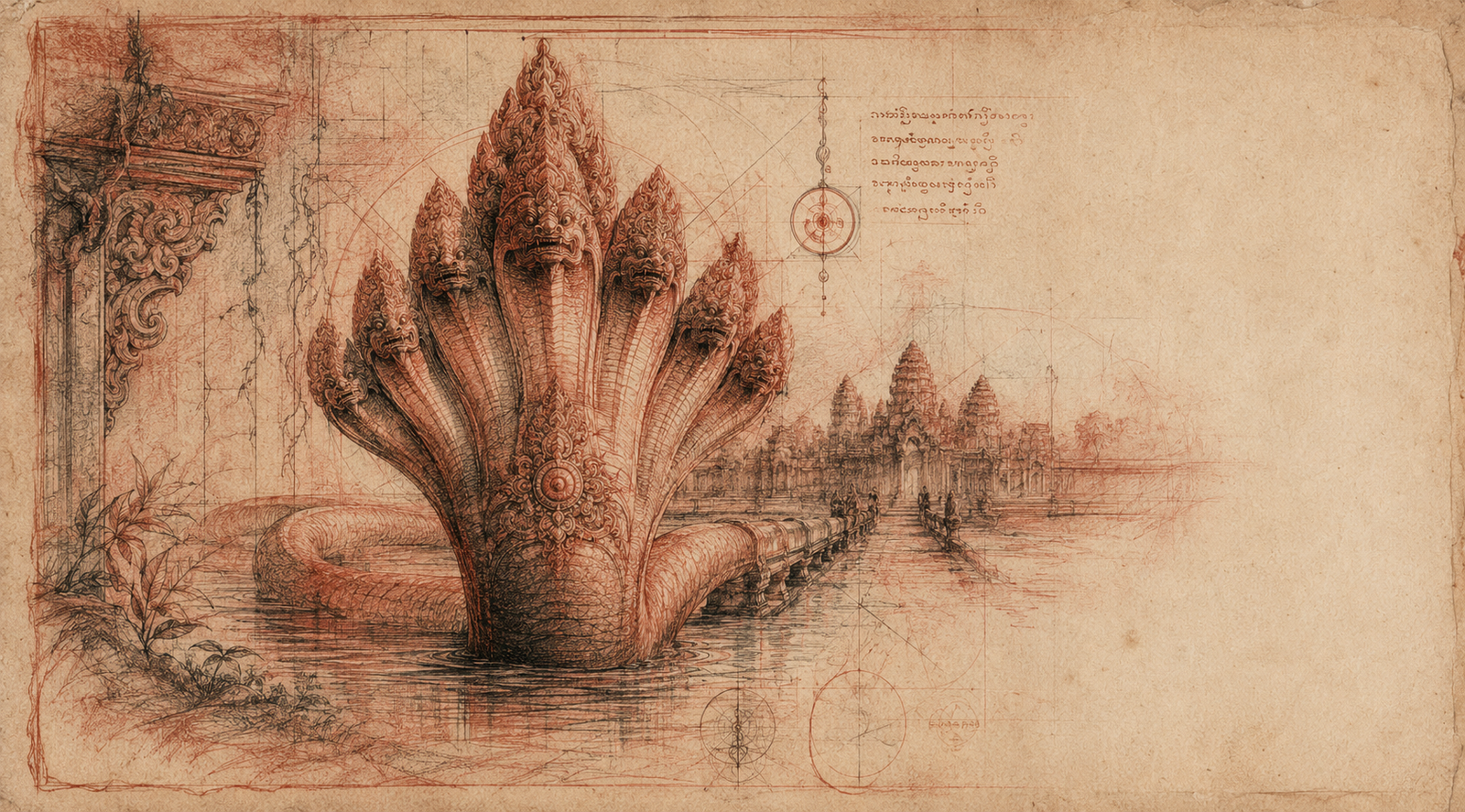
Before the tower, before the sanctuary, before the god in darkness, there is the long body of the Naga drawn out beside the causeway. Its stone coils have become a railing for human hands. Its many heads rise at the threshold, hoods spread, mouths alert, eyes turned toward the one who approaches. The temple may lift itself toward heaven, but the path to it begins with a creature of water.
This is not an accident of decoration.
The Naga is one of the oldest truths Angkor kept in stone.
To walk through the Khmer sacred world attentively is to discover that the serpent is everywhere. It rises from balustrades. It frames pediments. It guards gopuras. It coils beneath Vishnu. It becomes the rope by which gods and demons churn the ocean of immortality. It shelters the Buddha from storm. It lives in marriage songs, foundation legends, royal ritual, village memory, pagoda roofs, and the deep grammar of Cambodian belonging.
The Naga is not simply an image in Khmer art.
It is a way of understanding the world.
Before Cambodia had towers, it had water. Rain, river, lake, moat, canal, floodplain, mist, monsoon: these were not background elements. They were the conditions of life. Water fed rice. Water made kingdoms possible. Water carried danger and blessing together. Too little, and the land withered. Too much, and the land disappeared beneath it. The Khmer world did not think of water as a passive substance. It was alive with power, agency, memory, and demand.
Beneath that water, the old imagination placed a serpent.
The Naga is a semi-divine serpent of the deep places: rivers, lakes, seas, subterranean realms, and hidden paradises below the surface of the visible world. It belongs to the underworld, but not as a creature of damnation. It belongs there as a guardian of sources. It is close to springs, roots, fertility, treasure, jewels, rainfall, and the unseen potency of soil.
The Naga is what the earth keeps beneath itself.
In Khmer art, it is most often a cobra-like serpent with expanded hoods and multiple heads. These heads are usually uneven in number — three, five, seven, nine — so that plurality does not dissolve into confusion. There is always a centre. One head remains sovereign, while the others flare around it like powers gathered into one living sign.
Even its body thinks.
The serpent does not move in a straight line. It curves. It oscillates. It advances by bending. Its S-shaped movement is a visible philosophy of life: flood and withdrawal, danger and blessing, poison and medicine, concealment and revelation, deathly stillness and sudden vitality. The Naga is not one moral thing. It is the force beneath moral simplification.
This is why it could become such a complete symbol of water.
Water gives life and takes it. Water purifies and drowns. Water nourishes fields and erases paths. The Naga carries that doubleness without reducing it. It is fertility, but not softness. Protection, but not harmlessness. Ancestry, but not sentiment. Sacred power, but never domesticated power.
Many traditions say that the Naga bears a jewel in its head. The detail is small, but inexhaustible. It tells us that darkness is not emptiness. The depths are not merely places of fear. Below the visible world, something shines. Pearls, corals, gems, hidden teachings, rain-power, fertility, ancestral force — all belong to the same imaginative field. The world’s treasure is not always above us in the light. Sometimes it is guarded below, in the keeping of the serpent.
At Angkor, this becomes a civilisation’s theology of place.
The Khmer empire was not only a kingdom of temples. It was a kingdom of water intelligence. Its power depended on the management of reservoirs, canals, moats, embankments, monsoon rhythms, and rice fields. To rule was to take part in the ordering of water. Kingship itself had to be imagined in relation to the powers that made the land fertile.
The Naga gave sacred form to that relationship.
In Cambodia’s foundation myth, the land is born through a marriage. An Indian Brahmin prince, Kaundinya — remembered in Khmer tradition as Preah Thong — comes to the Naga realm and marries the serpent princess Soma, or Neang Neak. Their union joins the human and serpent worlds. The Naga king then drinks the waters that cover the land, revealing a kingdom for them to rule.
It is one of the great political myths of Southeast Asia because it does not imagine sovereignty as simple conquest.
The stranger does not merely arrive and possess the land. He must marry its depth. He must enter kinship with the serpent world. The land is not seized; it is revealed after the waters withdraw. The kingdom appears because the hidden power beneath the water consents.
Cambodia is therefore not founded only by a man.
It is founded by a union with the Naga.
That matters profoundly. The serpent is not a decorative emblem added later to Khmer identity. It stands at the beginning of belonging. It is maternal, ancestral, territorial, aquatic, and royal. The people are linked to the land through the serpent bride. The kingdom emerges from a pact between human rule and chthonic fertility.
The Naga is the ancestor beneath the throne.
This ancestral depth did not remain confined to mythic beginnings. It entered the imagination of kingship itself. At the Phimeanakas, the Golden Tower inside Angkor Thom, tradition tells of a nightly royal encounter. The king was required to ascend the tower and meet a nine-headed Naga spirit who appeared in the form of a woman. Their union preserved his sovereignty and the fertility of the realm. If he failed to appear, disaster followed: the king’s death, or ruin for the kingdom.
However we read this tradition — as ritual memory, symbolic drama, political theology, or courtly legend — its meaning is unmistakable.
The king did not possess power by himself.
He had to renew it through the hidden feminine serpent of the land. He had to climb upward in order to meet what came from below. The royal body became the point of contact between palace and underworld, law and fertility, human authority and the old power of water.
A throne, in Cambodia, required a serpent beneath it.
This is one of Angkor’s deepest lessons. Its architecture rises, but its imagination descends. Towers imitate Mount Meru. Sanctuaries draw the mind toward gods. Stairs climb almost violently toward height. Yet everywhere there are moats, pools, serpents, churning oceans, flooded myths, and beings who belong to the deep. Angkor does not allow the sacred to become merely celestial. It insists that heaven is approached only by crossing water.
The Naga balustrades make this truth physical.
A Khmer causeway is not merely a path. It is a passage between worlds. The visitor moves from ordinary ground toward charged space, from the human settlement toward the divine centre, from the visible into the ritually intensified. The Naga lies along that crossing, its body extended as threshold. One does not simply walk to the temple. One walks with the serpent.
At Angkor Thom, this becomes cosmic theatre.
The causeways before the gates are lined with gods and demons pulling on the body of a great Naga. The scene evokes the Churning of the Ocean of Milk, in which divine and anti-divine forces use the serpent Vasuki as a rope around Mount Mandara to churn the cosmic ocean and bring forth amrita, the elixir of immortality.
But at Angkor Thom, the myth is not only illustrated.
It is built.
The moat becomes the ocean. The gate becomes the mountain axis. The gods and demons strain across the bridge. The Naga’s body stretches between opposing powers. The person entering the city passes through a myth already under tension.
This is cosmology turned into passage.
The visitor does not stand before the myth and look at it. The visitor crosses it. Angkor makes the sacred legible not only to the eye, but to the body: through approach, threshold, water, strain, and entry.
Here the upward imagination is quietly corrected. The temple may rise toward heaven, but one reaches it by passing through the deep.
The Naga is not passive. It is the tension by which transformation becomes possible. Gods pull one way. Demons pull the other. The serpent bears the strain. Creation requires opposition held within order. Immortality does not emerge from untouched purity. It rises from the churned depths.
The serpent makes fertility possible because the serpent can bear contradiction.
The city itself depended on the disciplined movement of water. Its prosperity required balance, storage, release, force, timing, and restraint. The Churning was therefore not only a distant Indian myth translated into Khmer stone. It became a vision of the world as Angkor knew it: abundance drawn from depth through tension, rhythm, and sacred engineering.
In Hindu imagination, the Naga appears again and again at the foundations of cosmic life. Ananta, or Shesha, the Endless Serpent, supports Vishnu as he reclines in cosmic sleep between cycles of creation. The god rests upon coils of infinity. The universe begins again from that deep repose. The serpent is not one being among others; it is the support on which preservation dreams.
Vasuki becomes the rope of cosmic churning. In both forms, the serpent is linked to primordial force. It may uphold the divine or enable transformation, but it is never merely decorative. It belongs to the deep machinery of creation.
Buddhism did not erase this old serpent power.
It turned it toward shelter.
One of the most tender images in Buddhist art is Mucalinda, the Naga king who protects the Buddha after enlightenment. As the Buddha sits in meditation, a storm breaks. Rain falls for seven days. Waters rise. Mucalinda coils beneath the awakened one, lifting him above the flood, and spreads his hooded heads above him as a canopy.
The serpent of water becomes protection from water.
The deep power of the earth recognises awakening and serves it.
This is not the destruction of the Naga. It is its conversion into guardianship. The dangerous chthonic force is not denied. It bows. It shelters. It becomes devoted. The old serpent does not vanish before the Dharma. It enters the Buddhist world as protector.
This is why the Naga could move so naturally through Cambodia’s religious transformations. It was large enough to belong to Hinduism and Buddhism without being exhausted by either. Under Vishnu, it could become infinity. In the Churning, it could become the rope of immortality. Beneath the Buddha, it could become sheltering devotion.
The serpent survives because it is older than doctrine.
It belongs to the level at which human beings first encounter the sacred: rain, fear, fertility, underworld, river, ancestor, threshold, storm.
There are Buddhist traditions in which Naga kings attend the Buddha’s birth. There are stories in which profound teachings are entrusted to the Nagas until human beings are ready to receive them. Wisdom is hidden underwater. Doctrine is kept in the serpent realm. Truth waits below history until the world has ripened enough to receive it.
Again the pattern returns.
The depths are not empty.
They are custodians.
To understand the Naga is therefore to understand something essential about Khmer sacred imagination. The world is not divided neatly into nature and religion, animal and deity, myth and architecture, politics and cosmology. These realities pass into one another. A serpent may be a creature, an ancestor, a god, a bridge, a rain-power, a royal consort, a guardian, a balustrade, a cosmic rope, and a Buddhist canopy.
The Naga refuses flatness.
It teaches that reality has levels. What appears as ornament may be theology. What appears as story may be political memory. What appears as architecture may be a ritual crossing. What appears as animal form may be the visible edge of a hidden world.
This is why the Naga remains alive in Cambodia.
Its presence continues in wedding traditions, where the old union of human groom and Naga bride still echoes. It appears in songs, ceremonies, and stories. It is honoured in relation to water, harvest, rainfall, and prosperity. It lives as a spirit of place, a neak ta presence, governing local territories and their wellbeing. It crowns pagoda roofs. It moves along the prows of royal barges. It remains one of Cambodia’s most recognisable national forms.
But its survival is not merely cultural persistence.
It survives because Cambodia still knows water.
The monsoon still arrives as blessing and threat. The Tonle Sap still breathes with seasonal expansion and withdrawal. Rice still depends on the marriage of sky and earth. Villages still live by the rhythms of rain, river, and spirit. The serpent remains credible because the powers it embodies have not vanished.
Modernity may explain water differently, but it has not made water less mysterious.
At Angkor, the Naga gives that mystery a body.
It tells the visitor that the temple is not only a structure of stone. It is an agreement with depth. The sacred is not reached by escaping the world, but by passing more truthfully through it: through water, ancestry, fertility, danger, memory, and the powers beneath human control.
This is the great correction the Naga offers to the upward imagination.
We are tempted to think the sacred is above us. Angkor knows better. Its towers climb, yes. Its sanctuaries rise. Its gods inhabit height. But the path begins below the level of doctrine, below the level of abstraction, below even the level of stone. It begins with water. It begins with the serpent.
The Naga waits at the crossing and asks whether we understand where life comes from.
Not from height alone.
Not from kings alone.
Not from temples alone.
Life comes from the hidden consent of the depths.
The kingdom rises because the waters withdraw.
The tower stands because the earth holds.
The god may be approached because the serpent permits passage.
That is why the Naga remains one of the deepest figures at Angkor. It keeps the temples from becoming merely vertical. It returns grandeur to dependence. It reminds every tower that it has a foundation, every king that he has an ancestor, every field that it needs rain, every religion that it crossed older waters to arrive here.
To enter Angkor is to cross the serpent.
To understand Angkor is to feel that the crossing has never ended.
The Naga still lies beneath the kingdom.
Not dead.
Not past.
Coiled in the dark.
Remembering the rain.
—
Receive the next work
Subscribe free to receive new work from the Lucas Varro Library by email.
More from the Library


See Also
A concise and impartial dictionary of absence, promises, quarrels, ordinary objects, and the troublesome instability of words.

The City of Service
The temple we inherit is a building from which almost all necessity has been removed. Nothing must be brought for it to continue being what we call a temple. The sanctuary asks nothing of us. Stone is good at this kind of independence.
A living temple was otherwise.
Water had to come in. So did grain, cloth, oil, aromatic substances, fuel. The things required for worship arrived because someone carried them across a threshold.

Houses of Wood, Light, and Smoke
Some of Angkor’s most intimate ruins do not rise above the ground at all. They are postholes, low mounds, hearths and ponds: durable traces of a domestic city built largely from things that decay. To restore that city is to see Angkor not only as stone, but as wood, smoke, water, repair, and people living within calling distance.