
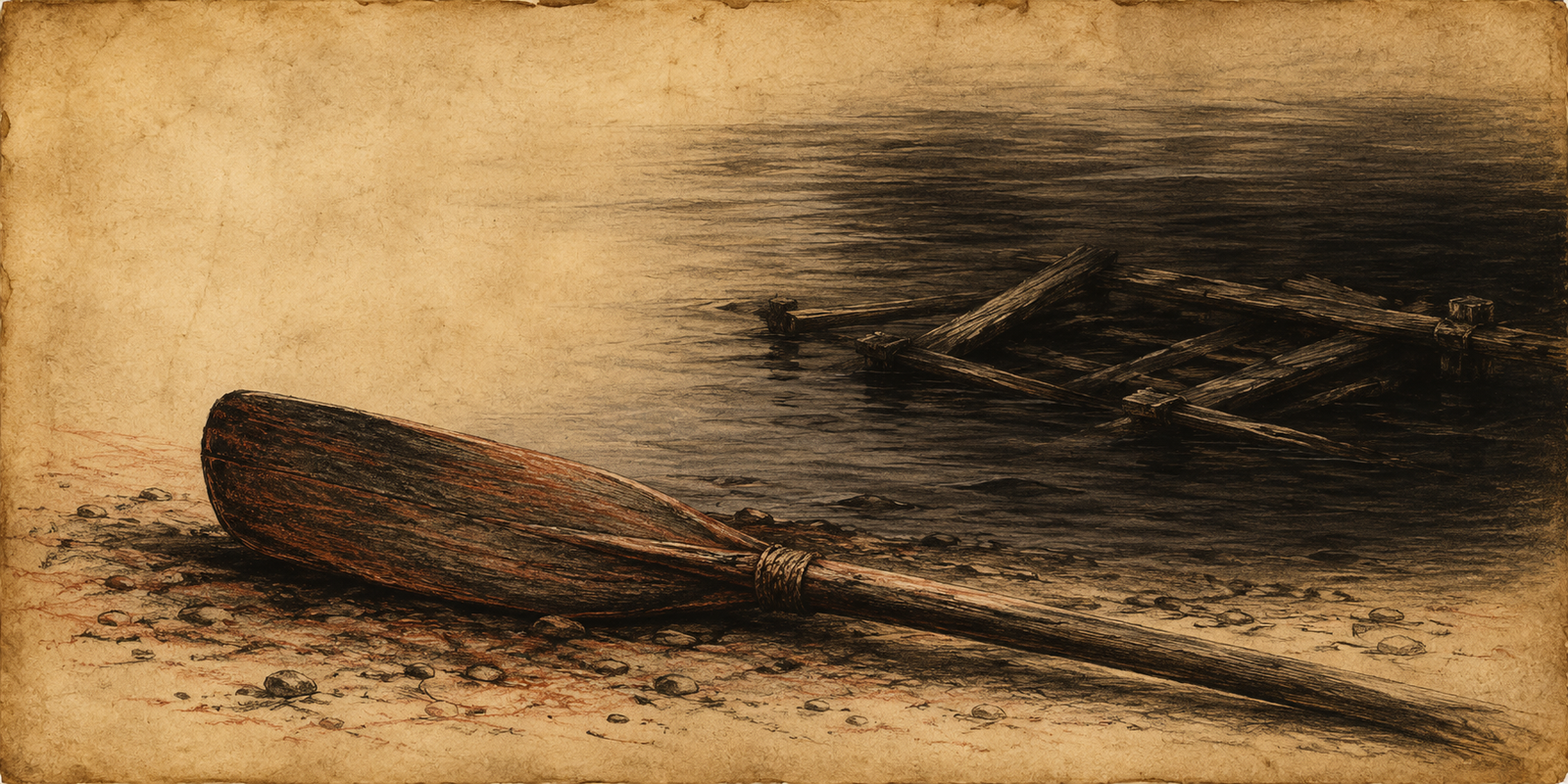

The Long Return V — From the Goddess to the Storm
Homer’s Odyssey retold in clear, grave, story-forward prose.
Each day he went down to the shore and looked at the road that would not hold still.
Behind him, the island stood green and faultless. The trees were heavy with leaves. The air had the softness of a place where winter had never learned the way in. Vines climbed over the mouth of the cave, and the cave itself opened into cool stone and shadow, with a fire kept bright, and tables laid, and a bed where no draught came through the wall. There was food enough. There was wine enough. There was music when the goddess sang, and light on the loom when she wove.
There was, in short, almost everything a tired man might have begged from the gods if he had not known himself better.
Odysseus sat where the grass gave way to sand. He sat with his cloak gathered round him and his hands loose between his knees, and he watched the sea until the watching hurt. Sometimes he spoke aloud, though no man was there to answer him. Sometimes he said nothing from dawn until the shadows lengthened behind him. The gulls cried. The water came forward and withdrew. The horizon remained exactly where it was.
That was the cruelty of it. A road one cannot step onto is worse than a wall. A wall is at least honest.
For seven years Calypso had kept him there.
She had not kept him in chains. That would have been simpler, and the world is rarely kind enough to make its prisons simple. She had kept him with shelter, with beauty, with a god’s patience, and with a love that had no use for time. She had given him a place where no old age waited at the door, where no man insulted him, where no child asked why he had not returned, where no wife had to decide whether grief was faithfulness or merely habit.
She had given him safety.
Odysseus had learned the shape of safety by then.
It was the cave behind him.
It was the fire that never failed.
It was the voice of the goddess calling him from the shore, not in anger, but in sorrow.
It was waking each morning and finding that nothing had changed.
A man may endure danger for a long time. Some men, and Odysseus was certainly one of them, may even begin to think clearly inside it. But changelessness is a different trial. It does not strike. It surrounds. It does not kill the body. It teaches the soul to forget its own edges.
So each day he went down to the shore and looked toward Ithaca.
He could not see it. Of course he could not. Ithaca was too far away, and there were seas between, and storms, and the anger of a god who had not forgiven him. But there are places the eye cannot reach and the mind refuses to release. He saw the hard fields above the harbour. He saw olive trees, narrow paths, goats on stony ground, smoke lifting from roofs in the evening. He saw the hall where men now ate his bread. He saw a woman sitting awake after others slept. He saw a boy who had grown tall in his absence, though when Odysseus had left him he had been small enough to be lifted in one arm.
The boy would not know that arm now.
That thought hurt differently each time it came.
It is possible to long for home and fear it at once. Anyone who says otherwise has never been away long enough.
—
The gods, meanwhile, had not forgotten him. They had merely waited, as gods do, until waiting had become one more thing a mortal must endure.
Poseidon was far away that day, receiving honour among distant people who knew how to set out sacrifices properly and how to praise a god without troubling him with arguments. His absence left a space in Olympus, and Athena stepped into it.
She had waited too.
Not idly. Athena rarely did anything idly. Her waiting was a drawn bow, not an empty hand.
The gods were gathered in their brightness, which is not the same thing as peace. Zeus sat above them with the old care on his brow, the care of one who rules beings who do not like being ruled. Around him were the deathless ones, shining, dangerous, and only partly interested in justice unless justice had first touched something belonging to them.
Athena spoke.
She did not weep. She did not plead as mortals plead. She reminded them.
She reminded them of a king who had honoured the gods, who had ruled with care, who had suffered beyond measure, and who now sat alone on an island in the middle of the sea while a goddess kept him from his house. She reminded them that his son had sailed out into danger to seek news of him. She reminded them, though she did not say it so bluntly, that a house can rot while heaven is deciding when to be merciful.
Zeus listened.
That is no small thing. Many prayers have had less.
“My child,” he said at last, “you know the answer before you ask. This matter is not forgotten. Odysseus shall come home. But Poseidon’s anger is not a small weather. He will suffer yet before the shore receives him.”
Athena did not smile. She had not asked for ease. Ease was not among the tools she trusted.
So Zeus turned to Hermes and gave him the message.
Hermes rose at once. He bound on his sandals, took up his wand, and went down through the air toward the sea.
The water opened below him in long shining folds. Islands passed under his shadow. Fish turned in the deep. He travelled where ships would have been broken and where men would have named every wave an enemy. Hermes did not name the waves anything at all. He crossed them.
At last he came to the island of Calypso.
Even a messenger of the gods paused there.
The place was beautiful in the way a snare may be beautiful when the hand that made it loved the thing it meant to catch. Around the cave grew alder, poplar, and dark cypress. Birds nested in the leaves. Four springs ran clear through the grass, each taking its own path and each sounding as if it had never known drought. Violets and soft parsley flowered in the meadow. The vines over the cave-mouth were heavy and alive.
Within, Calypso was singing at her loom.
Her shuttle moved back and forth, back and forth, carrying bright thread through the cloth. The song was low, not for company. Gods sing often; not always for joy.
She turned when Hermes entered.
A god knows a god.
“Hermes,” she said, and set aside the shuttle. “You are welcome, though you have not come here before. Tell me what brings you. Whatever is within my power, if it can be done, I will do it.”
This was well said. Hospitality matters even among gods, though they sometimes remember it chiefly when another god is watching.
She gave him a chair. She brought ambrosia and set nectar before him. Hermes ate and drank, and only then delivered the grief he had carried so lightly over the sea.
“Zeus commands you to send Odysseus away.”
The cave changed. Not visibly. The fire burned. The springs outside continued their bright argument with the stones. The loom stood where it had stood. But a room can darken without losing light.
Calypso’s face was still.
“So,” she said. “The gods have remembered him.”
Hermes did not answer. There are moments when a messenger does well to let the message take the blame.
“You are hard,” Calypso said, and now she was not speaking only to Hermes. She was speaking through him, past him, to all those bright dwellers above who could not bear to see a goddess keep what she loved. “You gods are always hard when a goddess loves a mortal. Dawn loved Orion, and you were not content. Demeter knew grief, and you made the earth answer for it. But when the male gods take mortal women to themselves, no one comes down from Olympus with a command.”
“I did not make the command,” Hermes said.
“No,” said Calypso. “You only bring it.”
“What does Zeus say?”
“He says Odysseus must leave. He will not go with gods. He will not go with a ship sent by men. You are to give him tools and help him make his own way. He will suffer on the sea and come at last to the people who must receive him. From there, if fate keeps its word, he will reach Ithaca.”
“If fate keeps its word,” Calypso repeated.
Even gods notice where that little word is placed beside mortal hope.
Hermes rose. He had said what he came to say.
“He wants to go,” he said, not unkindly.
Calypso looked toward the light beyond the cave.
“I know.”
That was the worst of it.
—
Odysseus was at the shore when she found him.
He had not heard Hermes arrive. He did not know that heaven had spoken over him again. He only knew the usual ache of the afternoon, the water flashing too brightly to look at for long, the salt wind moving his hair, the terrible patience required of a man who has no ship and no sail and no companion left to tell him whether hope has become foolish.
Calypso stood behind him for a while before speaking.
“You unhappy man,” she said at last.
He turned.
There was no anger in her voice. That made him wary at once.
“You need not sit here grieving any longer,” Calypso said. “I will send you away.”
He stood slowly.
“You will send me away.”
“Yes.”
“To Ithaca.”
“To the sea first. The sea lies between you and everything you name.”
He watched her face. There were very few faces he could not read at all, and hers was one of them. A goddess may show grief honestly and still be hiding a hundred other things behind it.
“Lady,” he said, carefully, “this is a strange kindness. Yesterday there was no ship. Today there is freedom. I have learned to mistrust sudden mercy.”
Calypso’s mouth tightened. “You think I am setting a trap.”
“I think I am a man among gods.”
That was both answer and apology.
For a moment neither spoke. Then Calypso lifted her hand toward the sky and swore the great oath no deathless one may break: that she meant him no hidden harm, that she had no plan beneath her words, that she would help him leave as one mortal might help another if pity still had any authority in the world.
Odysseus listened. He believed the oath. He did not entirely relax.
This was sensible.
“Come,” she said. “You cannot build a raft by staring at the water.”
He almost smiled then. Almost.
They walked back together from the shore.
At the cave she set food before him. Mortal food for him, divine food for herself. The distinction had always been there, but that evening it seemed to stand between them like a third guest.
He ate because a man must eat before hard work, and because he had long ago learned that grief is not an argument against bread.
Calypso watched him.
“If you knew what waits for you,” she said, “you would stay.”
Odysseus kept his eyes on the bread in his hands.
“I know some of what waits.”
“You know less than you think. There is more sea. There is more loss. There are men in your house who do not fear your name. There is a wife who has been alone for twenty years. There is a son who has had to grow without you. There is an island that may not know how to receive you. Stay here, and none of that can touch you.”
He said nothing.
“I would make you deathless,” she said. Her voice had changed. It was not command now. It was almost pleading, and that made it harder to bear. “You would not grow old. Your strength would not leave you. No spear would take you. No fever. No sea. No bitterness of age. You would remain.”
Remain.
A small word. A heavy one.
Odysseus looked at her then.
She was beautiful. Of course she was beautiful. Beauty in a goddess is not an achievement; it is the weather of what she is. Light seemed to know where she stood. Her hair held something of the deep earth and something of the sun on leaves. No mortal woman could be compared to her without the comparison becoming foolish at once.
Calypso knew this. She saw him know it.
“Do not tell me your wife is my equal in beauty,” she said. “I am not so easily flattered.”
“No,” Odysseus said. “She is mortal.”
The word did not come out as apology.
Calypso’s eyes sharpened.
“She will age.”
“Yes.”
“She may no longer look as you remember.”
“No one does.”
“She cannot give you what I offer.”
“No.”
“Then why?”
Odysseus looked away from the fire and toward the darkening mouth of the cave.
“Because she can die,” he said. “Because I can. Because there is a house where time has been at work without me, and a son whose voice I do not know, and a bed I made with my own hands. Because if I stay here, nothing will happen to me.”
He stopped.
The fire gave a small sound in the hearth.
“And that is not the same as living,” he said.
Calypso did not move.
“That is a hard answer.”
“It is the only one I have.”
“You would rather suffer.”
“I would rather go home.”
“Those may be the same thing.”
“I know.”
And he did know. Not fully — no one knows the cost of the next shore until it has been reached — but enough.
Calypso turned away first.
“Then tomorrow,” she said, “we begin.”
—
At dawn she brought him an axe.
It was a fine tool, double-edged, with a handle set well into the head. She brought also an adze, ropes, cloth for a sail, and augers for boring timber. She showed him where the trees grew straightest. Her face was calm. That was a mercy, though it cost her something to give it.
Odysseus took the axe in his hands.
The weight of it nearly undid him.
Not because it was too heavy. Because it was a thing to do.
After years of being held in a life arranged by another, the plain weight of a tool can feel like the return of one’s own name. He turned it once in his grip and felt his body remember the old grammar of work: measure, cut, lift, bind, test. Before kingship, before counsel, before war and stratagem, there is the hand knowing whether wood will hold.
He began.
The first tree fell with a crack that ran through the grove and startled birds up from the leaves. Odysseus stood over it breathing hard, not from the labour only, but from the shock of action. The tree had stood. Now it lay down. The world could still be changed.
All day he worked. He cut trees and trimmed them, shaped beams, bored holes, drove pegs, fitted planks, and bound the frame. Calypso watched for a while, then left him, then returned with water. She did not hover. She did not instruct him where he knew better. She knew many things, but he knew wood and sea and the miserable requirements of survival.
For four days the shore rang with labour.
Chips of pale wood scattered on the ground. Rope roughened his palms. Sweat dried on him and returned. At night he slept heavily and without dreams, and this too was a gift. A man who has spent years sitting beside the sea may be saved first by weariness.
On the fifth day the raft stood ready.
No one would have mistaken it for a ship. It had no proud curve, no painted eyes, no rows of oars, no companions to pull together and curse together and sing when fear required noise. It was a made thing, temporary and stubborn. A platform against drowning. A little argument with the sea.
Odysseus looked at it for a long time.
Calypso stood beside him.
“It is not beautiful,” she said.
“No,” he answered.
“Will it hold?”
“For a while.”
She looked at him then. “That is enough for you?”
He almost smiled again. “It has often had to be.”
She gave him bread, wine, water in skins, and clothing against the wind. She gave him a cloak, and he took it with gratitude, though both of them knew gratitude was not the same as staying. She showed him the stars by which he must steer. She spoke of currents and winds. She told him where danger leaned. She did all this clearly. If she was sending him away, she would send him well.
At the last, when there was nothing left to delay with instruction, they stood together at the water’s edge.
The sea moved quietly against the raft.
Calypso touched the timber once, as if to test the reality of the thing that was taking him from her.
“I could have made you deathless,” she said.
“I know.”
“You will remember that when you are cold.”
“Yes.”
“And when you are old.”
“If the gods permit me to be old.”
“And when she has angered you, as mortal wives do. When your son disappoints you, as mortal sons do. When your house proves smaller than longing made it. When your island is poor and stony and full of trouble. You will remember.”
Odysseus looked out at the water.
“Yes,” he said. “I will remember.”
This was not the answer she wanted. It was, however, the truer one. He would remember. He would remember the island, and the cave, and the offer. He would remember the goddess who loved him and let him go because a higher god commanded it, and perhaps also because love without release had begun to rot in her own hands.
Calypso stepped back.
“Go then,” she said.
He pushed the raft into the shallows.
The water took it.
He climbed aboard, set the sail, and felt the wind open in the cloth.
For a moment the raft hesitated, as if it too understood the size of the sea before it. Then it moved.
Calypso stood on the shore until the man was no longer a man to the eye, but a dark mark between water and light.
Then even that was gone.
—
For seventeen days he sailed.
The world became water, sky, wind, and the small labour required not to die. He slept when he could, which was little. He watched the stars. He kept the Bear to his left as Calypso had taught him. He ate sparingly. He spoke to the raft when the lashings creaked, because a man alone at sea will speak to anything that has not yet failed him.
The sea was not always cruel.
There were mornings when the water lifted him gently. There were evenings when the horizon burned low and clear, and the wind held steady as if it had been hired honestly for the day’s work. Flying fish broke silver out of the surface. Once a bird rested briefly on the edge of the raft and looked at him with the rude confidence of a creature that can leave whenever it wishes.
Odysseus laughed then, once.
It surprised him.
The sound went out over the water and vanished.
On one day the wind failed almost entirely. The sail hung loose. The raft moved only because the sea had not decided to stop moving beneath it. Odysseus sat with the steering oar across his knees and felt the sun work through his skin. There is a special cruelty in still water when a man is trying to return. Storm at least declares itself. Calm asks him to endure without giving him anything to resist.
He drank less that day. He shaded his eyes with one hand and watched the empty rim of the world. Toward evening he thought he saw land, but it was only cloud lying low in the west. He did not curse it. He had learned not to waste curses on things that could not hear.
Still, with each day, hope became more dangerous. The nearer a man comes to what he has longed for, the more there is to lose. On the eighteenth day he saw land.
At first he did not trust it.
Cloud can lie. Light can shape distance into mercy and withdraw it again. But the dark line remained. It rose. It gathered itself. It became hills, then forest, then the clear fact of a shore.
Odysseus gripped the steering oar until his hand hurt.
Land.
Not Ithaca. He knew that. His heart knew the shape of Ithaca too well to be fooled. But land meant people. People meant fire, questions, bread, danger, welcome perhaps, a name perhaps, the next road.
He had forgotten, for one breath, that Poseidon had not.
The sea-god was returning then from the distant feast where he had been honoured well. He came over the water with his old anger unsoftened. Gods do not always tire of anger as mortals do. Mortals must carry anger in bodies that grow hungry, sleepy, and sore; gods may keep it bright for years.
Poseidon saw the raft.
He saw the man upon it.
He saw, beyond him, the land he was nearly permitted to reach.
“So,” Poseidon said. “While I was away, the others have been kind.”
The sea heard him.
The wind shifted first.
Odysseus felt it before he understood it. The sail snapped. The raft lurched. The line of land shuddered through rain beginning to gather where, a moment before, the air had been clear.
He looked up.
Clouds were coming from more than one direction. The sail shuddered before the wind fully struck it. The water changed colour under him.
He lowered the sail as fast as he could. The rope burned through his hands. The mast groaned. A wave struck the raft from the side and spun it half round. Another came over the front and broke across his chest. The water was cold enough to make breath an argument.
“Not now,” he said.
The wind rose.
The sea lifted under him and dropped away. The raft climbed one wall of water and fell into the hollow behind it. Rain drove hard against his face. The land disappeared. The sky disappeared. There was only grey force and the dark back of the next wave.
Odysseus had been afraid before. At Troy, in the night raids, under spears, beside burning ships, in councils where a wrong word could kill men by the hundred. He had known fear as a commander knows it: something to be folded small and put behind the next decision.
This was different.
The sea did not care what he decided.
He tied himself as best he could. He bailed with a wooden bowl until the bowl was struck out of his hand. He tried to keep the raft’s head to the waves. For a while skill mattered. For a little while, and no more. Then a great wave came down with the whole weight of Poseidon’s memory behind it.
The raft broke.
Not all at once. That would have been kinder. One binding failed, then another. A plank tore loose and vanished. The mast twisted. The sail snapped and dragged in the water. Odysseus threw himself toward the largest remaining beam and clung to it as the thing he had made with four days of hope came apart beneath him.
A wave took him under.
The world became force, salt, dark, and the sound of his own body trying not to open itself to water. He came up choking. Another wave struck before he could clear his eyes. The cloak Calypso had given him dragged heavily at his shoulders. He tore himself free of what he could and clung to the beam.
Then, out of the storm, something spoke.
It was not the voice of Poseidon. Poseidon’s anger was everywhere; it had no need to speak.
This voice was near.
“Poor man,” it said, “why does the earth-shaker hate you so?”
Odysseus turned his head.
A woman rose from the water.
Not as mortal women rise, fighting weight and cold, but as a seabird lifts from foam. Her hair was wet and bright. Her eyes held the old distance of those who belong to more than one world.
“I am Ino,” she said. “Take this veil. Bind it beneath your chest. Leave the timber. Swim. When you reach land, throw the veil back into the sea and turn your face away.”
She held it out.
Odysseus did not take it.
Not at once.
A man half-drowned in a storm sent by one god has reason to be careful when another shining being offers cloth and advice.
Ino understood, or perhaps she did not care to argue. She cast the veil toward him. It fell across the water and did not sink.
Then she vanished beneath the wave.
Odysseus clung to the beam and thought.
If he left the timber too soon, the waves might break him. If he trusted the timber too long, it might drag him down. If the veil was a trap, he was lost. If it was mercy and he refused it, he was also lost.
For a while he stayed with the beam.
Poseidon, seeing him not yet finished, drove one more great wave toward him. It struck the broken timber and scattered it. The beam rolled. Odysseus lost his hold, found it again, lost it once more, and then there was no raft, no mast, no work of his hands left to argue with the sea.
He took the veil.
He bound it beneath his chest.
He let the timber go.
That, too, was a kind of courage.
For two days and two nights he swam.
Not always forward. No swimmer in such water moves as he intends. Sometimes he was carried. Sometimes he fought. Sometimes he floated because fighting would have spent the last strength he had. Athena steadied the worst of the winds, though she did not make the sea gentle. Divine favour is not comfort. It is sometimes only the narrow space in which destruction does not quite close.
On the third day the wind fell.
The sea, exhausted by its own anger, began to loosen.
Then Odysseus saw land again.
This time it was close enough to show trees, rocks, the white break of water against shore. His heart rose so violently that it almost betrayed him. For joy can be dangerous too. Men have drowned in sight of land because hope made them foolish.
He swam toward it.
The shore was not kind.
Great rocks stood where the waves broke. Water threw itself against them and burst upward in white force. There was no harbour, no soft beach, no hand reaching out. Odysseus saw what would happen if he let the sea carry him straight in. He would be lifted, flung, and broken against stone.
He turned along the coast, though every limb in him protested.
Now he prayed.
Not to Zeus high above, nor to Athena, nor to the god who hated him. He prayed to the river he saw cutting through the land, its mouth opening into the sea.
“Lord of this water,” he said, though his mouth was cracked with salt and the words came poorly, “receive me. I have come far enough through death. I am a suppliant to you. Pity is not wasted on a man with no strength left.”
The river heard.
The current slackened. The water at the mouth grew calmer. The waves seemed to pause in their assault, not from love, perhaps, but from recognition. A river knows what it is to travel toward home without being allowed to remain where it began.
Odysseus entered the river.
Fresh water closed around him.
There are mercies so simple that they seem too small until the body receives them. No song was sung. No god appeared in brightness. No feast was laid. Only the salt began to leave his skin, and the terrible lift and drop of the sea gave way to the steadier pull of inland water.
He crawled out among the reeds.
For a while he could do nothing else.
His body lay half in the shallows and half on mud. His hands, which had gripped spear, oar, sword, rope, timber, and the edge of death more times than a man should be asked to remember, opened at last. His face was against the earth.
Earth.
He had almost forgotten its smell.
When breath had returned enough for obedience, he unbound the veil. He turned his face away and cast it back into the water. The river bore it out, and somewhere beyond the breakers Ino received her own again.
Then Odysseus rose.
Or rather, he attempted to rise, which in that hour was nearly the same thing. He staggered through the reeds and into the trees. Night was coming. He did not know whose land this was. He did not know whether the people here were just or cruel, whether they honoured guests or killed strangers, whether their dogs would scent him, whether their young men would mock him, whether their king knew the law of the gods.
He knew only that he could not remain in the open.
He found a place where two bushes grew close together, their branches interwoven, one wild olive and one thorn. Beneath them the ground was dry enough. He gathered leaves with the last care left in him, pulling them over himself until they covered his body from the wind.
Under the leaves, no one would have known him for a king.
He lay there in the dark, salt-stiff, bruised by wave and rock, emptied of tools, raft, cloak, and almost hope. Behind him the sea continued speaking in its sleep. Before him, somewhere beyond the trees, a household he had not yet entered was going about its evening. Fires were being covered. Girls were folding cloth. Bread was being put away. A queen perhaps sat in thought. A king perhaps lifted a cup. No one there knew that a naked, nameless man had come ashore at the edge of their world.
Athena poured sleep over his eyes.
Not victory. Not arrival. Not recognition.
Sleep.
For that night, sleep was enough.
—
Receive the next work
Subscribe free to receive new work from the The Hospitable Dark Library by email.
More from the Library

See Also
A concise and impartial dictionary of absence, promises, quarrels, ordinary objects, and the troublesome instability of words.

The City of Service
The temple we inherit is a building from which almost all necessity has been removed. Nothing must be brought for it to continue being what we call a temple. The sanctuary asks nothing of us. Stone is good at this kind of independence.
A living temple was otherwise.
Water had to come in. So did grain, cloth, oil, aromatic substances, fuel. The things required for worship arrived because someone carried them across a threshold.

Houses of Wood, Light, and Smoke
Some of Angkor’s most intimate ruins do not rise above the ground at all. They are postholes, low mounds, hearths and ponds: durable traces of a domestic city built largely from things that decay. To restore that city is to see Angkor not only as stone, but as wood, smoke, water, repair, and people living within calling distance.