

The Spark and the Weight of Being Human
We like to think of self-awareness as a gift. And it is. A creature that can say “I” does not merely feel hunger, fear, pleasure, or pain. It knows that it is the one who feels them. It can remember itself, anticipate itself, judge itself. Somewhere in the long prehistory of our species, life crossed a threshold strange enough to seem almost mythical: a being arose that could turn inward and find itself there.
That changed everything.
It gave us language, memory shaped into story, plans stretched across seasons and generations, moral reflection, ritual, science, law, confession, prayer, theatre, burial, prophecy. It made possible not merely experience, but experience gathered into a self.
And yet the same power that raised us also unsettled us.
For self-awareness does not only illuminate. It exposes. It places the mind before itself. It makes us both actor and witness, creature and commentator. A deer may startle. A wolf may suffer injury. But a human being can suffer, then think about suffering, then fear its return, then ask what it means, then wonder whether the suffering reveals weakness, failure, punishment, injustice, or fate. The hurt does not remain an event. It gathers echo.
This is one of the central facts of human life: we do not merely live. We also live with ourselves.
That is why self-awareness cannot be understood as a simple improvement, as though evolution merely fitted a brighter lamp inside the animal mind. It altered the whole interior climate. Once consciousness folds back upon itself, experience thickens. It gains depth, tension, recursion. Pain becomes more than pain. It becomes memory, anticipation, interpretation. The body burns; the mind can watch the fire.
From this come many of our highest achievements. Also many of our torments.
The first burden of self-awareness is ignorance.
Not ignorance itself. Any animal may not know. Our difficulty is stranger: we know that we do not know. We are aware of the edges of our understanding, and often of how narrow it is. The child asking why the stars are there, the philosopher asking what can be known, the physicist staring into equations that explain one layer while opening ten more — all belong to the same lineage. Human beings are compelled towards understanding. Once the inward light is lit, it begins to search.
This hunger has made us formidable. We have learned to split the atom, map the genome, predict eclipses, model the birth of stars, send instruments into the dark between worlds. We have torn open matter and found pattern in it. We have looked at life closely enough to read something of its script.
Yet knowledge has not given us rest. It has made our ignorance more articulate.
The old hope was that, if we kept learning, reality would at last become transparent. But the horizon retreats. Each solved problem opens further depths. We know more than our ancestors could have imagined, yet the unknown has not shrunk into a manageable remnant. In some ways it has grown larger, because we can see it better. We know enough to understand how much escapes us.
This is not an accidental frustration. It belongs to the structure of self-aware life. A reflective being does not simply meet mystery from the outside. It carries mystery within its own method. It thinks by means of a mind that cannot fully stand outside itself. The eye sees much, but not itself directly.
The second burden is control.
To become self-aware is to imagine alternatives. Once a being can compare what is with what might be, it grows restless. It does not merely adapt. It begins to revise. It seeks leverage over circumstance. It wants shelter against winter, remedies against disease, laws against chaos, tools against frailty, methods against confusion. Much that is admirable in human civilisation begins here: in the refusal to leave life entirely at the mercy of accident.
And yet again the power carries its own wound.
We can alter much, but never enough. We can lengthen life, not cancel death. We can tame certain forces, not contingency itself. We can impose order for a time, but not abolish disorder from the world or from our own depths. Even the self that seeks control is unstable terrain. Our motives are mixed. Our resolutions weaken. Our conduct is shaped by impulses we notice too late or disguise from ourselves. We can govern ourselves, but only imperfectly, and often after the fact.
We are clever enough to build systems, foolish enough to be trapped by them, and opaque enough to misread our own reasons for building them.
So the human being stands in a peculiar place: powerful without being sovereign, reflective without being transparent, capable of mastery yet never master enough.
Then comes the deepest burden of all: mortality.
Animals die. We know this. Human beings do something further. We die in advance.
We carry the fact of death not only in the body but in the imagination. We can foresee our own absence. We can picture the world continuing without us. We can feel the odd chill of knowing that all our efforts — our loves, grievances, ambitions, convictions, works of hand and mind — are undertaken under a sentence no intelligence has yet overturned.
This changes everything it touches.
It changes ambition, because ambition becomes entangled with the wish to leave a mark. It changes love, because tenderness is sharpened by fragility. It changes fear, because many fears are only smaller shadows cast by the larger one. It changes culture itself, because human beings do not live only as organisms. We live symbolically. We have names, roles, loyalties, stories, values, inheritances, imagined futures. A human life does not feel like a mere biological episode. It feels like a claim.
That is where much human grandeur and absurdity arise together. We are mortal creatures who cannot quite bear to live as though mortality were the whole truth. So we reach for continuity — through children, monuments, reputation, tribe, nation, faith, achievement, memory, God, art, or history. We want not only to live, but to count.
This is often mocked as vanity. Some of it is vanity. But some of it is more dignified than that. It is the symbolic self resisting reduction. It is the refusal to believe that consciousness, love, and moral struggle can be adequately described as a brief rearrangement of atoms before dispersal. Whether or not one believes in immortality, one can understand the protest.
Modern life has made that protest harder to place.
Older civilisations usually embedded human life within a larger order. Whether that order was divine, cosmic, ancestral, karmic, or mythic, it gave suffering and death a frame. One could be small without being meaningless. One could be finite without being accidental in the deepest sense.
The modern world has weakened many of those shelters. Science has given us enormous truth, but not consolation as such. It explains mechanism brilliantly; it does not, by its own method, tell us what anything is for. The universe it reveals is vast, ancient, and magnificently indifferent to our preferences. It does not flatter us. It offers no obvious guarantee that human longing corresponds to any final design.
For some people, this becomes a reason for despair. If the cosmos does not care, they conclude, then nothing really matters.
But that conclusion is too quick, and perhaps a little childish. It assumes that meaning must be handed down from above, stamped upon reality from the outside, or else it is unreal. Yet much of what matters most in human life has never existed in that way. Justice is not a mountain. Fidelity is not a molecule. Betrayal has no colour. A promise weighs nothing. And yet these are among the heaviest things in the world.
Meaning is not unreal because it is not material. It belongs to another order of reality: the order opened by consciousness, relation, valuation, memory, and care. It does not lie about in nature like a mineral waiting to be extracted. It appears where a reflective being meets life and answers it.
That answer can be noble or base. It can be false, sentimental, evasive, cruel, lucid, creative, reverent. But it is never nothing.
This, to me, is the hidden splendour inside the burden of self-awareness. The same inwardness that allows despair also allows transfiguration. A being without self-awareness can be hurt. A being with self-awareness can make of hurt a lament, a warning, a philosophy, a tenderness, a discipline, a song.
Not always. Not automatically. Often not at all.
But possibly.
That possibility matters.
It is why art matters. Art does not abolish death. It does not close the gap between what we long for and what the world permits. It does something more subtle and, in its way, more miraculous: it gives form to what would otherwise remain mute inside us. It takes fear, grief, awe, estrangement, longing, and makes them shareable without thinning them into mere explanation. A poem does not solve mortality. It lets mortality speak in a human voice. A painting does not defeat loss. It arrests a gesture against the dark.
And love matters for a similar reason. Perhaps an even deeper one. For self-awareness does not only reveal the self to itself. At its height, it reveals that others, too, are centres of inwardness. Other people are not scenery. They are not merely functions in our drama. They are worlds. To realise this fully is already a moral event. Much cruelty depends on refusing that realisation. Much goodness begins in accepting it.
This is why self-awareness is not only the source of existential anxiety. It is also the root of conscience.
A creature that cannot step back from its own impulse cannot properly ask whether it ought to act otherwise. A creature that cannot imagine another’s pain as pain cannot really enter the moral field. Conscience is inwardness under judgement. Responsibility is self-awareness made answerable. Guilt, remorse, forgiveness, integrity — none of these are possible without a self that can turn towards itself and be measured.
Of course this, too, is painful. Conscience wounds. Shame burns. Reflection accuses. But without that pain we would lose not only a tormentor, but a guide.
Perhaps this is the truth we resist. We often speak as though the goal were to preserve the powers of self-awareness while removing all their cost. We want depth without anguish, attachment without grief, ambition without failure, lucidity without dread, love without loss. We want the summit without the climb, the flame without the heat.
But the structure of the thing does not allow it.
The very powers that open the heights open the abyss. The mind that can know beauty can also know its passing. The mind that can imagine justice can also perceive injustice in unbearable detail. The mind that can love another person as irreplaceable must also live under the knowledge that the irreplaceable can be lost.
There is no surgery by which we remove the wound and keep the vision.
So the deepest question is not whether self-awareness is a blessing or a curse. It is both. The deeper question is how to bear it well.
Not grandly. Not theatrically. Well.
To bear it well may mean first abandoning certain childish demands: the demand to be certain before one commits; the demand to be in control before one acts; the demand to be guaranteed significance before one gives oneself fully to a life. These demands are understandable. They are also impossible. A mature human being is not one who has solved uncertainty, but one who has ceased making certainty the price of seriousness.
What remains then?
Humility, for one thing: not self-abasement, but a clear sense of proportion before reality. Discipline of attention, because a self-aware mind can become a hall of distortions unless it learns where to rest its gaze. Companionship, because isolation magnifies the burden of consciousness until every private fear begins to sound like revelation. Courage, certainly — but not the loud kind. More often the quiet kind: the decision to continue loving, making, thinking, serving, and telling the truth without any final guarantee that one’s efforts will be vindicated.
This is not resignation. Resignation says that because nothing is secure, nothing is worth much. The wiser response says almost the opposite: because nothing is secure, things become precious.
The cup is breakable. Therefore handle it with care.
The evening ends. Therefore attend to it.
The person will die. Therefore love them properly.
You will vanish. Therefore speak truth while you can.
Seen in this light, finitude is not merely the thief of meaning. It is also one of its makers. A world in which nothing could be lost would be a world in which little needed cherishing. We honour things partly because they do not stay. We become answerable partly because time does not wait. Mortality is bitter. But it is also what presses human life into form.
Perhaps that is why the most admirable lives are rarely those that have escaped the human condition. They are the ones that have consented to it without collapse. Not blindly. Not cheerfully at every hour. But steadfastly. They have looked at ignorance without surrendering inquiry, looked at limitation without surrendering effort, looked at mortality without surrendering tenderness.
That, finally, may be the true dignity of self-awareness.
Not that it makes us invulnerable.
Not that it gives us mastery.
Not that it explains everything.
But that it allows a fragile creature to know its fragility, and still make something luminous within it.
If there was once a first spark — some forgotten inward turning by which a human being became present to itself — then its greatest consequence was not simply knowledge or power. It was this more difficult inheritance: that we became beings for whom existence is not merely lived, but borne; not merely endured, but interpreted; not merely suffered, but sometimes shaped into grace.
That is the burden.
And perhaps the beauty too.
Not that we escape the dark.
That we learn, briefly, to carry a little fire through it.
For more essays on how to live, think, and remain human in an uncertain world, subscribe to The Living Way on Substack and receive new pieces by email.
Also in Library


What the World Remembers
July moved through walls, bodies, songs, scars, cups, pages and stones—ordinary and mythic things that remember what human beings forget. Across Angkor, the Odyssey, Tolkien, Vedic creation, Greek war and quiet domestic rooms, the Library returned to one governing question: when memory fails, what in the world continues to know us?

The Story on the Wall
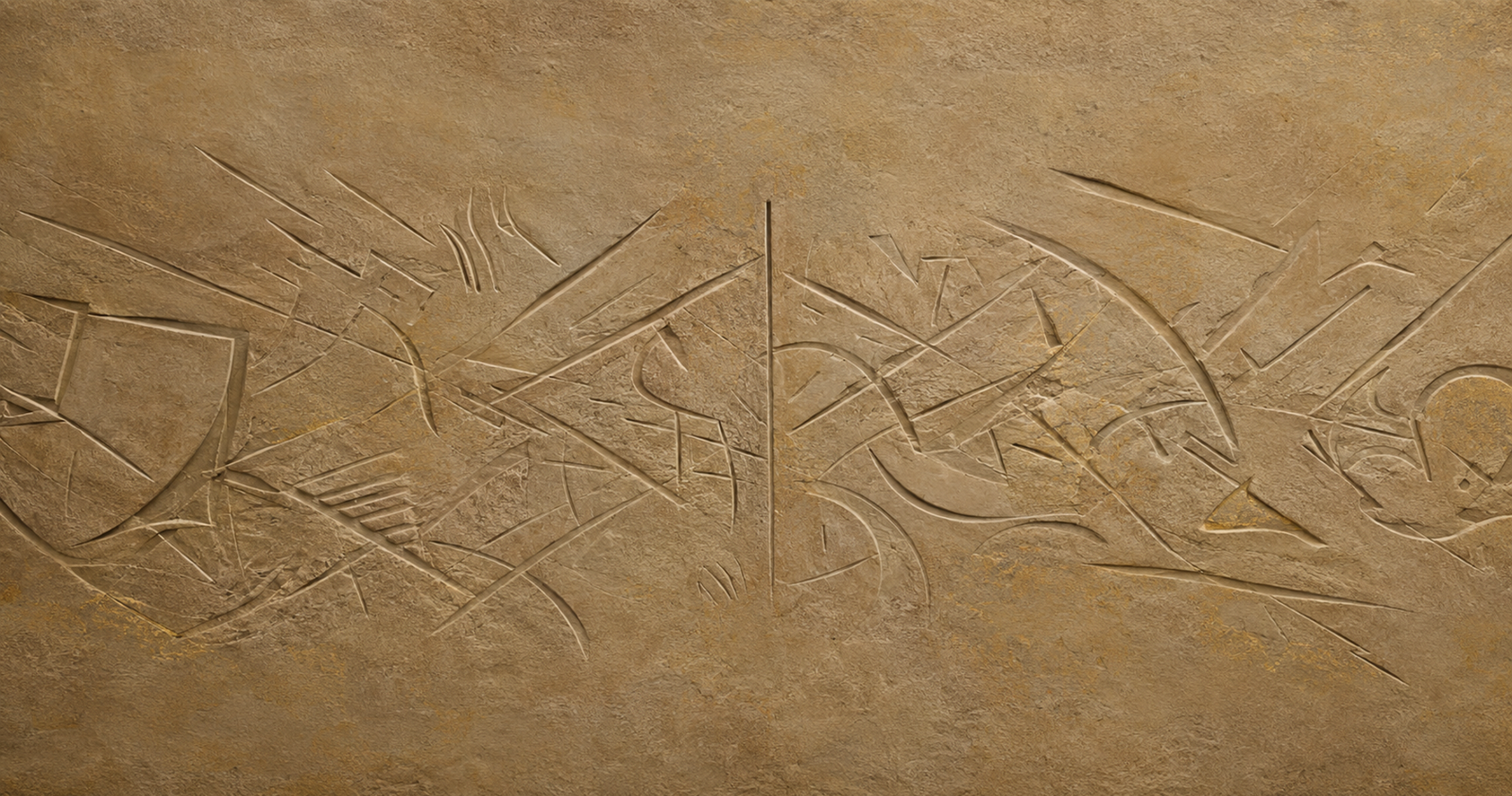
At Angkor Wat, more than fifty metres of carved sandstone hold the Battle of Lanka. Rama is present, but he must be found. This Prologue to The Story That Became Cambodia begins with the monumental certainty of the wall—and asks what the finished image cannot reveal about the Ramayana’s earlier journey into Khmer history.

The Mouth You Gave Me
A spare lyric poem from The Vow on breath, speech, gratitude, and the received body through which every answer must be formed and released.
Continue Reading
If this piece found something in you, you may wish to continue the journey elsewhere.
On The Lantern Chronicles, I gather writings from Angkor, myth and legend, contemplative essays, and poetry — works shaped by silence, beauty, wonder, memory, and the deeper questions that follow us through the world.
It is a place for stone and story, reflection and vow, shadow and revelation.
You would be most welcome there.