

The Pact of the Uncounted Grain
The Pact of the Uncounted Grain
In the years when the paddies still held the sky without breaking it, there was a village at the edge of the low water where each household kept its rice in clay-bellied jars beneath the house, cool in shadow, lifted from damp and rat and flood. The jars were never alike. Some were squat and broad, some narrow-necked, some patched with lime where a crack had once begun. Yet all were handled with the same grave care, because rice was not merely food. It was weather made white. It was time made edible. It was the patient body of the year.
In that village there lived a widow called Mae Sorn. Her husband had gone into the fever season three floods before and not come back from it. She had one son, still small enough to sleep with one hand folded beneath his cheek, and an old mother whose eyes had grown cloudy while her hearing remained sharp enough to catch a lizard moving on the wall.
Mae Sorn was not poor in the way strangers name poverty. Her house still stood. Her roof did not yet leak. There was rice in the jars. But loss had entered her hands before it entered her face. She tied the mouths of sacks tightly. She swept fallen grains from the floor and put them back in the pot. When she measured rice for the evening meal, she levelled the cup with the side of her finger so that nothing rose above the rim. If a neighbour came to borrow, she gave, but remembered afterwards how much.
At first no one judged her for it. Grief often teaches the hands to close.
That year the rains had come well. The seedlings took. The flooded fields held their green as though the earth had remembered its first promise. When harvest came, it came heavily. The stalks bent. The threshing yards sounded from dawn to dusk with wood on grain, with laughter, with the dry rush of husk rising from kernel. Dust shone in the late light like a finer harvest lifting above the first.
When the work was done and the rice brought in, the old women began reminding the village of the uncounted grain.
It was not much to look at. No drums. No lanterns hung in the trees. No special dishes prepared days in advance. On one evening after harvest, each household chose one sack and poured from it without measuring. Rice was given where it was needed, but not by tally. Bowls were filled for whoever came. Seed was shared where the next season looked uncertain. A widow might leave a basket by another widow’s steps. A man with strong sons might send grain to a house with none. A traveller passing through might be fed before his name was asked.
The point was not generosity made visible. The point was that, once each year, rice must move through the village without number.
“What is not counted does not vanish,” the old women said. “It learns the way between hands.”
Mae Sorn had heard this all her life. As a girl she had watched her mother plunge both arms into a sack and lift rice as though drawing water. As a bride she had laughed to see her husband carry a basket to his brother’s house without first checking what remained at home. In those days the gesture had seemed ordinary. Now it seemed careless.
Her old mother, sitting by the ladder in the evening dimness, said, “Tomorrow you must choose your sack.”
Mae Sorn was sorting rice on a tray, turning out bits of husk one by one. “We are not like other households this year.”
“No house is like another.”
“We have enough,” Mae Sorn said, “if nothing goes wrong.”
Her mother turned her clouded eyes towards the jars. “Nothing goes wrong only in stories told by fools.”
Mae Sorn said nothing. She kept sorting until the tray was clean.
The next day the village kept the pact. From one house rose the smell of rice steamed with pumpkin. From another came broth thickened with broken grain. Children carried leaf packets across the paths. Men who all year could remember a debt as sharply as a thorn now carried baskets without witness. An old man with no teeth was fed ginger congee. A woman in labour was sent enough rice for many days. Two brothers who had not spoken since planting season found themselves eating from the same bowl in their sister’s house, because she had called both and neither wished to shame her by refusing.
Only Mae Sorn did not open a sack.
She cooked as she always did. She fed her son, her mother, and herself. When a neighbour’s daughter arrived at dusk with a bowl in her hands and festival-confidence on her face, Mae Sorn filled it with one careful cup, level to the rim, as on any ordinary evening.
The girl thanked her and went away.
Her old mother said nothing. But later, when the lamps were out and the night insects had taken up their patient grinding in the dark, she spoke into the room.
“You gave as though someone were watching.”
“Someone is always watching.”
“Yes,” said the old woman. “But not always the same someone.”
After that, nothing dramatic occurred. No storm fell out of season. No jar cracked in the night. No sickness entered the house. The rice remained rice. It cooked. It filled the belly. The year did not announce offence.
And yet, by the cold months, something in the village had thinned.
People began to ask more questions before helping.
How much do you need?
For how many days?
Will you return the same measure after market?
Who else have you asked?
These were not hard questions. They were sensible. That was their danger.
Children sent with bowls were told to wait while quantities were discussed above their heads. Guests were welcomed, but with that quick glance which measures appetite before hunger is answered. Seed was lent with more witness than before. A man who had once given freely from an open basket now tied his sack shut between scoops, as though talk itself might spill it.
No one had turned cruel. They still shared. They still visited the sick. They still sent rice when death came to a household and the mourners had no strength to cook. But everything now arrived with a little explanation attached to it, and explanation leaves a thin taste when it sits too long beside need.
Even language altered. People spoke more often of fairness, of shortage, of management, of making things last. They were words fit for use. Yet under them something quieter retreated.
One evening, toward the end of the dry season, a travelling singer came along the raised path from the west. He wore his hair bound in a cloth dark with road dust, and he carried no instrument save two polished sticks, which he struck lightly together when he wished to gather listening around him. At dusk he was invited beneath the tamarind tree and given a place on a woven mat.
He sang three songs. One was of a prince who mistook praise for love. One told of a crocodile that remembered a promise longer than a monk. The third was so old that no one listening could say whether it was history, weather, or warning.
When he had finished, the village fed him. Each house sent something. Fish paste. Greens. A little salt. Rice.
The bowls were set before him one by one.
The singer looked at them for a long while.
Then he said, not unkindly, “Who among you has grown afraid of abundance?”
The villagers laughed, because the harvest had been good, and the question seemed foolish.
“No one,” they said.
But he shook his head. “Once I was fed in this village by a widow who had less than any three households together, and she put rice in my bowl as though the field itself were reaching through her hands. Tonight I am fed by careful people.”
The laughter thinned.
An elder said, “Care is no sin.”
“No,” said the singer. “But there is a kind of care that teaches grain to fear leaving the sack.”
This annoyed them. A younger man asked if travellers always praised generosity most loudly in other people’s houses. A woman said songs made a loose mouth seem wise. Someone muttered that a man who owned nothing found abundance everywhere.
The singer bowed his head as though accepting a just rebuke. Then he ate. Yet the air under the tamarind tree never quite settled again, because all who sat there had heard something they did not wish to carry home and could not wholly leave behind.
Mae Sorn, listening from the edge of the light, felt her face grow warm.
After the singer departed, the village went on. The ponds fell lower. The paths hardened. Men patched fences. Women mended mats. Seed was set aside. Life did not fail.
It merely took more explaining than before.
Where once a gift crossed a threshold with only the words here, take this, now came a chain of reasons. Where once help moved quickly, now it paused to account for itself. Even gratitude lengthened, as though simple thanks no longer trusted itself to bear the whole weight of what had passed between people.
One afternoon Mae Sorn’s son came to her holding a small basket.
“Can I take rice to Vanna’s house?” he asked. “His father cut his foot.”
“How much?” she said.
The boy shrugged. “Enough.”
“There is no such measure.”
He looked at her, puzzled rather than hurt. “There was before.”
From the shadow by the wall, her old mother opened one eye, then closed it again.
That night Mae Sorn could not sleep. She rose, lit a lamp, and climbed down from the house. The yard lay pale under a late moon. Frogs clicked in the ditch. Beyond the trees the paddies were flat and dark, holding the broken stars in their shallow water.
She stood before the jars.
What came to her then did not arrive as revelation. It came as shame, though even that word is too loud for it. It was smaller, nearer the bone. She saw that she had feared hunger so much that she had taught her hands to mistrust release. And because hands learn quickly, others had learned from hers. Not by command. By shape.
The pact had not been broken with noise. No one had declared it ended. The village had merely allowed measure to enter the one place where, for a single evening each year, measure was meant to stop at the threshold.
Mae Sorn stood there a long while, her lamp low in her hand, listening to the frogs and the far shifting of water in the ditches.
In the morning she said nothing to anyone.
She chose the fullest sack in the house and dragged it, straining, to the open ground beneath the tamarind tree. Her son followed behind her. Her old mother came last, leaning on a stick. People looked up from sweeping, washing, splitting wood, sorting greens.
At the foot of the tree Mae Sorn took a knife and cut the tie.
Then she overturned the sack.
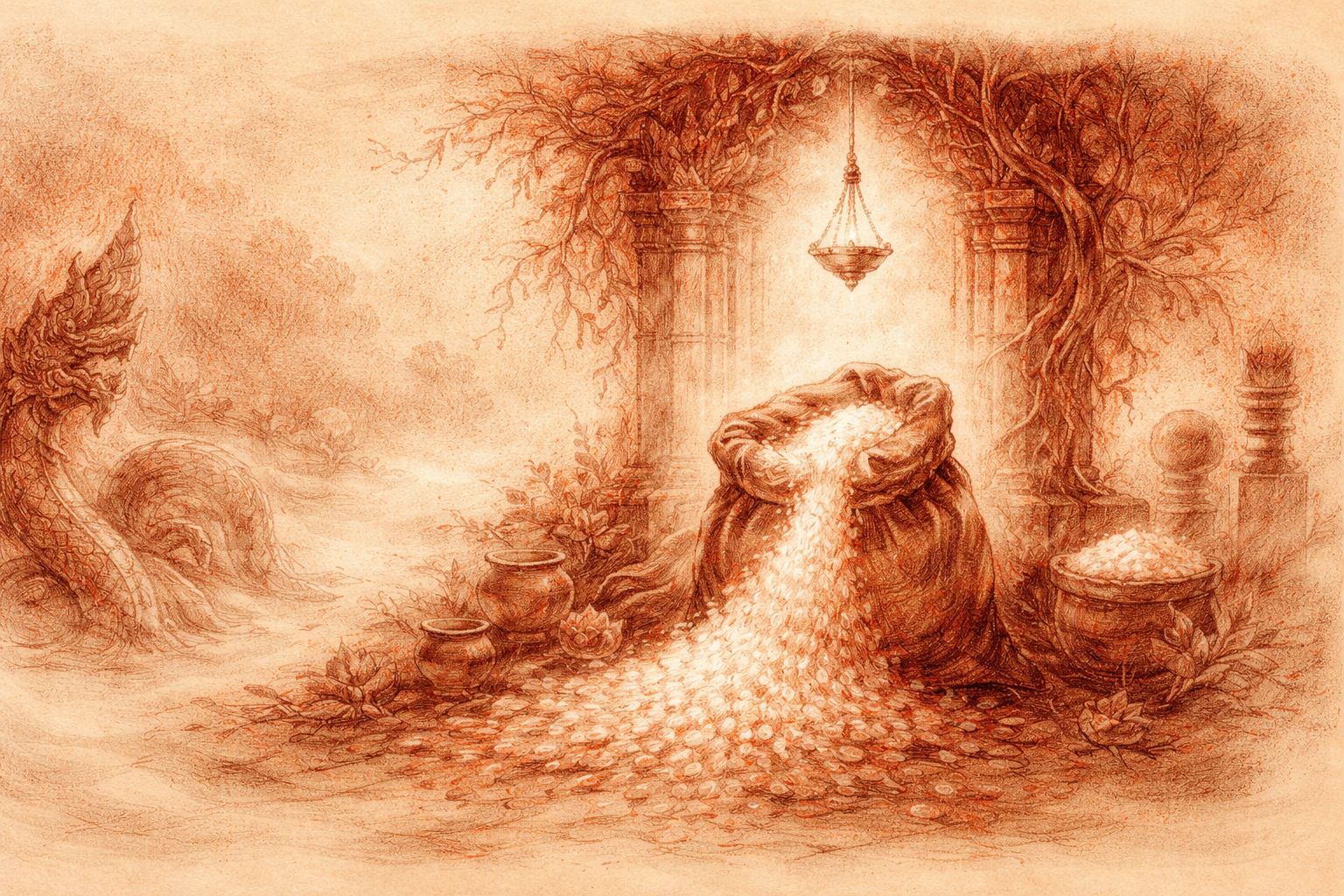
Rice poured out in a white rushing heap, bright as bone, bright as moonwater, bright as the inside of a promise suddenly opened. It struck the mat below with a soft, continuous roar.
People came from their houses.
No one spoke.
Mae Sorn knelt beside the heap and put both hands into it up to the wrists. When she lifted them, the grains slid between her fingers in bright streams.
“For whoever needs,” she said.
The silence that followed was not embarrassment. It was recognition.
Her old mother moved first. She did not take rice for herself. She filled a bowl and placed it in the hands of a child from the farthest house. Then another woman came. Then a man. Then another widow. Before midday someone had brought a second sack. Before the sun leaned west, rice was moving again from hand to hand, bowl to basket, basket to cloth, cloth to pot, without tally, witness, or instruction.
A stranger on the road was fed and asked his name only afterwards. Seed was set aside for a household whose field had taken too much water. A basket was sent to the house of the man with the cut foot. Children were allowed to carry what they spilled. No one scolded them.
No song was sung. No rite was spoken.
Yet by evening the air in the village felt altered. Faces had loosened around the eyes. Speech shortened back into trust. When thanks were given, they no longer carried the strain of settlement. Even the dogs sleeping beneath the houses seemed less watchful, as if the dust itself had ceased to hold tension.
When planting time returned, the seedlings took strongly. Whether because of rain, timing, soil, or grace, no one could say. The people were not fools. They knew the field answers to many things. But they also knew that the year had become readable again.
After that, the pact of the uncounted grain was kept more carefully than before, though never ceremonially. That was not its way. Each harvest, one evening was left open against arithmetic. Rice passed from household to household without number. It was cooked for mourners, sent to the sick, given for seed, carried by children, set before strangers, left at doors without witness.
And the old women taught its meaning plainly enough that no one would mistake it for luck.
“If you count everything,” they said, “you will still eat. But the village will begin to speak in a thinner voice.”
So the people remembered.
Not perfectly. Nothing human is kept perfectly. Some years the bowls were smaller. Some years fear returned at the edges of the season and had to be gently shamed away. Yet the form endured, and because the form endured, the way between hands remained open.
That is why there are places where the jars are full and still the meal tastes poor; where the stores are ample and yet no one feels held by them. The rice is there. The labour was real. The harvest came in.
But somewhere, once, a people forgot to let one portion of abundance pass through the world uncounted.
And the land, hearing only measure, grew a little harder to read.
—
Receive the next work
Subscribe free to receive new work from the Lucas Varro Library by email.
More from the Library

See Also
A concise and impartial dictionary of absence, promises, quarrels, ordinary objects, and the troublesome instability of words.

The City of Service
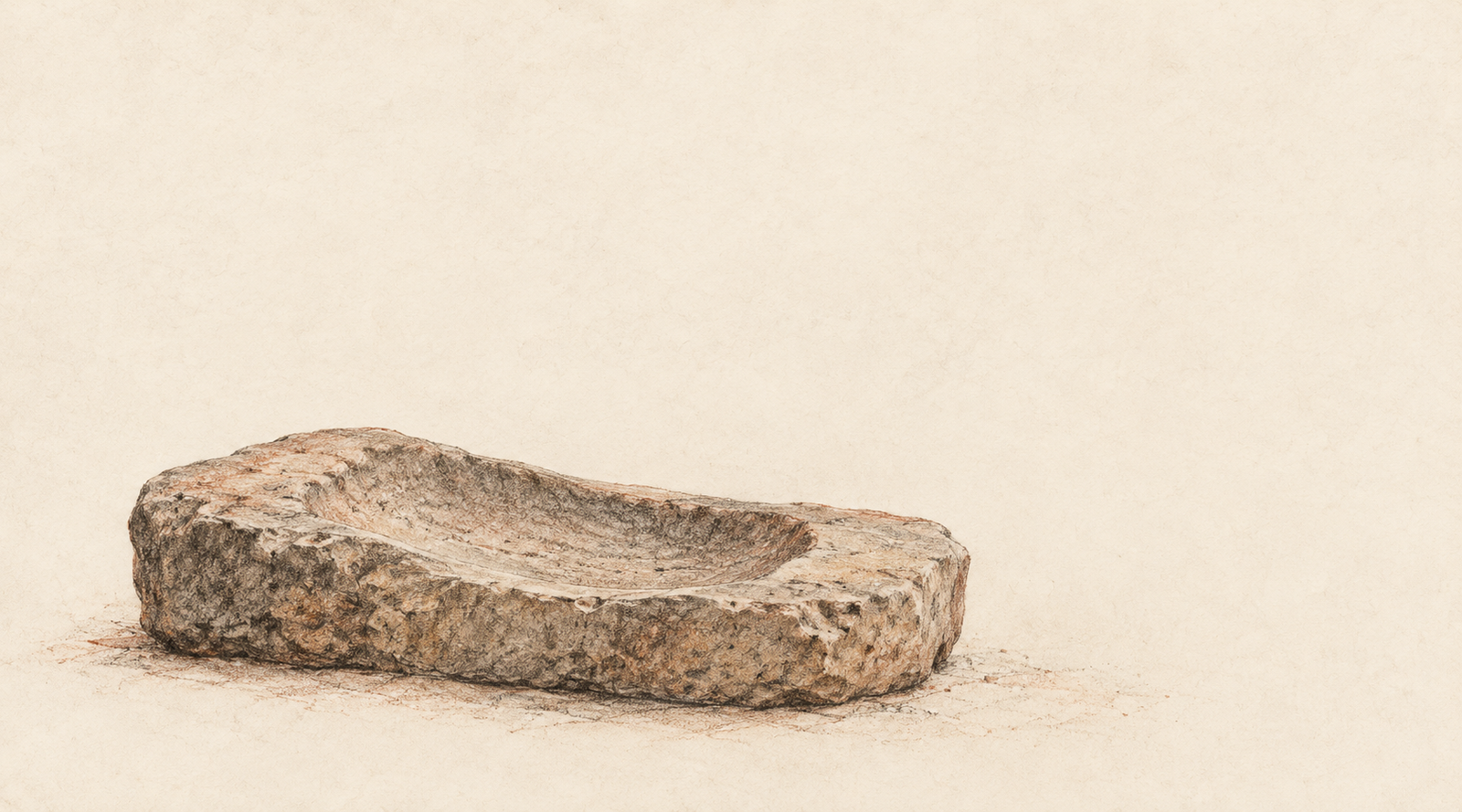
The temple we inherit is a building from which almost all necessity has been removed. Nothing must be brought for it to continue being what we call a temple. The sanctuary asks nothing of us. Stone is good at this kind of independence.
A living temple was otherwise.
Water had to come in. So did grain, cloth, oil, aromatic substances, fuel. The things required for worship arrived because someone carried them across a threshold.

Houses of Wood, Light, and Smoke
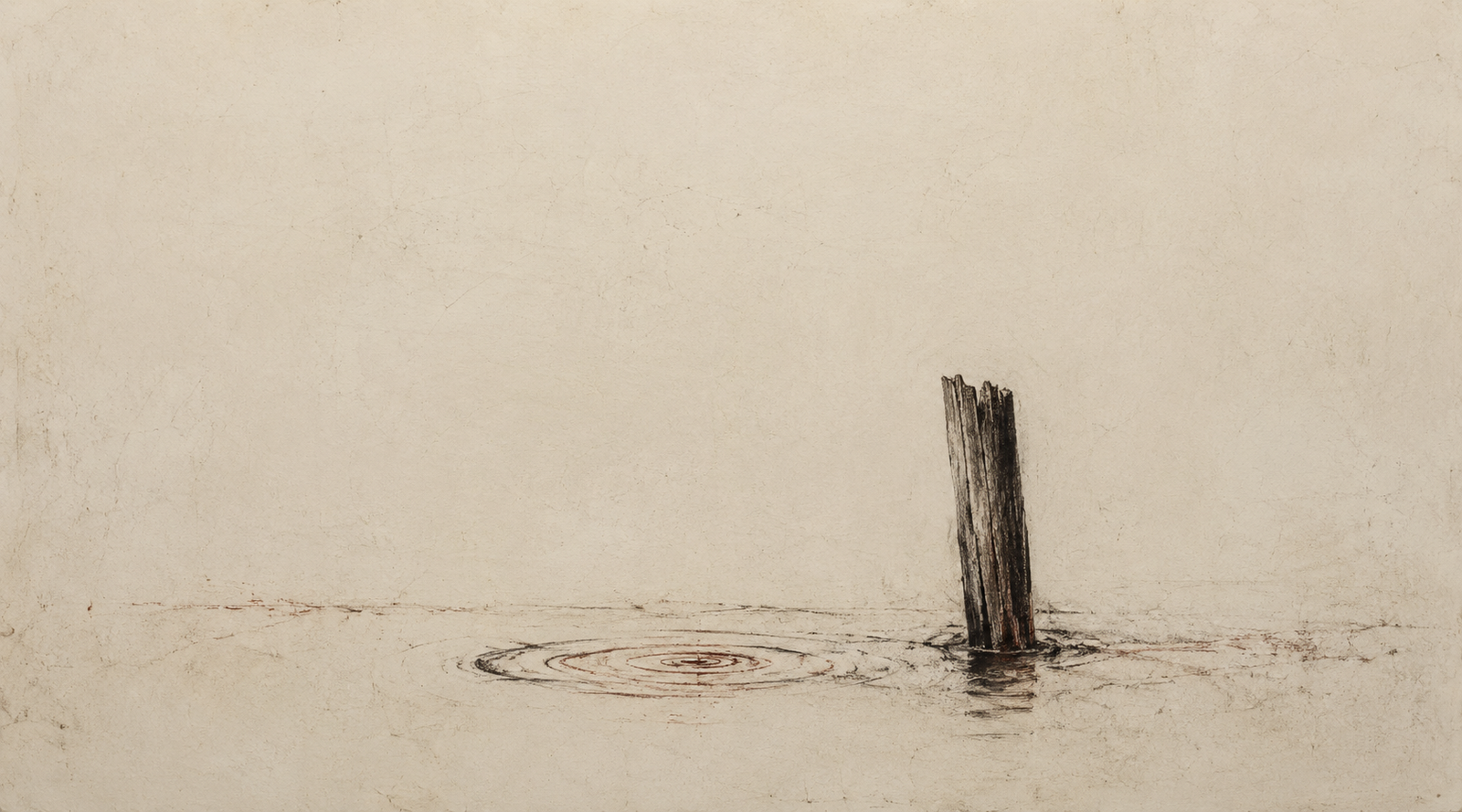
Some of Angkor’s most intimate ruins do not rise above the ground at all. They are postholes, low mounds, hearths and ponds: durable traces of a domestic city built largely from things that decay. To restore that city is to see Angkor not only as stone, but as wood, smoke, water, repair, and people living within calling distance.