

On Writing Angkor
There are two ways to leave a temple.
One is with photographs.
The other is with words.
A photograph preserves a moment. Writing reconstructs it. By the time the writer begins, the experience has already slipped into memory. The temple is no longer surrounding the body. It must be summoned again through language.
This is where the difficulty begins.
Seeing happens all at once.
A gallery at Angkor is never a single thing. Light moves across the carvings while shadow gathers in the corners. The air carries the faint smell of damp stone. Footsteps echo briefly beneath the ceiling and fade. A devata face looks outward from the wall. Somewhere outside, leaves shift in the wind.
All of this arrives together.
The mind does not experience the temple in sentences. Perception gathers the whole field at once, as the eye moves, the body turns, attention drifts and returns.
But writing cannot work this way.
A sentence must choose where to begin.
If the writer begins with the carving, the light becomes secondary. If the light comes first, the architecture recedes. If the corridor appears before the devata, the figure emerges from the space around her; if the devata appears first, the corridor becomes her setting.
Each sentence imposes an order the experience never had.
The temple does not unfold in this way.
Writing therefore alters what it attempts to describe. To translate perception into language is already to simplify it. The writer selects, arranges, and omits. Silence becomes description. Atmosphere becomes interpretation.
Something is always lost in this passage from stone to sentence.
Yet something is gained as well.
Seeing is immediate, but fleeting. The temple impresses itself upon the senses and then begins to dissolve into memory. Writing slows this process. It allows the experience to unfold again, more deliberately, through reflection.
What the eye grasped in an instant, language examines patiently.
This is why writing about Angkor so often feels inadequate and necessary at the same time.
The temple does not need explanation. It stands complete in its own presence. But the pilgrim who leaves the temple carries something away—an impression, a stirring of thought, a question that lingers long after the galleries have faded from view.
Writing begins there.
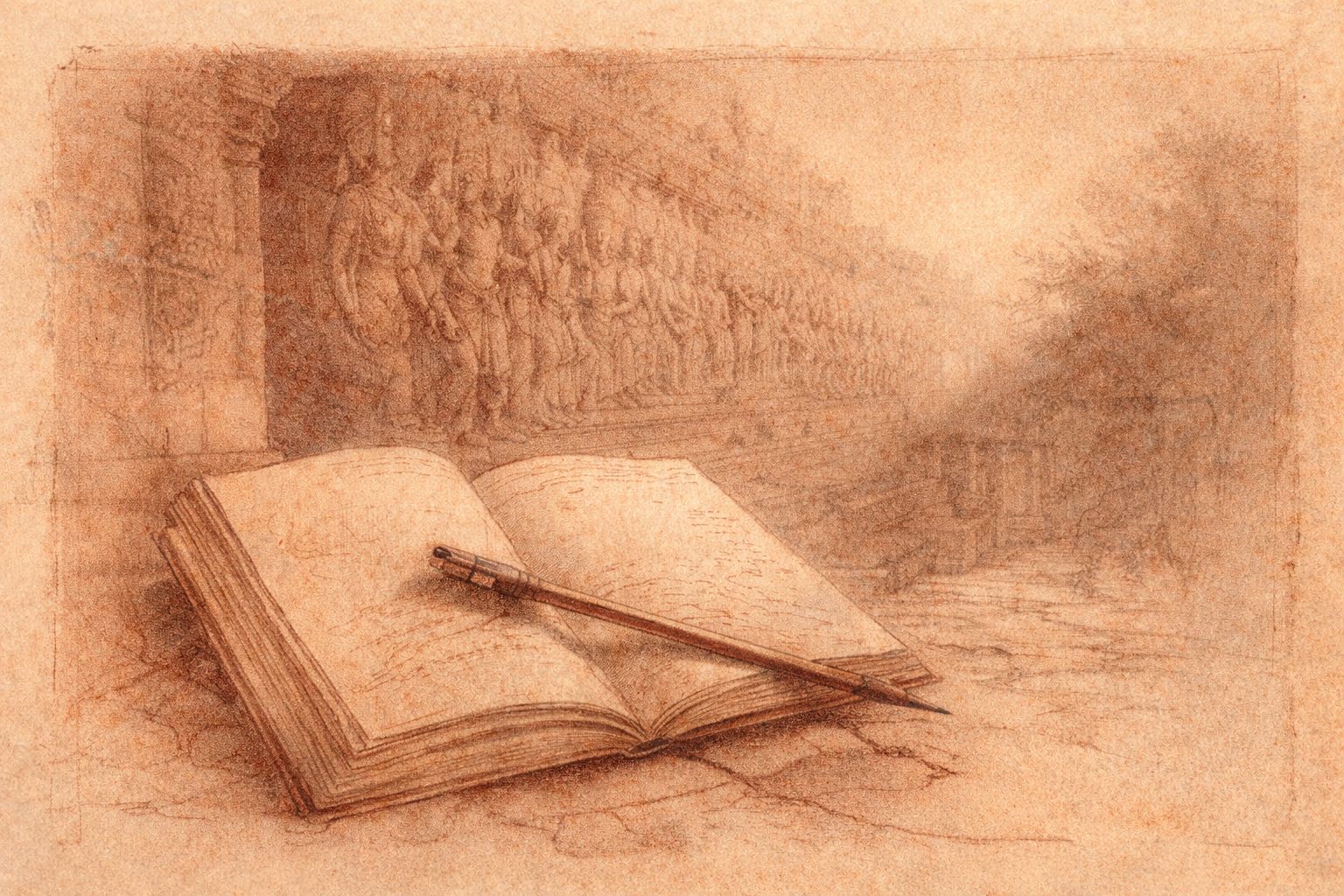
I once sat for a long time beside a bas-relief, studying a line of figures moving across the wall. The carving had softened with age. The sandstone held the warmth of the afternoon sun. Light drifted slowly across the surface, touching one face, then another.
The longer I remained there, the more the scene seemed to deepen. The figures were not merely decorative forms but gestures suspended across centuries—hands lifted, bodies turning, expressions almost visible in the worn stone.
Later that evening I attempted to describe what I had seen.
The sentences were accurate. They named the figures, the stone, the changing light.
But something essential had disappeared in the act of writing.
The stillness had vanished.
The slow duration of the moment—ten minutes of quiet attention—had collapsed into a few lines of description. What the temple had communicated wordlessly now seemed strangely reduced.
The temple had spoken clearly.
The sentence could only approximate.
Experiences like this reveal the peculiar position of the writer. Language cannot reproduce the temple as it is encountered. It can only circle around the experience, offering fragments of perception, gestures toward atmosphere, traces of what once stood vividly before the eye.
The writer learns to accept this limitation.
The purpose of writing about Angkor is not to capture the temple completely. Such a task would be impossible. The temple exceeds language in scale, in silence, in time.
Instead, writing becomes a form of guidance.
A good sentence does not attempt to replace the temple. It prepares the reader to encounter it. Words open a space in the imagination where attention can gather again.
In this way writing resembles pilgrimage itself.
The pilgrim does not arrive at the temple all at once. The journey unfolds step by step: the long causeway, the first gate, the shadowed galleries, the slow approach toward the inner courts.
Writing follows a similar path.
Sentence by sentence, the reader moves inward—not into the stone itself, but into the act of noticing that the temple once awakened.
If the essay succeeds, the reader does not feel that Angkor has been explained.
Something quieter happens.
An image begins to form. The mind grows still. Curiosity replaces certainty.
And gradually the reader senses a place waiting somewhere beyond the page.
They imagine the long causeway stretching across water.
They picture the first shadowed gate.
And almost without realising it, they find themselves walking toward it.
—
Receive the next work
Subscribe free to receive new work from the Lucas Varro Library by email.
More from the Library


See Also
A concise and impartial dictionary of absence, promises, quarrels, ordinary objects, and the troublesome instability of words.

The City of Service
The temple we inherit is a building from which almost all necessity has been removed. Nothing must be brought for it to continue being what we call a temple. The sanctuary asks nothing of us. Stone is good at this kind of independence.
A living temple was otherwise.
Water had to come in. So did grain, cloth, oil, aromatic substances, fuel. The things required for worship arrived because someone carried them across a threshold.

Houses of Wood, Light, and Smoke
Some of Angkor’s most intimate ruins do not rise above the ground at all. They are postholes, low mounds, hearths and ponds: durable traces of a domestic city built largely from things that decay. To restore that city is to see Angkor not only as stone, but as wood, smoke, water, repair, and people living within calling distance.