Complimentary worldwide shipping on orders over $400 · No import tariffs for most countries

4 min read
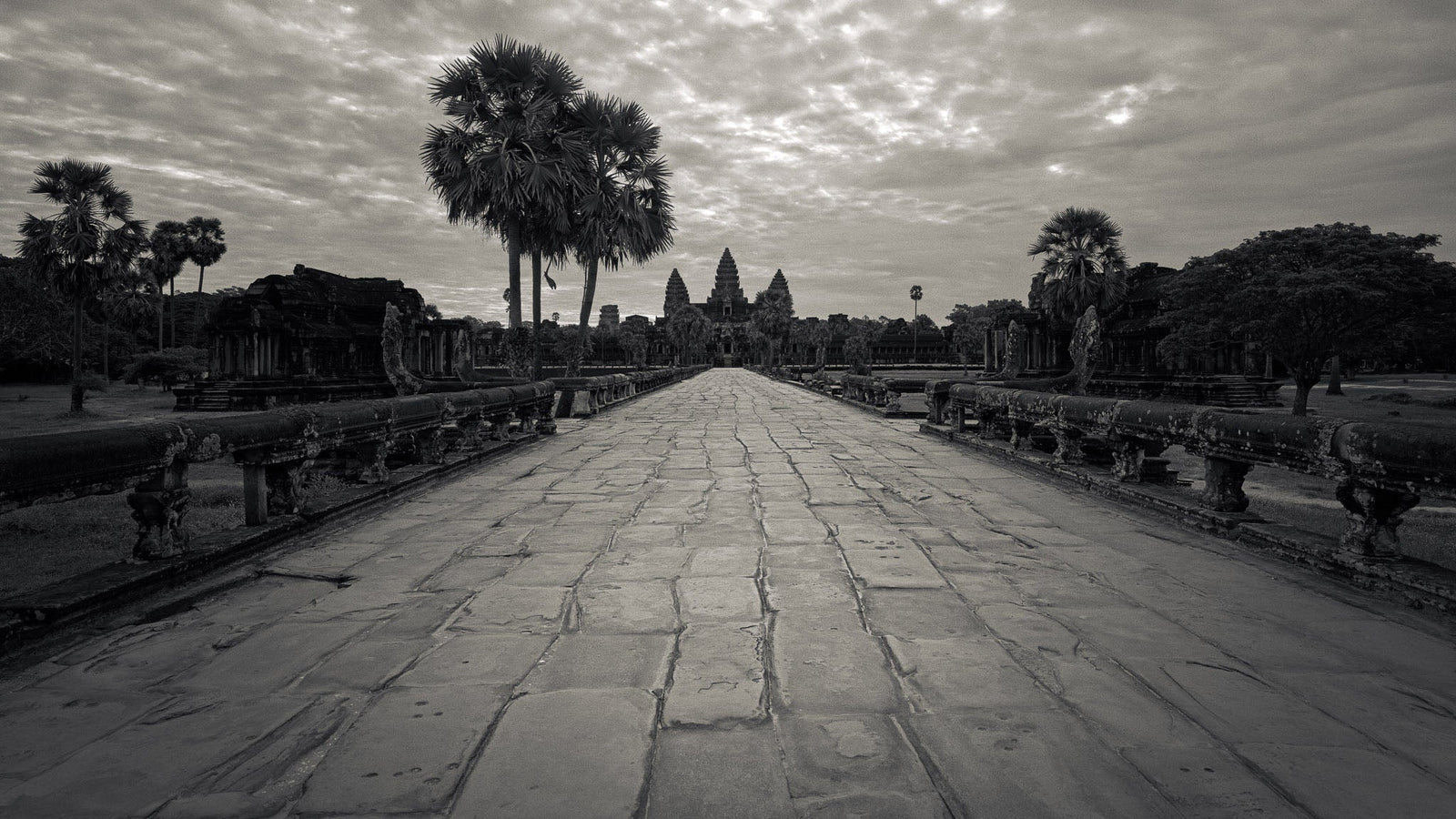
Angkor Wat is first encountered not as a building, but as a horizon. In the half-light before sunrise, it gathers itself slowly out of darkness—five towers held in still water, reflected, doubled, unsettled, before the stone itself is fully seen. The air is cool, the ground still holding the night. Even before one understands what is being seen, the body registers the scale of intention. This is not architecture that seeks to persuade. It stands, complete, awaiting recognition.
Built in the first half of the twelfth century by Suryavarman II, Angkor Wat functioned simultaneously as capital, state temple, and cosmic diagram. It was dedicated to Vishnu, guardian of order and preserver of the world, and aligned deliberately westward—toward sunset, toward conclusion, toward the long view of time. In this orientation alone, the temple declares its difference. It does not face beginnings. It faces fulfilment.
The approach is measured. A wide moat encloses the complex, not as defence but as cosmology: the primordial ocean encircling the world. Crossing the causeway, one leaves the ordinary ground behind and enters a geometry that governs everything to follow. Distance is calibrated. Proportion is disciplined. Each step feels pre-considered, as though the body itself has been taken into account by the architects. This is where Toynbee’s observation holds: Angkor Wat is not orchestral. It does not swell and subside. It is monumental—steady, unwavering, resolved.
The temple covers eighty-one hectares, a city compressed into stone. Yet its power is not merely quantitative. What astonishes is coherence. Galleries align with towers, towers with terraces, terraces with sky. The five lotus-bud towers rise in a quincunx, replicating Mount Meru, the sacred centre of the universe. The central tower stands as axis mundi—binding earth and heaven, anchoring the divine to place. Beneath it, a vertical shaft descends into the ground, mirroring the tower’s ascent above. The world is not only represented here; it is fastened.
Walking the galleries, one is drawn into time rather than space. The bas-reliefs stretch for hundreds of metres, unfolding epic after epic—battles, processions, cosmic churnings. The Churning of the Ocean of Milk moves relentlessly along the wall, gods and demons straining together around Mount Mandara, extracting immortality through shared exertion. Elsewhere, armies advance, kings preside, destinies are fixed. These are not decorative narratives. They are instructions about order: how chaos is held at bay, how authority is legitimised, how the world continues.
And yet, despite the scale of these stories, the carving is intimate. Almost every surface is worked. The stone carries the trace of human attention everywhere—hands that returned again and again to refine a fold, an anklet, a curve of muscle. Thousands of apsaras and devatas inhabit the walls, no two exactly alike. Their expressions are calm, their posture assured. They do not perform for the viewer. They belong to the place, as integral as the towers themselves. Fashion, jewellery, gesture—these figures quietly preserve an entire courtly world within stone.
Angkor Wat took more than thirty years to build. It is contemporary with Notre-Dame and Durham Cathedral, yet its conception differs profoundly. Where the Gothic lifts the eye upward through lightness and vertical tension, Angkor Wat spreads its weight deliberately. Gravity is embraced. The temple does not yearn skyward; it establishes itself. Its strength lies in balance, not ascent. One feels this in the long, shallow stairways, in the terraces that require effort but not strain. Even the upper sanctuary, steep and commanding, feels earned rather than imposed.
The westward orientation deepens this atmosphere. In Hindu cosmology, west is associated with Vishnu, but also with death and completion. Angkor Wat is widely understood to have functioned as Suryavarman II’s mausoleum—a place where king and god converge. The reliefs are meant to be read counterclockwise, following funerary ritual. Time here does not move forward into promise; it turns, returns, resolves. The temple embodies a worldview in which power is justified not by novelty, but by continuity.
Later centuries altered the site without erasing it. Buddhism took root. Monks remained. Additions were made, reliefs completed long after the original builders were gone. Angkor Wat was never abandoned. This continuity matters. While much of Angkor was reclaimed by forest and silence, Angkor Wat stayed inhabited, prayed within, repaired. Its survival is not only architectural; it is devotional. The temple endured because it continued to be used, not merely admired.
Standing in the upper galleries, looking outward across the enclosure, one senses the vastness of the project—not just its physical size, but its ambition. This was a civilisation attempting to give permanent form to its understanding of the universe, to embed time, power, devotion, and kingship into a single coherent structure. That it succeeded so fully is why Angkor Wat resists easy description. Words gesture. Stone remains.
At sunrise, when the light finally clears the horizon and strikes the towers directly, the reflections in the moat dissolve. The illusion breaks. What remains is mass, presence, fact. Angkor Wat does not ask to be believed in. It stands as proof of what patient labour, disciplined imagination, and absolute conviction can produce when aligned toward a single purpose.
Angkor Wat teaches endurance. Not the endurance of conquest or dominance, but the endurance of order—of a world carefully conceived and carefully maintained. To walk its galleries is to walk inside a thought made stone, a civilisation speaking to itself across centuries. It does not overwhelm through excess. It convinces through completeness. And long after one leaves, the sense persists that something here was finished properly, without haste, and therefore remains.
Photographs from Angkor Wat – Spirit of Angkor series by Lucas Varro
At Angkor Wat, the world is not only seen but felt—through corridors brushed by the breath of centuries, through carvings alive with myth and devotion. Built as a cosmic mandala in stone, this vast temple opens like a prayer, unfolding light across the faces of apsaras, warriors, and gods.
Within this sanctified geometry, artist Lucas Varro moves slowly, returning again and again with his large and medium format film cameras—not to document, but to listen. Each image in this collection was made at Angkor Wat and shaped through long exposure, chiaroscuro, and hand-toning, distilling not just what the temple looks like, but what it remembers.
These are photographs born in silence—etched in silver, shaded in reverence. A glance through shadow. A presence at the threshold. A single gesture of grace caught before it faded.
Offered as limited edition, hand-toned archival pigment prints on Hahnemühle Bamboo paper, each work is accompanied by a Collector’s Print Package including poetic writings, curatorial notes, and field reflections from the artist’s dawn pilgrimages.
This collection invites you to walk through Angkor Wat not with your eyes alone—but with your breath, your memory, and your spirit.
Receive occasional letters from my studio in Siem Reap—offering a glimpse into my creative process, early access to new fine art prints, field notes from the temples of Angkor, exhibition announcements, and reflections on beauty, impermanence, and the spirit of place.
No noise. No clutter. Just quiet inspiration, delivered gently.
Subscribe and stay connected to the unfolding story.
Receive occasional letters from my studio in Siem Reap—offering a glimpse into my creative process, early access to new fine art prints, field notes from the temples of Angkor, exhibition announcements, and reflections on beauty, impermanence, and the spirit of place.
No noise. No clutter. Just quiet inspiration, delivered gently.
Subscribe and stay connected to the unfolding story.