
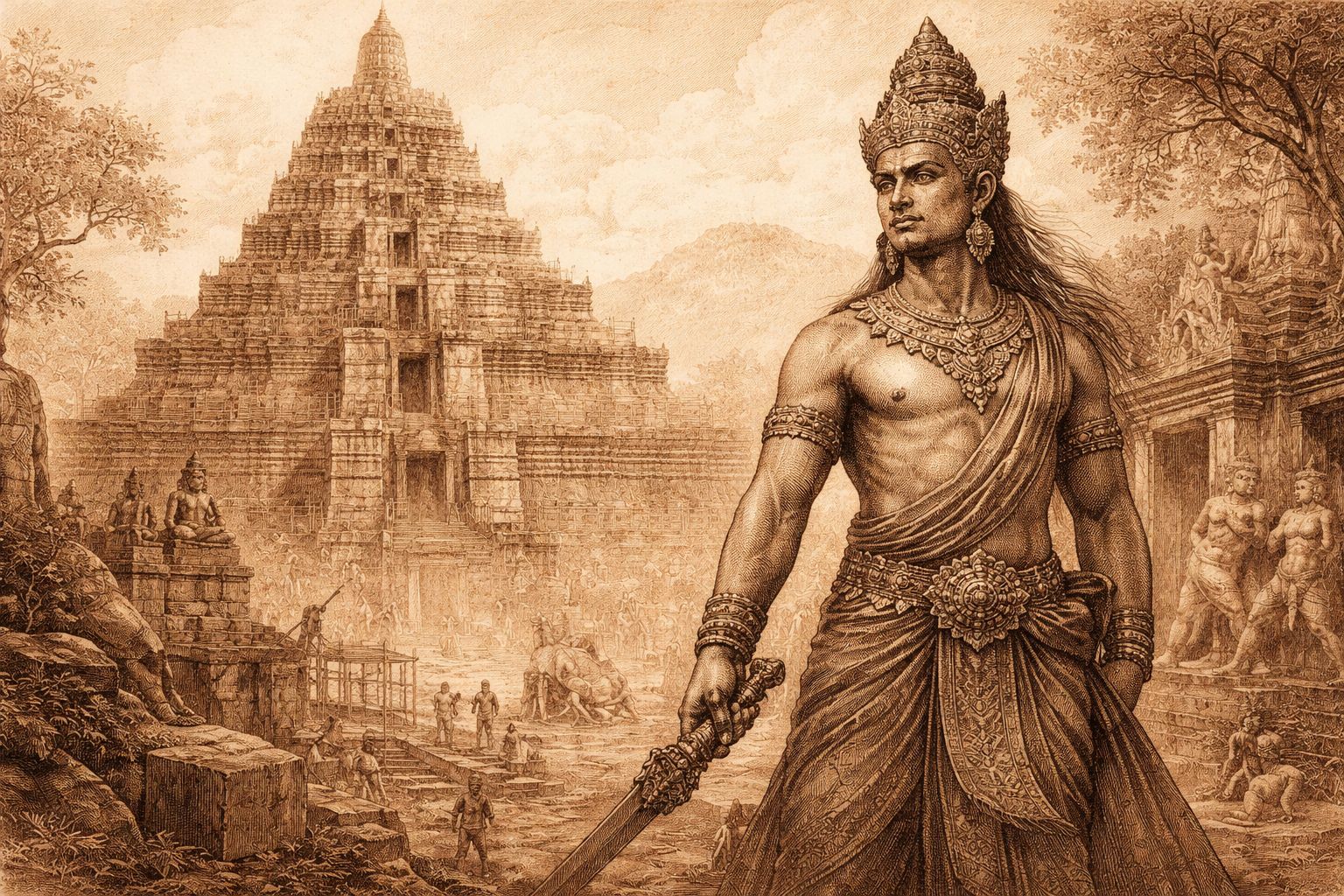

Jayavarman IV — The King Who Built Away from Memory
Some kings consolidate.
Others inherit.
A few, very rarely, walk away.
Jayavarman IV belongs to that smaller and more unsettling category: the ruler who refused the gravitational pull of Angkor and instead tested whether kingship itself could survive dislocation. His reign does not unfold along the causeways of precedent but cuts a hard diagonal across Khmer history, carving a capital out of forest, rock, and will at Koh Ker.
To understand him, one must resist the easy language of usurpation or ambition alone. Koh Ker was not merely a rival city. It was an argument.
When Jayavarman IV left Yashodharapura around 921 CE, Angkor was already dense with memory—temples accreted like sediment, authority layered through repetition. He did not dismantle this inheritance. He stepped outside it. From his own territorial base he began constructing a capital that did not ask permission from the past, only obedience from the present.
The sources tell us he was a maternal uncle to the reigning line, married into royal legitimacy, close enough to power to feel its pulse yet far enough to imagine its re-engineering. For several years he ruled as a king in waiting, a sovereign without consensus. Then, after the death of Ishanavarman II, the inscriptions shift. Jayavarman IV is named cakravartin—not first among equals, but universal monarch.
The question is not whether he seized power. The question is how he defined it.
At Koh Ker, kingship abandoned delicacy. The temples are not measured whispers but blunt declarations. Prasat Thom rises in seven stepped tiers, a sandstone pyramid that does not conceal its mass or temper its scale. This is architecture that advances rather than invites. It does not court the eye; it confronts it.
At its summit once stood a colossal liṅga—too large to be symbolic alone. Here, the divine was not implied. It was imposed. Jayavarman IV’s chosen form of Shiva, Tribhuvaneshvara, was not merely the god of three worlds but the god who was lordship itself. In the language of the inscriptions, divinity and sovereignty collapse into a single term. The king does not serve the god. The god is the condition of kingship.
This is why Koh Ker feels so different from Angkor. The art surges with movement—wrestlers locked in strain, ape kings frozen mid-combat, Shiva captured not in repose but in centrifugal force. Scale becomes rhetoric. Motion becomes proof.
Even water submits to this logic. The Rahal Baray is not gently contained but partially hewn from bedrock, an act of extraction as much as engineering. Nature is not aligned; it is compelled.
And yet, for all this ferocity, Jayavarman IV was not a doctrinaire ruler. He endowed distant sanctuaries such as Wat Phu, and through his officials supported Buddhist foundations at Angkor itself. Koh Ker was not a theological break, but a political one. Shiva remained central, but the field of devotion stayed plural.
His reign burned bright and fast. He died in 941 or 942 CE, entering posthumous union with Shiva. His son reigned briefly. Then the court returned to Angkor, drawn back by memory, water, and habit. Koh Ker was left suspended—complete yet abandoned, an answered question no one wished to repeat.
Jayavarman IV teaches us something uncomfortable: that power can be re-founded, but only briefly; that scale can persuade, but not endure; that kingship untethered from inherited place must shout to be heard.
Koh Ker remains his voice.
It has not softened with time.
It waits, still asking whether authority is something we inherit—or something we dare to build alone.
—
Receive the next work
Subscribe free to receive new work from the Lucas Varro Library by email.
More from the Library


See Also
A concise and impartial dictionary of absence, promises, quarrels, ordinary objects, and the troublesome instability of words.

The City of Service
The temple we inherit is a building from which almost all necessity has been removed. Nothing must be brought for it to continue being what we call a temple. The sanctuary asks nothing of us. Stone is good at this kind of independence.
A living temple was otherwise.
Water had to come in. So did grain, cloth, oil, aromatic substances, fuel. The things required for worship arrived because someone carried them across a threshold.

Houses of Wood, Light, and Smoke
Some of Angkor’s most intimate ruins do not rise above the ground at all. They are postholes, low mounds, hearths and ponds: durable traces of a domestic city built largely from things that decay. To restore that city is to see Angkor not only as stone, but as wood, smoke, water, repair, and people living within calling distance.