
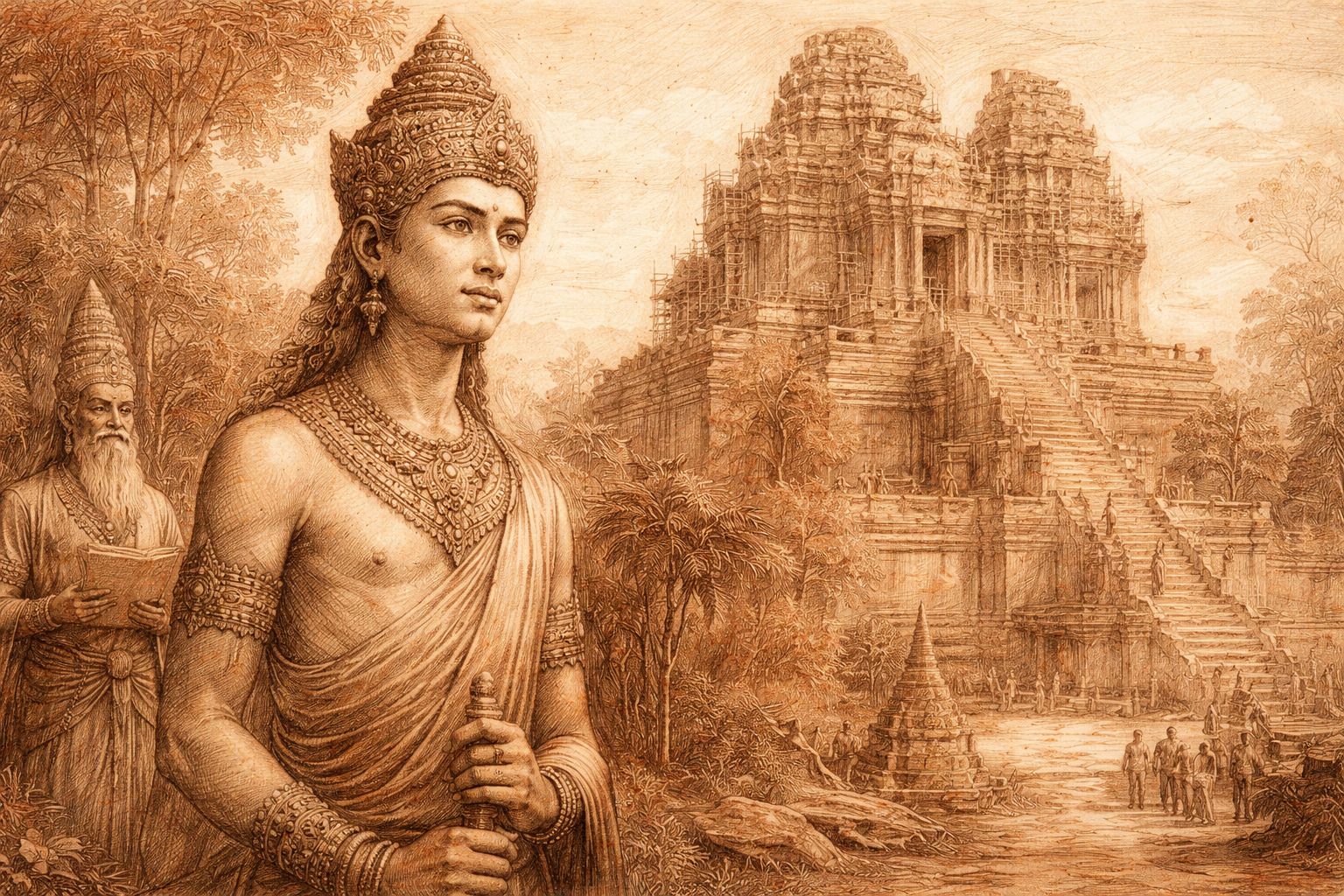

The Quiet Reign — Jayavarman V and the Discipline of Unfinished Stone
There are kings who declare themselves in thunder, and others whose authority is learned in silence. Jayavarman V belongs to the latter. His reign does not announce a rupture or a conquest, but a long, measured holding of the centre—a period in which Angkor was neither refounded nor fractured, but patiently sustained.
He ascended the throne in 968 CE, not as a man formed by power, but as a child barely ten years of age. The empire he inherited from his father, Rajendravarman II, was stable, expansive, and confident in its Shaivite foundations. Yet stability at succession is not the same as security. For several years, the kingdom rested not in the hands of its boy-king, but in the guardianship of his tutor and regent, the Brahman Yajnavaraha.
This guardianship was not merely administrative. Yajnavaraha was granted the unprecedented title vrah guru—holy spiritual master—and with it, both religious legitimacy and political gravity. In his household, the young king was instructed not only in the Vedas and philosophy, but in medicine, astronomy, and the disciplined arts of seeing and measure. Court inscriptions suggest that this was no ceremonial tutelage. Jayavarman V was removed from the volatility of factional intrigue and placed instead within an architecture of care: protected, educated, and held.
The result is a reign curiously free of crisis. For nearly three decades, Angkor knew peace. No major wars fracture the record. No radical reorientation of cult or capital interrupts the flow. Instead, the kingdom consolidates—economically, intellectually, and artistically. It is in this climate that one of the most refined monuments of the Khmer world is conceived: Banteay Srei, founded not by the king himself, but by his guru. Small in scale yet astonishing in precision, the temple stands as an emblem of the age: an assertion that mastery does not require monumentality, only attention.
And yet, Jayavarman V is not remembered for delicacy alone. Toward the end of his reign, he initiates a project of formidable ambition—the temple now known as Ta Keo. Its original name, Hemasringagiri—the Mountain with Golden Peaks—announces a vision of Mount Meru rendered in stone, rising sheer and unornamented from the plain. It was to be the centrepiece of a new royal foundation, Jayendranagari, on the western edge of the East Baray.
But Ta Keo was never finished.
Its walls remain largely undecorated. Doorways stand without relief. The mass ascends in disciplined geometry, yet stops short of completion, as if arrested mid-thought. Later tradition speaks of lightning striking the sanctuary—an inauspicious omen—but history suggests something quieter and more human: the death of the king in 1001 CE, followed by a decade of contested succession that left no one able, or willing, to complete another man’s mountain.
Jayavarman V received the posthumous name Paramaviraloka—he who has gone to the supreme heroic world. Yet his legacy is not heroic in the usual sense. It is defined instead by continuity without climax, ambition without resolution, authority exercised through restraint rather than display. His reign demonstrates that Angkor was not only shaped by founders and reformers, but also by stewards—those who held the centre long enough for refinement to occur.
Ta Keo remains as his most eloquent testament. A golden mountain that was never gilded. A Meru left intentionally bare, or perhaps simply left alone. In its unfinished stone, one feels the character of the reign itself: measured, stable, and vulnerable to the quiet truth that even the most disciplined order depends on time being kind.
When the dynasty faltered after his death, it was not because Jayavarman V failed to build forcefully enough, but because he built in trust—trust that continuity would endure. For a generation, it did. And that, in Angkor, is no small achievement.
—
Receive the next work
Subscribe free to receive new work from the Lucas Varro Library by email.
More from the Library


See Also
A concise and impartial dictionary of absence, promises, quarrels, ordinary objects, and the troublesome instability of words.

The City of Service
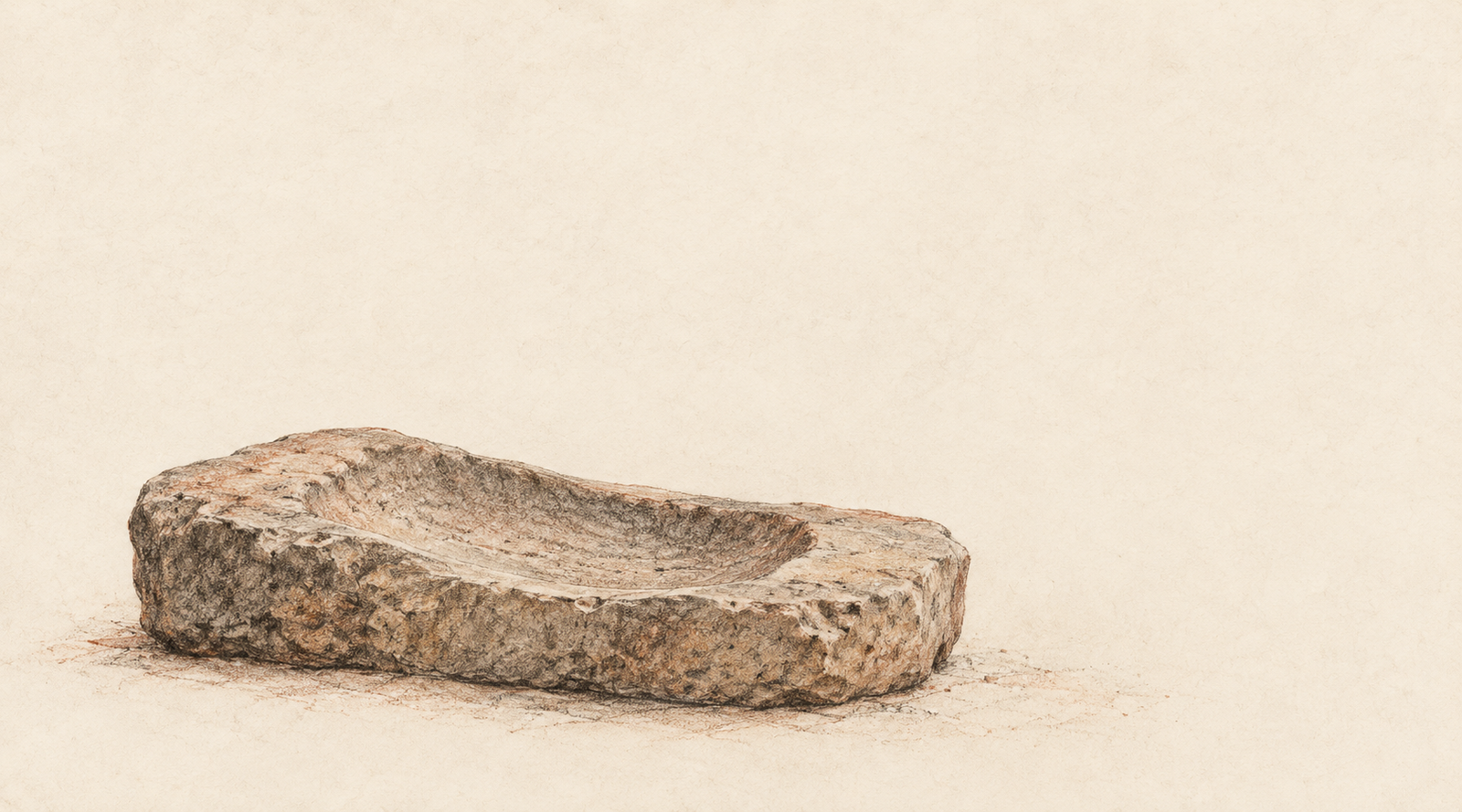
The temple we inherit is a building from which almost all necessity has been removed. Nothing must be brought for it to continue being what we call a temple. The sanctuary asks nothing of us. Stone is good at this kind of independence.
A living temple was otherwise.
Water had to come in. So did grain, cloth, oil, aromatic substances, fuel. The things required for worship arrived because someone carried them across a threshold.

Houses of Wood, Light, and Smoke
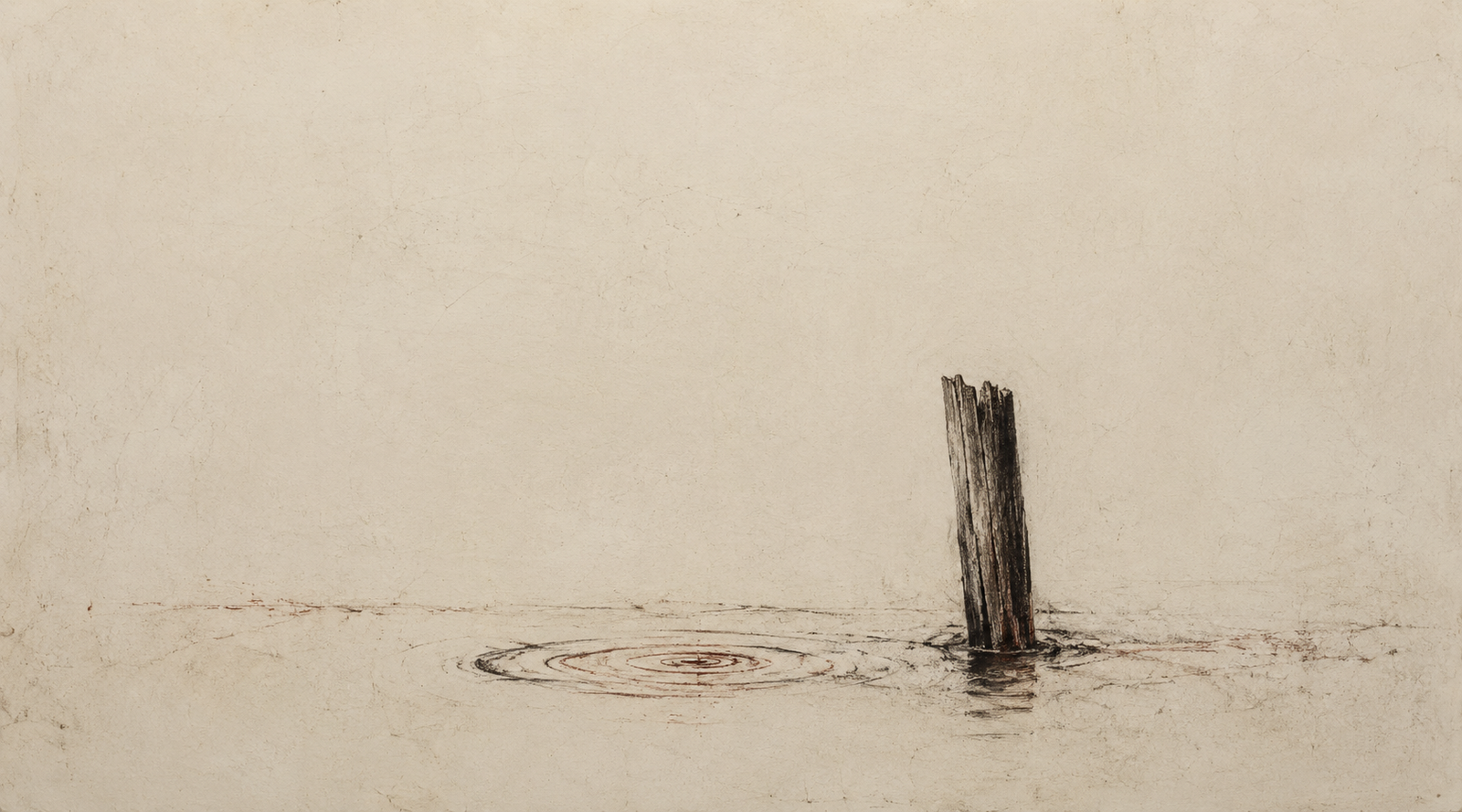
Some of Angkor’s most intimate ruins do not rise above the ground at all. They are postholes, low mounds, hearths and ponds: durable traces of a domestic city built largely from things that decay. To restore that city is to see Angkor not only as stone, but as wood, smoke, water, repair, and people living within calling distance.