Complimentary worldwide shipping on orders over $400 · No import tariffs for most countries

0

Your Cart is Empty

Banteay Srei does not announce itself with scale. It does not rise like a mountain or command the horizon with distance. Instead, it waits. A low enclosure, a short causeway, a cluster of sanctuaries no higher than the surrounding trees. And yet, the moment one steps inside, the effect is unmistakable: the sense that something here has been attended to with extraordinary care, that the stone has been treated not as mass but as surface, not as monument but as offering.

Consecrated in 967 CE, during the reign of Rajendravarman II, Banteay Srei belongs to an early and confident moment in Angkorian culture—nearly two centuries before Angkor Wat, before the empire learned to equate sacredness with immensity. The temple’s original name, Tribhuvanamahesvara, identifies its purpose with clarity: the Great Lord of the Threefold World, Shiva present not through scale, but through precision. The linga that once occupied the central sanctuary anchored the site cosmologically, but the language spoken here is not one of cosmic distance. It is intimate, tactile, near.

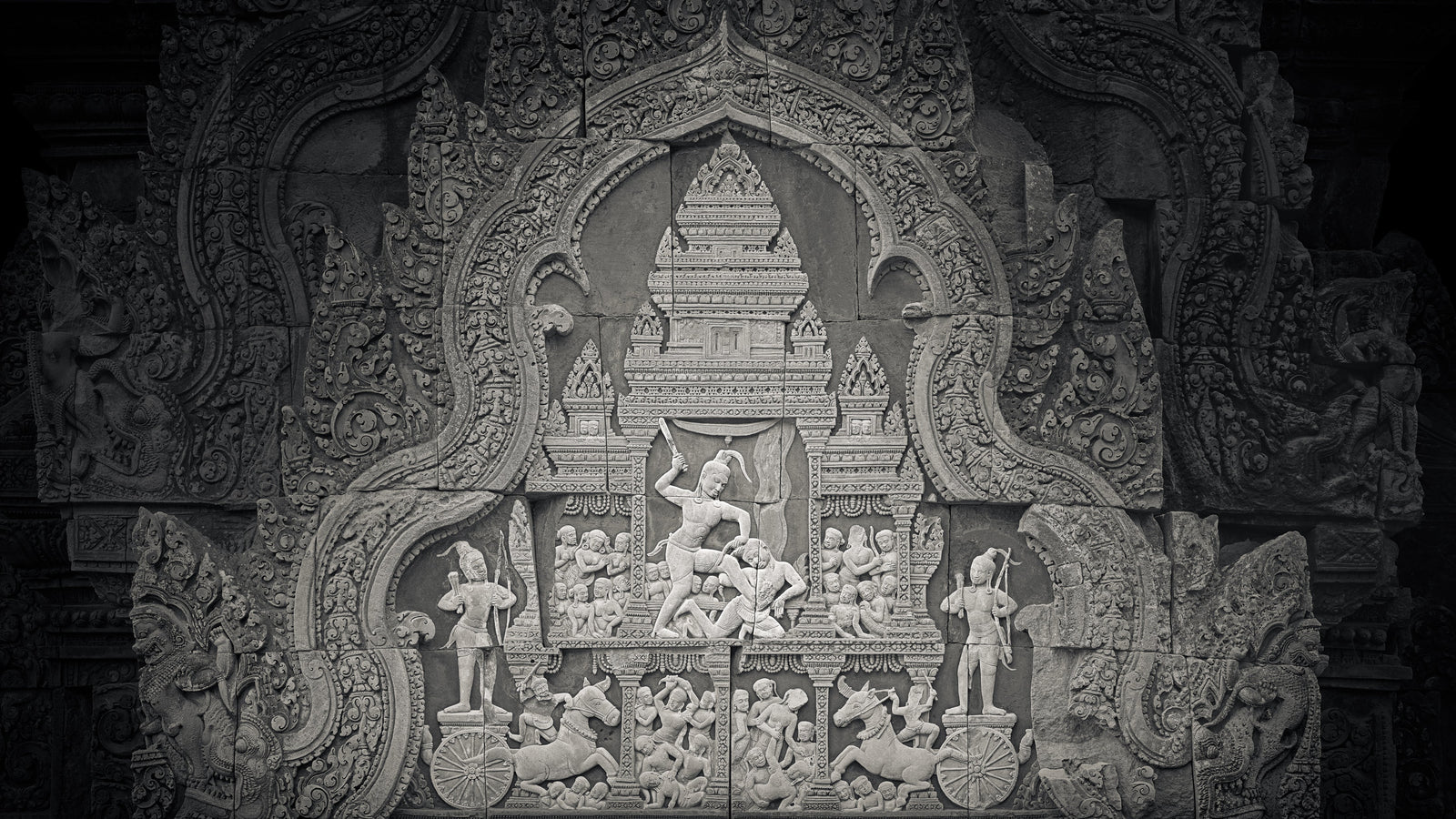
This intimacy begins with material. The hard pink sandstone quarried from the Phnom Kulen hills allowed the sculptors a freedom unknown elsewhere at Angkor. Lines cut sharply and remain sharp. Leaves curl, petals overlap, serpents twist with a confidence that suggests the stone was never a resistance but a collaborator. The carvings do not merely decorate the walls; they saturate them. There is scarcely a surface left unconsidered. Tongues of flame, floral garlands, divine figures and demons interlock in a density that feels deliberate rather than excessive—as if restraint here meant completeness, not reduction.

The scale of the buildings enforces a particular bodily response. Doorways are low. Chambers are tight. One must stoop, slow down, adjust posture. Entry becomes an act of submission not to power, but to craft. Unlike the vast axial processions of later state temples, movement at Banteay Srei is careful and close. The eye is drawn not forward but sideways, inward, back again. One reads the temple the way one reads a manuscript—line by line, margin by margin.

That this temple was not a royal foundation matters. It was commissioned by the Brahmin scholar Yajnavaraha and his brother Vishnukumara, figures of immense learning and proximity to the court, but not kings. Freed from the need to proclaim sovereignty, Banteay Srei proclaims devotion instead—devotion to Shiva, certainly, but also devotion to form itself. The sculptors here appear unhurried. The narrative reliefs—among the earliest in Angkor—do not rush to summarise myth. They linger. Episodes from the epics unfold with dramatic clarity, but also with playfulness: bodies bend, expressions shift, action pauses mid-gesture.

The devatas that line the sanctuaries are neither distant nor idealised. They sway. Their hips turn. Their smiles are personal rather than symbolic. The guardians are youthful, alert, almost mischievous. Even the violence depicted in the pediments is rendered with elegance, as though the act of carving has tempered the story it tells. Everything here suggests confidence without anxiety—an art that knows exactly what it is doing.

Banteay Srei is often called the highest achievement of Angkorian art, and the phrase is usually justified by craftsmanship alone. But its deeper achievement lies elsewhere. This is a temple that teaches attention. It does not overwhelm the visitor into silence; it invites silence by rewarding patience. Stand too far back and the reliefs collapse into pattern. Step closer, and entire worlds emerge. The temple insists on proximity, on time spent, on looking again.

In the early morning, before the tour groups arrive, the low sun grazes the carvings and draws out their depth. Shadows settle into the recesses of leaves and eyes and folded cloth. It is then that the temple feels most itself—not as an object to be admired, but as a conversation between light and stone, between hand and surface, between devotion and discipline. The crowds, when they come, circle predictably. There is always another path, another angle, another pause.

Banteay Srei does not teach grandeur. It teaches care. It reminds us that sacredness can be concentrated without being diminished, that beauty need not announce itself loudly to endure. In a landscape defined by empire and ambition, this small citadel endures as a quieter lesson: that attention, once given fully, becomes its own form of reverence.