
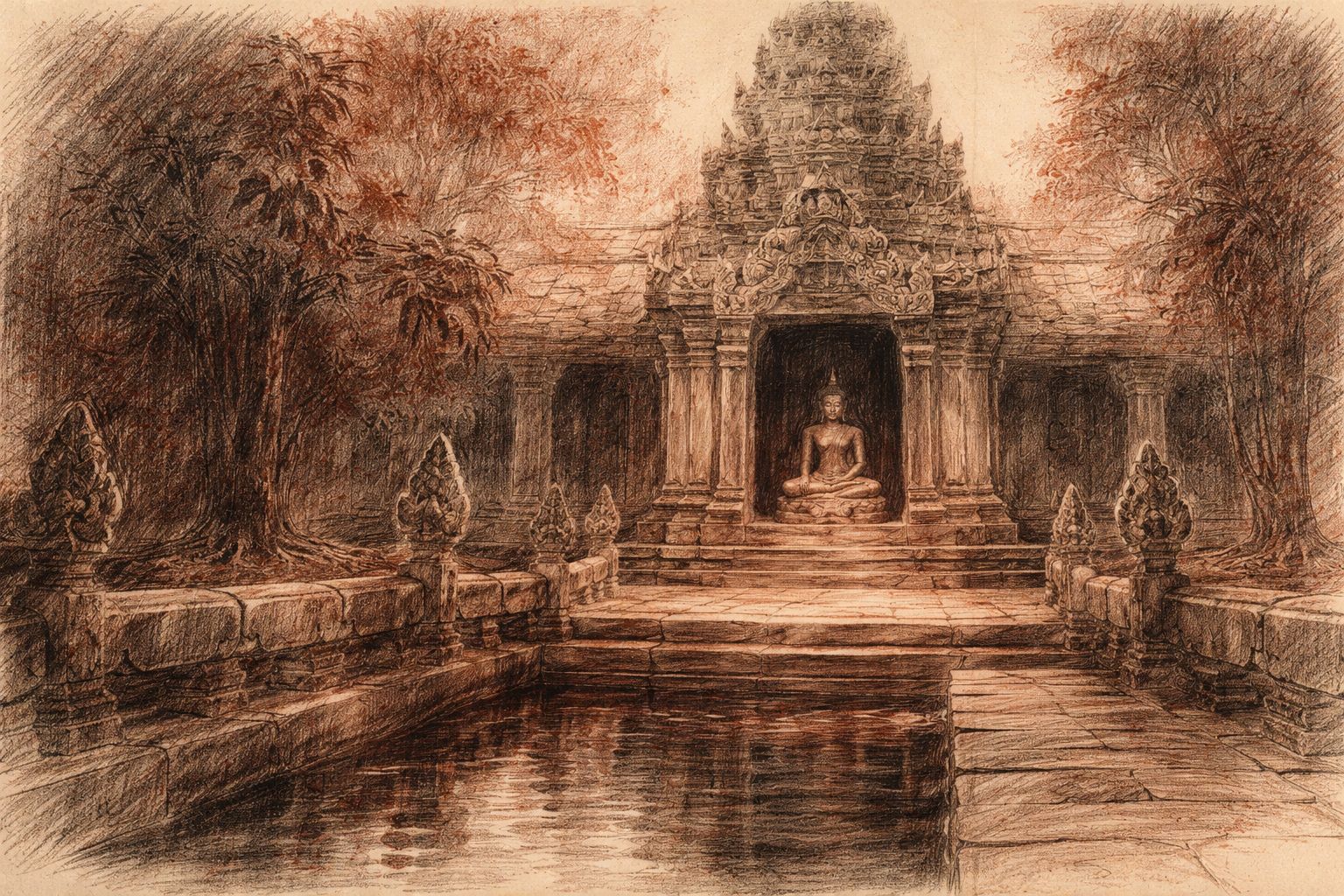

Bhaisajyaguru and the Silence of Healing in Angkor
In Angkor, healing was once given a roof of stone and a silence of water. The hospital shrines sit lightly on the land, modest in scale yet deliberate in placement, as if the body itself had been invited to rest. Within these spaces, Bhaisajyaguru was not addressed as an abstract principle but encountered as a presence—quiet, attentive, already listening.
The figure does not arrive with urgency. He sits. His posture teaches before any remedy is offered. The downcast eyes do not search for symptoms; they receive them. In this stillness, illness is not singled out or shamed. It is allowed to be present without resistance, and in that allowance something begins to loosen.
The Angkorian hospitals—arogayasalas—were built at measured distances across the kingdom, each one paired with a small basin of water. The sick would wash before entering, not to purify themselves of fault, but to cross a threshold. Water, stone, and body were aligned. Healing began not with cure, but with orientation.
Within the shrine, Bhaisajyaguru holds a small vessel. It is not raised, not offered outward. It rests in his lap, as though waiting for the moment when the sufferer is ready to recognise what is already there. The medicine is not forced. It is kept.
This is not the drama of rescue, nor the spectacle of miracle. It is the discipline of care repeated without display. The hospitals did not promise release from pain; they promised that pain would be met. In a kingdom recently marked by war and exhaustion, this mattered. Compassion was organised, given form, and sustained through ritual attention.
The king who ordered these foundations understood something austere: that authority fractures when suffering is ignored. To tend the ill was not a gesture of benevolence alone, but a rebalancing of the realm. The hospital chapels were civic acts of listening. Their silence was political.
In Khmer bronzes, the Medicine Buddha sometimes holds instruments associated with esoteric practice. Even here, the gesture remains restrained. Power is present, but folded inward. The work is not conquest but calibration—bringing body, breath, and circumstance back into accord.
Bhaisajyaguru does not stand at the edge of the world calling for faith. He sits at its centre, patient with time. His medicine is administered slowly, often invisibly. What is healed first is not the wound, but the isolation that surrounds it.
To stand in one of these hospital shrines today is to feel how carefully suffering was once accommodated. Stone remembers this. Water remembers it. The practice does not ask to be revived. It only asks to be noticed.
—
Receive the next work
Subscribe free to receive new work from the Lucas Varro Library by email.
More from the Library


See Also
A concise and impartial dictionary of absence, promises, quarrels, ordinary objects, and the troublesome instability of words.
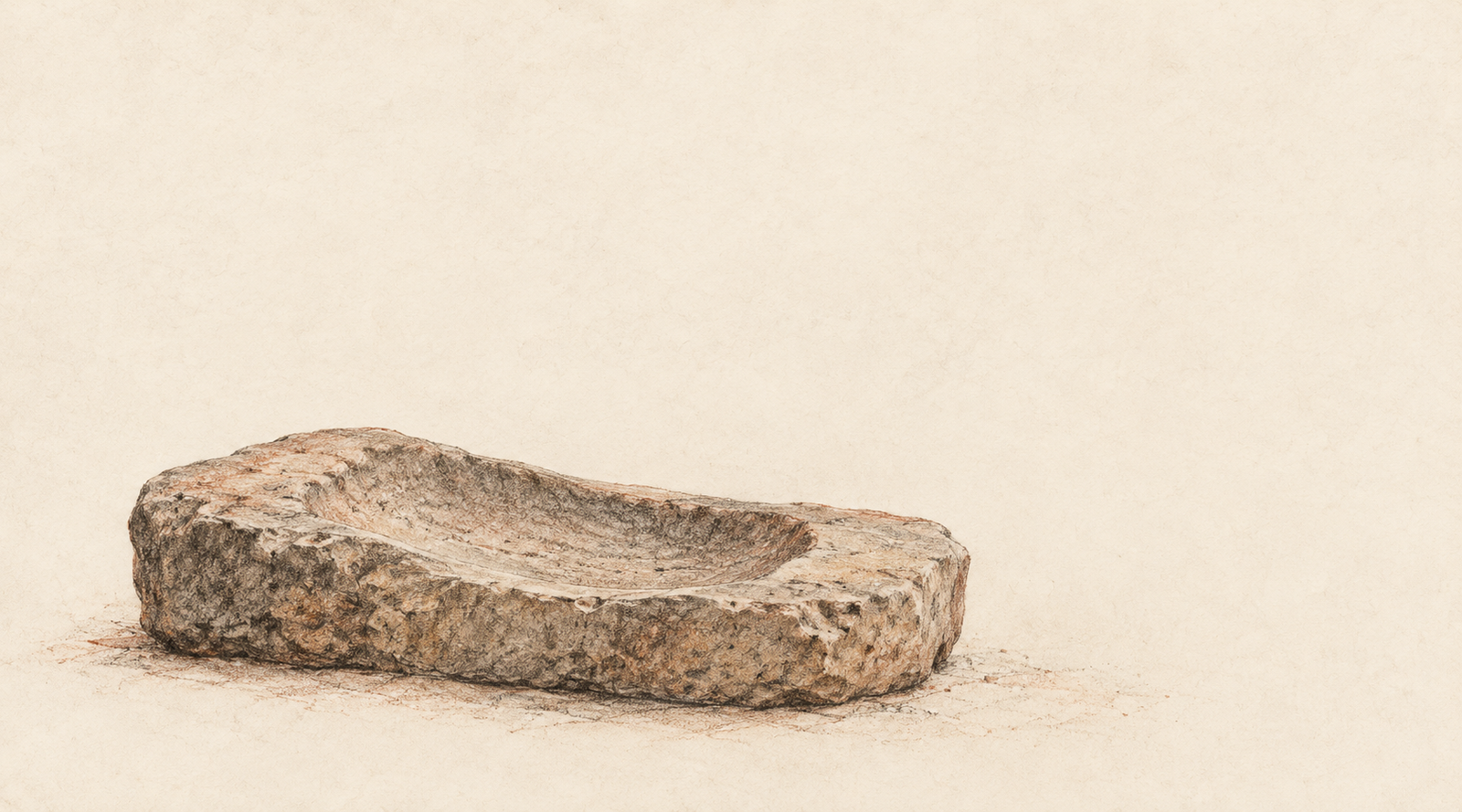

The City of Service
The temple we inherit is a building from which almost all necessity has been removed. Nothing must be brought for it to continue being what we call a temple. The sanctuary asks nothing of us. Stone is good at this kind of independence.
A living temple was otherwise.
Water had to come in. So did grain, cloth, oil, aromatic substances, fuel. The things required for worship arrived because someone carried them across a threshold.


Houses of Wood, Light, and Smoke
Some of Angkor’s most intimate ruins do not rise above the ground at all. They are postholes, low mounds, hearths and ponds: durable traces of a domestic city built largely from things that decay. To restore that city is to see Angkor not only as stone, but as wood, smoke, water, repair, and people living within calling distance.