
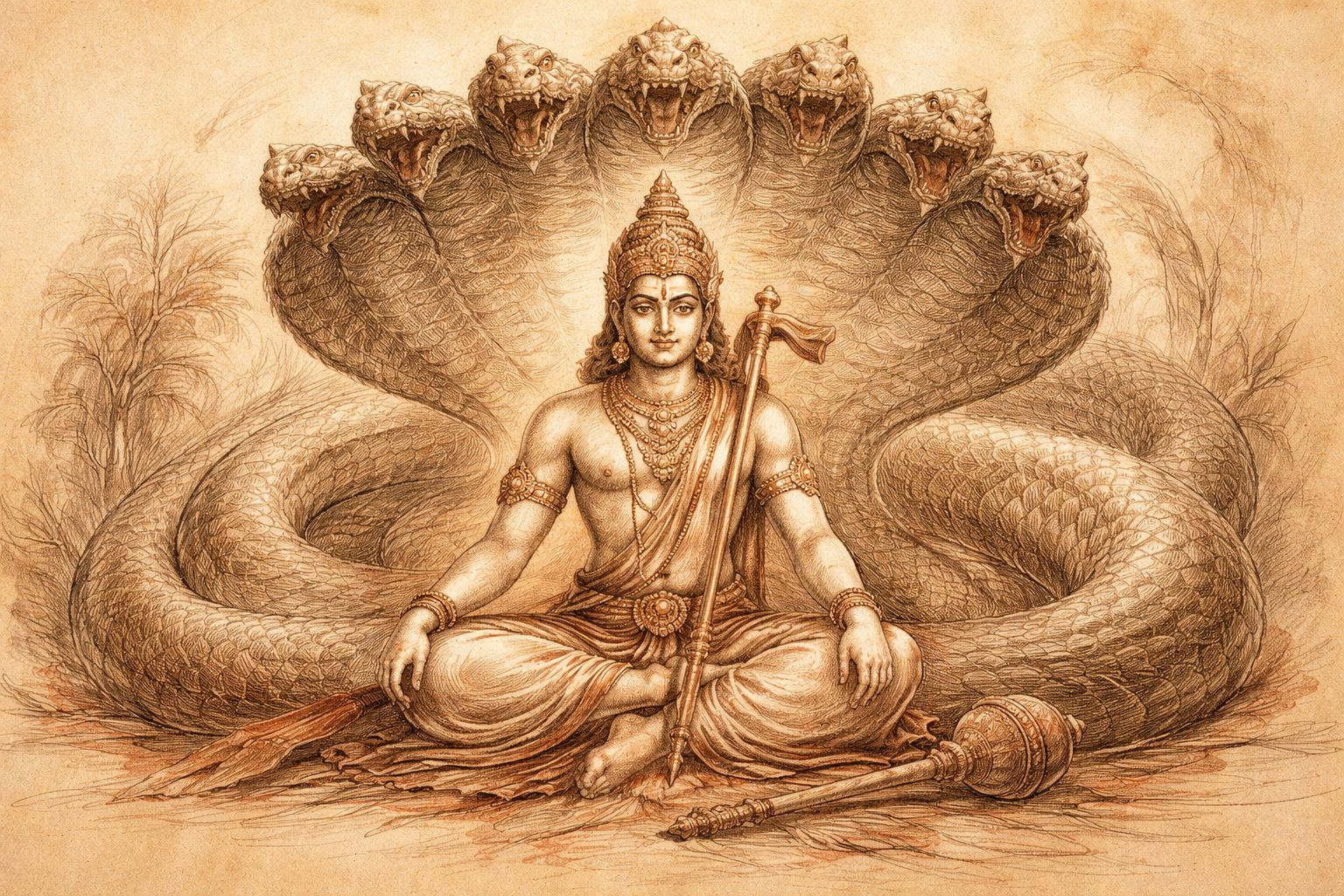

Balarama — The Weight That Holds
In the long grammar of Hindu and Khmer cosmology, not all power announces itself through conquest or brilliance. Some power remains pale, quiet, foundational—felt not in what it does, but in what does not collapse. Balarama belongs to this deeper register of strength.
He is elder brother, guardian presence, bearer of weight. Where his younger counterpart moves through the world with charm, strategy, and luminous play, Balarama stands as the unadorned force that allows such movement to occur at all. He is not the story’s centre, but its bearing wall.
According to tradition, Vishnu divided himself before descending into the world: two hairs, one white, one dark. From the white came Balarama—fair-complexioned, immense in stature, marked by gravity rather than radiance. This was not a division of good and evil, nor of light and shadow, but of balance. The cosmos does not arrive whole; it arrives paired.
Balarama’s deeper identity lies beneath this human form. He is the earthly manifestation of Ananta-Shesha, the endless serpent upon whose coils the universe rests, and upon whom Vishnu reclines during the long intervals between creation and dissolution. What the serpent performs invisibly beneath the world, Balarama performs among men: sustaining order by presence rather than proclamation.
In the Pancharatra vision of reality, he appears as Saṃkarṣaṇa—the emanation of knowledge and strength. Not cleverness, not persuasion, but the intelligence of structure: knowing how weight is borne, how force is directed, how chaos is restrained without spectacle. His weapon is the plough, not the blade. He reshapes rivers. He draws furrows through the land. He prepares ground rather than harvesting praise.
Even his violence, when it appears, is corrective rather than theatrical. When the demon Pralamba attempted to abduct him in disguise, Balarama did not chase or outwit. He simply made himself heavy. The world revealed the truth under that weight. Only when deception could no longer sustain itself did the decisive blow fall—swift, singular, final. Strength, here, is not frenzy, but inevitability.
In the Mahabharata, Balarama stands apart from the fever of allegiance. Related to both sides, he refuses the intoxication of total loyalty. When Bhima strikes Duryodhana below the navel—violating the law of the mace—Balarama’s outrage is not partisan, but principled. Law, measure, and form matter more than outcome. Without restraint, victory itself becomes disorder.
Khmer artists understood this quality intuitively. At Phnom Da and other early sites, Balarama appears with refined calm, often holding the phkak—the double-bladed club native to the Khmer world. He is not contorted by drama. His stance is balanced, grounded, assured. The body itself teaches the doctrine: power resides where balance is kept.
At the end of his life, the teaching becomes explicit. Sitting by the sea in meditation, Balarama releases his final form. From his mouth emerges the vast serpent Ananta, returning to the waters from which support arises. The human body falls inert. The foundation withdraws. What remains must now bear itself.
This is Balarama’s quiet instruction. Strength is not what dazzles the eye. It is what allows the world to continue when spectacle fades. It is the pale force beneath colour, the stillness beneath motion, the weight that holds while others shine.
In Angkor’s stone cosmology—where serpents line causeways and naga balustrades carry pilgrims across thresholds—this truth is carved without commentary. Before one reaches the sanctuary, one must cross what bears the world. Balarama waits there, unseen but indispensable, teaching that devotion begins not in ecstasy, but in steadiness.
—
Receive the next work
Subscribe free to receive new work from the Lucas Varro Library by email.
More from the Library

Houses of Wood, Light, and Smoke
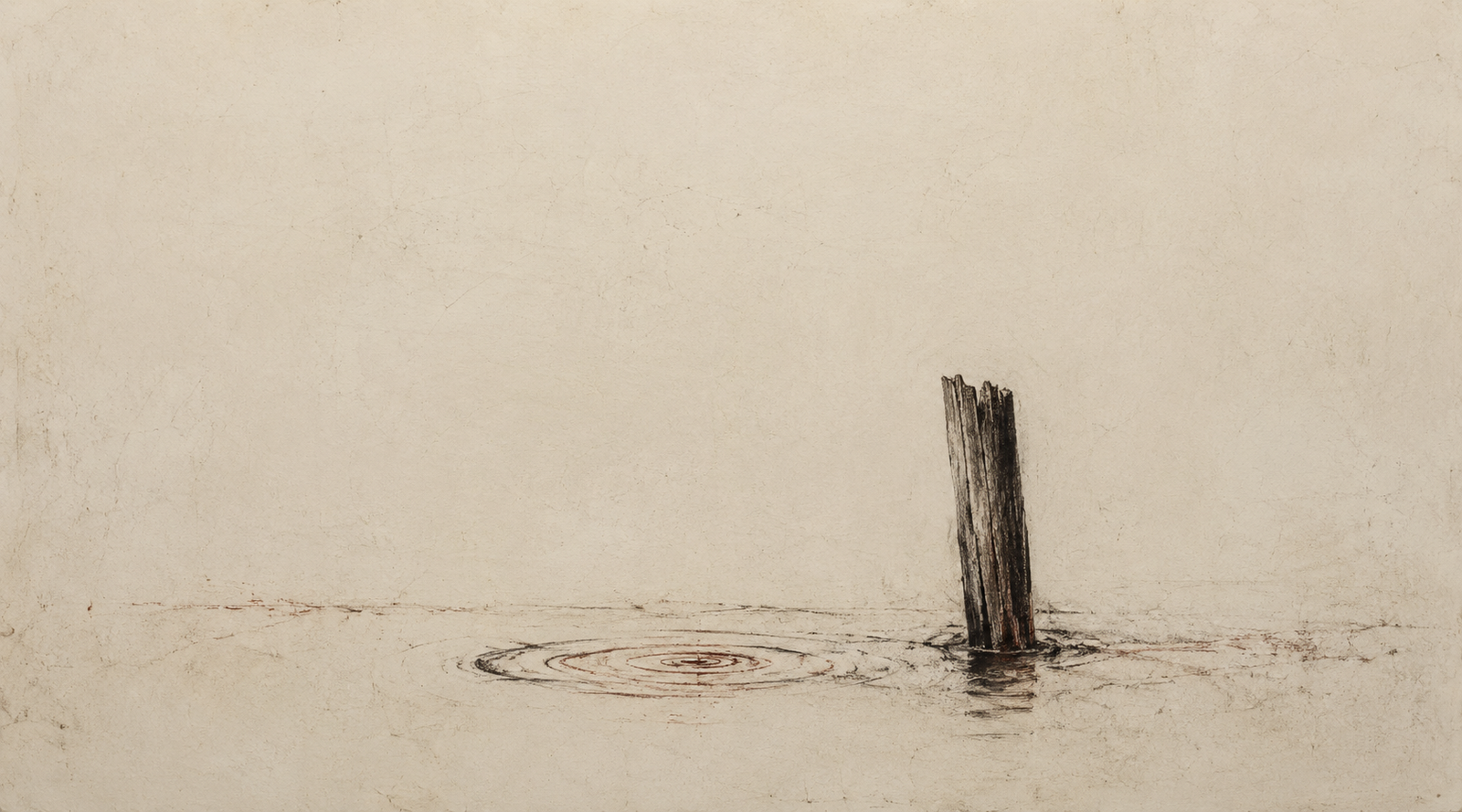
Some of Angkor’s most intimate ruins do not rise above the ground at all. They are postholes, low mounds, hearths and ponds: durable traces of a domestic city built largely from things that decay. To restore that city is to see Angkor not only as stone, but as wood, smoke, water, repair, and people living within calling distance.

What Stone Brings Forth
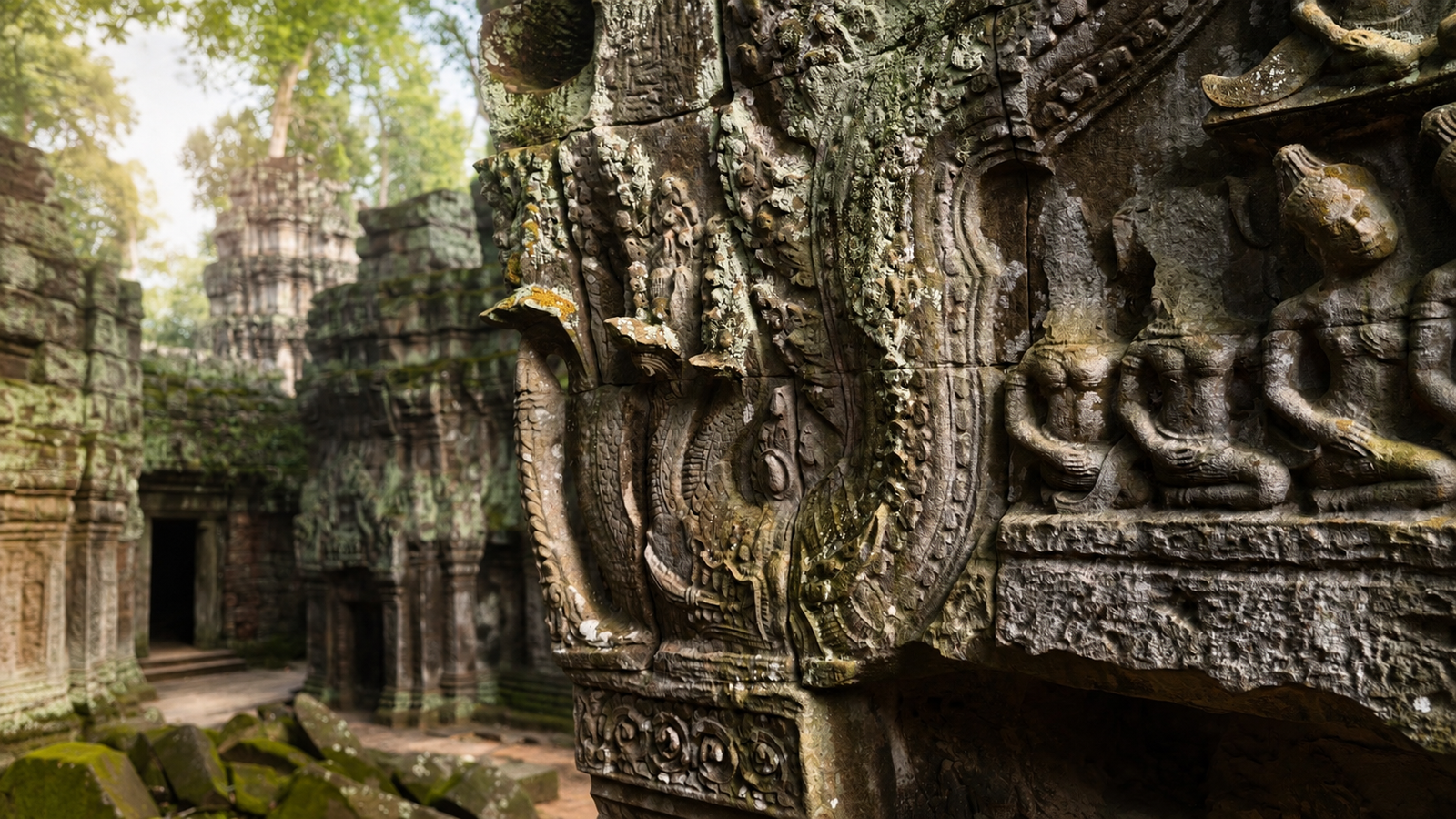
I had mistaken a gift for something being expelled.
Beneath the nāga's mouth, a stone garland descended bead by bead. Nearby, a makara opened its jaws and another form emerged. Looking closer, the whole temple began to change: serpent became ornament, ornament became architecture, architecture became foliage.
The forest did not introduce this language.
It answered it.

The Eighth Daughter
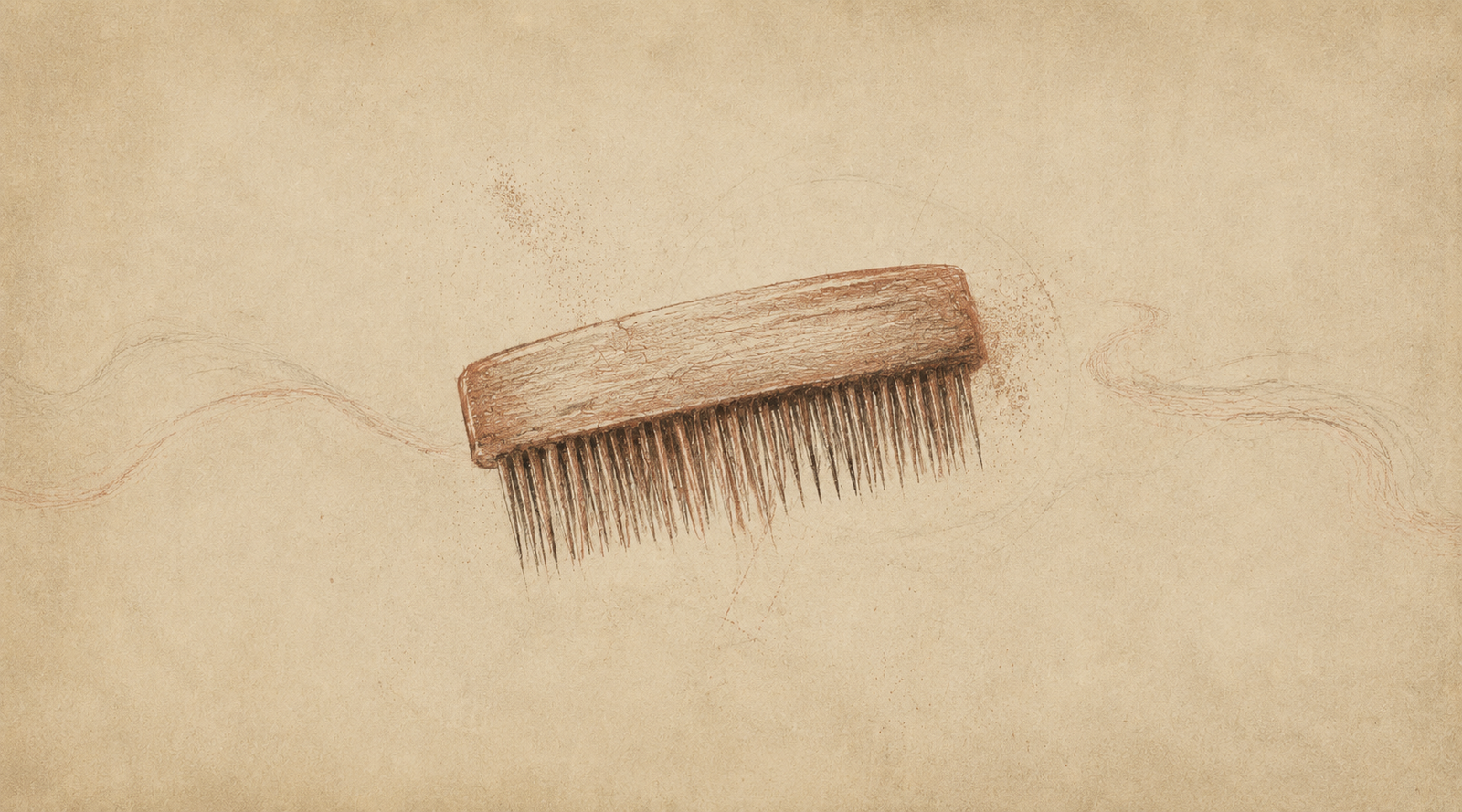
Seven daughters have already been taken by Yamata-no-Orochi when Susanoo reaches the River Hi. Only Kushinada-hime remains. The Eighth Daughter retells the Kojiki episode through a family’s waiting, a girl transformed into a comb, and the patient preparation for the serpent’s return.