
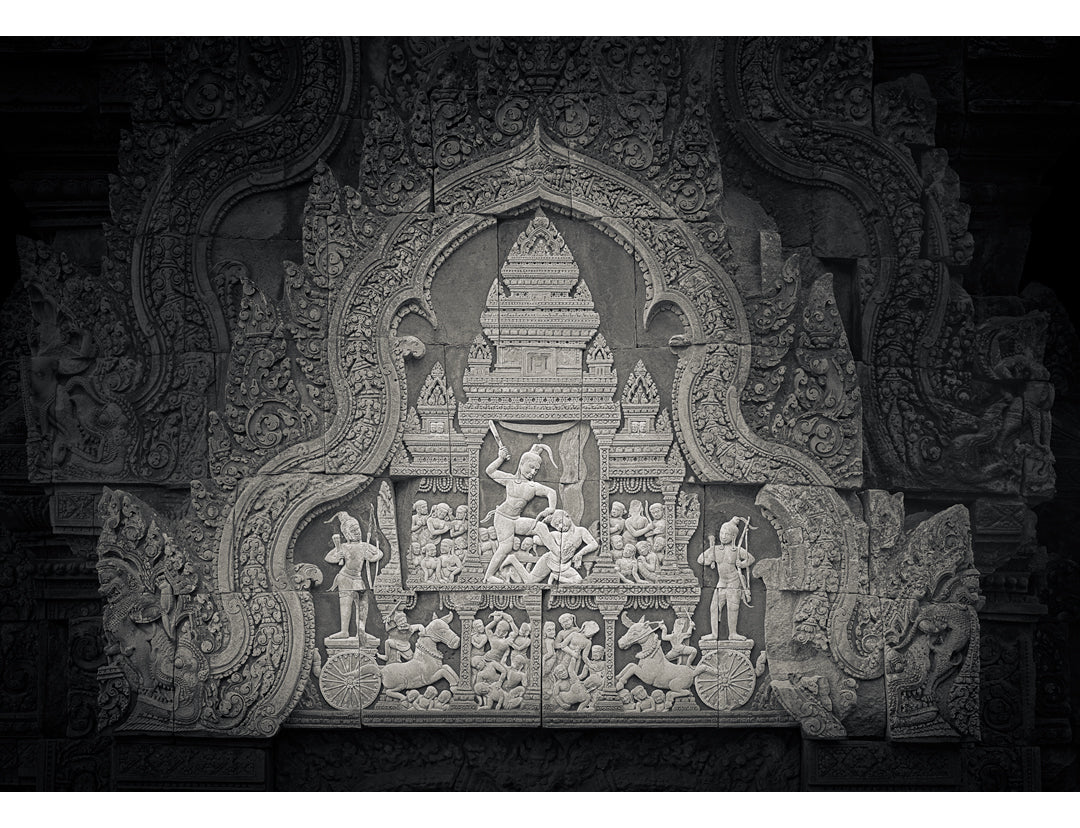

Tympanum
A tympanum is not an ornament added after a building has been conceived. It is a pause built into the act of entry—a held breath of stone that sits above a doorway and asks the body, and the eye, to slow before crossing a threshold.
Architecturally, the tympanum is the enclosed surface between lintel and roofline: triangular, arched, or gently bowed, depending on tradition and material. Its name comes from the Greek and Latin word for a drum, and the association is fitting. Like a drum skin, it is a taut surface stretched within a frame, waiting to be struck—not by sound, but by meaning. It is the place where a building speaks most directly.
Across cultures, this space has been recognised as special. Romanesque churches filled it with Judgement. Gothic cathedrals crowded it with saints and angels. Hindu and Khmer temples gave it to gods, myths, and cosmic struggle. The form changes, but the instinct remains: above the door, before entry, something must be shown.
In Khmer architecture, the tympanum becomes a site of extraordinary concentration. Framed by curling foliage or the arched body of a naga, it sits like a sealed field of energy above the opening. Early examples are restrained—vegetal scrolls, balanced symmetry, suggestion rather than declaration. Over time, the space thickens with intention. By the tenth century, particularly at Banteay Srei, the tympanum becomes narrative: gods wrestling demons, heroes defeating chaos, bodies frozen at the exact moment when fate turns.
What matters is not only what is depicted, but where it is placed. The tympanum is encountered at the moment of approach, when the visitor is neither outside nor fully within. It occupies the psychological threshold. One must look up to see it. The neck tilts. The gaze lifts. The body acknowledges something above itself. This is not accidental. The tympanum trains posture as much as belief.
Its shape reinforces this effect. The triangular pediment draws energy upward, gathering movement toward a peak. Horseshoe or arched forms cradle the scene, enclosing it like a womb. In later periods, especially at the Bayon, stories stack vertically in registers, compressing time into layers. A single glance holds multiple moments. The stone does not explain; it presents.
Unlike wall reliefs, which unfold through walking, the tympanum must be read instantly. It is compact, decisive. There is no wandering here. Whatever appears in this space has been chosen to stand for the whole: the essence of the deity within, the cosmic order upheld by the temple, the moral axis governing passage from profane to sacred. The tympanum does not decorate the doorway. It defines it.
In this way, the tympanum reveals something fundamental about sacred architecture. Temples are not entered casually. They require orientation—of body, of attention, of understanding. The tympanum performs this work silently. Before the foot crosses stone, the eye crosses story. One is reminded, briefly and wordlessly, that entry is not merely physical.
To stand before a tympanum is to stand before a compressed world. Stone becomes surface, surface becomes image, image becomes instruction. Then the doorway opens beneath it, and the visitor passes on—changed, if only slightly, by what has already been seen.
Suggesting, without insisting, the terms of entry: look up, look carefully, and remember that thresholds matter.
—
Receive the next work
Subscribe free to receive new work from the Lucas Varro Library by email.
More from the Library

See Also
A concise and impartial dictionary of absence, promises, quarrels, ordinary objects, and the troublesome instability of words.

The City of Service
The temple we inherit is a building from which almost all necessity has been removed. Nothing must be brought for it to continue being what we call a temple. The sanctuary asks nothing of us. Stone is good at this kind of independence.
A living temple was otherwise.
Water had to come in. So did grain, cloth, oil, aromatic substances, fuel. The things required for worship arrived because someone carried them across a threshold.

Houses of Wood, Light, and Smoke
Some of Angkor’s most intimate ruins do not rise above the ground at all. They are postholes, low mounds, hearths and ponds: durable traces of a domestic city built largely from things that decay. To restore that city is to see Angkor not only as stone, but as wood, smoke, water, repair, and people living within calling distance.

$895
Banteay Srei Temple, Angkor, Cambodia. 2019
Limited Edition Archival Pigment Print
Edition
Strictly limited to 7 prints + 2 Artist’s Proofs
Edition Number
This listing is for the first numbered print from the Large Collector Edition: 1/7
Medium
Hand-toned black-and-white archival pigment print on Hahnemühle Bamboo — a museum-grade fine art paper chosen for its quiet tactility and reverent depth, echoing the spirit of the temples.
Signature & Numbering
Each print is individually signed and numbered by the artist on the border (recto)
Certificate of Authenticity
Accompanies every print
Image Size
23.5 x 33.6 inches (59.7 x 85.3 cm)
This is an exceptional, individually crafted, museum-quality archival print on fine art paper.
It is accompanied by a unique certificate of authenticity to certify and preserve the provenance of your artwork.
Other print sizes and fine art framing services are available on request.
For more information on the making of this image, please see my Journal article About Krishna Slaying the Demon Kamsa, Banteay Srei Temple, Angkor, Cambodia. 2019.
It is something to be able to paint a particular picture,
or to carve a statue, and so to make a few objects beautiful;
but it is far more glorious to carve and paint the very atmosphere and medium through which we look,
which morally we can do.
To affect the quality of the day,
that is the highest of arts.
– Thoreau (1817-1862) [Where I Live]