
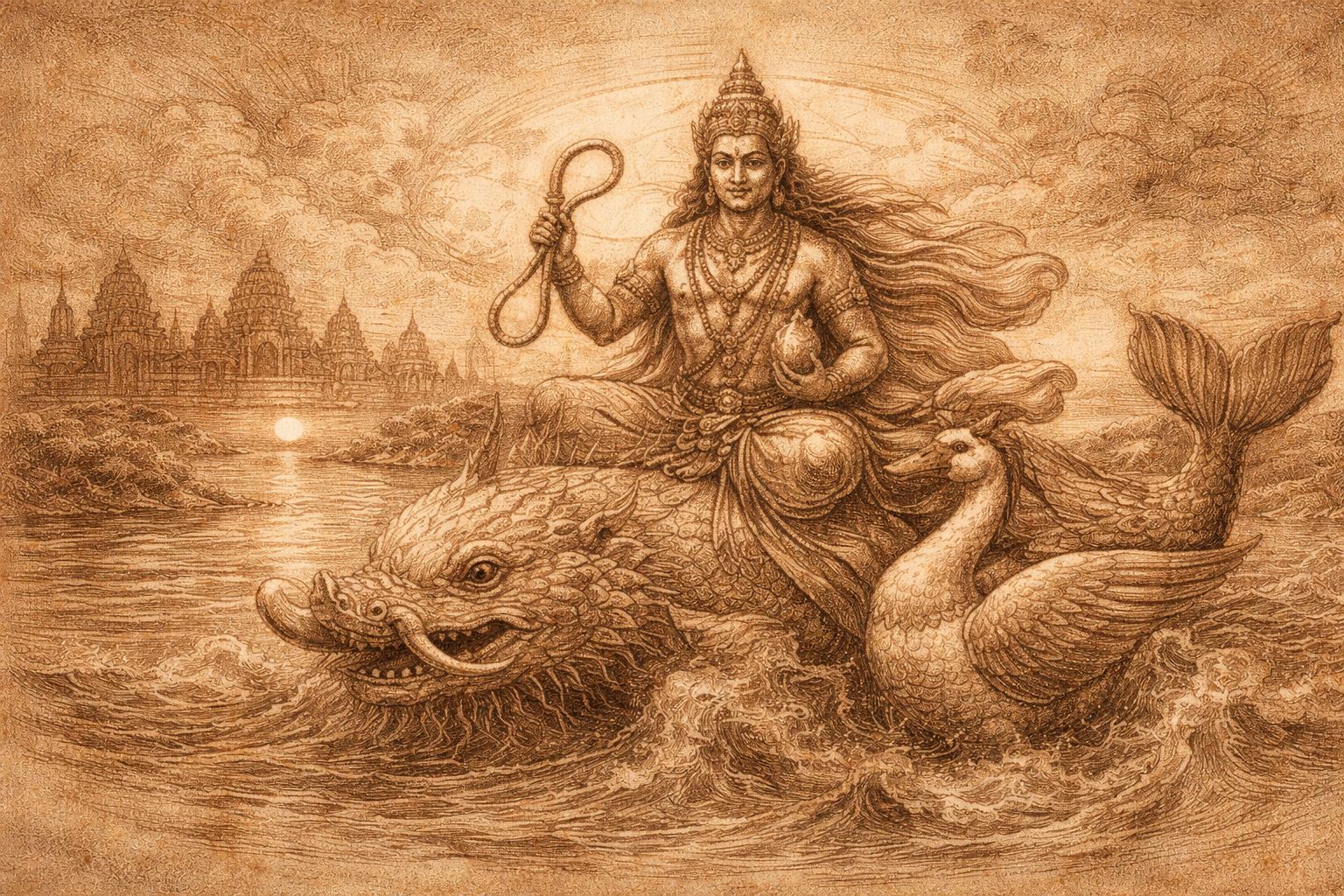

Varuna
Varuna does not thunder. He watches.
Before he becomes god of oceans and rivers, before he rides makara or hamsa, Varuna stands as sky itself—wide, enclosing, unbroken. In the earliest Vedic imagination, he is not merely a deity among others but the one who holds the world together: lord of the heavens, keeper of order, guardian of truth. His power is not force but oversight. Nothing escapes his regard.
Varuna’s domain is ṛta—the hidden law that binds cosmos and conduct into a single fabric. The seasons obey it. The stars keep their courses by it. Human beings, whether they know it or not, live within it. To lie, to break oath, to act falsely is not simply immoral; it is a disturbance in the structure of the world. Varuna feels this disturbance immediately. His judgement is quiet, patient, and inevitable.
In this early vision, the sky itself is moral space. The sun is Varuna’s eye, traversing the heavens to witness the deeds of men. Night does not conceal wrongdoing; it merely delays its recognition. This is why Varuna’s presence inspires less devotion than unease. He does not ask to be loved. He asks to be accurate.
Over time, the cosmos rearranges its hierarchy. Indra rises as warrior and storm. Vishnu absorbs the western quarter and the great cosmic task of preservation. Varuna recedes—not into irrelevance, but into depth. His authority narrows and intensifies. He becomes guardian of the West, keeper of the boundary, ruler of waters where clarity gives way to reflection and depth.
In Khmer temples, this transformation is carved into stone. Varuna appears mounted on a hamsa, the sacred goose—creature of liminal worlds, equally at home on land, water, and sky. Later, he rides the makara, half-beast, half-current, embodiment of the unknowable movement beneath surfaces. The iconography shifts, but the function remains: Varuna governs what lies beyond easy sight.
His most enduring attribute is the noose (pāśa). It is not a weapon of violence, but of restraint. The noose binds falsehood, draws the errant back into alignment, prevents disorder from dispersing unchecked. In myth, even Vishnu borrows this instrument. Sovereignty requires limits. Preservation requires binding.
Within temple cosmology, Varuna takes his place among the Navagraha, associated in the Khmer world with Mercury and the rhythms of Wednesday. This is fitting. Mercury governs flow—rivers, canals, reservoirs, passages between worlds. Varuna’s jurisdiction is not static water, but movement under discipline. The channel, not the flood. The boundary that allows life to circulate without collapse.
As a Dikpala, guardian of the West, Varuna defines not expansion but completion. West is where the sun sets, where day resolves, where things must be accounted for before they disappear from view. To stand on the western side of a temple is to face reckoning, not in fear, but in clarity.
Varuna’s lesson is austere and essential. Order is not enforced by spectacle. It is maintained by attention. By the willingness to remain answerable to what cannot be bribed or distracted. In a world of ambition and display, Varuna stands apart—not diminished, but distilled.
He reminds us that water remembers. That the sky records. That nothing done under heaven is truly unseen.
—
Receive the next work
Subscribe free to receive new work from the Lucas Varro Library by email.
More from the Library


See Also
A concise and impartial dictionary of absence, promises, quarrels, ordinary objects, and the troublesome instability of words.
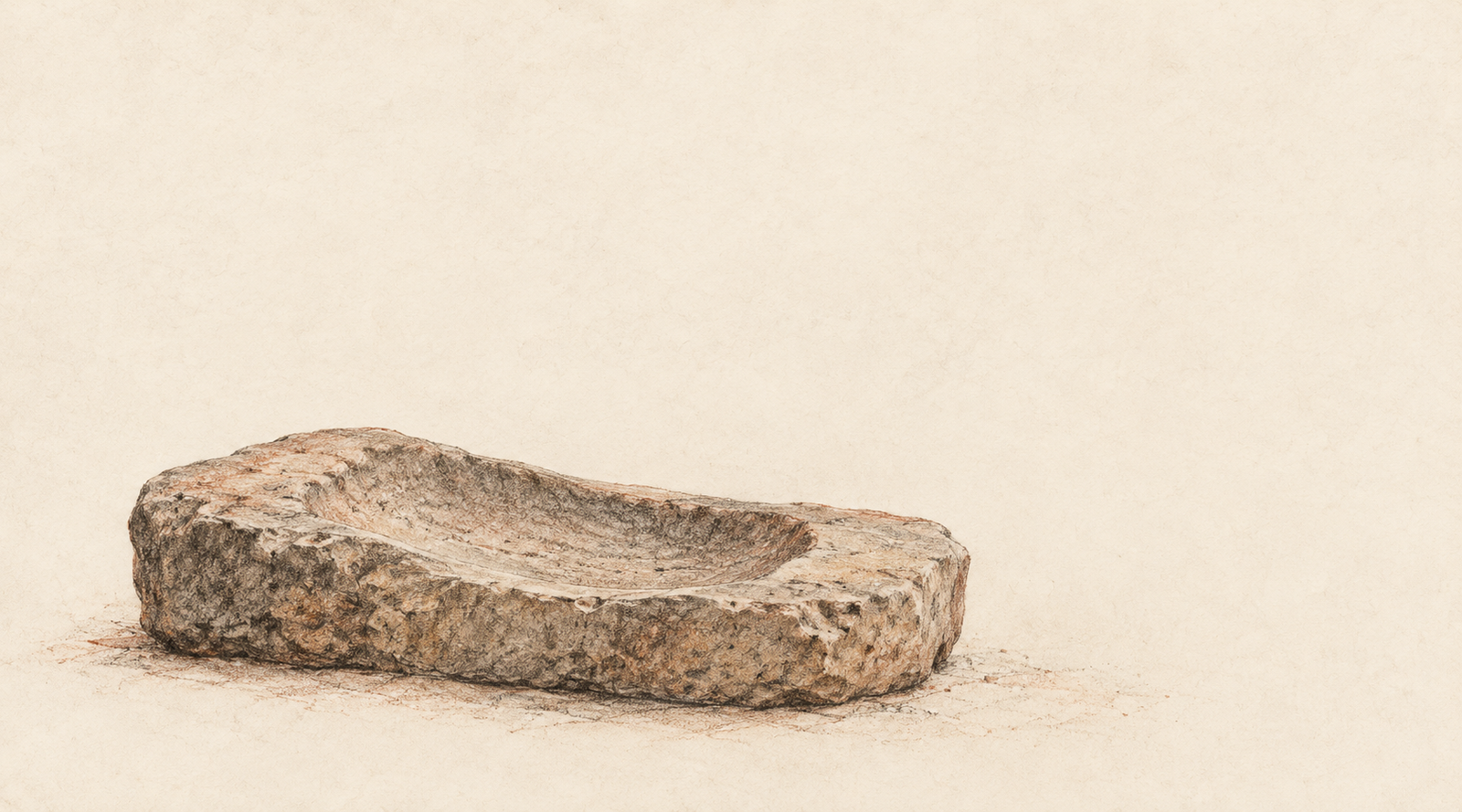

The City of Service
The temple we inherit is a building from which almost all necessity has been removed. Nothing must be brought for it to continue being what we call a temple. The sanctuary asks nothing of us. Stone is good at this kind of independence.
A living temple was otherwise.
Water had to come in. So did grain, cloth, oil, aromatic substances, fuel. The things required for worship arrived because someone carried them across a threshold.
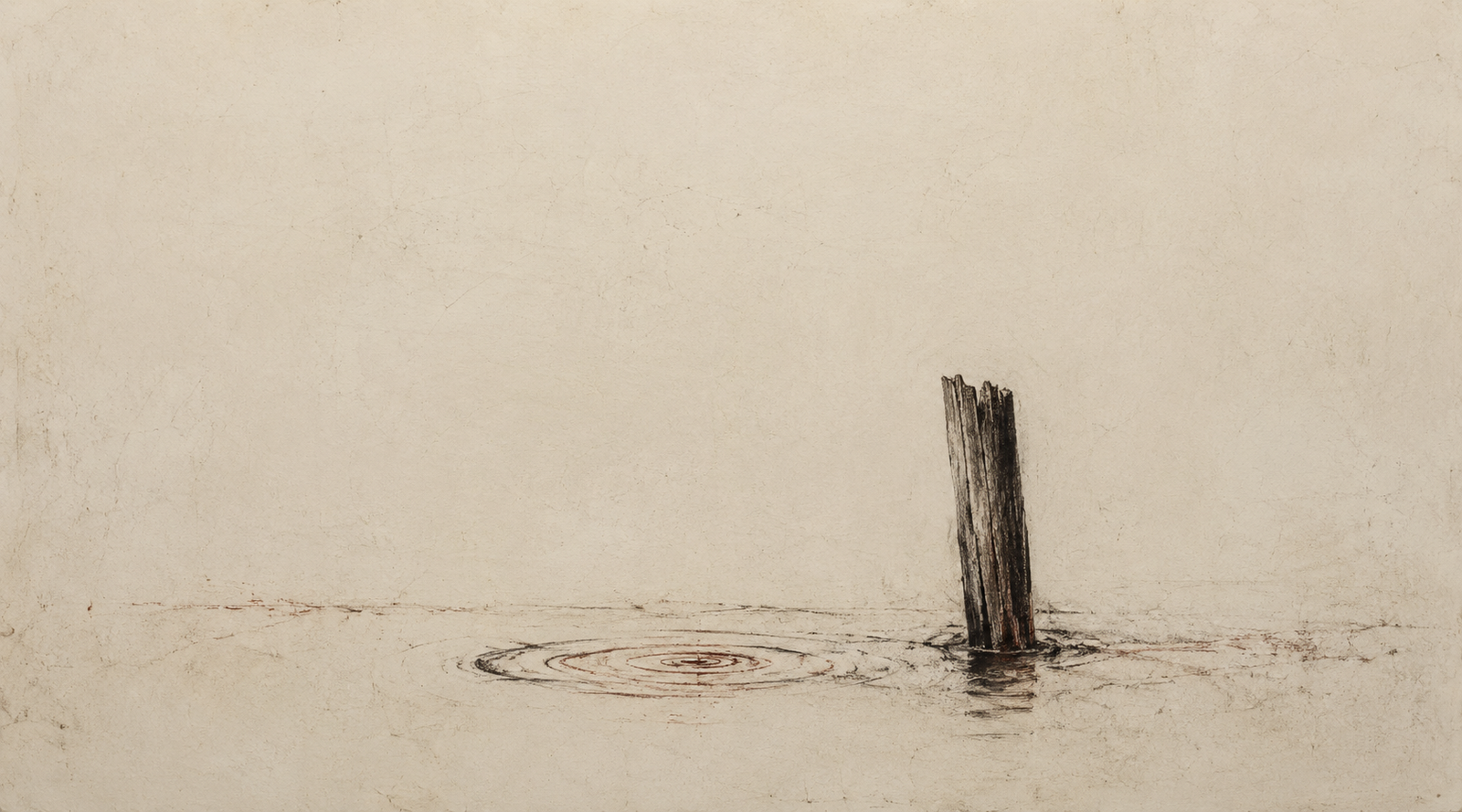

Houses of Wood, Light, and Smoke
Some of Angkor’s most intimate ruins do not rise above the ground at all. They are postholes, low mounds, hearths and ponds: durable traces of a domestic city built largely from things that decay. To restore that city is to see Angkor not only as stone, but as wood, smoke, water, repair, and people living within calling distance.