
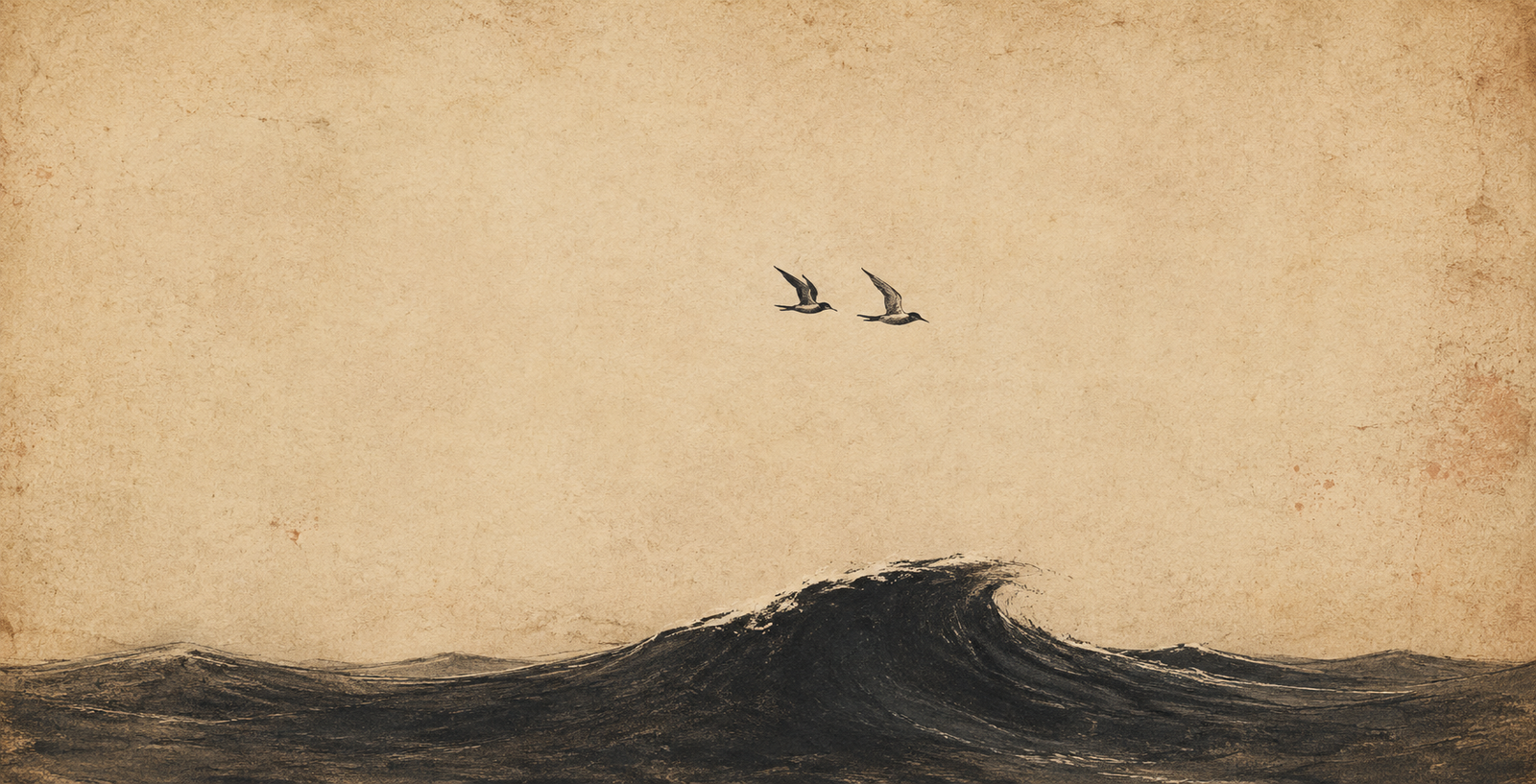

Alcyone and Ceyx — The Birds After the Storm
A warm, grave retelling of Alcyone and Ceyx, where love cannot prevent loss, but grief is given a new body.
Alcyone folded the cloak twice before morning.
The first time she folded it badly, though she would not have admitted this to anyone, least of all to Ceyx, who was sitting on the edge of their bed with the air of a man who had already left the room in his thoughts and was only waiting for his body to be reasonable enough to follow.
It was a travelling cloak, dark from use and salt at the hem. She shook it once beside the lamp, laid it across her knees, smoothed the crease with the flat of her hand, and folded it as she had folded his garments many times before. Then she unfolded it again.
Ceyx watched her do this.
He was a kind man, which is not the same as being an easily governed one. It is worth remembering that. Many sorrowful things in the world have been done by people who loved well but believed that love should stand aside when a man had business with the horizon.
“You have made that cloak smaller than I am,” he said.
“You may become smaller at sea.”
“That is not usually what men hope for.”
“No,” said Alcyone. “Men hope for many things. That is often the trouble.”
He smiled, because he loved her and because he was not yet frightened enough to understand her.
Outside, the dawn had not quite entered the house. The shutters were still closed, but the wind had found every narrow place in the wood and pressed its mouth there. It was a sea-wind, damp and restless, smelling faintly of weed and distance. The lamp burned low on the table. Beside it lay the small things of departure: a bronze clasp, a rolled belt, a knife in its plain sheath, a cup he had not finished drinking from, and the folded strip of linen she had torn for him in case of some ordinary injury.
A cut hand. A blister from rope. A shoulder bruised by labour.
The little harms for which love can make provision.
Ceyx had to sail. That was how he said it, and because he was a king, or close enough to a king for men to use that word when they wanted something from him, many people had already agreed that he had to. There were questions of counsel, kinship, obligation, signs badly read, promises half-made, and one matter concerning his father that had troubled him for too long. Men can build a whole ship out of such reasons, and after they have built it they are surprised when a woman hears only the water underneath.
“You could send another,” Alcyone said.
“I could.”
“And he would carry words?”
“Yes.”
“And hear words?”
“If he listened.”
“And bring them back?”
“If the gods permitted it.”
She looked up then. “You see? Even you cannot finish the sentence without giving them room.”
Ceyx rose and came to her. He did not take the cloak from her hands. He had been married long enough to know that some objects, in certain moments, belong to the one who holds them.
“The sea is not angry every day,” he said.
“No. That is why men trust it.”
“It is a short voyage.”
“All voyages are short when spoken beside a bed.”
He stood quietly. She lowered her head and pressed the cloak once more into shape.
There are houses in which love is loud. This was not one of them. Their love had learned the quieter arts. It knew which cup the other preferred when the morning was cold. It knew the sound of a footstep on the outer stair. It knew when not to speak. It knew how to leave the last fig on a plate and pretend not to have noticed doing so. It had become, as the deepest loves often do, a form of weather inside the rooms, felt most clearly when someone opened the door and let the air change.
Ceyx touched her hair.
“I will return before the lamp has missed me,” he said.
That was a foolish promise, but it was beautifully made. We should not despise him for it. Human beings often offer what they cannot command, because the person they love is suffering and they have nothing else in their hands.
Alcyone took the bronze clasp and fastened the cloak at his shoulder. Her fingers were steady. Her face was not.
“Do not go,” she said.
She had meant to say more. She had meant to give reasons, to name omens, to speak of the wind, to accuse the dream she had not slept deeply enough to finish. But the sentence came out bare, and because it was bare it had more authority than all the reasons would have had.
Ceyx took both her hands and kissed them.
“I must.”
There are two words by which many lives have been broken. They sound strong before the door closes. They sound very poor afterward.
At the doorway, he turned back once. She had not moved. The lamp behind her made a small gold line at the side of her face.
“Keep the house warm,” he said, gently.
“Bring yourself back to it,” she answered.
Then he went out.
For a little while she could hear him in the courtyard: his voice among the men, the sound of sandals, a horse stamping, someone laughing too loudly because dawn departures make men perform their courage for each other. Then the sounds thinned. Then they were gone.
Alcyone stood with the door open until the wind came in and troubled the lamp.
Only then did she close it.
—
The ship left under a pale morning.
There were gulls on the harbour stones, and fishermen looking up without stopping their work, and boys running where boys had no business running, hoping to see ropes cast off and men shouted at by older men. The sail took the wind cleanly. The oars moved. The harbour, which had held the vessel as a hand holds a bowl, gave it to the larger water.
Ceyx stood near the stern.
If he was afraid, he did not show it. This is less impressive than young men think and more impressive than old men admit. There are times when fear is a duty. There are times when not showing it is a kindness. He looked back until the house roofs and the harbour wall lost their clear shape. He could not see Alcyone from there, but he knew where she was in the world, and for that morning it was enough.
The sea was calm at first.
It took the ship as though it had been expecting it. The water opened, closed, lifted. Men began to speak more easily. A sailor made a joke about kings who bring too many thoughts aboard and not enough wine. Ceyx laughed, because he was not proud in that way, and because he had always preferred men who could speak plainly in front of rope.
By noon the land had become a dark line.
By evening it had become memory.
That was when the wind changed.
It did not come roaring at once. The worst things rarely arrive in their final form. First there was a turning in the air, as if some great beast under the water had shifted its sleep. Then the sail strained strangely. A rope snapped against the mast. One sailor looked toward the west and stopped in the middle of what he had been saying.
Cloud gathered where the sun had gone down.
“Take in sail,” said the master.
The men moved.
The ship leaned.
The sea, which had been a road, became a field of broken doors.
Ceyx had known storms before, but not this one. This one seemed not to blow from one direction but from every place that could not be reasoned with. Wind struck the sail, then the mast, then the bodies of men. Water came over the side in heavy sheets. The sky dropped low and lost its shape. Commands were shouted and swallowed. Oars lifted, vanished, reappeared, useless as twigs in a flood.
He held to a rope until the skin tore in his palm. He did not feel it. A man fell against him, and Ceyx caught him by the belt and shoved him back toward the mast. Another was calling the name of his mother. Another was calling a god. Another called nothing at all, which is sometimes the deepest prayer.
The ship climbed a wave.
For one breath it hung there, high in the dark, and Ceyx saw the world opened beneath him: water below, water above, water coming from the side as though the sea had remembered a hundred ways to be itself.
Then the wave took them.
The mast cracked.
Not all at once. First there was a sound like a tree deep in winter, bearing more snow than it could honourably hold. Then came the splitting. Then the fall.
Men cried out. The sail collapsed into the water like a dead wing. The ship lurched, struck, opened.
Ceyx was thrown hard against the broken rail. He tasted salt and wood and blood from his bitten lip. He tried to rise. The deck was no longer where a deck ought to be. Everything moved. Everything struck. Everything that had been made by hands was being returned to what hands cannot hold.
He thought then of Alcyone.
Not nobly. Not in a speech. No dying man has ever made as many speeches as poets have kindly given him.
He thought of her hands folding the cloak. He thought of the lamp near her face. He thought of the cup he had not finished. He thought, with a sudden foolish sorrow, that he had left the clasp crooked and she would have noticed.
The sea came over him.
He caught at a plank. For a moment it held. The storm lifted him, dropped him, turned him. He saw the ship break away into darkness. He saw one pale hand in the water and could not reach it. He tried to speak Alcyone’s name, but the sea entered his mouth and made the name its own.
There are losses no one witnesses properly. That is part of their cruelty.
The storm went on long after the ship had ceased to be a ship. It spent its rage against broken wood, against rope, against bodies, against the indifferent night.
By morning the water was almost calm.
That, too, is one of the sea’s cruelties.
—
In the house, Alcyone kept the lamp burning.
Not all day. She was not foolish. Oil had to be saved, servants watched, and households have their ordinary tyrannies. Bread must be baked even when dread has entered the flour. Floors must be swept. Messages must be answered. A woman may feel the future breaking and still be required to know whether there is enough barley.
But at evening she lit it.
Each evening she trimmed the wick and set the lamp near the shutter where the sea-wind found its way in. It was not a signal. The harbour had its own lights. It was not a charm, though perhaps all waiting becomes a charm if it lasts long enough. It was only that she could not bear the room without it.
The cloak he had not taken — for there had been another, heavier one kept aboard — lay folded in the cedar chest.
Three times she opened the chest and touched it.
Three times she closed it again.
No news came.
People spoke gently to her at first. Then carefully. Then with that bright, brittle kindness that tells a woman everyone has begun arranging her grief before she has been permitted to know its name.
“He may have been delayed,” they said.
“Yes,” she answered.
“The weather has been difficult.”
“Yes.”
“Ships sometimes shelter.”
“Yes.”
“You must not let fear master you.”
At that she looked up. “Fear is not my master. It is my messenger.”
After that they sent fewer people to comfort her.
She prayed to Juno, who had watched over marriages since before most marriages had learned how to endure themselves. She offered wine, wool, the first bread of morning. She did not ask for glory or favour or wealth. She asked for a man to come home.
Juno heard her.
The gods hear many things. That is not always the same as answering them. But this prayer troubled her, because it came from the old place where marriage is not contract, not appetite, not arrangement, but a room two people have spent years making habitable for one another. Even gods, when they are not busy being splendid, sometimes understand the force of such rooms.
Juno could not return Ceyx.
There are limits, though gods do not like to speak of them. Or perhaps there are not limits, only laws even they will not cross because the crossing would unmake too many other things. In either case, Ceyx was gone from the world of breathing men, and Alcyone still waited beside a lamp.
So Juno sent for Iris, whose feet knew the road between sky and sea and sleep.
“Go to the house of dreams,” she said. “Tell them to send the truth. Not a riddle. Not a sign that can be softened by hope. The truth.”
Iris bowed and went.
She passed beyond the high bright air, beyond the places where clouds are born, beyond the last colour of evening. She came to the valley where Sleep keeps his house, if house is the word for a place so quiet that even the stones seem to be listening inward.
No rooster called there. No dog barked. No hinge complained. A river moved near the gate, slow and dark, whispering against its banks with a sound that made even memory loosen its fingers.
Sleep lay in shadow.
Around him drifted dreams: thin ones, bright ones, foolish ones, dreams of teeth and falling, dreams of lost mothers, dreams of feasts, dreams of doors opening into rooms the dreamer had never seen and yet somehow recognised. They moved like moths around a lamp that had no flame.
Iris stood at the threshold and spoke Juno’s command.
Sleep, who disliked being woken even by gods (and in this, at least, many mortals would agree with him), stirred just enough to hear. Then he called one of his sons.
Morpheus came forward.
He was the dream who could take the shape of any human being and make the likeness true enough to break the heart. Not merely the face. Faces are easy, or so the dreams say. Morpheus knew the weight of a shoulder, the habit of a hand, the way one person stands when speaking to another whom he loves. He knew the little delays by which the dead become recognisable to the living.
“Go,” said Sleep. “Take the form of Ceyx. Tell her.”
So Morpheus went.
—
That night Alcyone slept because the body sometimes betrays the heart by needing rest.
The lamp had burned low. The shutters were closed. The sea-wind had tired of searching the room and lay quiet in the cracks.
In her dream, the door opened.
Ceyx stood there.
At first she felt joy, and the joy was so complete that it almost spared her. He was in the doorway as he had been that morning before leaving, his cloak at his shoulder, his head slightly bent because the lintel was low and he always forgot it until the last moment. She began to rise.
Then she saw the water.
It darkened his hair. It ran from the hem of his cloak. It gathered where his feet should have warmed the floor. His face was the face she loved, but changed by a cold no hearth could answer.
“Alcyone,” he said.
She could not speak.
“My wife.”
“No,” she said then, because the heart has few words when it is asked to understand too much.
“I tried to come back.”
“You are here.”
“No.”
The word entered the room more quietly than the water, and did more harm.
She reached toward him. He did not step away, but neither did he come nearer. Dreams are cruel in their obedience. They will show what is true, but not always let it be touched.
“The storm took the ship,” he said. “The sea has me. Do not wait at the door.”
“Do not say that.”
“I did not leave you willingly.”
“I know.”
That was the mercy in her. Even in the dream, even standing inside the first certainty of loss, she gave him that.
His face changed then — not away from Ceyx, but further into him. The dream had found the little sorrow between his eyes, the one she had known when he was ashamed of having caused pain and could not yet undo it.
“I should have listened,” he said.
She shook her head. “Come home and I will scold you properly.”
He smiled, and that was the worst of it.
“You always did prefer to finish things in order,” he said.
The dream trembled.
Somewhere far away, or very near, water struck wood.
“Find me if the sea permits it,” he said. “But do not give your life to waiting. I am not on the road. I am not delayed. I am gone.”
“No.”
“Alcyone.”
This time her name was not summons but farewell.
She woke with her hand outstretched toward the door.
The lamp had gone out.
—
Before dawn she rose.
No one in the house heard her. Or perhaps someone did and did not dare to stop her. She took the cloak from the cedar chest and wrapped it around herself, though it was his and too large at the shoulder. She did not light the lamp. She did not call for sandals. She went barefoot through the sleeping house and out into the grey before morning.
The path to the shore knew her. She had walked it in other weathers, beside Ceyx, with talk between them or silence, which is one of marriage’s better languages. Now the stones were cold. Gulls stood along the strand, watching the water with the professional patience of creatures who expect the sea to give up something eventually.
The storm had ended.
The world looked washed and innocent.
This angered her.
There should have been some mark on the sky. Some wound in the air. Some crack running through the morning so that everyone who woke would understand what had happened in the night. But the clouds were lifting. The tide breathed in and out. The water shone where the first light touched it.
Alcyone walked to the edge.
There was wreckage there: a length of spar, a twist of rope, a broken oar with weed caught around it. She saw these things one by one, as if the world had decided to teach her loss through objects before it asked her to bear the whole.
Then she saw him.
Not clearly at first.
The sea does not return what it has taken in a manner suitable for the living. It gives back slowly, turning, withholding, offering and withdrawing. A shape moved beyond the next wash of foam. The cloak around her shoulders pulled in the wind. She went forward.
The water came over her feet.
“Ceyx,” she said.
The shape lifted, fell, came nearer.
She knew him before she should have been able to know him. That is one of love’s terrible accuracies. The face may be changed, the hair darkened, the body carried strangely by water; love knows the shoulder, the hand, the ruin of what it has touched in life.
She went into the sea.
The cold took her knees. Then her waist. Someone called behind her, perhaps, but the sound was small and belonged to a world that had not yet understood.
“Ceyx.”
She reached him as the wave brought him close.
For one moment she held him. Not as she had held him in the room, not as one living body holds another, but with the desperate courtesy of the bereaved, who understand that even what is gone must be received.
Her mouth touched his wet hair.
“You came back,” she whispered.
It was not true. It was the only true thing she had.
The wave drew at him.
She held harder.
Another wave came.
There are griefs that make the body forget the shore. The old stories know this. They do not praise it. But they know.
Alcyone felt the pull of the water around her legs, the weight of the cloak, the cold entering, the shore behind her full of voices. She was not thinking of death. She was thinking only of not loosening her hands.
Above her, the sky opened.
Not greatly. No thunder. No blaze. The gods were quiet for once, and because they were quiet they were almost kind.
Juno looked down. Perhaps she remembered the prayers. Perhaps she remembered the lamp. Perhaps she remembered that marriage, when it has been true, is one of the few mortal things that can make even the gods hesitate.
She did not bring Ceyx back.
She did not restore his breath. She did not return them to the room, to the cup, to the cloak folded over the chair, to the small quarrels and shared figs and mornings not yet broken.
She changed the shape of the grief.
Alcyone felt it first in her hands.
The fingers that had gripped the wet cloth grew light. Her arms, straining against the pull of the sea, thinned and opened. The heavy cloak slipped from her shoulders, or perhaps became something else before it fell. Her cry changed in her throat.
The water released her.
Feathers broke from her skin, small and salt-dark. Her body lifted, astonished by its own lightness. Beside her, from the place where Ceyx had been held by the wave, another bird rose, crying out with a voice that was not human and yet was not strange to her.
They beat their wings above the water.
Two small birds.
That was all.
Not splendid. Not golden. Not large enough to command anyone’s worship. They were almost lost at once against the breadth of sea and sky. But they turned toward one another in the air with such exactness that those watching from the shore fell silent.
The birds circled once above the dark wave.
Then they flew together.
Since then, the old people say, there are days in winter when the sea grows strangely calm, as though some ancient pity has laid its hand upon the water. They call them halcyon days. They say the small birds nest then upon the quieted sea, and the wind, remembering, holds back its breath.
The storm still happened.
The ship still broke.
The room was still emptied.
The lamp still went out.
But somewhere above the water, two birds fly close enough that the space between them is no longer the whole world.
—
Receive the next work
Subscribe free to receive new work from the The Hospitable Dark Library by email.
More from the Library

See Also
A concise and impartial dictionary of absence, promises, quarrels, ordinary objects, and the troublesome instability of words.
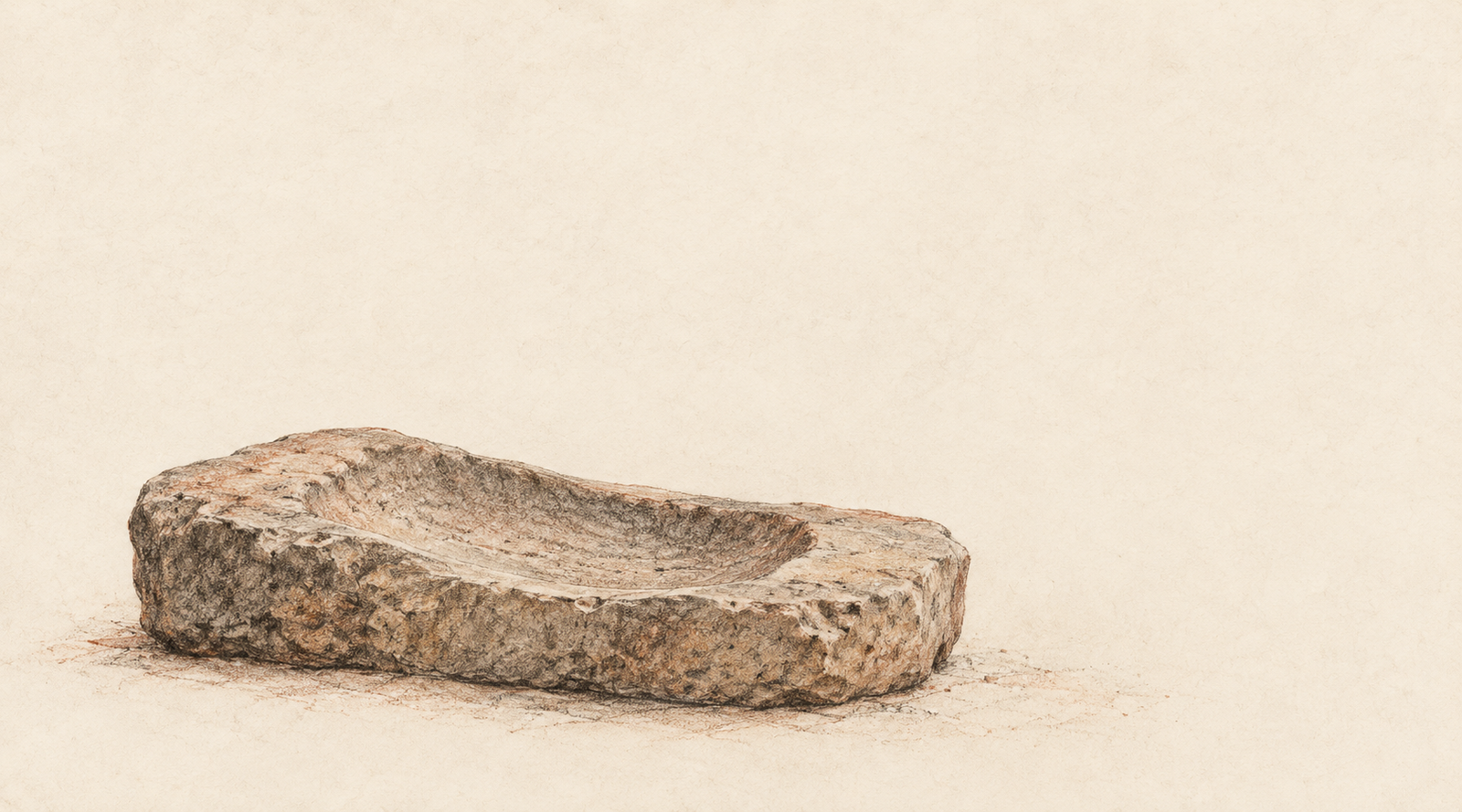

The City of Service
The temple we inherit is a building from which almost all necessity has been removed. Nothing must be brought for it to continue being what we call a temple. The sanctuary asks nothing of us. Stone is good at this kind of independence.
A living temple was otherwise.
Water had to come in. So did grain, cloth, oil, aromatic substances, fuel. The things required for worship arrived because someone carried them across a threshold.
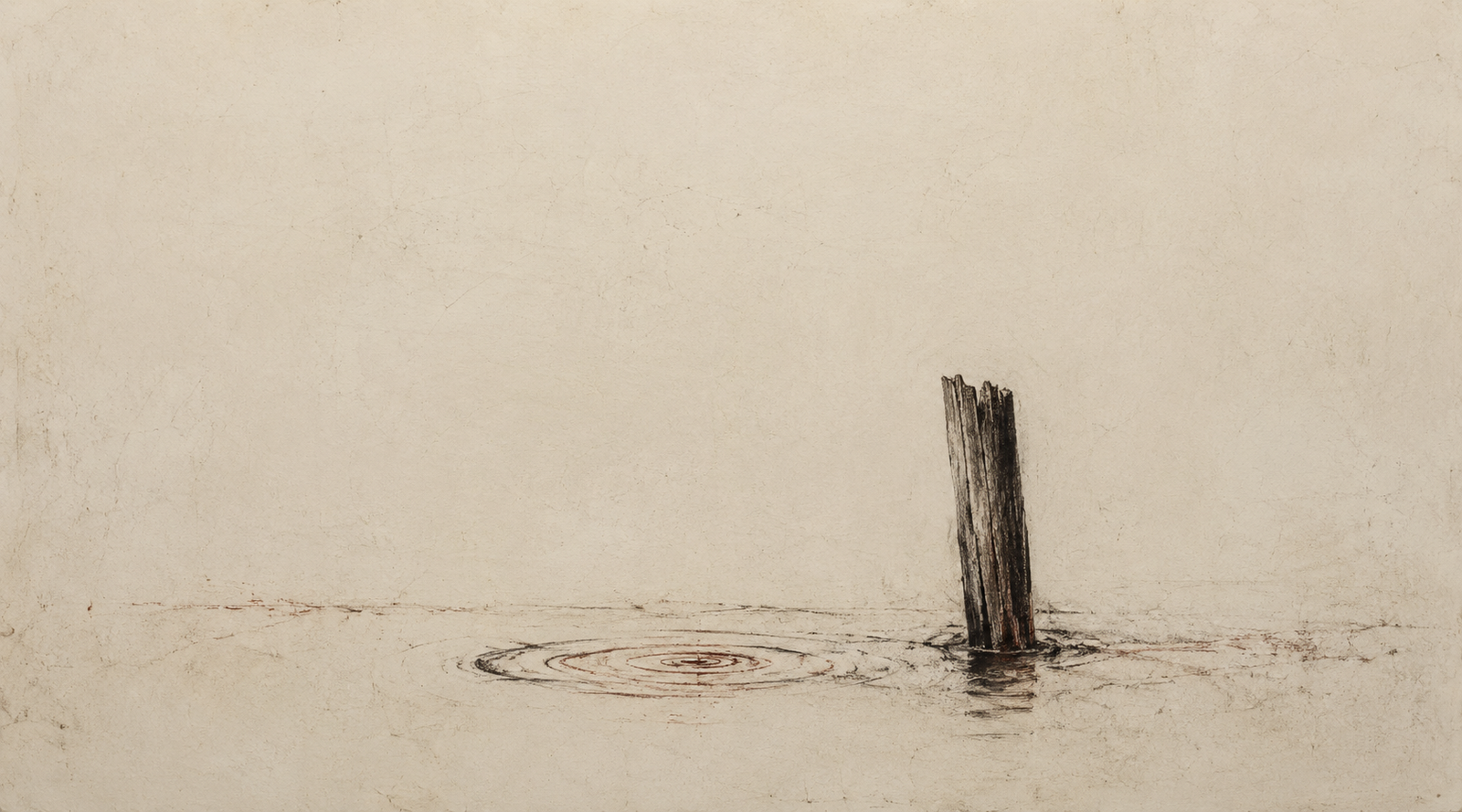

Houses of Wood, Light, and Smoke
Some of Angkor’s most intimate ruins do not rise above the ground at all. They are postholes, low mounds, hearths and ponds: durable traces of a domestic city built largely from things that decay. To restore that city is to see Angkor not only as stone, but as wood, smoke, water, repair, and people living within calling distance.