
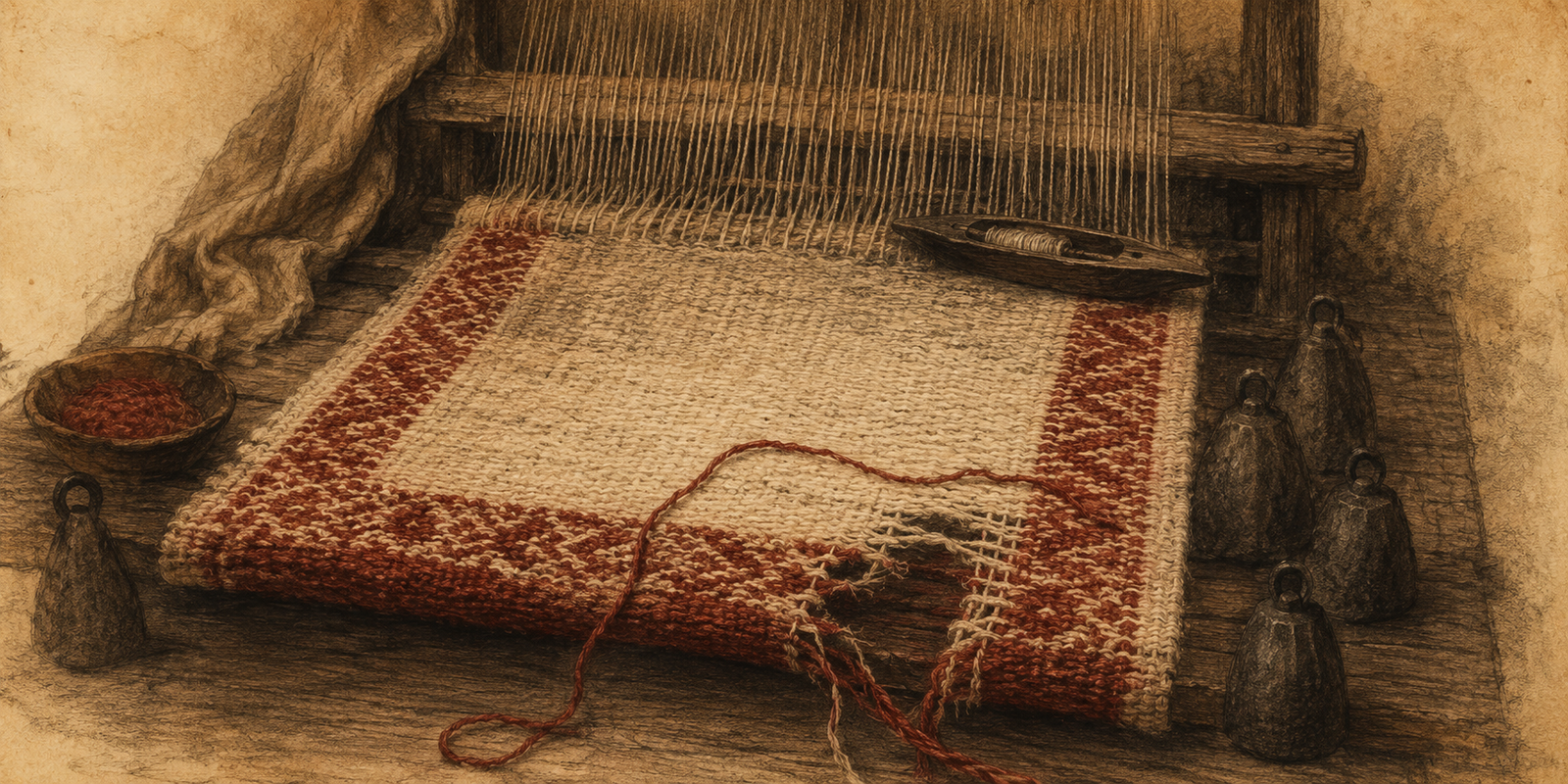

Arachne — The Weaver and the Goddess
A warm, grave retelling of Arachne’s myth, where mortal skill becomes dangerous in the presence of divine power.
Arachne learned early that thread had a temper.
Some threads sulked. Some frayed if pulled too sharply. Some yielded only when coaxed through the fingers with patience, and some seemed to have been spun from the stubbornness of goats. Wool remembered the hillside. Flax remembered the field. Purple thread, because it had been born from little sea-creatures crushed for their colour, remembered the violence of its making and liked to declare itself in the cloth.
Arachne knew all this before she was old enough to be trusted with a full loom.
Her father was a dyer, and his house in Lydia smelled of mordant, wet wool, river mud, smoke, and those strange sharp shells from which rich men purchased the colour of their importance. He was not a rich man himself. That is one of the arrangements of the world children notice before adults think to explain it: the man whose hands make purple may still eat from a plain wooden bowl.
But Arachne had never minded plain things.
She liked the rough bench by the wall, because the light fell there longest in the afternoon. She liked the clay jar where her mother kept the clean spindles. She liked the loom-weight in her palm, heavy and ordinary, as if some small part of the earth had agreed to help her keep order. She liked the moment before a pattern began, when the threads were stretched and waiting, and the whole cloth existed nowhere except in her mind.
There are children who are praised for being clever, and children who are scolded for being restless, and children whom everyone says are beautiful because no one has yet discovered what else to say of them.
Arachne was none of these.
By the time she was ten, people had begun saying only one thing.
“Look at her hands.”
Not her face. Not her manners. Not even her eyes, though they were bright and quick and missed very little.
Her hands.
They moved with a calm so complete it made older women stop speaking. They pinched, passed, lifted, beat, tightened, loosened, and smoothed as if they had been taught by something older than instruction. A pattern did not grow beneath them so much as emerge, like a thing long hidden under water.
At first, this made her mother proud.
Then careful.
Pride is a warm thing in a house when it sits beside the hearth and behaves itself. But when it grows tall enough to be seen from the road, neighbours begin to arrive carrying admiration in one hand and danger in the other.
Women came from nearby houses and stood near the door. Girls came pretending to borrow combs or ask about dye. Merchants came because merchants have an excellent nose for anything that may be praised into profit. Even old men who knew nothing about weaving except that women did it began making remarks with their hands clasped behind their backs.
“That child has been blessed,” one said.
Arachne’s mother crossed herself in the old country fashion, though not too obviously.
“By Athena, surely,” said another.
At this, Arachne glanced up.
Only for a moment.
Then she returned to the cloth.
You must understand: Athena was not a small name in a weaving room. She was not a pretty story told to make work feel grander than it was. Athena was the clear-eyed goddess of the shuttle, the measured hand, the counted thread, the disciplined mind that turned wool into order. A woman could pray to Aphrodite for love, to Artemis for safety, to Demeter for grain enough to last the winter. But at the loom, whether she said the name aloud or not, she lived under Athena’s gaze.
So when people said Arachne had been blessed by Athena, they meant it kindly.
At first.
Kindness, however, is not always received in the form in which it is given.
Arachne did not think Athena had guided her hands. She knew the long days. She knew the sore wrists, the bitten lip, the ruined cloths cut apart in anger, the knots picked loose by lamplight after everyone else had slept. She knew the difference between a gift and labour, and she had never liked the habit people had of seeing only the flower and praising the weather.
“She taught herself,” her father said once, in the tone of a man trying to save a room from becoming difficult.
Arachne loved him for that.
But love does not always teach prudence.
More people came. More cloths left the house. Word travelled, as word does, growing taller at every village. Soon they said no girl in Lydia wove like Arachne. Then no woman. Then no mortal.
There are comparisons that should be stopped at the door.
This one was invited in and given wine.
“Not even Athena herself—” someone began one afternoon.
The room went still.
Arachne’s mother dropped her spindle.
Her father, who had been sorting dyed skeins near the doorway, closed one hand around a length of wool until purple stained his thumb.
The woman who had spoken laughed nervously.
“I mean only—”
“I know what you mean,” Arachne said.
She did not lift her eyes.
That was the trouble. If she had looked up, if she had blushed, if she had smiled and said, “Do not speak so foolishly,” the thing might have passed. The gods are accustomed to mortal carelessness; they hear a great deal of it, and much of it, one hopes, is lost in the wind.
But Arachne kept weaving.
And after a while she said, very quietly, “Let her come and see.”
Now, there are sentences that enter the world as sparks. They are small. They are bright. They are almost nothing.
Then they find straw.
The woman gasped. Arachne’s mother made a sound — not a word, only the beginning of one. Her father said her name once, low and warning.
Arachne tightened a red thread with the tip of her nail.
“What?” she said. “If the work is hers, let her claim it. If it is mine, let people stop giving it away.”
No one answered.
That was wise.
Unfortunately, silence is not the same as undoing.
By evening, half the town knew. By morning, the other half knew a version improved by distance. By the next day, people were repeating what Arachne had said with hands over their mouths, which is how people signal disapproval while making quite sure the words survive.
Arachne worked.
Her mother pleaded once, then stopped, because she saw that pleading made the girl’s face harder. Her father tried anger, then tenderness, then a kind of exhausted caution. Arachne listened to him. She loved him. Then she returned to the loom.
It would be easy here to say she was proud, and she was.
But pride is a coarse word for a complicated thing.
Arachne had been poor in a house full of colours other people would wear at feasts. She had watched men praise cloth and bargain down the hands that made it. She had heard her work called a blessing when what it had cost her was visible in every rough place on her fingers. She had lived, as many gifted mortals do, between admiration and erasure.
So yes, she was proud.
But she was also tired of being made smaller than her own hands.
On the third morning after the sentence had been spoken, an old woman came to the doorway.
She was bent under a grey shawl, and her face was lined so deeply that shadow seemed to have settled there for good. She carried no basket, no spindle, no business anyone could name. Yet she stepped inside with the confidence of a person who expects a place to make room for her.
Arachne’s mother rose at once.
“Come in,” she said, because hospitality is sometimes simply the terror of being found wanting.
The old woman looked around the room. Her gaze passed over the dyed skeins, the loom weights, the bowls of carded wool, the half-finished cloth. At last it came to rest on Arachne.
“So,” she said.
Her voice was dry as a spindle left too long in the sun.
“So,” said Arachne.
The old woman smiled. It was not a kind smile, but it was not cruel either. It had too much knowledge in it for either.
“You are the girl who thinks herself equal to Athena.”
“I am the girl who knows what she has made.”
“A narrow distinction.”
“A useful one.”
The women in the room forgot, all at once, how to breathe.
The old woman came closer. Her staff tapped once against the packed earth floor.
“You are young,” she said. “Youth mistakes heat for light. Take the praise and give thanks. Say the goddess has been generous. Keep your work. Keep your name. Keep your human shape in the world.”
There was mercy in that. Hard mercy, perhaps, but mercy even so.
Arachne heard it.
That must be said of her.
She heard the door opening in the old woman’s words. She heard the path by which the whole matter might yet be made smaller. All she needed to do was lower her head, speak the expected sentence, and let the story become one of those little warnings families keep for winter evenings: how our Arachne nearly offended the goddess, but was wise in time.
Her mother looked at her.
Her father looked at her.
The loom waited.
Arachne placed one hand on the woven cloth before her. The wool was warm from the day.
“If Athena wants my thanks,” she said, “let her earn them by doing better.”
The old woman stood very still.
Then the shawl fell from her shoulders.
It did not drop like cloth. It seemed to become unnecessary. Age left her face the way mist leaves a hill when the sun strikes it. Her back straightened. Her eyes cleared into grey brightness. The staff was gone; in its place there was a spear, or the thought of one, or perhaps only the certainty that a spear would come if she wished it. The room widened without growing larger.
Athena stood in the dyer’s house.
No one screamed.
This is worth noticing. People often imagine that when gods enter a room, mortals make dramatic sounds. Sometimes they do. More often, they recognise at once that sound is useless.
Arachne’s father bowed his head.
Her mother sank to the floor.
Arachne remained seated at the loom.
Athena looked at her for a long time. If there was anger in the goddess, it was not the flushed anger of embarrassment. It was colder, steadier, and far more dangerous: the anger of an order challenged in the one place it most believed itself secure.
“Very well,” said Athena.
A second loom appeared beside her.
No hand carried it in. No thunder announced it. The room simply made space, as rooms do when a god has decided what must be present. One moment there was one loom beneath the roof; the next there were two, and the second was finer than any mortal carpenter had ever made. Its wood was smooth as still water. Its weights shone faintly in the house’s ordinary light.
People gathered outside the house. Of course they did. Fear rarely keeps people away from what they most want to see. They stood in the yard, at the window, beyond the threshold, each of them aware that this was dangerous and each of them unwilling to leave.
Athena sat.
Arachne sat.
The contest began.
Now, if you have never watched a master weaver at work, you may think the act too quiet for a contest. There are no horses. No bronze. No shouted commands. No dust. Only thread passing through thread, only hands moving, only the small beat of the weft pressed home.
But there are wars less tense than a room in which two makers are being watched.
Athena wove first of order.
Her cloth opened with Olympus in its high brightness: the gods seated in their proper places, each rendered with such clarity that even those who had never seen a god felt they had always known them. Zeus held the centre. Hera sat beside him, queenly and unsmiling. Poseidon had the sea gathered under one hand. Apollo shone. Artemis stood apart and wild. Hermes was already half turned toward some errand no one else had noticed.
And Athena — yes, Athena placed herself there too. Why should she not? She wove herself as she was: helmeted, clear-eyed, unsoftened, the guardian of skill, of cities, of minds sharpened toward use. Around the border she showed mortals who had challenged the gods and learned, too late, the shape of the world they lived in.
It was magnificent.
No honest person could have denied it.
Even Arachne did not deny it.
Her father saw that. He saw the small change in his daughter’s face: not surrender, not envy, but the wound of admiration. Later, when people told the story, they would forget this part. They would say only that Arachne challenged a goddess. They would not say that, for one breath, she loved the work that would undo her.
Then Arachne began.
She did not weave Olympus enthroned. She did not weave the gods as the gods preferred to be remembered.
She wove Europa beneath the bull’s lowered head, one hand still reaching toward the shore that had already become too far away. She wove Leda by the river, the white wings closing the world around her. She wove Danae in the locked room where gold fell like weather and no lock, however carefully made by men, could keep a god from entering. She wove Semele, who had asked to see glory and was answered with more than flesh could bear.
Around them she wove smaller things: women looking away; doors left open; servants who had seen too much; children born into stories no one had asked them to enter; mothers holding silence like a hot coal.
The room changed as she worked.
Not visibly. The walls remained clay. The loom weights hung straight. The sunlight kept its place on the floor.
Outside, a child who had been whispering stopped. Somewhere near the threshold, a woman drew her shawl across her mouth. Even the flies seemed to keep to the darker corners.
Arachne’s cloth was beautiful.
Worse than that, it was true.
The people outside shifted. No one spoke. One of the older women made the sign against ill luck and then lowered her hand at once, as if afraid the goddess might see even that. Some looked at Athena. Some looked away from Athena, which was also a form of looking. Arachne’s mother covered her mouth with both hands.
Arachne wove on.
The red thread moved through the cloth like a wound that had learned discipline.
Athena’s face did not change.
That may have been the most frightening thing of all.
At last Arachne stopped. She tied the final thread. She smoothed the cloth once with both hands. Then she lifted her eyes to the goddess.
There was no triumph in her expression.
Only the exhaustion of someone who had finally said what she meant.
Athena rose.
For a moment, nobody knew what had been decided. Perhaps even Arachne did not know. Perhaps she thought — because mortals do sometimes think impossible things in the clear instant after danger — that the goddess might praise the work. Not forgive it, perhaps. Not love it. But acknowledge it.
Athena came close.
She looked at the cloth.
Then she struck it.
Not with thunder. Not with flame.
With her hand.
The sound was small.
Arachne flinched as if the blow had landed on her body.
Athena struck the cloth again, and this time threads broke. A line of Europa’s shore vanished. A servant’s face came apart. A red border loosened and fell in a soft, terrible loop.
Arachne made one sound then. No word. Only a sound pulled from the place where work and self had been bound too tightly together.
Her father stepped forward.
Athena turned her eyes on him.
He stopped.
That was all. A father may love his daughter more than breath and still know when breath is the only thing left to keep.
Arachne gathered the torn cloth to herself. Her hands were shaking now. Not from fear alone. From rage, yes. From grief. From the humiliation of seeing the thing she had made become breakable in the hands of someone who did not need to be careful.
“Was it false?” she said.
No one answered.
So she asked the goddess.
“Was it false?”
Athena’s gaze was bright enough to hurt.
“You mistake truth,” she said, “for innocence.”
Then the goddess reached toward her.
What happened next has been told many ways. Some say grief took Arachne first and Athena changed her before death could claim her. Some say the goddess touched her in anger. Some say pity entered late, as pity often does, after it would have been more useful. Old stories are not always careful to preserve the order in which mercy and punishment arrive.
This much is certain.
Arachne was changed.
The room saw it. The women at the door saw it. Her mother saw and did not understand what she was seeing until understanding came and nearly broke her. Her father reached for his daughter and found the air full of absence.
There was no monstrous display. No spectacle fit for men to repeat over wine. Only a terrible lessening and concentrating, as if the human life of Arachne had been drawn through a needle so fine that almost none of it could pass.
Her voice was gone.
Her place at the loom was gone.
Her hands, those hands everyone had once said to look at, were no longer hands.
But from the beam above, where shadow gathered near the roof, something small moved.
A thread descended.
Then another.
The people in the room watched as the little creature began to weave.
No one spoke for a long time.
Athena looked up. Her face was unreadable. That is another thing people dislike about the gods: even when they have done exactly what they intended to do, one cannot always tell whether they are satisfied.
“She will weave,” said the goddess.
It was sentence, gift, and curse together.
Then she was gone.
The second loom vanished with her.
The torn cloth remained.
For a while after, people did not come to the dyer’s house. Then, because people are what they are, they came again. Not inside. Not at first. They stood near the doorway and asked careful questions. They wanted to know whether the spider was still there. They wanted to know whether it made webs differently from other spiders. They wanted to know whether the goddess had been angry, whether Arachne had screamed, whether the cloth still existed.
Arachne’s mother shut the door on them.
Her father kept the cloth.
He folded it, though the torn places made folding difficult, and placed it in the chest where the family kept things too important for daily use and too painful to display. He never sold another purple cloth at the old price. Men complained.
He did not answer them.
As for the spider, she remained in the corners of the house.
Sometimes near the loom. Sometimes above the door. Once, in winter, near the place where her mother sat carding wool with hands that had grown older very quickly.
The webs she made were unlike any others.
Of course they were.
In the morning, when light entered through the smoke-hole and touched the high beams, the threads shone briefly silver. They caught dust, gnats, ash, the smallest loosened fibres of dyed wool. They trembled at breath.
They held.
Children born later were told not to harm spiders.
When they asked why, their mothers said, “Because they are weavers.”
When they asked again, as children do, some were told the story of Arachne, though not all of it and not always truthfully. In one house she was a wicked girl who insulted a goddess and was punished. In another she was a foolish girl who forgot humility. In another she was a great artist whom the gods could not bear to see.
Stories, like threads, remember the hand that draws them.
But somewhere beneath all the versions, one thing remained.
The goddess did not take the gift from her.
That was the mercy.
And the punishment.
—
Receive the next work
Subscribe free to receive new work from the The Alexander Series Library by email.
More from the Library


See Also
A concise and impartial dictionary of absence, promises, quarrels, ordinary objects, and the troublesome instability of words.

The City of Service
The temple we inherit is a building from which almost all necessity has been removed. Nothing must be brought for it to continue being what we call a temple. The sanctuary asks nothing of us. Stone is good at this kind of independence.
A living temple was otherwise.
Water had to come in. So did grain, cloth, oil, aromatic substances, fuel. The things required for worship arrived because someone carried them across a threshold.

Houses of Wood, Light, and Smoke
Some of Angkor’s most intimate ruins do not rise above the ground at all. They are postholes, low mounds, hearths and ponds: durable traces of a domestic city built largely from things that decay. To restore that city is to see Angkor not only as stone, but as wood, smoke, water, repair, and people living within calling distance.