
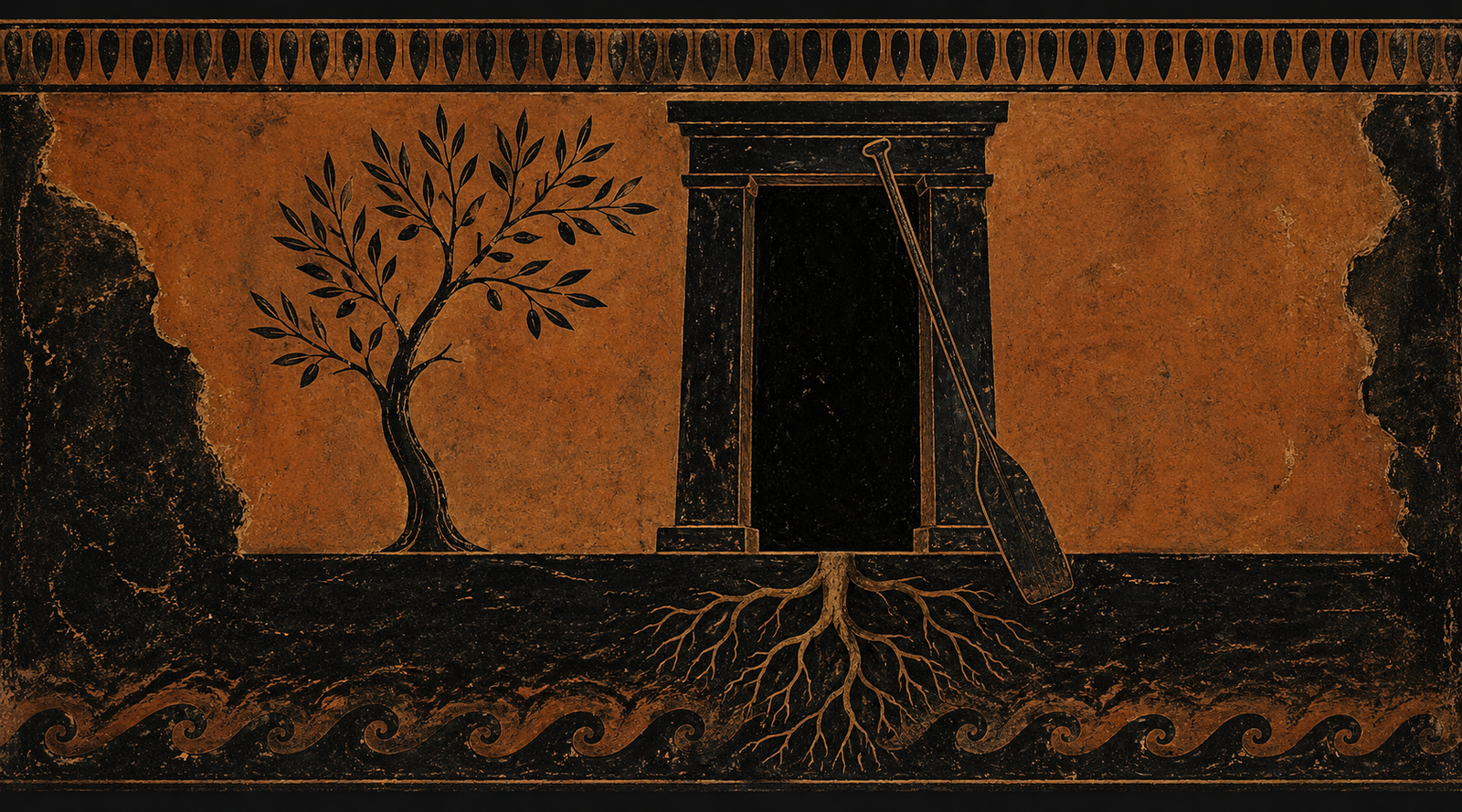

Before the Door: On No Man Comes Home
A threshold statement for a twelve-canto Odyssey retelling about concealment, recognition, return, and the cost of surviving long enough to come home.
There are stories that appear to move towards home.
And there are stories that discover, very late, that home is the severest place of all.
The Odyssey is often remembered as a tale of wandering: islands, monsters, enchantresses, storms, songs, shipwreck, disguise, vengeance, bed, reunion. It contains all these things. It is generous enough to hold adventure, marvel, danger, humour, grief, cunning, recognition, and the dark intelligence of household law. It has crossed centuries because it can be read by children as a tale of return and by adults as a study in what return requires from those who have survived too much.
But beneath the voyage lies a harder wound.
Odysseus survives by concealment.
He lies, brilliantly. He hides, patiently. He becomes Nobody and escapes death. He listens while others are sealed against hearing. He enters his own island as a stranger, his own house as a beggar, his own marriage by way of a test. He withholds in order to continue. He survives because he can make himself difficult to know.
Yet home asks another thing.
A house cannot be restored by a man who remains only strategy. A wife cannot receive a legend in place of a husband. A son cannot be healed by a name. A father cannot embrace a method. A dog knows by scent what a hall refuses to see. A scar speaks before speech is safe. A bow remembers the hand. A bed proves what fame cannot.
No Man Comes Home is a twelve-canto literary retelling of The Odyssey written from that pressure.
It does not begin with the hero.
It begins with the damage.
The house has been occupied by appetite. Penelope has learned the intelligence of delay. Telemachus has grown inside absence. Servants have been tested by years rather than declarations. The suitors have mistaken duration for permission. Ithaca has become a place where wrong has had time to make itself ordinary.
Into this world Odysseus must return.
Not as a simple hero.
Not as a restored king.
Not as a man whose sufferings cancel the sufferings caused by his absence.
He returns as someone who has survived by arts that intimacy cannot wholly trust.
The twelve cantos are not episodes arranged for ornament. They are twelve surfaces on which return becomes visible and less simple: absence, sonship, captivity, nakedness, naming, displacement, the dead, command, disguise, recognition, marriage, morning.
Each canto advances the story.
More importantly, each canto advances the reader’s capacity to feel the final silence correctly.
For this is not a poem of easy restoration.
The son goes out seeking news and discovers that his father is larger in other men’s mouths than in his own life. Calypso offers immortality, and Odysseus chooses mortality not because it is noble, but because only the mortal world can know him completely enough to wound him. Nausicaa receives a naked stranger at the river, and civilisation begins in the discipline of need before another’s fear. The Cyclops is defeated by Nobody, but the name Odysseus calls the storm.
The oar waits to be misunderstood inland.
The dead teach him that the way home includes what home has already lost.
The Sirens reveal that knowledge itself can be a form of appetite.
Scylla makes command visible as unequal knowledge.
Ithaca receives him as a beggar because only the powerless shape can force the hall to tell the truth.
Penelope refuses the easy ending because fidelity has made her too wise to be fooled by relief.
The old objects carry much of the burden.
Name.
Oar.
Wax.
Scar.
Bow.
Bed.
Door.
These are not ornaments placed upon the tale after the fact. They are instruments of recognition and refusal. They know what speech hides. They make visible what the hero cannot safely say. They test him where reputation fails.
The bow proves force.
The scar proves history.
The bed proves marriage.
But even proof has limits.
No proof can make twenty years unhappen.
That is where this retelling finally stands: not in the triumph of arrival, but in the long labour after recognition. The suitors may be dead; the wife may have received him; the father may have held him; the son may have stood beside him. Still the house must learn what it means to live with the man who has returned. Still Odysseus must learn what no ship taught him: how to be known without first concealing himself.
The title, No Man Comes Home, carries both wound and law.
Nobody comes home from the cave.
No man comes home unchanged.
No man comes home alone, because every return brings the dead, the delayed, the withheld, the unspoken, the unpaid-for.
And perhaps no man comes home entirely.
Not if home is more than arrival.
Not if it requires recognisability.
Not if the door cannot be crossed by cunning alone.
Here, myth is not escape from moral pressure. It is one of the oldest forms by which moral pressure becomes visible. The gods remain. The marvels remain. The old story remains. But the emphasis falls on the chamber beneath the adventure: what has been damaged, what has been withheld, what must be recognised, and what cannot be repaired by being named.
The cantos should be read as a serial, but they are not merely serial publication.
They are architecture.
Each week opens one more door. Each door reveals another condition of return. Each condition makes the final morning harder, quieter, and more exact.
The poem begins where Troy ends.
It ends where return begins to demand more than survival.
Between those two thresholds stands Odysseus: brilliant, dangerous, wounded, beloved, withheld — a man whose deepest gift has become his deepest problem.
He has crossed the sea.
Now he must enter the house.
—
No Man Comes Home is a twelve-canto literary retelling of The Odyssey within The House of Cadmus: a poem of return, concealment, recognition, and the cost of surviving long enough to come home.
—
Receive the next work
Subscribe free to receive new work from the House of Cadmus Library by email.
More from the Library

See Also
A concise and impartial dictionary of absence, promises, quarrels, ordinary objects, and the troublesome instability of words.
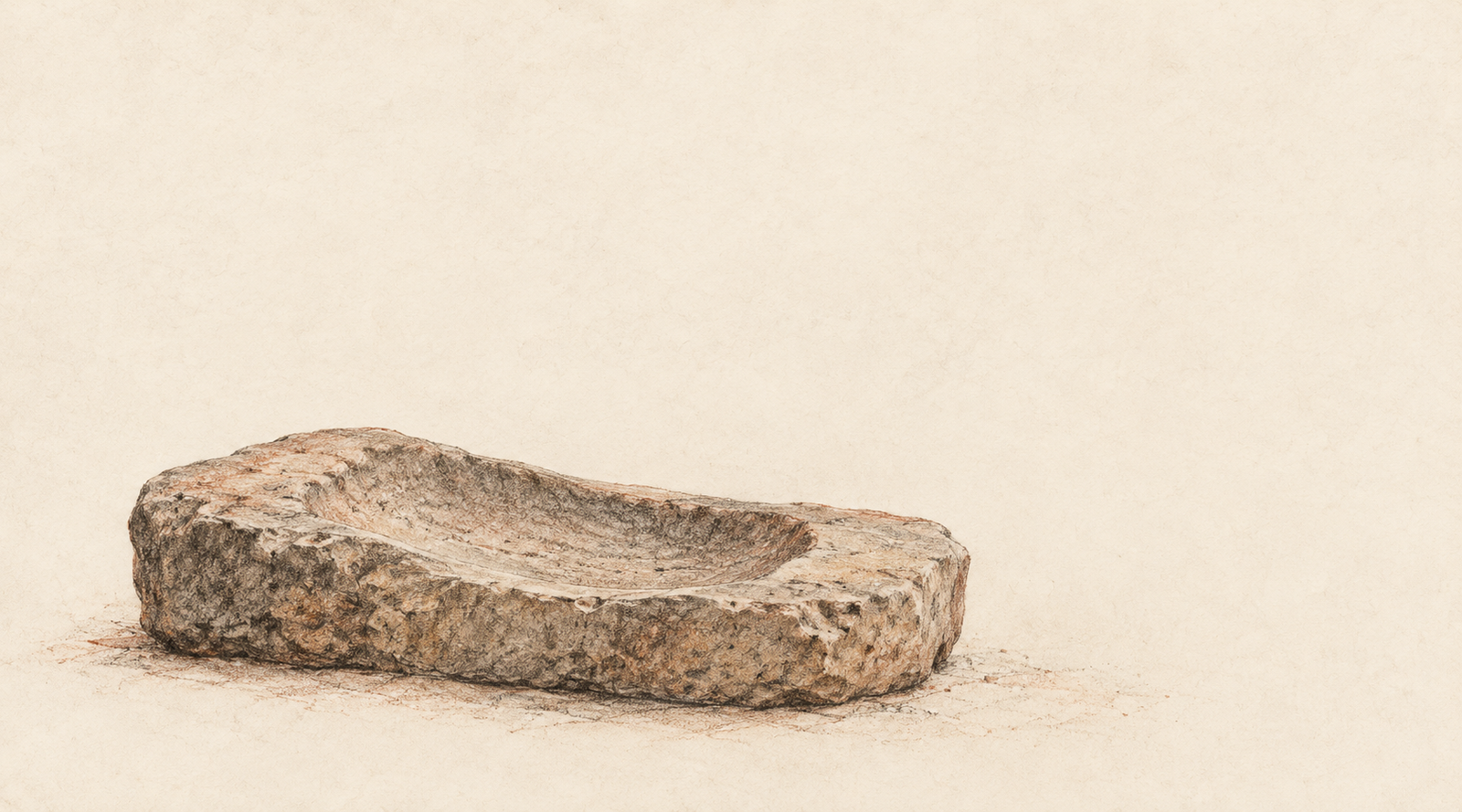

The City of Service
The temple we inherit is a building from which almost all necessity has been removed. Nothing must be brought for it to continue being what we call a temple. The sanctuary asks nothing of us. Stone is good at this kind of independence.
A living temple was otherwise.
Water had to come in. So did grain, cloth, oil, aromatic substances, fuel. The things required for worship arrived because someone carried them across a threshold.
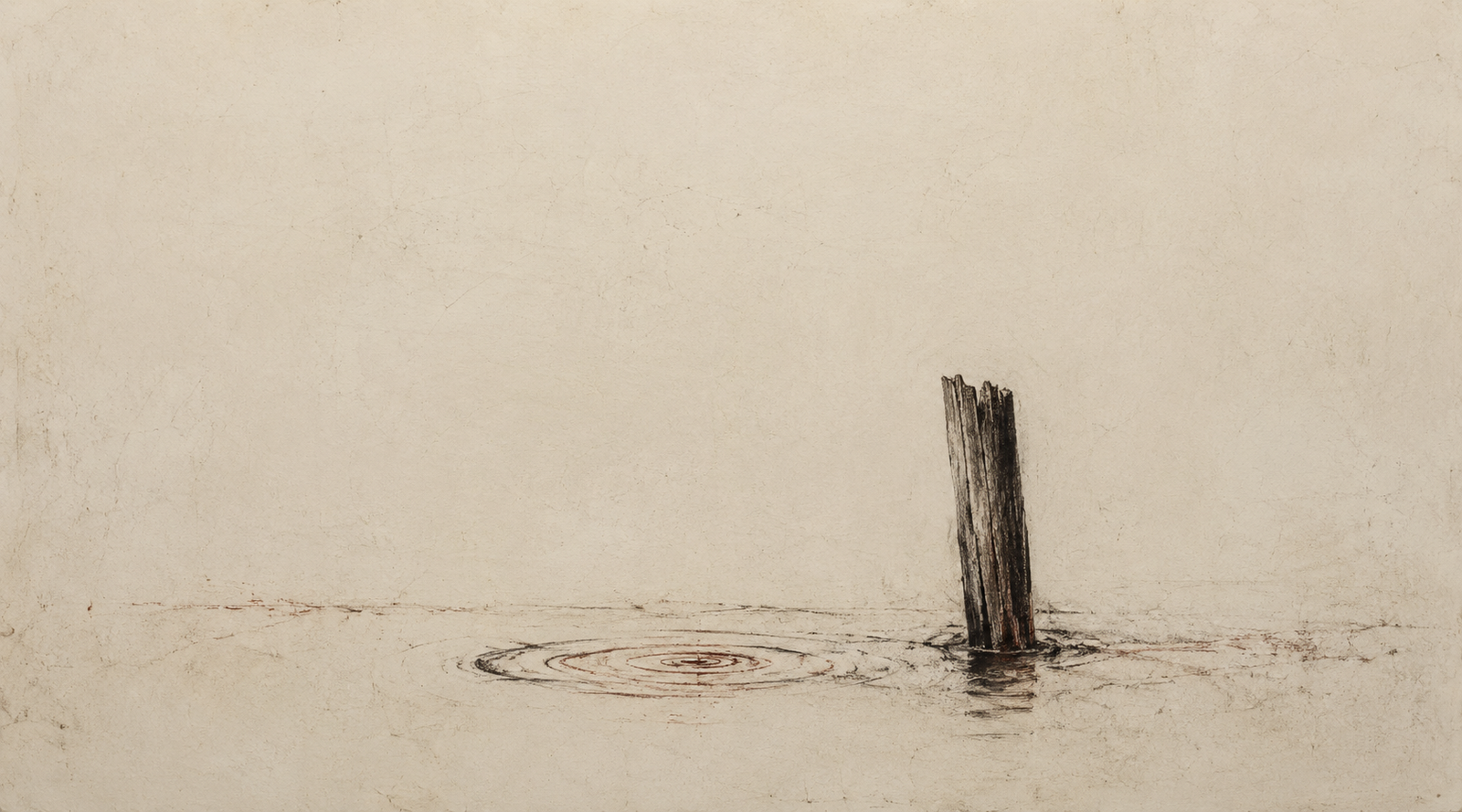

Houses of Wood, Light, and Smoke
Some of Angkor’s most intimate ruins do not rise above the ground at all. They are postholes, low mounds, hearths and ponds: durable traces of a domestic city built largely from things that decay. To restore that city is to see Angkor not only as stone, but as wood, smoke, water, repair, and people living within calling distance.