
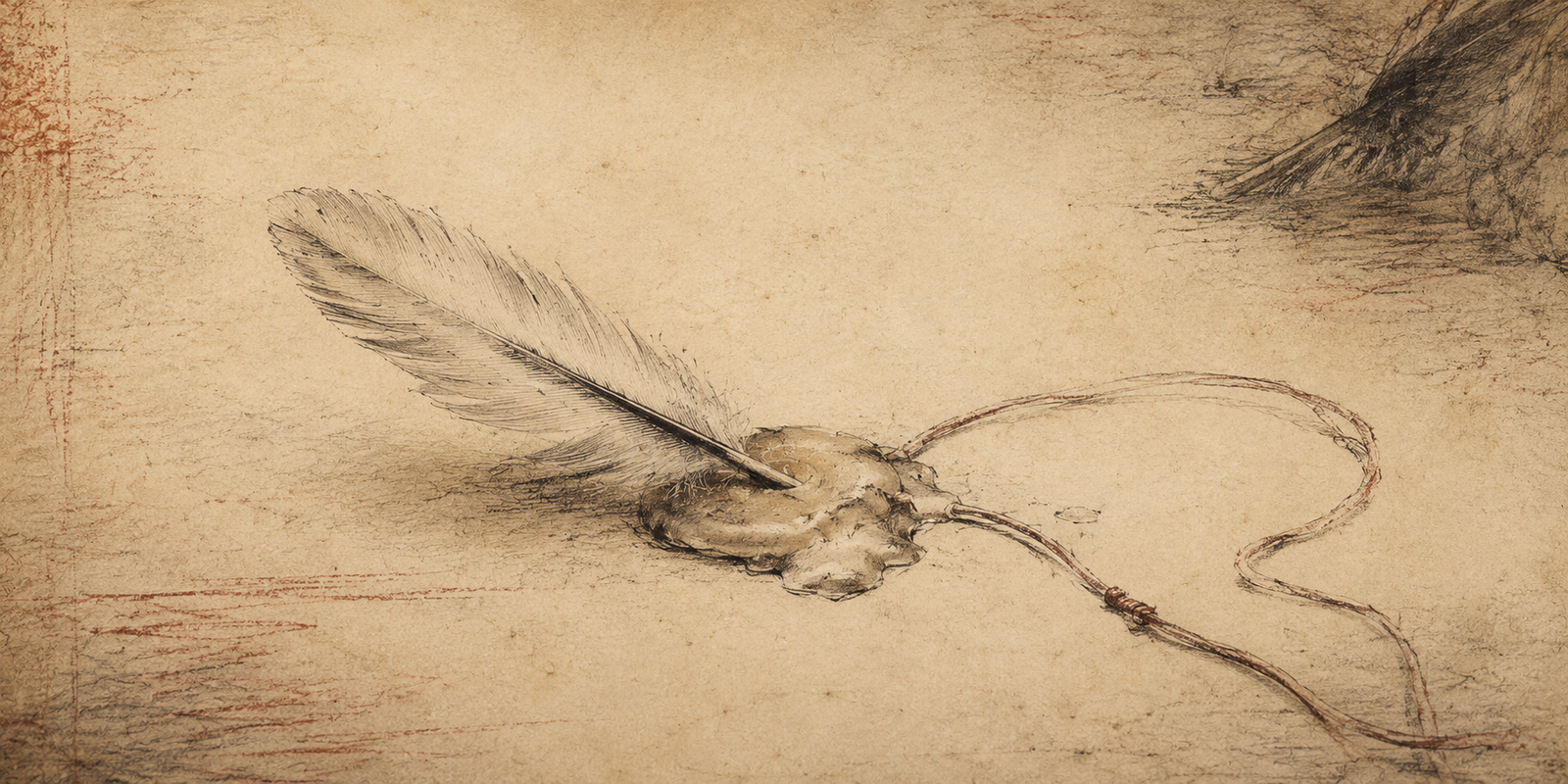

Daedalus and Icarus — The Wax Beneath the Sun
A myth of craft, captivity, warning, flight, and the limit of a father’s hand.
Daedalus worked by lamplight because the king had forbidden him the sun.
That was not how the order had been phrased. Kings rarely say such things plainly. They say a man is being honoured, protected, kept near because his skill is precious to the city. Then they place guards at the door and bars across the window, and the gift becomes a room from which no road leads out.
Daedalus understood such arrangements. He had spent his life making things that were not quite what they appeared to be.
A wall might hide a passage. A door might open only to the hand that knew where to press. A floor might hold beneath a friend and fail beneath an enemy. Daedalus had made such things. He had been praised for them. He had been paid for them. He had been brought from city to city because kings are very fond of clever men until they begin to wonder what cleverness might do when it is no longer obedient.
So Minos had kept him.
The room was high in the palace, though not high enough for freedom. From one narrow window Daedalus could see a strip of sea, and beyond it, on clear days, the place where the sky lowered itself toward the water. The window was too small for a grown man to pass through and too high above the stones for anyone to leap from it and hope to live. The door was watched. The stair was watched. The courtyard below was watched. The harbour was watched.
Minos was not a fool. That was one of the difficulties.
The lamp burned beside Daedalus’s left hand. A shallow clay dish sat above a small brazier, and in the dish the wax had begun to soften. It shone dully, not like gold, not like honey, though poets have called it both. It looked like what it was: a patient substance, obedient to heat, willing to hold the shape pressed into it for as long as the world remained kind.
Beside the wax lay feathers.
Small feathers, large feathers, flight feathers from wings Daedalus had bought from servants, gathered from courtyards, begged from bird-catchers, hidden in folds of cloth, stolen from the refuse of kitchens, collected one by one until the pile had become an argument.
Icarus sat on the floor nearby with his knees drawn up and his chin resting on them.
He had been told to sleep.
This, because it had been said plainly, he had ignored.
“You are not sleeping,” Daedalus said.
“I was nearly sleeping.”
“No.”
“I was being quiet.”
“That is not the same thing.”
“It is better than asking questions.”
Daedalus looked up then, and against his will the corner of his mouth moved. “Is it?”
Icarus considered this with solemn care. He was still young enough to believe questions were not interruptions but offerings. He was old enough to know some questions made his father’s face close like a door.
“What are you making?”
Daedalus returned his attention to the feathers. “You know what I am making.”
“I know what I think you are making.”
“That is usually worse.”
“It looks like wings.”
“Many things look like wings.”
“Not this many.”
That was true. The room had begun to look as if a flock of pale birds had entered it and forgotten how to leave. Feathers lay on the floor, the table, the stool, the low chest by the wall. Some had been sorted in bundles. Some had been trimmed. Some were already joined into long, curved rows that trembled whenever the night wind slipped through the little window.
Icarus lifted one hand toward the nearest row.
“Do not touch.”
He withdrew his hand at once, but not his gaze.
Daedalus saw the hunger in it.
There are many hungers in a child. Hunger for bread is the easiest to answer, if there is bread. Hunger for comfort can be answered with a hand on the hair, a blanket, a low voice in the dark. Hunger for praise can be dangerous but is not always fatal. Hunger for the world is something else. It looks out before the child knows its name. It has no patience. It has no measure. It believes that what is visible has already been partly given.
Daedalus feared that hunger more than he feared the guards.
“Father,” said Icarus.
“No.”
“I did not ask yet.”
“You were about to.”
Icarus smiled then, briefly and beautifully, as boys do when they discover that they are known and forgiven for it at the same time.
Daedalus bent again over the work.
He set the smallest feathers low, the broader feathers above, the long feathers along the outer reach where air would need something to take hold of. He joined them first with thread, then with wax, then with careful pressure from the side of his thumb. Each join had to be firm enough to bear motion and light enough not to burden the arm. A wing that was too delicate would fail. A wing that was too heavy would never rise. Invention, like courage, is often a matter of surviving between two errors.
Outside, the palace slept as palaces sleep: with servants still moving in corridors, guards shifting weight from one foot to another, dogs turning in courtyards, and rich men believing that because they are unconscious the world has stopped happening.
The lamp hissed softly.
Icarus’s eyes followed every motion of Daedalus’s hands.
Once, before Crete, before Minos, before the labyrinth, before the room with the narrow window, those hands had been famous for other reasons. They had made figures that seemed almost ready to move. They had made tools so precise that craftsmen shook their heads and swore affectionately at them. They had made toys for Icarus when he was small: a wooden bird whose wings opened when a string was pulled, a little cart that turned by itself when placed on a slope, a boat that could right itself after being knocked sideways in a basin of water.
Icarus had laughed then.
Daedalus remembered that laugh clearly. He remembered it with the sharpness sometimes given to small things before large griefs, though no one knows why the memory has sharpened until much later.
He had made the labyrinth too.
There was no avoiding that.
The king had wanted a secret that could hold a shame. Daedalus had given him corridors, turns, blank walls, false openings, routes that returned the walker to his own despair. He had made a place where intention could not keep itself straight. It had been brilliant work. Men had said so. The king had said so. Even Daedalus, who trusted praise very little, had known it.
Perhaps Minos had known it too. Perhaps that was why he had kept Daedalus close after the labyrinth was finished. A man who can make a prison from which no one can escape is also a man who will spend the rest of his life thinking about escape.
“Will they work?” Icarus whispered.
Daedalus pressed a feather into the wax and held it there until the softened edge cooled.
“Yes,” he said.
Icarus sat up straighter.
Daedalus wished he had lied.
Not because the wings would not work. They would. That was the terror of them.
A failed invention is sometimes merciful. It remains on the table. It breaks in the hand. It embarrasses the maker and changes nothing. But a successful invention enters the world. It leaves the reach of the one who made it. It answers to air, heat, haste, fear, joy, and all the other forces that do not care what was intended.
He had made many things.
He had never made freedom before.
“Will I have one?” asked Icarus.
Daedalus did not answer at once.
The first wing lay finished on the table. It looked impossible and inevitable at the same time, as if human beings had been foolish for walking so long. Daedalus lifted it carefully and flexed it. The feathers opened in a pale shiver. The lamp threw their shadows across the wall, and for a moment the room seemed crowded with wings.
Icarus breathed in.
That was all. One breath. But Daedalus heard in it the sea, the window, the height, the sky, and every warning he would ever give arriving too late.
“Yes,” he said. “You will have one.”
Icarus did not speak after that.
He only watched.
Toward morning, when the lamp had burned low and the first grey of dawn was loosening the dark from the window, Daedalus fitted the smaller pair to his son’s shoulders.
Icarus stood very still.
This was unusual enough to trouble Daedalus more than fidgeting would have done.
The boy’s tunic had been pulled tight and bound to keep loose cloth from tangling. His dark hair fell over his forehead. His face had the serious inward look of children when they know an adult is doing something important to their body and they are trying to become worthy of the moment by not moving.
Daedalus tightened one strap, then another.
“Does it hurt?”
“No.”
“Do not be brave with me. Does it hurt?”
“A little under the arm.”
Daedalus loosened the strap and tied it again.
“There?”
“Yes.”
“Better?”
“Yes.”
He moved around him, checking every fastening. The feathers stirred when Icarus shifted his weight. They were absurdly beautiful. Daedalus hated them for that. He wanted them plain, functional, untempting. But flight has never consented to look like caution. Even when made from stolen feathers and prison wax, it carries the old splendour of birds.
When both wings were fitted, Icarus looked over one shoulder, then the other, trying to see himself.
“I feel strange,” he said.
“You are strange.”
“No, I mean—”
“I know what you mean.”
Daedalus lifted his own wings and fastened them with practised difficulty. They were larger, heavier, built to bear a man. He could feel the pull of them across his back. He could feel every join he had made. Each one seemed suddenly too fragile.
He went to the window.
The sea below had begun to brighten.
Crete lay under morning in terraces, roofs, courtyards, walls. Smoke rose thinly from kitchens. Far below, someone was leading a mule across the yard. A guard leaned against the outer gate, bored and sleepy, as if the world had never contained anything more serious than the end of his watch.
Daedalus turned back to his son.
Now came the part that frightened him more than the making.
Instruction is a poor substitute for reach. Every parent knows this, though not all know that they know it. You can say the words. You can say them clearly. You can repeat them. You can bend down and look into the child’s eyes. You can make the danger plain. You can make the love plainer.
And then the child must carry the words into a place where your hand cannot go.
“Listen to me,” Daedalus said.
Icarus looked at him.
“Not as you listen when you are hoping I will finish soon. Not as you listen when you already think you understand. Listen.”
The boy’s face changed. Some of the brightness withdrew. Beneath it was trust, and that nearly undid Daedalus.
“We will go through the window. I will go first. You will follow me. You will keep close enough to see my shoulder. Do you understand?”
“Yes.”
“You will not go below me.”
“Yes.”
“You will not go above me.”
“Yes.”
“I have not finished.”
Icarus closed his mouth.
“If you fly too low, the sea-spray will wet the feathers. They will grow heavy. They will pull you down. If you fly too high, the sun will warm the wax. The joins will loosen. The feathers will come away.”
Icarus glanced at the wings.
“Look at me,” Daedalus said.
The boy looked.
“Between the sea and the sun. That is the road. There is no other. Not low. Not high. Near me.”
“Near you,” Icarus repeated.
“Again.”
“Near you.”
The words were not enough. Daedalus knew they were not enough. He wanted to put the rule into the boy’s bones, into his breath, into the hinges of his arms. He wanted to make obedience not a decision but part of the body. But he had not been given that art. No maker has.
He put both hands on Icarus’s shoulders.
For a moment, neither of them moved.
Then Daedalus kissed his son’s forehead.
It embarrassed Icarus, which was fortunate, because embarrassment steadied them both.
“Father.”
“Yes?”
“The guards will see.”
“Only if they look up.”
“People do not look up?”
“Not often enough.”
That made the boy smile again.
Daedalus turned before he could see too much of it.
The window was narrow, but the frame could be removed. Daedalus had seen to that over many nights. One bar had been loosened, then seated again so perfectly that a guard’s glance would not know the difference. The stone had been worried patiently at one edge. The whole thing came free with only a small scrape, which sounded to Daedalus as loud as thunder and to the sleeping palace as nothing at all.
Morning entered.
So did height.
Icarus stepped back.
Daedalus saw it: the first true understanding in the boy’s body. Until that moment the wings had been wonder, secrecy, cleverness, the answer to imprisonment. Now the open window showed him the cost of the answer.
Good, Daedalus thought. Be afraid. Fear is one of the hands that keeps us alive.
He climbed onto the sill.
For a moment the whole world narrowed to stone beneath his feet, weight on his back, salt in the air, and his son’s breathing behind him.
Then he opened his wings and stepped out.
He did not fall.
That was the first miracle.
The second was that he rose.
Not gracefully. Not at first. There was a wrenching downward pull, then a violent beat of the wings, then the shock of air taking hold beneath them. His shoulder burned. His chest seized. The palace wall slid past him. A shout rose somewhere below, then another.
Daedalus found the motion. Down, forward, lift. Down, forward, lift. The wings answered. The air answered. The impossible became work.
He turned wide, fighting the panic that would have made him climb too quickly, and looked back.
Icarus stood in the window.
Small, pale, winged, held there between the room and the sky.
For one heartbeat Daedalus feared the boy would not come.
For the next he feared he would.
“Icarus!” he called.
The boy leapt.
His wings opened badly. One side dipped. Daedalus’s whole body lurched toward him, though there was nothing his hand could do at that distance. Icarus dropped, struck air, beat too hard, then rose crookedly, laughing in terror.
“Slowly!” Daedalus shouted. “Not so hard!”
Icarus flailed once, twice, and then the wings caught properly.
The boy steadied.
He was flying.
Later, Daedalus would remember that moment first.
Icarus in the morning air, frightened and alive. Icarus looking at him with astonishment. Icarus discovering that the world had depth beneath him and room above him and that his own arms, bound to feathers and wax by his father’s hands, could keep him there.
The guards were shouting now. Men ran in the courtyard. Someone pointed upward. Someone loosed an arrow, but it fell short, and Daedalus almost laughed because Minos had guarded the doors, the stair, the harbour, the walls, the servants, the roads, and every ordinary answer.
He had not guarded the air.
Crete began to fall away behind them.
They flew out over the sea.
At first Icarus kept close. Too close, almost. Daedalus could hear the rough beat of the boy’s wings, the small gasps of effort, the sudden broken laughter whenever they rose on a warmer current of air. He kept looking sideways to see if his father saw what he saw.
Daedalus saw.
He saw the island retreating. He saw the morning widening. He saw the sea opening under them in long folds of light and shadow. He saw gulls startled into white confusion. He saw fishing boats below, their men standing open-mouthed, one of them dropping an oar into the water and not noticing.
He saw his son alive in the sky.
For a while, wonder was stronger than fear.
There was joy. The wings worked. The prison was behind them. The king’s cleverness had been answered. The morning received them. Daedalus, who had trusted stone, wood, bronze, wax, thread, and the strict obedience of measure all his life, felt for a brief while that perhaps air, too, could be persuaded.
They flew between sea and sun.
The road was narrow, but it was there.
Then Icarus began to rise.
At first it was nothing. A boy’s correction. A little height gained after a dip. Daedalus glanced and saw him still near, still safe, still laughing with the effort.
“Lower,” he called.
Icarus lowered.
A while later he rose again.
This time the motion was cleaner. He had found the wings more fully. His body had begun to believe in them. That was the danger. A thing first obeyed with fear, then with skill, then with delight. Delight is quick. Delight forgets the terms on which it was granted.
“Icarus,” Daedalus called. “Keep near.”
“I am near!”
He was not far.
Not yet.
But the distance had begun.
Below, the sea flashed. Above, the sun lifted itself with calm indifference. It was not angry. It was not vengeful. It did not know the boy’s name. It warmed kings and prisoners, gulls and stones, wheat fields and grave markers. It warmed the wax because that is what the sun does.
Daedalus felt the heat on his own shoulders.
He looked up.
Icarus had climbed again.
“Icarus!”
The boy turned his face downward. He was bright with flight. His hair streamed back. His wings opened wide, too wide. For one wild instant he looked less like a child than like the idea of escape itself.
That was the most terrible thing about it.
Daedalus could still admire what he feared.
“Down!” Daedalus shouted. “Come down!”
Icarus dipped, but the dip became a sweep, and the sweep became another climb. He had mistaken correction for play. He had mistaken danger for room. Or perhaps he had heard and meant to obey and the air had carried him differently. It is easy, afterward, to turn a child’s final movement into a moral shape. It is harder, and more honest, to say that the world is sometimes lost in an interval too small for judgement.
Daedalus beat upward, forcing his heavier wings to climb. Pain tore through his shoulders. The wax near his own straps had softened in the heat, and he knew then with the full coldness of understanding that his warning had been correct.
Correctness did not help him.
“Icarus!”
The boy heard him then.
He truly heard.
Daedalus saw the change. The joy broke open. Fear entered.
Icarus tried to descend.
One feather loosened.
It did not fall like a sign. It simply came away, pale and small, turning in the light.
Then another.
The wing faltered.
Daedalus called his son’s name again, but now the name was no longer instruction. It was no longer warning. It was only the shape love makes when it has no tool left.
The air changed.
The boy dropped out of the road between sea and sun.
Daedalus followed as far as wings would let him.
No farther.
The sea received what the sky could not keep.
For a long time there was only brightness and water and the sound of Daedalus’s own wings beating badly above the place where his son had been.
He circled until circling became useless.
He called until calling became a thing the air carried away from him and returned unanswered.
Once, a feather brushed his cheek.
He caught it without meaning to. His fingers closed around it as if it were a hand.
The wax at its base had softened and cooled again into a rough, shapeless bead.
Daedalus held it.
At last he turned from the water.
Not because he was finished.
Not because grief had released him.
Not because there was anywhere in the world left for him to go where he would not carry that small, bright body falling away from his reach.
He turned because the wings were failing, and the dead are not honoured by joining them too soon.
He flew lower now. Lower than he had told Icarus to fly, but he had learned something since then about the uselessness of perfect rules after loss. Salt touched the feathers. Heat pressed his back. Every beat of his arms was pain. The island ahead blurred and steadied, blurred and steadied. He did not know its name. Names were for those who believed arrival meant something simple.
When his feet struck earth, he fell to his knees.
The wings collapsed around him.
For a while he did not move.
The shore was small and stony. There were grasses above it, bent by wind. A few birds lifted from a low cliff and wheeled away from him, crying sharply.
Daedalus unfastened the wings.
His hands moved slowly. They knew how to work even when the rest of him did not. That, too, was a cruelty. The body goes on remembering its trades.
One strap.
Then another.
Wax clung to his thumb.
He stared at it.
In the room, by lamplight, the wax had seemed obedient. Warm it and it softened. Press the feather in and it held. Let it cool and it became firm again. Such a small thing. Such a workable thing. He had trusted it because it answered him.
But the sun had touched it too.
Daedalus sat on the shore until evening.
No king came. No guard. No messenger from the palace. Minos had lost him, and for once in his life Daedalus took no pleasure in outwitting a powerful man.
Near dusk, he dug into the earth above the shore with a flat stone. He worked longer than the task required because stopping would mean standing. He placed what he had found there: feathers, broken straps, a little wax, all the poor remains he had been able to gather.
Not enough.
Never enough.
When he was done, he sat beside the small mound and took from his tunic the feather that had brushed his face in the air.
He should have buried it with the rest.
Instead he held it until the light failed.
There are stories that say Daedalus went on. They are true. He came to other courts. He made other marvels. Kings still wanted what his mind could build. Men still praised the cunning of his hands. Some even asked him, in later years, how the wings had been done.
He answered them sometimes.
He spoke of feathers, wax, balance, lift, the movement of shoulders, the road between sea and sun. He could explain all that. Explanation was easy. It was only another kind of making, and making had never been the part at which he failed.
But if anyone praised the invention too much, Daedalus would close his hand.
Inside it, though no one saw, he would feel again the small roughness of wax at the base of a feather.
And he would remember the room before morning.
The lamp.
The sleeping palace.
The child who would not sleep.
The way Icarus had watched every movement of his father’s hands, believing, as children must, that what the hand can make the hand can save.
That was the last and bitterest thing Daedalus learned from flight.
He had made the wings.
He had not made reach.
—
Receive the next work
Subscribe free to receive new work from the The Hospitable Dark Library by email.
More from the Library

See Also
A concise and impartial dictionary of absence, promises, quarrels, ordinary objects, and the troublesome instability of words.

The City of Service
The temple we inherit is a building from which almost all necessity has been removed. Nothing must be brought for it to continue being what we call a temple. The sanctuary asks nothing of us. Stone is good at this kind of independence.
A living temple was otherwise.
Water had to come in. So did grain, cloth, oil, aromatic substances, fuel. The things required for worship arrived because someone carried them across a threshold.

Houses of Wood, Light, and Smoke
Some of Angkor’s most intimate ruins do not rise above the ground at all. They are postholes, low mounds, hearths and ponds: durable traces of a domestic city built largely from things that decay. To restore that city is to see Angkor not only as stone, but as wood, smoke, water, repair, and people living within calling distance.