
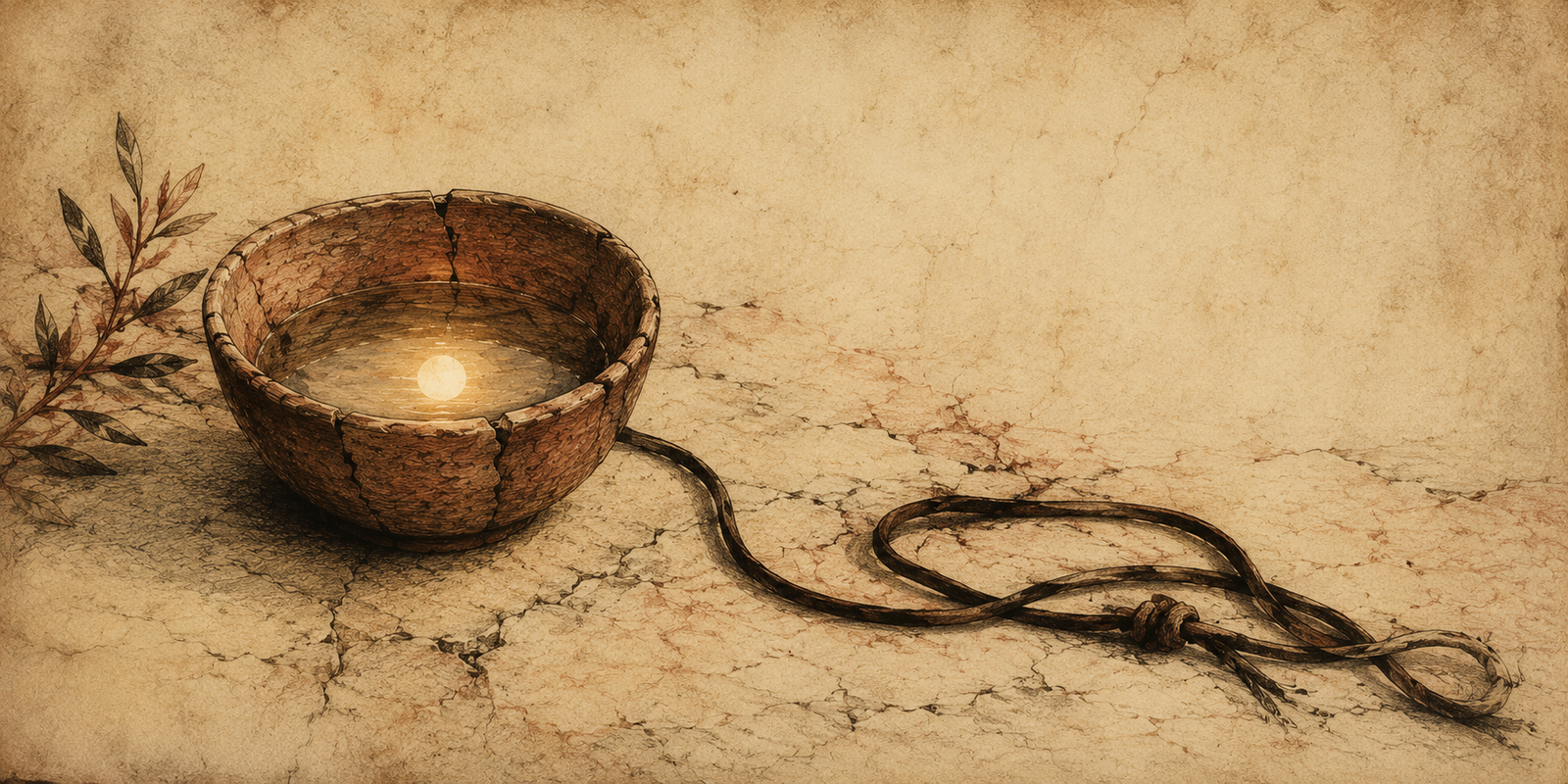

The Danger of Being Proved Right
On Phaethon, proof, paternal love, and the catastrophe of granting what protection should have refused.
On Phaethon
Phaethon is often remembered as the boy who wanted too much.
That is the usual warning, and it is not false. He asks for the chariot of the Sun, and the day passes into hands that cannot govern it. The horses break from their road. The earth burns. Zeus intervenes before the world itself is lost. It is a story about overreach, about a mortal hand placed where only a god’s hand can remain steady.
But before Phaethon wants the sky, he wants certainty.
That is the quieter wound inside the myth. The chariot does not enter the story first as an object of ambition. It enters as an answer to shame. Phaethon has been told he is the son of Helios, the Sun, and Clymene, a mortal woman. Then that divine parentage is questioned. The insult matters because it strikes at the most fragile kind of inheritance: the name a child has received but cannot prove.
So Phaethon goes to his father.
In the ancient story, Helios does not deny him. That is important. The catastrophe does not begin because the father withholds recognition. It begins because he gives it. He receives Phaethon as his son, and then, in the dangerous warmth of that recognition, swears to grant him whatever he asks.
Everything depends on that oath.
Without it, Helios may remain father and god at once. He may love the child and still refuse him. He may say: you are mine, and because you are mine, I will not place you where you cannot live. But once the oath has been spoken, tenderness is trapped inside law. The father’s promise becomes stronger than the father’s judgement.
The oath turns tenderness into law.
This is why the myth is more painful than a simple warning against pride. Phaethon’s request is reckless, but it is not empty. He wants something that no one can laugh at. He wants proof that will silence the courtyard, the village, the world. He wants not merely to know who he is, but to be seen knowing it.
There is a terrible human accuracy in that.
A child can live for a long time on a parent’s word. Then the world presses against that word and asks for evidence. Sometimes the pressure comes from gossip. Sometimes from rivalry, class, absence, inheritance, the cruelty of other children, the carelessness of adults. Sometimes it comes from one sentence spoken at exactly the place where belief has not yet hardened into self-knowledge.
Then love, which once felt sufficient, begins to feel private. Hidden. Unverified. The child may not stop believing. Often the hurt is sharper because he still believes, but cannot make belief visible.
That is Phaethon’s condition. His mother’s word may be true, but it cannot protect him from doubt. So he goes to the father whose name has become both treasure and injury.
Helios gives him recognition. In a wiser world, perhaps that would have been enough. But shame does not usually ask for what would heal it. Shame asks for what would defeat its accuser. It wants something public, indisputable, irreversible. It wants proof large enough to make every former humiliation impossible.
The chariot is that proof.
But the sun-chariot is not a prize. It is not an ornament of divine belonging, not a crown briefly placed on a son’s head, not a splendid object by which identity can be confirmed. It is an office. To drive the sun is to keep measure. It is to hold heat, height, distance, time, growth, and survival in balance. The world does not need the sun to be glorious. It needs the sun to be governed.
Phaethon wants the radiance of the office. He cannot bear its discipline.
Helios knows this. His warning matters because it is not stinginess. It is knowledge. He knows the horses. He knows the road through the air. He knows that there are powers one does not make safe by naming a beloved child heir to them. Love may explain why the child wants the thing. It cannot make the thing survivable.
And yet the father has sworn.
His failure is not lovelessness. Lovelessness would make the story colder and much simpler. Helios fails because he wants to answer the wound. He wants to be not merely true, but visibly true. He wants to repair absence with splendour. In that desire, he grants before he has listened deeply enough to what the child may ask.
A father may fail by giving too little. He may also fail by giving too much.
That is the harder sorrow in the myth. The child experiences refusal as disbelief, and the father cannot bear to be mistaken for one more doubter. So he yields. He allows the child’s wound to define the shape of love. What should have remained protection becomes permission.
Phaethon does not know this. He is too young, too wounded, too close to the insult. He hears warning as rejection because warning has arrived after recognition, and his shame cannot separate the two. The father who has just called him son now appears to be withholding the proof that would make the word complete.
So the chariot rises.
The catastrophe is cosmic, but its cause remains intimate. The wrong hands hold the reins of the day. The world burns because a private wound has been given divine machinery. Mountains smoke, rivers shrink, fields fail; but beneath the scale of the disaster remains the smaller human truth that made it possible. Someone needed proof. Someone promised too much. Someone mistook the granting of power for the repair of love.
Zeus’s thunderbolt ends the danger, but it does not solve the grief. Myth is often like that. It can stop the world from burning and still leave the house ruined. Phaethon falls. Helios remains the Sun. Clymene remains the mother of a child whose divine parentage was proven in the most unbearable way. The world survives, but survival is not the same as restoration.
If Phaethon were only a myth of ambition, it would be easier to put away. We could say: do not reach too high; do not take what belongs to gods; listen when warned. All true enough. But the story asks for more attention because his error begins in a place many people recognise. He wants the world to stop laughing. He wants his mother’s word vindicated. He wants his father to become undeniable.
He wants to be proved right.
That is the danger. Not because truth is unimportant. Not because belonging should remain hidden. But because proof, when demanded by shame, often asks for the wrong witness. It does not ask: what would make me whole? It asks: what would make them unable to doubt me again?
Those are not the same question.
The old warning remains: no mortal hand can govern the chariot of the Sun.
But beneath that warning lies the quieter wound. Phaethon wanted the world to stop laughing. Helios wanted his son to know he was loved. Between them stood an oath, and once it had been spoken, love could no longer move freely.
By the time proof arrived, protection had already failed.
—
Receive the next work
Subscribe free to receive new work from the The Hospitable Dark Library by email.
More from the Library

See Also
A concise and impartial dictionary of absence, promises, quarrels, ordinary objects, and the troublesome instability of words.

The City of Service
The temple we inherit is a building from which almost all necessity has been removed. Nothing must be brought for it to continue being what we call a temple. The sanctuary asks nothing of us. Stone is good at this kind of independence.
A living temple was otherwise.
Water had to come in. So did grain, cloth, oil, aromatic substances, fuel. The things required for worship arrived because someone carried them across a threshold.

Houses of Wood, Light, and Smoke
Some of Angkor’s most intimate ruins do not rise above the ground at all. They are postholes, low mounds, hearths and ponds: durable traces of a domestic city built largely from things that decay. To restore that city is to see Angkor not only as stone, but as wood, smoke, water, repair, and people living within calling distance.