
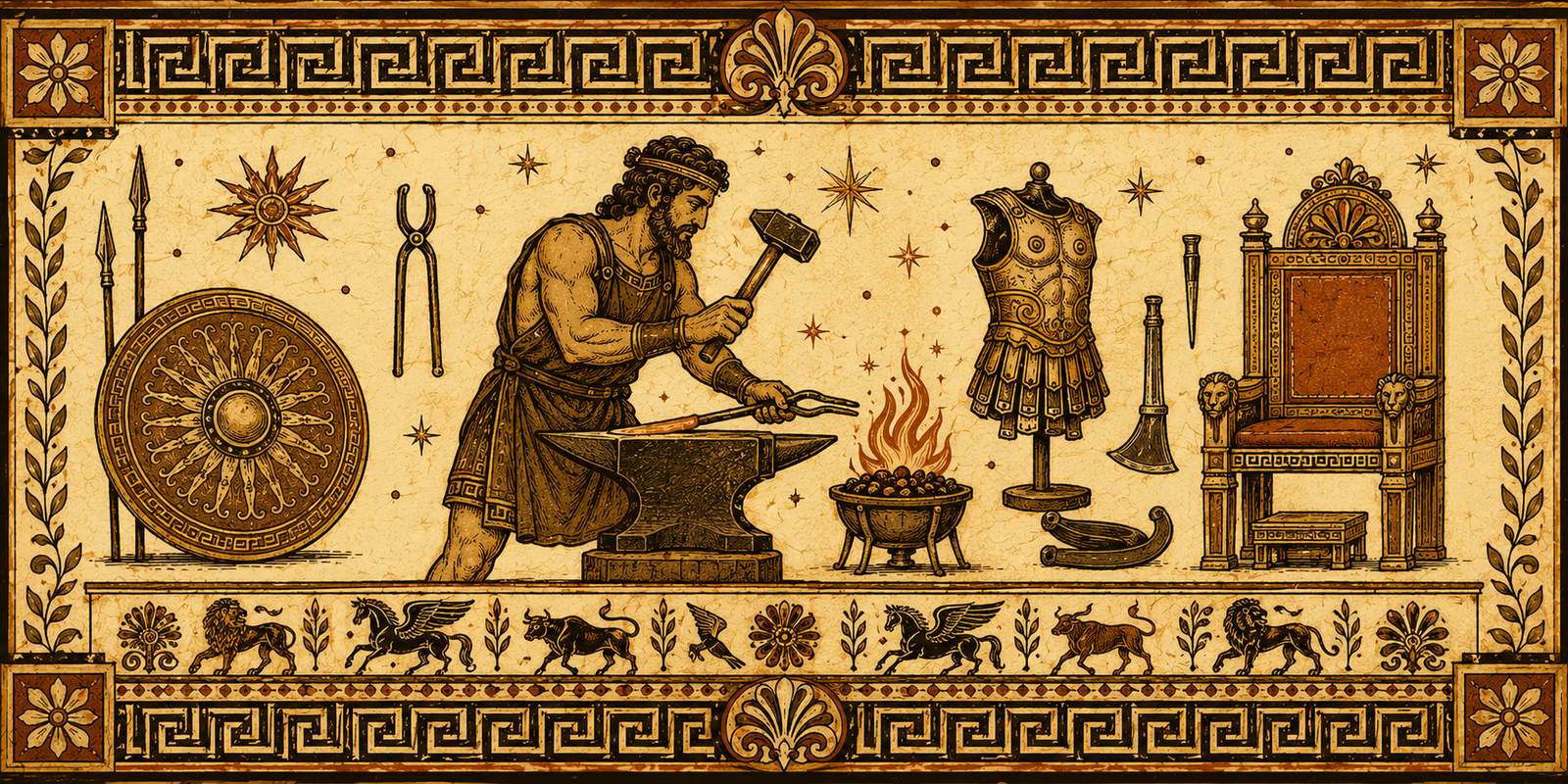

Hephaestus — The God of the Forge
After Daedalus makes wings, meet the god whose fire, hammer, and impossible objects show that making is one of Greek myth’s great powers.
After the Tale
Now that Daedalus has made wings from feathers and wax, we can turn to another maker in the Greek world — one whose workshop burned hotter than any human hearth.
Daedalus was a mortal craftsman. He made under pressure. He made because King Minos had trapped him on Crete, because the sea could not be crossed, because a son needed escape, and because no door would open.
Hephaestus was different.
He was a god.
But that did not mean his making was simple, safe, or peaceful. Very little on Olympus was simple, safe, or peaceful, whatever the gods may have liked to think about themselves.
Hephaestus worked with fire, bronze, gold, iron, hammer, tongs, anvil, and patient skill. He made things that even gods could not easily make for themselves. Armour, palaces, thrones, traps, chains, tools, jewellery, and wonders that seemed almost alive all came from his forge.
If Daedalus shows us what mortal craft can do when the walls close in, Hephaestus shows us something larger.
In Greek myth, making is a power.
And power, as the Greeks knew very well, is never harmless.
The Short Answer
Hephaestus is the Greek god of fire, metalwork, smithing, craft, and marvellous invention.
He is the god of the forge: the place where flame is not only wild, but useful; where metal grows soft enough to obey; where hammer-strokes turn shapeless ore into a shield, a chain, a cup, a throne, a weapon, or a wonder.
Other gods had their own powers.
Zeus had thunder.
Poseidon had the sea.
Athena had wisdom, war-craft, and clear counsel.
Hermes had roads, messages, tricks, and winged sandals.
Apollo had music, archery, prophecy, and light.
Hephaestus had the knowledge of how things are made.
That may sound quieter than thunder.
It is not.
A thunderbolt can strike.
A thing made by Hephaestus can wait.
What You Need to Know
Hephaestus was one of the Olympian gods, but he did not feel quite like the others.
Many Olympians loved to be admired. They stood bright in stories: beautiful, swift, commanding, dangerous, impossible to ignore. Hephaestus belonged to Olympus too, but he was often imagined a little apart from the glitter and boasting.
His place was the workshop.
There, fire burned. Bellows breathed. Metal glowed. Hammers rang. Sparks leapt into the dark like small, brief stars.
Hephaestus did not need to be the loudest god in the room.
The things he made could speak for him.
Some stories say he was born different from the other gods. Some say he was cast down from Olympus. Some say he did not move as easily as the bright, swift gods who loved beautiful bodies and quick feet.
Greek myth can be cruel about this, as Greek myth can be cruel about many things.
But no one on Olympus could ignore what his hands could do.
The gods might quarrel with him. They might underestimate him. They might forget, for a little while, that a maker sees more than other people think.
But when they needed something impossible, they knew where to go.
To the forge.
To the fire.
To Hephaestus.
What He Made
Hephaestus made armour for heroes.
This was not ordinary armour knocked together in a hurry by someone who hoped the straps would hold. A shield from Hephaestus could be a whole world in metal: cities, fields, stars, rivers, dancers, battles, ploughmen, harvests, and all the bright and terrible pattern of human life beaten into bronze.
He made weapons too, though weapons were never only weapons in Greek myth. A spear, a sword, a shield, or a set of armour might decide who lived, who returned, who was remembered, and who vanished into the dust of story.
He made palaces for the gods.
That is worth pausing over. The Olympians were gods, and yet even gods needed places shaped by another god’s skill. Their halls did not simply appear because Zeus snapped his fingers and looked important. Someone had to make splendour stand up.
Hephaestus made divine furniture.
That sounds harmless until one remembers that this is Greek myth, where a chair may be more dangerous than a battlefield.
In one story, Hephaestus made a beautiful throne for Hera. It was splendid, shining, and impossible to resist. Hera sat on it — and could not rise again.
The throne held her fast.
The other gods discovered, rather late, that beauty made by Hephaestus might have a purpose hidden inside it.
This is useful to remember.
When Hephaestus makes something beautiful, do not assume it is only beautiful.
He made traps.
He made chains.
He made clever devices.
Some stories even imagine him with golden helpers: marvellous figures who could move and assist him, as if craft had come so close to life that the difference between object and servant had begun to tremble.
A thing made by Hephaestus may protect.
It may punish.
It may shame.
It may astonish.
It may save a hero.
It may catch a god.
That is why his work matters.
In his hands, metal is never merely metal.
His Story Shape
Hephaestus often appears when making changes the balance of power.
He is not usually the god who rushes into the middle of a battlefield with a shout. He is the god whose work may already be there when the battle begins.
The shield is there.
The armour is there.
The chain is there.
The throne is there.
The hidden mechanism is there.
The thing made in the forge waits quietly until the right moment.
Then everyone discovers what it was made to do.
This makes Hephaestus different from many of the gods.
Zeus commands.
Poseidon shakes the earth.
Ares charges.
Hermes slips through.
Athena counsels.
Apollo strikes from far away.
Hephaestus makes.
And in the Greek world, making can be just as powerful as commanding, shaking, charging, slipping, counselling, or striking.
Sometimes more powerful.
A command ends when the voice stops.
A made thing remains.
That is one of the secrets of Hephaestus.
His power can stay in the world after he has set down the hammer.
Signs and Symbols
When you meet Hephaestus in Greek myth, watch for these signs.
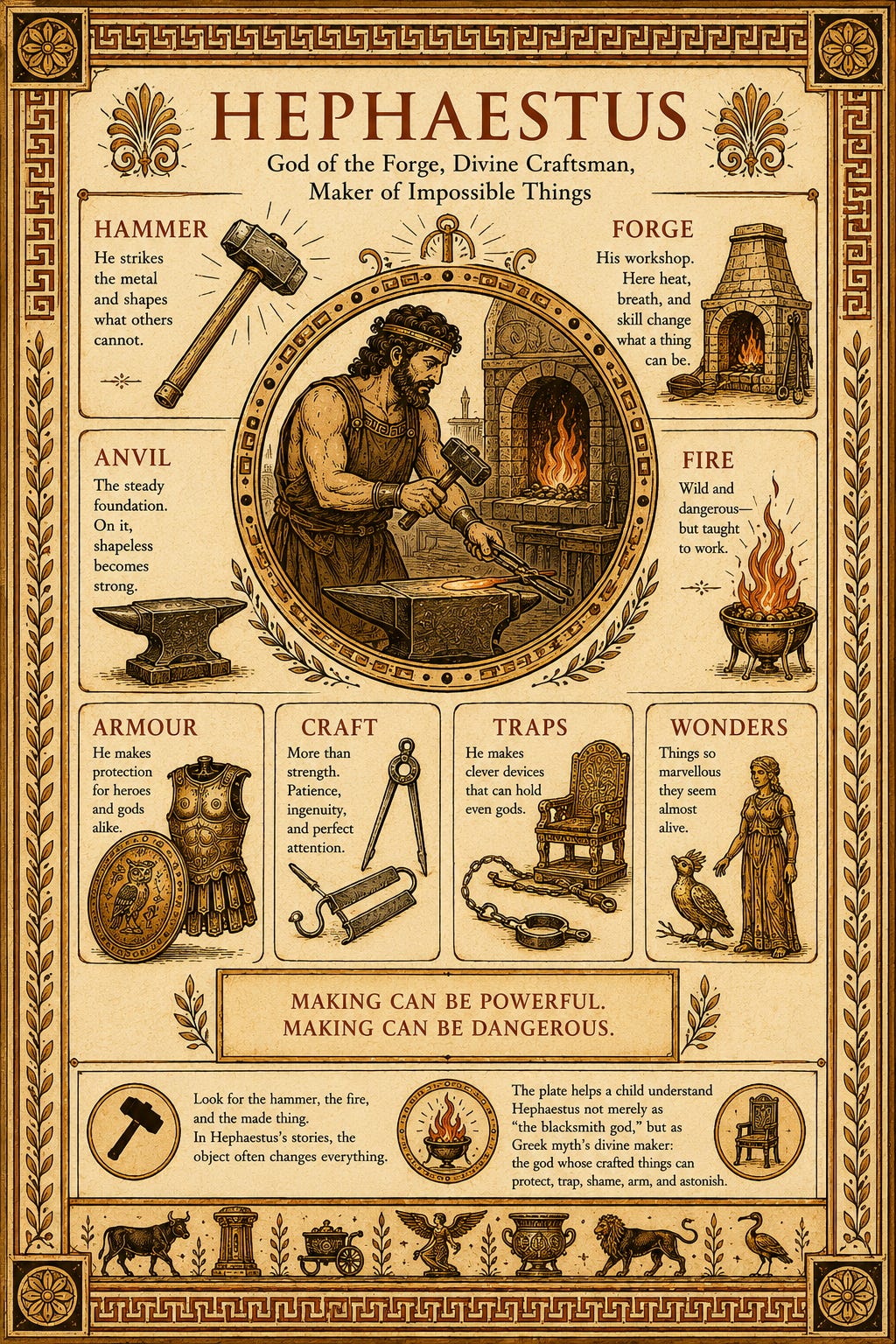
Hammer
The hammer is the tool of striking and shaping. It does not merely hit. In the right hands, it teaches metal what form to take.
Anvil
The anvil is the heavy block on which metal is beaten into shape. It is patient, solid, and necessary. Without something firm beneath the work, the hammer has nowhere to send its force.
Forge
The forge is the fire-place of craft. It is where heat, breath, tools, and skill change what a thing can become.
Fire
Hephaestus’s fire is not only wild flame. It is fire brought into service: dangerous, yes, but taught to work.
Tongs
Tongs let the maker hold what human hands cannot safely touch. This is a very Hephaestus kind of tool: practical, precise, and quietly wise.
Armour
Armour is protection made by skill. It lets a hero enter danger without pretending danger is harmless.
Throne
In Hephaestus’s stories, a throne may be a seat of honour, a trap, a joke, a punishment, or all of these at once.
Traps
Hephaestus can make devices clever enough to catch even gods. This is one reason the Olympians should have been more careful about laughing at makers.
Wonders
Some of his works are so marvellous that they seem almost alive. In Greek myth, the boundary between a made thing and a living thing is not always as tidy as we might expect.
Why This Matters After Daedalus
After Daedalus and the Wings, Hephaestus helps us understand why makers matter so much in Greek myth.
Daedalus is mortal. He has human hands, human fear, human grief, and human limits. He makes wings because he and Icarus are trapped. His craft opens the sky, but it cannot make the sky gentle.
Hephaestus is divine. His forge burns among the gods. His work belongs to bronze, gold, fire, armour, thrones, traps, and wonders. He does not make because he is trapped in the same way Daedalus is trapped.
He makes because making is his power.
But both of them teach us something important.
A maker is not just someone useful.
A maker changes what is possible.
Before Daedalus, the locked room seems final.
Then there are wings.
Before Hephaestus, metal is only ore.
Then there is armour, a shield, a chain, a throne, a palace, a trap, a marvel.
This is why Greek myth pays attention to craftsmen. The old stories know that force is not the only kind of strength. A sword matters, but so does the hand that made the sword. A hero matters, but so does the shield that turns aside the spear. A god’s command matters, but so does the clever object waiting silently in the room.
Daedalus makes because he must escape.
Hephaestus makes because fire, metal, and craft are his kingdom.
Both remind us that the clever hand can change the world as surely as a sword.
One Thing to Remember
In Greek myth, a maker does not only shape metal, wood, wax, or stone.
Sometimes he shapes the fate of everyone who touches what he has made.
—
Receive the next work
Subscribe free to receive new work from the The Alexander Series Library by email.
More from the Library

See Also
A concise and impartial dictionary of absence, promises, quarrels, ordinary objects, and the troublesome instability of words.

The City of Service
The temple we inherit is a building from which almost all necessity has been removed. Nothing must be brought for it to continue being what we call a temple. The sanctuary asks nothing of us. Stone is good at this kind of independence.
A living temple was otherwise.
Water had to come in. So did grain, cloth, oil, aromatic substances, fuel. The things required for worship arrived because someone carried them across a threshold.

Houses of Wood, Light, and Smoke
Some of Angkor’s most intimate ruins do not rise above the ground at all. They are postholes, low mounds, hearths and ponds: durable traces of a domestic city built largely from things that decay. To restore that city is to see Angkor not only as stone, but as wood, smoke, water, repair, and people living within calling distance.