
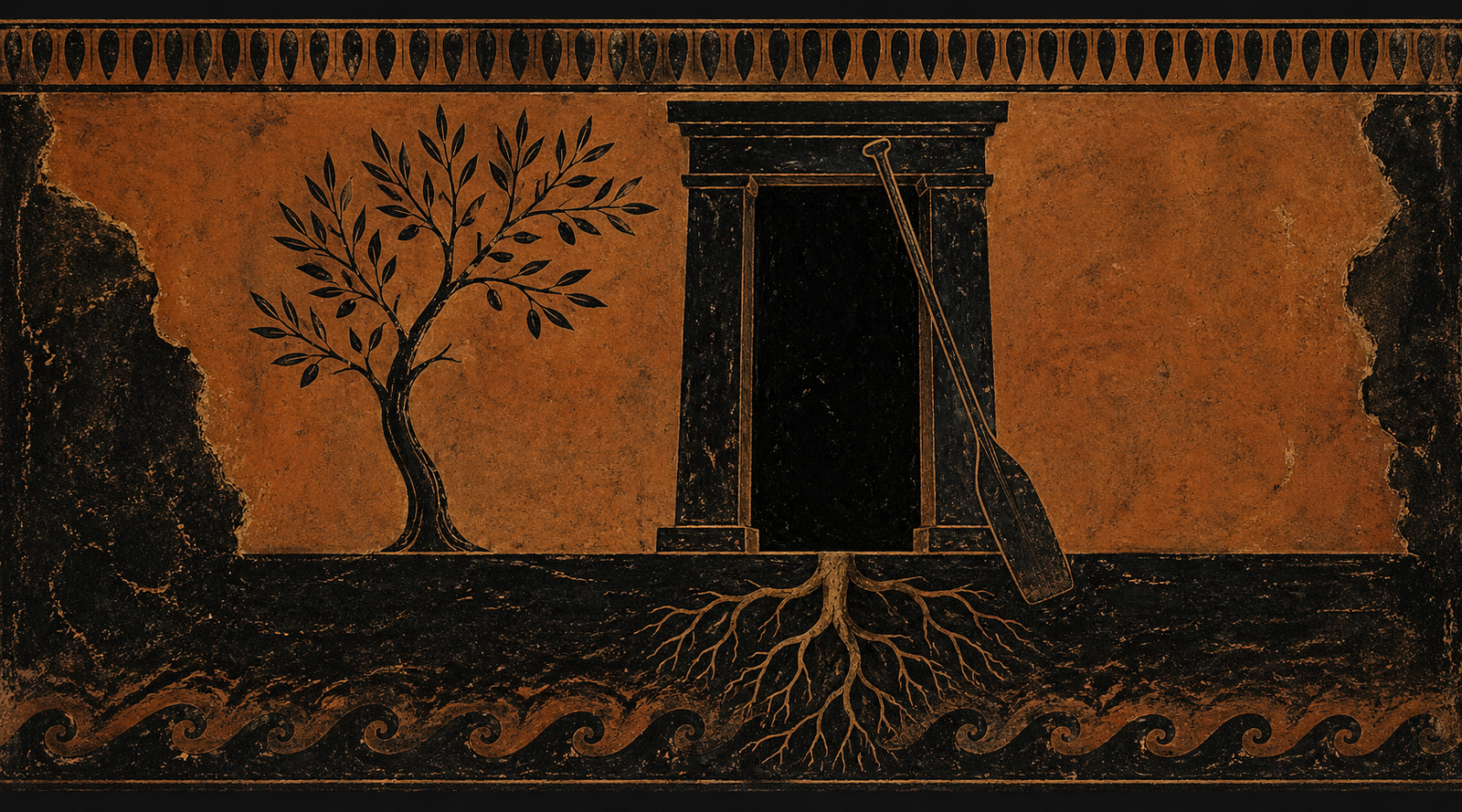

No Man Comes Home III — The Island of the Kept Man
Calypso offers Odysseus immortality. He chooses the mortal road that may kill him, because only there can he be known.
The island did not age.
That was its cruelty.
Every morning came cleaover the same trees, the same bright water, the same cave-mouth breathing sweetness into the air. Birds crossed and returned. Vines hung heavy. The spring ran clear. The grass accepted light as if light had never fallen on a battlefield, never flashed along bronze, never entered the eyes of men who died calling for mothers no god returned to them.
Calypso’s island was beautiful in the way a thing can be beautiful when history has been refused.
It held him.
Not with chains.
Chains would have been easier. A chained man can understand his dignity. He can show his wounds, measure his confinement, make honour out of resistance. Iron grants clarity to the prisoner. It tells him where captivity begins.
Odysseus had no iron.
He had fruit, shade, fragrance, a goddess’s bed, a shore from which the sea could be watched but not crossed. He had no gaoler with a whip, no wall with a gate, no soldiers at the path. He had immortality offered not as thunder, not as command, but as tenderness becoming law.
This was the danger.
Captivity can learn the language of gift.
Calypso loved him, if love is the name for wanting a mortal man to remain where mortality cannot complete him. She had taken him from wreckage. She had washed salt from him. She had given food to the body the sea had almost reclaimed. She had laid him in the hidden place of the island and said, in all the languages a goddess may say it, Stay.
For a while he had stayed.
There is no use making him purer than men are.
A man washed ashore after ruin does not first become faithful. He becomes alive. Breath returns. Hunger returns. Skin remembers warmth before duty finds its voice again. The body accepts what saves it before the mind can accuse the gift. Odysseus lived because the island received him.
That truth remained.
So did the other.
The island that saved him had become the place where return was delayed without violence and therefore almost without blame.
This is one of the gods’ refinements: to make the wound resemble mercy.
Each day Calypso gave him what men cross seas to desire. No work was required of him that would make him king. No assembly called his name. No son stood under mockery because of him, not visibly. No wife undid the day’s labour by lamplight. No servants shifted under corrupt power. No cattle diminished. No suitors laughed beneath his roof.
The island concealed all this from his eyes.
But not from the part of him that would not die.
He went often to the shore.
The shore was the one place the island failed to persuade him.
There he sat, looking out at the water that had taken his ships, his men, his years, his certainty, and still remained the only road home. The sea did not console him. It did not remember for his sake. It moved under the sun with the inhuman patience of something that has destroyed many men without becoming cruel.
Odysseus watched it.
Some days he wept.
The tears did not make him innocent.
They made him human.
A lesser telling would call this longing and be satisfied. But longing is not simple in a man who has survived by wanting and calculating at once. He longed for Ithaca. He longed for Penelope. He longed for the smoke rising from his own land, for the rough fields, the low house, the bed rooted in the secret of their marriage. He longed to be where his name did not need to be announced.
He also feared return.
Not always in words. Men do not name all the fears that govern them. Some are held in the hands, the stomach, the throat before speech can soften them. The part of Odysseus that had commanded men through storm and slaughter knew that home is not only the place one desires. It is the place where desire is tested by what has changed.
He had been gone too long.
That was not a feeling.
It was a fact with teeth.
A short absence can be crossed by embrace. A long absence becomes architecture. Rooms alter around it. Children grow inside it. Women make laws under its pressure. Servants choose. Enemies enter. The dead accumulate behind the living. Even love, if left too long to defend itself, becomes skilled.
What would he meet if he returned?
What would meet him?
These questions came to the shore and sat beside him.
He did not invite them.
They came because the sea was honest.
Calypso came too.
She did not always speak at first. A goddess knows the power of arrival without sound. The air changed around her. The island recognised its mistress before the man chose whether to turn.
She stood where the grass began and watched him facing the water.
“You are grieving again,” she said.
Odysseus did not answer quickly.
He knew speech with gods must be handled as one handles fire brought into a dry room. Too little and one is cold. Too much and the house is gone.
“At times,” he said.
“At times,” she repeated, almost gently. “You sit here until the day fails. You eat what I give you. You lie beside me. Then you come back to the shore and grieve as if grief were the truer wife.”
There are accusations that wound because they are not false.
He looked at the sea.
Calypso came nearer. Her beauty did not move towards him as mortal beauty moves. It did not ask the eye to follow. It changed the terms of seeing. Where she stood, the island became more itself: leaf, spring, rock, shadow, sweetness, brightness too complete to be trusted.
“I have offered you what no mortal wife can give,” she said.
He heard the sentence before he heard the offer.
No mortal wife.
There it was.
The island’s whole error laid bare in kindness.
Immortality was not being offered to Odysseus alone. It was being offered against Penelope. Against age. Against the bed made from the living tree. Against the son whose body had grown beyond his father’s memory. Against the dog who would not live forever. Against the fields that knew drought. Against burial. Against the law by which love becomes real because time can injure it.
Calypso thought she was offering him more.
She was asking him to abandon the scale in which a man can be known.
He said nothing yet.
Silence, with a goddess, can be the last safe country.
She turned towards him more fully.
“Would you rather grow old beside a woman who cannot keep you? Would you rather suffer the little roof, the smoke, the hard ground, the mortal bed? You have seen death. You have seen men torn open by war and sea. Why do you still desire the country where death knows your name?”
Because it knows my name, he might have said.
He did not.
There are truths too large to offer an immortal who cannot need them.
Instead he said, carefully, “You are greater than she is.”
The words were true.
Truth can be used as a shield when it is not the whole truth.
“No mortal woman could stand beside you in beauty,” he said. “No house of men could equal this place. No field I own could rival your island.”
Calypso watched him.
She was not deceived.
Gods are seldom deceived by flattery. They are sometimes wounded by the part of it that is sincere.
“And yet,” she said.
“And yet,” he answered.
The sea moved.
That was all the speech the shore could bear.
What is a man choosing when he chooses mortality?
Not death only. Death is too simple a word for the mortal condition. He chooses succession, injury, decay, uncertainty, obligation, the ageing of the beloved face, the child grown strange, the house damaged by his absence, the possibility that those who waited also judged. He chooses to be measured by time rather than released from it. He chooses the world in which every embrace is shadowed by loss and therefore given shape by urgency.
Immortality would preserve him.
It would also conceal him from consequence.
Odysseus had been hidden long enough.
The island had kept him from the suitors’ insult, from Telemachus’s shame, from Penelope’s labour, from the dog’s ageing, from the bed’s silence, from the house’s daily diminishment. It had kept him from the cost of being absent. Its mercy had become another form of theft.
A man can be spared so thoroughly that he is stolen.
So he chose the road that might kill him.
Not because he was noble.
Because the other road would leave him alive where no one could finally know him.
This, too, must be said plainly: Calypso grieved.
Not like a mortal woman. No goddess grieves within human proportion. Her sorrow had weather in it. The trees seemed for a moment to hold their leaves more still. The water in the spring brightened, then darkened, as if light had reconsidered itself. The island felt the insult of his desire for elsewhere.
She had loved him according to her nature.
That was part of the tragedy.
We are most dangerous to one another when we offer what our own nature most values and cannot understand why it wounds the one who receives it.
To Calypso, permanence was mercy.
To Odysseus, it had become erasure.
Zeus had sent the command. Hermes had crossed the bright air and spoken what even Calypso could not refuse. The man must go. The house of the nymph would release him. The sea, which had been denial, would become trial again. The gods had remembered him, though not because remembering is kindness. Divine attention is never simple.
Calypso obeyed.
Obedience did not make her gentle.
She gave him tools.
That was the first hard mercy.
An immortal might have lifted him from the island as one lifts a cup from a table. She might have called a ship out of brightness or commanded dolphins or softened the sea into a road. She did not. She showed him trees. She brought the axe. She told him where timber grew straight enough. If he wanted return, he would have to build the thing that carried him away from her.
So he cut.
The sound changed the island.
Bronze bit into trunks that had stood outside his longing. Chips fell. Sap opened. His shoulders worked. His hands remembered labour that was neither slaughter nor embrace. Tree after tree gave way. He stripped branches, smoothed timber, measured by eye and habit, bored, bound, fitted, lashed. The raft rose slowly from damage.
That is how men often begin again: by wounding what has sheltered them.
Calypso watched.
Perhaps she hated him then.
Perhaps love and hatred, in an immortal, are not as separate as mortals need them to be.
Odysseus worked because work gave mercy to thought. A man building departure need not answer every question departure asks. His hands occupied the place where fear might otherwise gather. Timber, rope, peg, mast, sail. Food stored. Water prepared. Cloth folded. Cord tightened. Each act made the impossible less enormous.
By evening his body ached honestly.
He slept.
Not well.
But as one who has put something between himself and despair.
On the fourth day the raft stood ready. It was not beautiful. No true instrument of survival is beautiful in the way palaces are beautiful. It was sufficient, and sufficiency has its own stern grace. It could float. It could carry. It could fail.
Calypso bathed him.
This, too, was cruelty and mercy intertwined.
She washed him as if preparing a body for return or burial. She gave garments that shone too finely for a man going back towards storm. She set food beside him, wine, water, the things a traveller requires when no god promises arrival. Her hands did not tremble. Goddesses do not grant witnesses such comfort.
At the shore they stood together.
The island was behind him now.
Men often think departure begins when the vessel moves. It begins when the place one is leaving can no longer persuade the body to remain.
Calypso looked at him, and for a moment all the power between them became useless. She could keep an island fragrant, turn mortality aside, open pleasure into permanence, command nymphs, receive gods, outlast grief. She could not make one mortal man choose what would preserve him.
“Remember me,” she said.
Memory.
He bowed his head.
He could promise that. He would remember. Not as she wished, perhaps. Men do not remember according to the desires of those who loved them. He would remember the cave, the shore, the scent of her hair, the years concealed in sweetness, the terrible gift he had refused. He would remember that he had been held not only by force, but by beauty.
“I will remember,” he said.
The words were true enough to wound them both.
Then he pushed the raft into the water.
The sea took hold.
At first it bore him.
For seventeen days he sailed by stars, by wind, by the old knowledge of a man who had not forgotten how to read what might kill him. The island diminished behind him until it became not land, but memory already altering under distance. Ahead, nothing promised him Ithaca. The sea does not deal in promises. It offers surface, depth, weather, hunger, reflection, grave.
Odysseus sailed.
The body returned to its older disciplines. Sleep broken. Hand on rope. Eye to sky. Mouth tasting wind. Salt stiffening cloth. Hunger measured. Thirst guarded. No goddess beside him now. No cave. No offered endlessness. Only the plank beneath him and the world’s old refusal to explain itself.
Then Poseidon saw him.
The god had been away among distant worshippers, receiving sacrifice from men who still knew how to fear correctly. He turned his gaze and found the man on the open water, small as defiance, moving where he had not been permitted to move.
The sea changed.
Not all at once. Gods do not need haste. First the wind lost its agreement. Then the light darkened in the wrong direction. Clouds gathered with the confidence of judgement. The water lifted itself into shoulders. The raft answered beneath him, no longer instrument but question.
Odysseus knew.
Recognition entered the body before thought completed it.
Storm.
Not weather.
Will.
The first wave struck.
The raft rose, fell, twisted. Rope screamed. Timber shuddered. The sail tore against the mast’s command. Water came over him hard enough to erase island, goddess, shore, all thought except grip. He held because the hands often know before the mind whether a life has consented to ending.
Poseidon struck again.
The sea took the raft apart by degrees, as if correcting an error in the world. Mast, beam, rope, platform: the labour of days undone in moments. Odysseus clung to what remained. He cursed nothing at first. Curse requires breath. Breath had become work.
So this was release.
The island had concealed danger from him.
The sea restored it.
A goddess of the water pitied him and rose near, offering a veil, a charm against drowning, a narrow mercy in the vast refusal. He mistrusted it because survival had trained him against gifts. A man who has lived by suspicion cannot become simple because help arrives. Yet help must sometimes be taken before it is understood.
He took it.
Not immediately.
That hesitation was him.
The raft died beneath him.
For two days and nights he was reduced to what could endure. No kingdom. No goddess’s bed. No men to command. No name useful against water. No story to arrange the sea into meaning. Only arms, breath, salt, pain, memory refusing to detach from flesh.
The body carried what the mind could not govern.
That is why bodies tell the truth.
He wanted shore.
Not glory.
Shore.
A place where the hands could stop gripping the world.
When land appeared, it did not appear as home. It appeared as possibility sharpened by danger. Rocks. Surf. River-mouth. Trees beyond. The sea that had carried him near now tried to break him against arrival. This, too, is a law: the end of one ordeal often resembles its refusal.
He prayed.
Not nobly. Necessity strips prayer of ornament. He asked the river to receive him. He asked because a man who has lost all instruments must become supplicant, and supplication is the body admitting what pride cannot manage.
The river softened.
He came through.
Not walking.
Not triumphant.
Spat out.
He dragged himself from the water like a thing the sea had decided not to keep. Salt crusted him. Skin torn. Eyes burned. Breath animal. The veil returned to the water. The trees stood above him without welcome and without accusation.
He kissed the earth.
There are gestures older than thought.
Then fear returned, as it always does when the body has survived enough to imagine dying differently. Night. Cold. Beasts. Exposure. The wet nakedness of a man with no fire, no cloak, no household, no witness, no proof of rank except the body’s refusal to end.
He found leaves.
He made himself small beneath them.
The great Odysseus, sacker of cities, counsellor of kings, breaker of Troy’s sealed silence, lay hidden under leaves like an animal avoiding weather.
This was not humiliation yet.
Humiliation requires the eyes of others.
This was reduction.
Reduction is older and more honest.
The island had offered to keep him from mortality. The sea had returned him to it completely. He slept under leaves, in the dark, on strange ground, with nothing between him and the world but exhaustion.
Athena covered his eyes with sleep.
The goddess did not make him safe.
She made safety possible for a little while.
That is often all gods give.
Dawn would bring a girl with washing, a ball thrown among servants, the shock of voices, the necessity of speech, the naked man deciding how to enter the human world without terrifying it.
But not yet.
For now, he slept outside all names.
No king.
No husband.
No father.
No captain.
No Nobody.
Only a body concealed by leaves, breathing because mortality, once chosen, demands to be suffered to the end.
—
No Man Comes Home is a twelve-canto literary retelling of The Odyssey within The House of Cadmus: a poem of return, concealment, recognition, and the cost of surviving long enough to come home.
—
Receive the next work
Subscribe free to receive new work from the House of Cadmus Library by email.
More from the Library

See Also
A concise and impartial dictionary of absence, promises, quarrels, ordinary objects, and the troublesome instability of words.

The City of Service
The temple we inherit is a building from which almost all necessity has been removed. Nothing must be brought for it to continue being what we call a temple. The sanctuary asks nothing of us. Stone is good at this kind of independence.
A living temple was otherwise.
Water had to come in. So did grain, cloth, oil, aromatic substances, fuel. The things required for worship arrived because someone carried them across a threshold.

Houses of Wood, Light, and Smoke
Some of Angkor’s most intimate ruins do not rise above the ground at all. They are postholes, low mounds, hearths and ponds: durable traces of a domestic city built largely from things that decay. To restore that city is to see Angkor not only as stone, but as wood, smoke, water, repair, and people living within calling distance.