

The Society That Does Not Turn Away
On hospitality, refuge, and the moral architecture a civilisation builds when mercy becomes more than a feeling.
The door is one of the oldest moral instruments in the world.
It is not only wood, hinge, threshold, lock. It is the place where a household, a city, or a nation discovers what it believes a human being is before that human being has become useful. Someone stands outside. Traveller, exile, refugee, widow, scholar, child, labourer, stranger, defeated neighbour, foreigner, inconvenient guest. They may bring gifts. They may bring need. They may bring skill, hunger, language, grief, memory, trade, knowledge, danger, song.
The door asks its question before any policy does.
Who is this person allowed to be?
Most societies prefer to answer after calculation. Will the stranger contribute? Will the exile assimilate? Will the refugee become grateful? Will the migrant labour, invent, enrich, obey, disappear into usefulness? Practical questions are not immoral. A society must have roads, schools, houses, work, law, language, patience, and order. Mercy without form can become confusion. Welcome without wisdom can create resentment. The door is not improved by pretending it has no hinges.
But a civilisation has already failed the test if it can welcome the stranger only after calculating what the stranger may become worth.
There is a powerful historical argument for welcome, and it should not be surrendered to those who imagine compassion to be economically naive. Again and again, societies that received outsiders were enlarged by them. Huguenot exiles carried craft, discipline, finance, and manufacture into the places that gave them room. Jewish scientists fleeing Nazi Germany helped alter the intellectual destiny of the twentieth century. The Dutch Republic gathered persecuted minorities, traders, printers, financiers, mapmakers, and makers of instruments into a density of exchange that helped ignite one of Europe’s great periods of art, science, and commerce. America, in its great periods of openness, became repeatedly more than it knew how to be because it received labour, invention, restlessness, music, language, ambition, and argument from elsewhere.
The pattern is not mysterious. Human beings carry worlds with them.
They carry techniques, recipes, prayers, tools, stories, wounds, networks, disciplines, and ways of solving problems that the receiving society did not yet know it had. When people meet in sufficient density under conditions of relative freedom, knowledge crosses from hand to hand. A loom changes. A workshop improves. A word is borrowed. A business model travels. A philosophy is translated. A child grows up between languages and sees what neither parent could see alone.
Culture thickens where difference does not have to spend all its strength defending its right to breathe.
But the deeper question is not whether welcome pays.
It is what welcome practises.
A society becomes what it repeatedly permits itself to do to the vulnerable. If it makes a habit of recognition, it trains recognition. If it makes a habit of suspicion, it trains suspicion. If it makes a habit of turning away desperate people by first making them less than fully human in the public imagination, then dehumanisation becomes one of its civic skills.
That skill does not remain at the border.
Cruelty is never successfully quarantined. A nation may tell itself that hardness is reserved for outsiders, but the soul does not obey administrative categories. The language used against the stranger becomes available for the poor. The suspicion used against refugees becomes available for neighbours. The coldness practised at the edge becomes a style of governance at the centre. Soon the citizen also learns that dignity is conditional, that need is shameful, that protection must be earned by usefulness, that misfortune is a defect in the unfortunate.
This is how a society damages itself while believing it is defending itself.
The ancient Greeks knew that the stranger at the door was a test. Xenia was not mere politeness. It was a sacred discipline of reception. The unknown guest might be a god in disguise; but even when he was not, he carried a claim older than convenience. A household that knew how to receive the stranger knew something about order, restraint, reverence, and honour. You did not feed the hungry because he had submitted a convincing economic forecast. You fed him because hunger had appeared before you in human form.
A household can open the door once. A civilisation must learn how to keep faith beyond the mood of the moment.
Private kindness can save the person immediately before us. It can give a bowl of rice, a bed, a cup of tea, a room for one night, a hand on the arm, the brief restoration of being seen. But a society cannot live by private kindness alone. At scale, compassion must become durable or it becomes exhausted. It must become more than mood, more than rescue, more than the occasional nobility of individuals. It must be given shape sturdy enough to survive fatigue.
This is why Jayavarman VII’s rest houses matter.
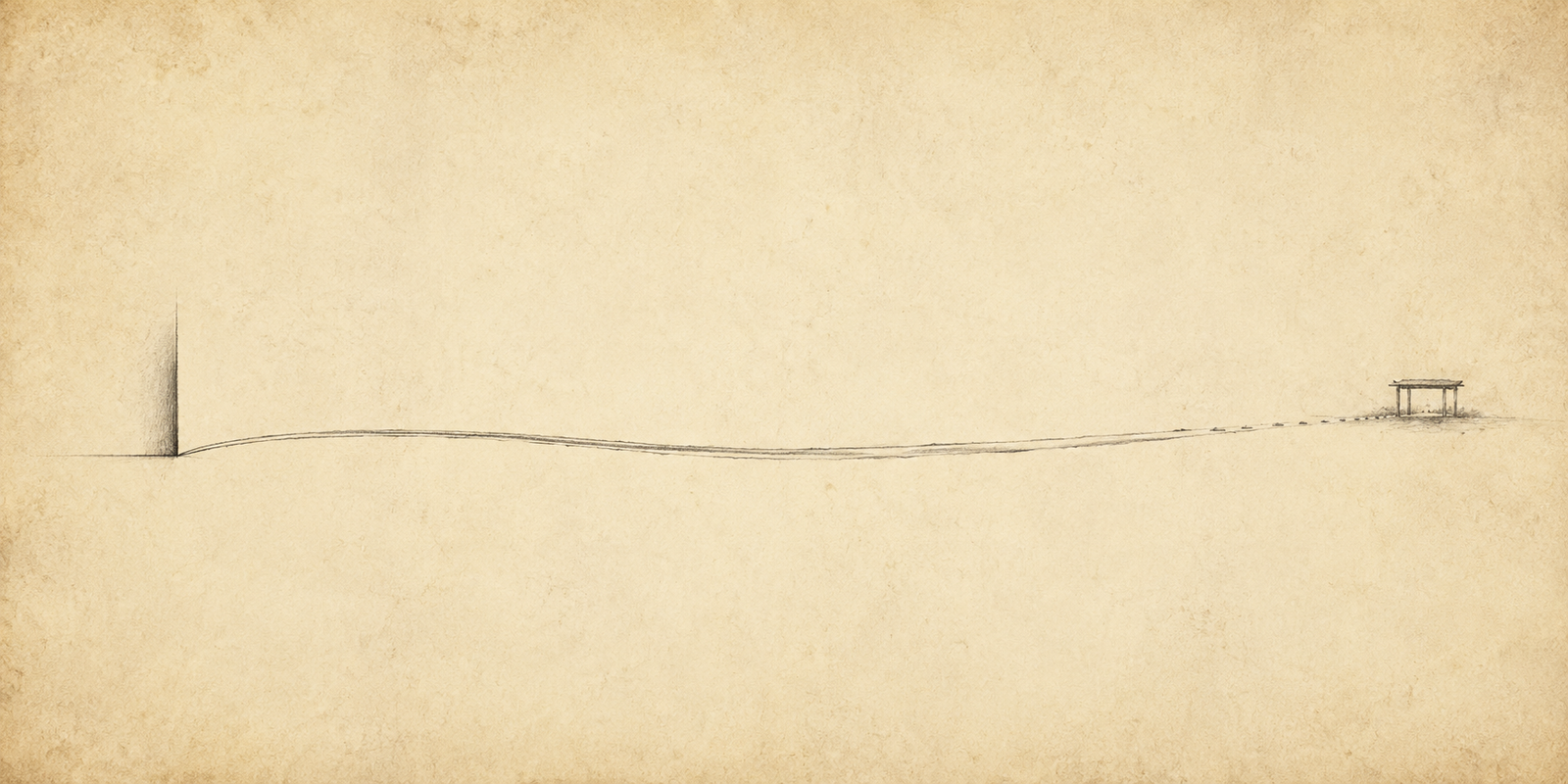
Along the roads of the Khmer empire, he did not merely praise compassion. He placed it where travellers would need it. Shelter, water, fire, direction, care: mercy set into distance. A traveller moving through heat, forest, danger, and uncertainty did not encounter benevolence as an idea. He encountered it as a prepared place. The kingdom had imagined his arrival before he appeared.
That is one of the highest forms of civilisation: when mercy stops being an emotion and becomes a road.
The image is powerful because it corrects our smallness. We often think of hospitality as a moment at the door: an opening, a permission, an exception granted to someone outside. But the rest house belongs to a deeper moral architecture. It says that the vulnerable should not have to beg existence from the mood of whoever happens to be in charge of the threshold. They should not have to depend entirely on whether a tired official is kind, whether a fearful crowd is calm, whether a prosperous citizen feels generous, whether the language of the day has made them frightening or pitiable.
A road with places of shelter says something else.
It says: we knew you might come. We made room for your need before your face was known to us.
A society’s ethics must eventually take form. If welcome is real, it becomes interpreters, schools, clinics, legal pathways, decent housing, fair work, patient offices, rituals of belonging, and public language that refuses contempt. Moral life at scale requires architecture. Without architecture, kindness remains private, and exhaustion does the rest.
Yet architecture alone is not enough. Institutions can process people without seeing them. A country can create mechanisms of reception while quietly teaching its citizens to resent everyone received. Hospitality requires both form and imagination. It requires the ability to see the stranger not as an abstraction called immigration, not as a threat called influx, not as a burden called numbers, but as a person whose life has crossed into the radius of our responsibility.
This does not make prudence unnecessary. A serious society must tell the truth about scale, housing, work, language, law, security, integration, and the needs of those already inside its care. To deny these realities is not compassion. It is evasion in the opposite direction. A welcome that ignores limits will eventually injure the very possibility of welcome.
But prudence is one thing. Moral hardening is another.
Prudence asks: how can we receive without breaking the forms that make reception humane?
Hardening asks: how can we justify not feeling responsible?
Prudence remains troubled by refusal. Hardening becomes proud of it. Prudence names limits with sorrow. Hardening discovers in limits a permission to despise. Prudence works to preserve compassion under constraint. Hardening uses constraint to be freed from compassion altogether.
The difference is not always visible in law. It is visible in the face, the voice, the metaphor, the joke, the headline, the ease with which people begin to speak of other human beings as floods, swarms, contaminants, burdens, waste. A society should fear that ease. It is one of the signs that the door has ceased to be a moral instrument and has become only a device of exclusion.
The stranger is not innocent because he is strange. The refugee is not noble because she is displaced. The migrant is not automatically wise, grateful, industrious, gentle, or enriching. That sentimental error is only another way of refusing full humanity. Those who arrive are human in the ordinary way: capable of goodness, resentment, courage, fatigue, brilliance, confusion, loyalty, selfishness, gratitude, grief, and hope. The moral case for welcome does not depend on pretending otherwise. It depends on saying that ordinary humanity is enough.
That is where the question becomes difficult.
We prefer mercy when it is crowned afterwards by success. We like the refugee who becomes a scientist, the poor child who becomes a judge, the exile who becomes an artist, the migrant family whose restaurant becomes beloved, the stranger whose grandchildren speak the language better than those who mocked their grandparents. These stories are true and beautiful. They should be told.
But they can hide a bargain.
We will honour your need once your usefulness has redeemed it.
The deeper civilisation refuses that bargain. It understands that the person who never becomes exceptional still tests us. The frightened mother, the old man, the unskilled labourer, the traumatised boy, the person who will need translation for years, the one whose gratitude is complicated, the one whose presence costs more than it returns in any visible ledger — these are not failures of the hospitality argument. They are its centre.
For the question is not only what they will become.
The question is what we will become in their presence.
Every society tells a story about itself. It speaks of freedom, justice, faith, compassion, dignity, civilisation, human rights, national character, moral tradition. But these words remain ornamental until someone vulnerable stands before the systems built in their name. Then the language is weighed. Not in ceremonies. Not in speeches. In the arrangement of fear, money, patience, welcome, resentment, law, and care.
The vulnerable reveal whether a society believes its own highest sentences.
To not turn away is not always to say yes without limit. It is to refuse the inner simplification by which another person’s suffering becomes unreal to us. It is to keep the door as a place of conscience even when the answer must be difficult. It is to build institutions that do not require cruelty in order to function. It is to speak of strangers in ways that do not make future violence easier. It is to remember that a people can defend its borders and still lose its soul, if defence becomes the organising principle of its humanity.
The society that does not turn away is not weak. It may require more discipline than the society that closes itself. Welcome asks for administration, patience, translation, sacrifice, confidence, civic imagination, and the humility to be changed by those one receives. It asks a people to endure enlargement. It asks them to believe that identity is not always weakened by encounter, and that moral strength is not proven by the refusal to be inconvenienced.
The first act of hospitality is to open the door.
The higher act is to build the road.
A door may open for a moment and close again. A road remains after the first feeling has passed. It carries the decision into distance. It says that mercy was not a mood, not a performance, not an exception granted under favourable weather. It was laid down deliberately, so that those who came after might find their way through a country without needing to prove, at every step, that their need deserved to exist.
Someone is always travelling toward the edge of our arrangements.
They have not yet become useful. They have not yet learned the language. They have not yet been translated into economic benefit, cultural enrichment, demographic necessity, or national myth. They are still on the road, carrying the terrible credential of need.
Beyond the door, the road is waiting to be built.
The measure of a civilisation is not only whether it lets the stranger enter.
It is whether, long before the stranger arrives, it has prepared a place where mercy can meet him.
—
Receive the next work
Subscribe free to receive new work from the Lucas Varro Library by email.
More from the Library

See Also
A concise and impartial dictionary of absence, promises, quarrels, ordinary objects, and the troublesome instability of words.

The City of Service
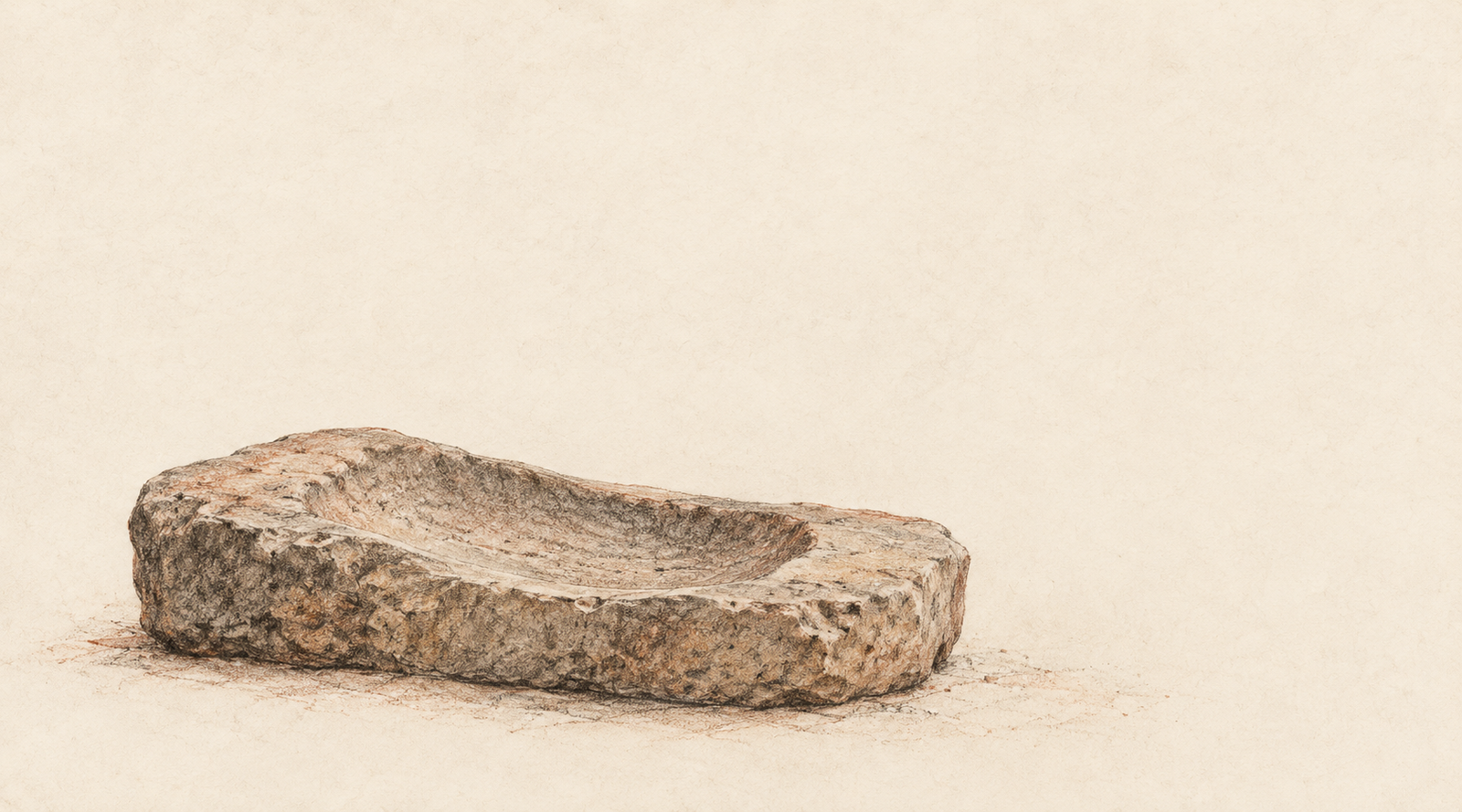
The temple we inherit is a building from which almost all necessity has been removed. Nothing must be brought for it to continue being what we call a temple. The sanctuary asks nothing of us. Stone is good at this kind of independence.
A living temple was otherwise.
Water had to come in. So did grain, cloth, oil, aromatic substances, fuel. The things required for worship arrived because someone carried them across a threshold.

Houses of Wood, Light, and Smoke
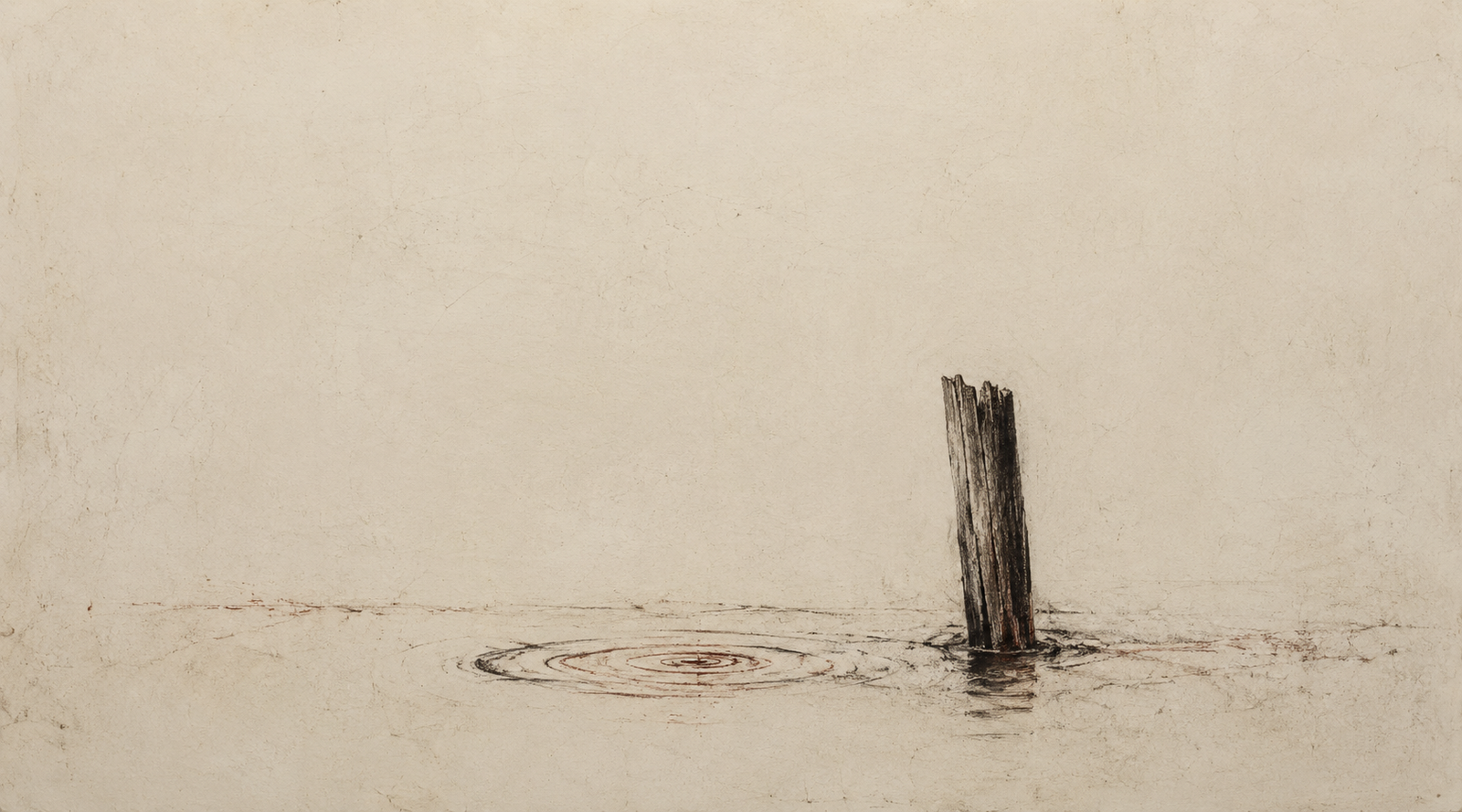
Some of Angkor’s most intimate ruins do not rise above the ground at all. They are postholes, low mounds, hearths and ponds: durable traces of a domestic city built largely from things that decay. To restore that city is to see Angkor not only as stone, but as wood, smoke, water, repair, and people living within calling distance.