

What the King Built for His Parents
Wisdom, compassion, and the sacred work of Jayavarman VII
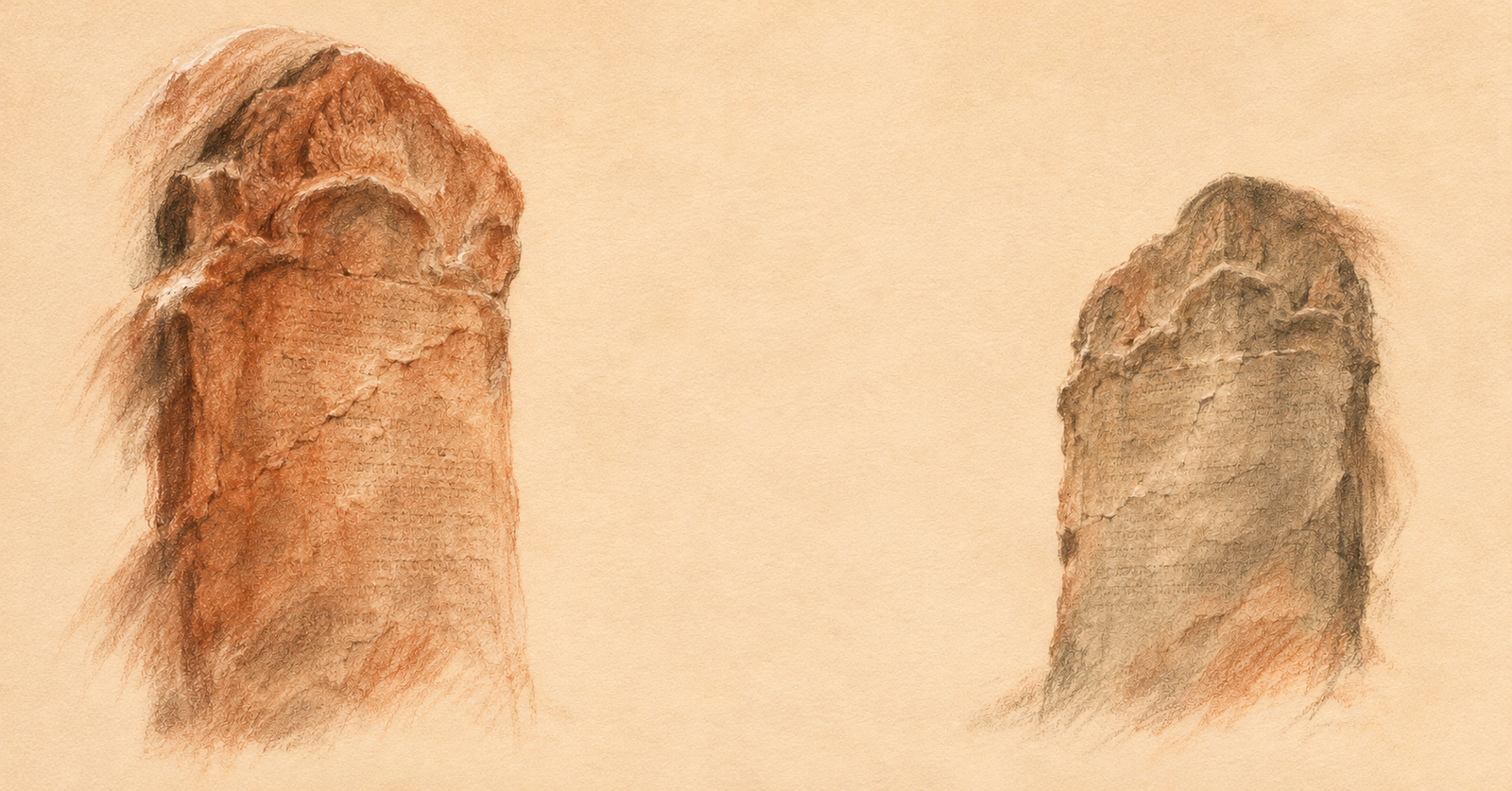
On the foundation stele of Ta Prohm, a king installs an image of his mother in the form of Prajñāpāramitā, the Mother of Buddhas. Elsewhere on the same stone, after the account of shrines and offerings, gold vessels and garments, rice and those whose work sustained the temple, another number appears.
One hundred and two hospitals.
The two declarations belong to the same royal inscription. The first speaks of a mother who has died, and of the form in which her son wishes her to be remembered. The second concerns the sick, dispersed through the provinces of a kingdom. Nothing in the inscription pauses to explain why these matters should stand together. To the people who composed it, perhaps no explanation was needed.
Ta Prohm was established in 1186 under Jayavarman VII, whose long reign transformed Angkor after years of war. Its Sanskrit name was Rājavihāra, the royal monastery. The great sanctuary honoured Śrī Jayarājacūḍāmaṇi, the king’s mother, in the form of Prajñāpāramitā. It was a particular act of remembrance, although the deity through whom remembrance was made belonged to an immense tradition of Buddhist thought.
Prajñāpāramitā means the Perfection of Wisdom. Not learning in the ordinary sense, nor an accumulation of correct answers, but the insight that neither self nor world possesses the fixed, independent existence we so readily attribute to them. In Mahāyāna Buddhism, such wisdom cannot remain a private accomplishment. Seeing into the nature of suffering places one under an obligation towards those who suffer. Wisdom and compassion belong to one another, though they are not the same thing.
The goddess was also the Mother of Buddhas: the wisdom from which awakening becomes possible. There was a tenderness, as well as theological precision, in the choice of image for Jayavarman’s mother. But it would be misleading to imagine a sculptor simply making a portrait of the dead queen, with the attributes of a goddess added afterwards. The inscription describes a sacred likeness, a joining of a human identity to a divine one. The original image cannot now be securely identified.
What remains is the inscription, and its extraordinary patience.
It tells us what was to be offered to the goddess each day. It counts rice, sesame, beans and millet. It enumerates textiles, jewels and the inhabitants who served the foundation. The figures are so large that they can begin to lose their meaning; the reader moves through them as through a crowded hall, knowing there are people there but scarcely seeing their faces.
Then the hospitals appear. One hundred and two establishments, distributed through the kingdom, with images of deities set up in them. Rice was assigned annually for their gods, their residents and their patients. The record then counts hundreds of villages and tens of thousands of men and women, although their precise connection to the hospitals is less clear. The stele gives the scale of a royal obligation, not a view of the ward.
For that we must turn to another inscription.
At Say Fong, near the Mekong in what is now Laos, one of the hospital steles preserves something closer to the business of attending the sick. It names the Healing Buddha, Bhaiṣajyaguru, with his attendants associated with sunlight and moonlight. It speaks of two physicians. There are people to store and distribute remedies, cooks to prepare food, workers to fetch water and fuel, women to grind medicines and pound rice. Others clean the sanctuary. Others are charged with guarding the establishment and administering treatment.
The sick do not appear by name. The tasks do.
Here compassion is not quite the feeling we might expect. It must be measured, stored, carried and renewed. Someone has to know what has arrived. Someone has to prepare it. Someone must remain when the ceremony is over and another person is still ill.
The hospital edict declares that people of all four castes may receive care. It also sets down quantities and occasions for supplies from the royal stores. Some medicinal materials were to be obtained three times each year, while the Ta Prohm inscription records annual provisions for the wider network. These are different schedules in different texts, not a single reassuring account of a system that worked without interruption.
Nor should we imagine an ancient hospital as a modern one, transplanted into laterite and sandstone. Care, ritual and medicine were closely joined. The Healing Buddha stood within the hospital sanctuary; the daily offering of rice was also food from which the patients could benefit. The physician and the priest occupied the same institutional world.
The inscriptions tell us what was prescribed. They cannot tell us how many patients recovered, whether supplies reached every distant settlement, or what the sick thought of those who attended them. The royal language presents a generous and ordered kingdom. It was meant to. These were monuments to kingship as well as records of pious provision.
Yet the practical detail resists being dismissed as praise. A physician named in a hospital regulation was an office to be filled. A storekeeper had stores to keep. The accounts depended on fields, villages and labour. Even a king’s compassion required other people to make it real.
It is sometimes said that Ta Prohm was the headquarters of the entire medical network. Its inscription records the hospitals and their provisions; the hospital regulations name the royal storehouses from which supplies were drawn. Neither gives us a precise chain of command between Ta Prohm and the provincial sanctuaries, or identifies the chamber from which remedies were dispatched. There is strength enough in what they do say.
North of Angkor Thom, another royal monastery carries the memory of another parent.
Preah Khan, the sacred foundation known in Sanskrit as Jayaśrī, was dedicated to Lokeśvara, the compassionate bodhisattva who hears the distress of the world. The image at its centre was named Śrī Jayavarmeśvara and identified with the king’s father, Dharaṇīndravarman II. The consecration is conventionally dated to 1191, although the numerical expression on the stele also permits a reading corresponding to 1192. Whatever the precise year, it followed the foundation of Ta Prohm.
The father’s sanctuary stood on ground the Preah Khan poet remembered as a battlefield. The city’s stone and golden lotuses had changed the colour of that ground, he wrote; and yet it still shone as though stained with blood.
It is a difficult beginning for a temple of compassion. Perhaps that difficulty matters. Jayavarman had gained his position through war. The buildings that proclaimed his religious merit also proclaimed his power to conquer, command labour and dispose of land. The bodhisattva’s mercy was not set apart from the state. It stood in the midst of it.
Preah Khan is often described as a university. The word is useful, up to a point. Its inscription names a religious teacher and fifteen assistant teachers; it also refers to practitioners who maintained, recited and taught the Buddhist doctrine. Other personnel included followers of Śiva. One passage records several hundred religious specialists. Some guidebooks nevertheless speak of more than a thousand teachers; that figure cannot be securely recovered from the surviving lines.
But neither does it describe an empty ceremonial place. Teaching and study were sustained by buildings, food, assistants and grants. A religious tradition could not endure through images alone. Someone had to learn the words, speak them again, attend to their meanings, and pass them to a generation that had not been present when the foundation was made.
The correspondence is alluring. At Ta Prohm, Wisdom was consecrated in the image of the king’s mother, while the foundation inscription embraced care for the sick. At Preah Khan, Compassion took the form of his father, while the monastery maintained a community of teaching and learning. The two seem to exchange their gifts.
Wisdom made useful through care. Compassion made durable through understanding.
But the exchange is not exact, and the inscriptions ask us not to make it so. Ta Prohm also supported learned religious men and those associated with a lecturer. Its festivals drew upon Buddhist teaching and ritual knowledge. Preah Khan, for its part, was a substantial endowed community requiring food, service and the ordinary provision of bodies. These were not departments of a modern government, divided into health and education. They were inhabited religious foundations in which worship, learning, care and royal administration crossed one another.
There is no inscription in which Jayavarman declares that he designed one temple to turn wisdom into compassion and the other to turn compassion into wisdom. To put those words into his mouth would diminish what the surviving evidence has to give.
For the pattern does not vanish when we loosen our hold on it. Something more particular comes forward.
Near the end of the Ta Prohm inscription, the king’s good works are described as arising from devotion to his mother. He wishes that, through their merit, she might attain Buddhahood and help others cross the ocean of worldly existence.
At Preah Khan, a corresponding prayer is made for his father. The work of the king is offered towards the father’s enlightenment, again so that other beings might cross that same ocean. The images differ. The aspirations meet.
This is no symmetry invented by a visitor standing before three monuments. It survives in the words of the two foundations.
Nor were the parents kept entirely apart in the ritual life imagined by their son. Preah Khan’s inscription sets out an annual festival at which sacred images from other places were to be present. Among those named is Śrī Jayarājacūḍāmaṇi, the goddess of Ta Prohm, the king’s mother. In the terms of worship, the mother’s presence could be brought to the father’s sanctuary. The monuments were fixed in their places; their devotions moved.
At the Bayon, within the walled city of Angkor Thom, Buddhist imagery gave these relationships a further centre. Scholars have long recognised a triad of Lokeśvara, the Buddha and Prajñāpāramitā, expressed both in smaller images and in the great royal foundations. The Bayon’s principal image was a Buddha sheltered by the coils and hoods of a nāga. It is tempting to see the parents’ deities approaching the awakened figure from either side.
Tempting, and not wholly without reason. But the Bayon has no surviving foundation stele comparable to those of Ta Prohm and Preah Khan. Its complex religious history will not yield a single instruction from the king explaining what the entire arrangement was meant to be. The temples have their geography; a theological reading has its own. They need not coincide point for point.
The Bayon need not solve the two earlier inscriptions.
There is a passage towards the close of the Preah Khan stele that refuses the distance of doctrine. It speaks of the grief that remains when parents have died, even after many years, because no one else can take their place. This is a carefully composed royal poem, not a private confession. Still, the claim is painfully ordinary. A son has lost his father and mother, and even kingship cannot bring them back.
He could give them new forms. He could feed the shrines in which those forms were honoured. He could endow teachers and hospitals, assign villages, command stonecutters, call upon successors not to let his works fall into ruin.
And he could write down a wish.
On one stele he asks it for his mother. On the other, for his father. In both, the dead are asked to do something that the living king, for all his power, cannot accomplish by command: help others across the ocean of suffering.
—
Receive the next work
Subscribe free to receive new work from the Lucas Varro Library by email.
More from the Library


The Spaces Between Her Fingers
One hand rises towards her breast; the other follows her waist. Between their gestures, the smallest spaces become strangely difficult to leave.

Almost Ready
A face of perfect composure. Two hands still busy with a crown. A tiny human comedy, held in weathered stone.

The Second Doorway
A little doorway keeps its darkness. Beneath the waterline, another appears — just as clear, and impossible to touch.