
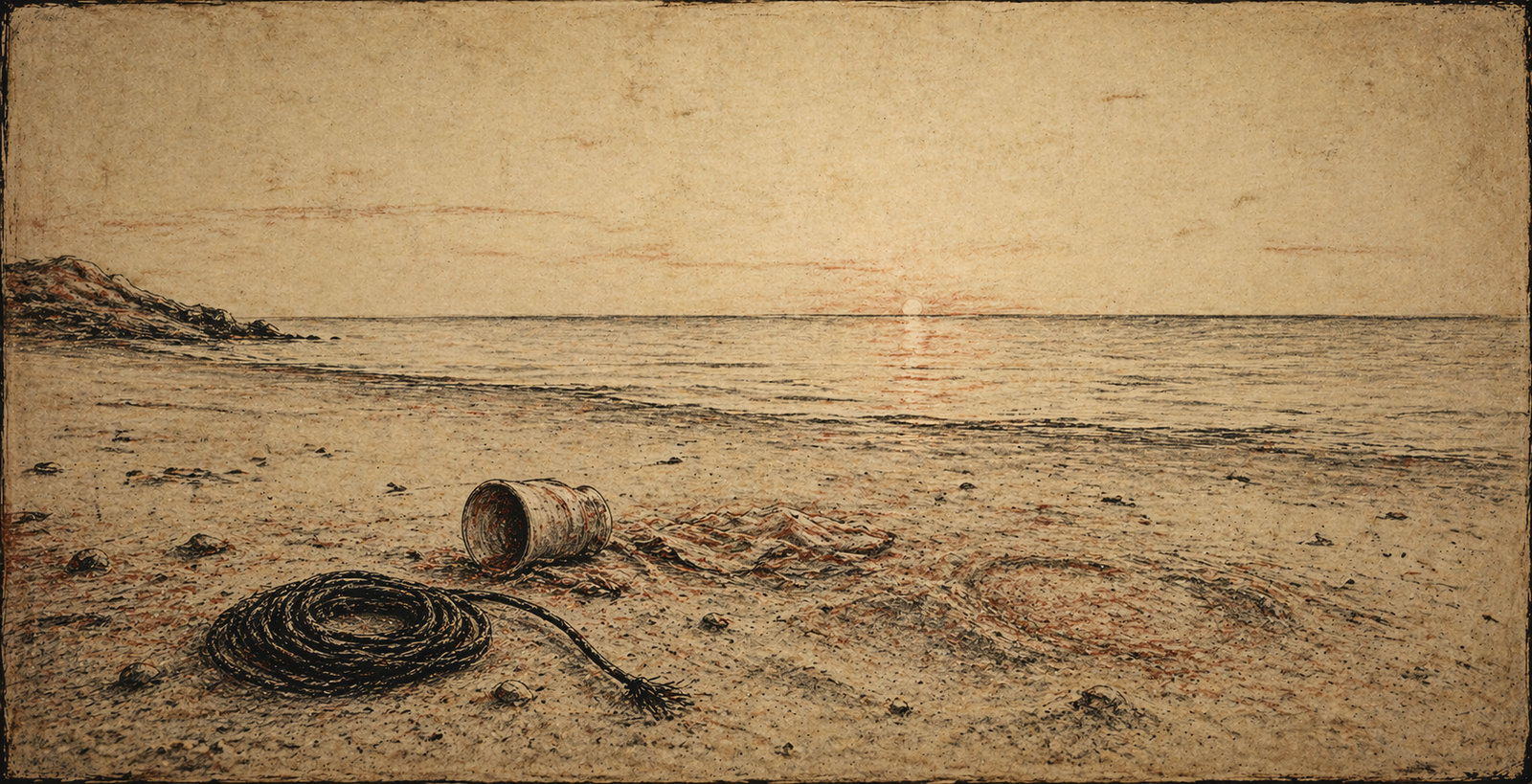

Ariadne — The Shore After Naxos
She gave him the way back. He left her with the morning.
She woke with sand against her face and salt dried at the corner of her mouth.
For a little while she did not move. Sleep still weighed upon her, though morning had already begun its patient work along the shore. Light pressed red through her closed lids. The sea kept breathing. Somewhere near her, she thought, he would still be lying wakeful after danger, or sitting with his arms around his knees and watching day separate itself from the water. They had come too far, and paid too much, for anything but this brief carelessness. She had slept because she believed herself no longer alone.
Then she opened her eyes.
The place beside her was empty.
Not fear at once. Only the mind’s first refusal. She turned, expecting to find him a little way off—at the edge of the water perhaps, or among the low scrub beyond the strand, or bent over the few things they had brought ashore. A man might rise before dawn. A man might go for water. A man might walk a short distance from the woman who had helped save his life and still intend to return.
She pushed herself up on one elbow.
A cup lay overturned in the sand. A fold of cloth stirred and settled. There were marks where weight had pressed, where something had been lifted, where something had been dragged. Beyond them the shore ran pale and bare toward the rocks.
No ship.
Ariadne sat upright so quickly that the world tilted. She looked again, not now at the land but at the open sea, searching the thin morning brightness for the dark line that ought to have been there simply because it had been there when she slept.
There was nothing.
Only water, and the long clear light spread over it.
She rose. Her limbs were still heavy from the voyage and the nights before it, and for an instant they seemed to belong to someone else. She took a few steps over the sand, then more, as if a different angle might restore the missing thing. Once she turned back and looked at the place where she had lain, absurdly, as though absence might yet prove itself a mistake of posture, or distance, or waking too suddenly.
The ship did not return.
Then the knowledge came in fully, as the sea comes into a hollow of stone: not in one blow, but in a gathering that leaves nowhere dry.
He had gone.
Not gone inland for water. Not gone before her to make some easier way. Gone.
Theseus had sailed without her.
She stood still after that. Morning, which a moment before had seemed almost kind in its mildness, showed itself for what it was: clear, indifferent, already occupied with the making of day. It gave her nothing back. No movement upon the horizon. No sound of oars. No wavering shape that pity might mistake for a hull. Not even uncertainty.
Only this: he had waited until she slept.
She looked down and saw, half-buried where her hand had pressed into the sand, a small coil of thread.
She bent and picked it up.
It clung damply to her palm, streaked with grit. In another life it might have been almost nothing: a household thing, a woman’s remnant, the sort of length one winds about the fingers while thinking of something else. Here it lay with all its meaning returned to it.
There had been a moment—she could feel its shape with a cruelty sharper than sight—when she had placed such thread into his hand in the dark below her father’s house. Stone had sweated around them. The air had seemed not to move. She had told him what he must do, where he must fasten it, how he must trust the line and not his own courage when the turns began to defeat him. Courage was of little use in a place built to unmake direction. Courage could carry a man inward. It was the road back that needed help.
He had taken the thread from her as men take what they cannot do without and would prefer not to remember too clearly afterwards.
And he had promised.
Not perhaps in the grand words singers later favour, but plainly enough. When this was done. When they were clear of Crete. When danger was behind them. She should not remain in the house of Minos to bear what followed. He would take her with him. She would be his wife. The thing she risked would not be spent into nothing.
She had believed him.
That belief seemed to her now the strangest thing of all. Stranger than the deep stone ways beneath Knossos. Stranger, perhaps, than the gods, who at least did not pretend to be safe. But a man whose death she was preventing—why should he speak falsely then? Why should the hand that closed around the means of life not later close around the hand that had given it?
She sat down because her legs had begun to tremble.
Far away, beyond sight, lay whatever future had risen before him when he made his oath—Athens, perhaps, or glory, or simply the next shore after triumph. It is often difficult to tell which of these men love most. They go to danger with shining faces and return wanting witness more than gratitude. The thing that saved them must sometimes learn its smallness alone.
Ariadne drew her knees up and held them, the thread trapped in one fist.
Crete came back to her then—not as a kingdom, nor as the whole shining and darkened spread of her father’s dominion, but in hard particulars. Oil-smell in the passages at evening. The measured tread of servants who knew which doors were not to be opened. The sea beyond the terraces. Music in upper rooms. And always, beneath all of it, the hidden pressure in the house itself: that old sealed dread laid into stone, the knowledge of something below which no feast cancelled and no daylight reached. She had grown up above it. She had learned the shape of a palace built around concealment. She had left all of it behind. Left father, mother, country, the high rooms, the courts, the carved pillars, the law of her own house, and the stain at its heart.
She had left not only safety, if safety had ever existed there, but belonging.
And for what?
She had not done it for the bright disorder singers later prefer when they want a woman’s risk to seem prettier than it was. She had done it because a man would not come back alive from the dark without what she gave him.
That was the measure of it.
Without her, he would have entered the winding stone under his own brave name and not returned at all. With her, he had become the man the songs would keep. He had descended with his courage and risen by means of her cunning, her disobedience, her severance, her willingness to place the future of another life above the claims of her own blood. He had come out owing his road to her hand.
And now the road had carried him onward without her.
A short, dry sound escaped her then—too sharp to be called laughter, too bitter to be anything else. It vanished at once into the sea-air.
“So this,” she said quietly, and heard how strange her own voice was in the empty morning. “This is what it bought.”
The water went on breaking in its small patient way upon the shore.
She bowed her head.
Some griefs arrive first as sound. Hers came first as knowledge. Only afterwards did the body begin to understand what the mind had admitted. Her chest drew tight, as if another cord had been wound there and pulled. Her throat burned. She pressed the heel of her hand against her mouth, but that did nothing. The cry that rose in her had too much truth to be quieted by touch.
He had taken the road out, and she had remained where he left her.
Not in Crete. That gate was closed. Not in Athens. That gate had never opened. Not daughter any longer in the old house, nor wife in the new one, but cast up upon a bare strip of earth between them, as though the world had paused there to discover what remained of a woman once her usefulness was over.
Then at last she wept.
Not beautifully. Not in the well-shaped cadences poets prefer from abandoned women. She bent over herself and wept as those do whose lives have been altered beyond easy restoration in a single hour. Once she said his name. Once she called him faithless. Once, in a voice almost level from the force required to keep it so, she asked what he imagined he had done to her, and whether he believed the sea would hide it.
After that, words failed.
Day climbed. The island disclosed itself more fully: rough stone, low growth, a rise of land beyond the strand, the first waiting heat. Ariadne wiped her face with the back of her wrist and tasted salt again without knowing whether it was the sea or grief.
Then something changed.
Not in the manner of comfort. Not in the manner of hope. Hope looks back over the water. This did not.
The shore, which all morning had seemed merely empty, grew attentive.
A stillness came first, though the sea did not cease. Then a depth in the air itself, as if the day had opened somewhere beyond sight. Ariadne lifted her head. The light had altered—not brightened, but gathered. The world no longer looked vacant. It looked inhabited by something not yet seen.
She did not rise at once. Some instinct older than courage kept her quiet.
The thread lay across her palm, dark with seawater and tears. She looked at it, then out toward the line where land, sea, and sky held one another in hard silence, and knew for the first time since waking that abandonment, though complete, might not be the final thing spoken over her. Not because the wrong had lessened. It had not. Not because the man already gone over the water would remember justice. He would not. But because the world had not finished with her merely because he had.
The knowledge brought no ease. It was too grave for that, and too strange.
She rose slowly.
Behind her the sea went on shining with its pitiless beauty. Before her the island waited, no kinder than before, but no longer empty. Ariadne stood between the vanished wake and the silent land, with the broken oath still living in her body and the thread still resting in her hand, while around her the day, in some new and watchful manner, began to look back.
—
Receive the next work
Subscribe free to receive new work from the The Hospitable Dark Library by email.
More from the Library


See Also
A concise and impartial dictionary of absence, promises, quarrels, ordinary objects, and the troublesome instability of words.

The City of Service
The temple we inherit is a building from which almost all necessity has been removed. Nothing must be brought for it to continue being what we call a temple. The sanctuary asks nothing of us. Stone is good at this kind of independence.
A living temple was otherwise.
Water had to come in. So did grain, cloth, oil, aromatic substances, fuel. The things required for worship arrived because someone carried them across a threshold.

Houses of Wood, Light, and Smoke
Some of Angkor’s most intimate ruins do not rise above the ground at all. They are postholes, low mounds, hearths and ponds: durable traces of a domestic city built largely from things that decay. To restore that city is to see Angkor not only as stone, but as wood, smoke, water, repair, and people living within calling distance.