Complimentary worldwide shipping on orders over $400 · No import tariffs for most countries

Bakong does not belong to Angkor’s climax. It belongs to its decision.
Set on the flat plain of Roluos, far from the later grandeur of Angkor Wat, Bakong rises as a deliberate act of will: the moment when the Khmer world first chose to lift stone into a mountain and declare that the gods could be housed, permanently, in architecture. What comes later—scale, refinement, spectacle—begins here, but Bakong itself is austere, resolved, and foundational.
Dedicated in 881 CE by Indravarman I, Bakong served as the state temple of the ancient capital Hariharalaya. It was consecrated to Shiva, and it held the royal linga, Sri Indreshvara, binding king and god at a single vertical axis. Indravarman was buried here. This was not symbolism layered on later; it was the point. The temple was conceived as a statement of cosmic legitimacy made permanent in stone.
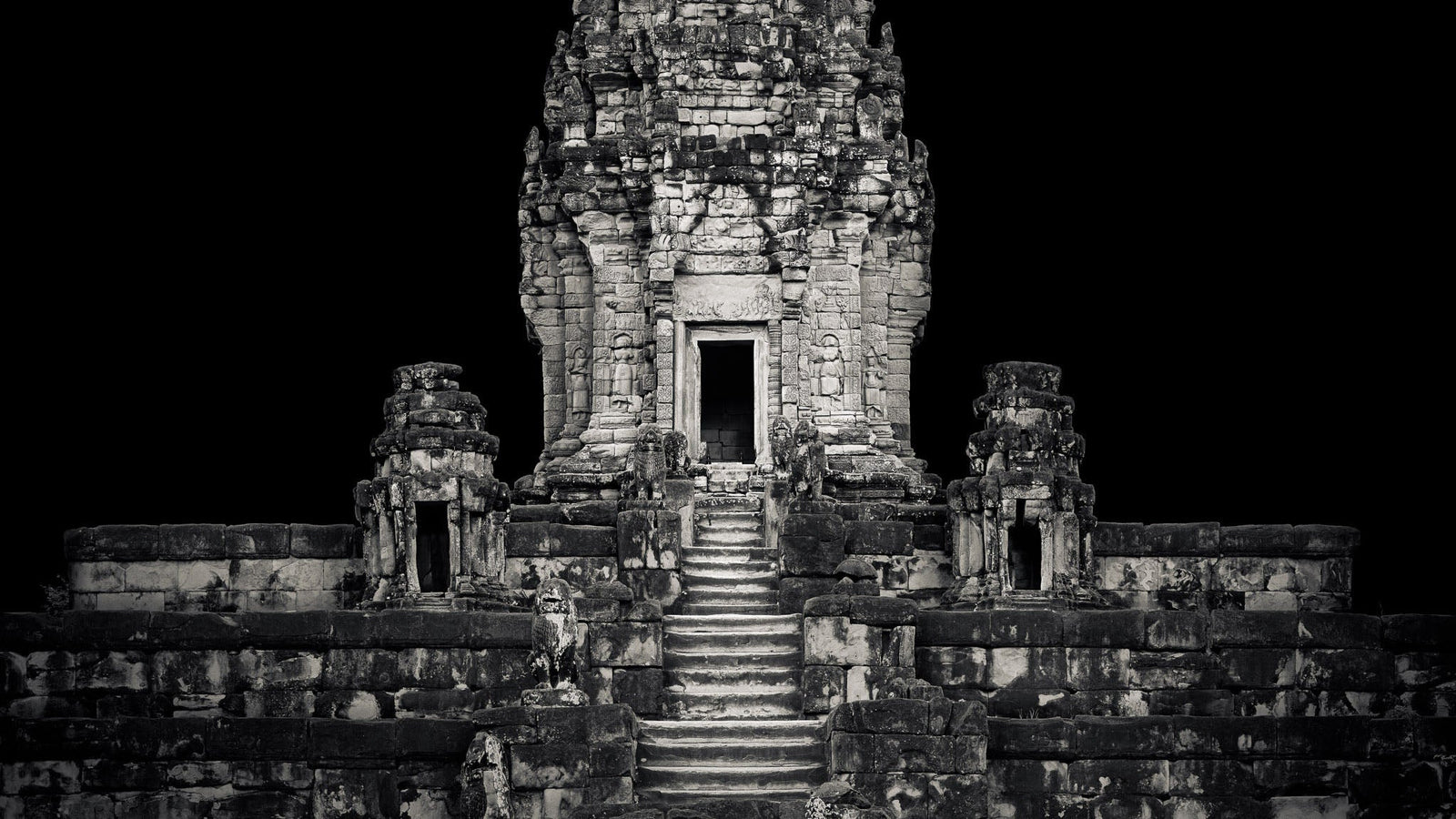
Bakong is the first great temple-mountain of the Angkorian world. Its five-tiered pyramid does not gesture toward Mount Meru—it insists upon it. Each terrace recedes with intention, forcing the eye upward, compressing perspective, making ascent feel steeper than it is. This is early Khmer architecture discovering how power can be shaped through geometry alone. There is no ornament here to distract from the form. The mass does the work.
A bridge flanked by a seven-headed naga crosses the remains of a once-water-filled moat. The symbolism is unambiguous: the cosmic ocean is crossed, chaos is left behind, and the mountain of the gods rises ahead. Unlike later temples, Bakong’s ground level is ringed by eight brick sanctuaries whose features still carry the memory of the pre-Angkorian world—round colonettes, makaras turned inward, a softness of transition rather than rupture. The empire has not yet erased its past. It has absorbed it.
Four monumental gates dominate the cardinal points of the pyramid, a feature unique to Bakong. They do not invite wandering. They command orientation. Each axis is guarded, once by towering dvarapalas, now by absence. Even in ruin, the logic holds. Entry is not casual. Movement is regulated. The body is instructed where to go.
At the corners of the terraces, elephants anchor the structure. They are simple, blocky, direct—creatures of weight and steadiness. Lions guard the stairways, among the finest early examples in Angkor. Nandi, Shiva’s bull, faces the ascent from below, watching. Heads are missing, details eroded, but the clarity of intention remains. This is not decorative sculpture. It is structural belief.
On the fourth level, twelve small sanctuaries once held lingas, encircling the central shrine like satellites around a core truth. Here, for the first time in the Khmer world, narrative relief begins to appear. Only fragments remain, but they are enough. A story is being tested in stone. The experiment will succeed beyond measure in later centuries, but its origin is here, tentative and essential.
Bakong’s central tower, as it stands today, is not original. It was rebuilt in the twelfth century, shortly before Angkor Wat, in a lotus-bud form that looks forward rather than back. This layering is important. Bakong was never abandoned. It was corrected, reinforced, reasserted. Even as the capital moved north to Angkor, the logic of Bakong remained intact: the temple-mountain as the axis of kingship, the king as mediator between earth and heaven.
Walking Bakong now, one feels its difference immediately. There is no excess. No labyrinth. No visual saturation. The temple speaks in primary forms: step, tower, axis, enclosure. It is architecture still learning its own power, and therefore unwilling to waste it. Where later temples elaborate, Bakong establishes. Where they refine, Bakong declares.
This is why Bakong matters. Not because it is beautiful in the later sense, but because it is necessary. It is the proof-of-concept for an empire that would soon remake the plain of Cambodia into a cosmological landscape of stone. Without Bakong, Angkor does not happen—not in this way, not with this confidence.
Bakong teaches that sacred architecture begins not with ornament, but with decision. The decision to align the world. To raise the centre. To bind king, god, and mountain into a single vertical fact.
Everything else follows.
Photographs from Bakong Temple – Spirit of Angkor series by Lucas Varro
Long before Angkor Wat, there was Bakong.
Rising from the earth like a mandala of stone, Bakong was the first great temple-mountain of Angkor—an axis of heaven and earth dedicated to Shiva and the sacred stillness at the heart of all things. Its five tiers unfold like an ancient hymn, each level drawing the pilgrim inward, upward, into quiet communion with the divine.
In this rare and intimate collection, Lucas Varro brings his large and medium format film cameras to the weathered grace of Bakong. These black-and-white photographs—captured in the silence of pre-dawn and the hush that follows monsoon rain—are shaped with chiaroscuro and hand-toned by the artist to reveal not just form, but presence. A flicker of devotion in the eye of a guardian. A monk’s solitary ascent. The breath of time on stone.
Printed in strictly limited editions on museum-grade Hahnemühle Bamboo paper, each image is offered with a Collector’s Print Package that includes poetic writings, curatorial notes, and reflections from the artist’s field journals.
This collection is a return to origin—a reverent honouring of Angkor’s first sacred mountain, where the stones still remember the prayers that shaped them.
Receive occasional letters from my studio in Siem Reap—offering a glimpse into my creative process, early access to new fine art prints, field notes from the temples of Angkor, exhibition announcements, and reflections on beauty, impermanence, and the spirit of place.
No noise. No clutter. Just quiet inspiration, delivered gently.
Subscribe and stay connected to the unfolding story.
Receive occasional letters from my studio in Siem Reap—offering a glimpse into my creative process, early access to new fine art prints, field notes from the temples of Angkor, exhibition announcements, and reflections on beauty, impermanence, and the spirit of place.
No noise. No clutter. Just quiet inspiration, delivered gently.
Subscribe and stay connected to the unfolding story.