
The Library gathers the written works of Lucas Varro — journals of the temples, mythic retellings, contemplative essays, poems, and volumes shaped by shadow, silence, and wonder. Here, words stand beside images as offerings: field notes from Angkor, meditations on sacred stone, old stories rekindled, and reflections carried beyond the visible world.
Within these shelves you will find many rooms: Angkor journals, myth and legend, apsara meditations, contemplative essays, poems, children’s mythic wonder, literary retellings, and quieter devotions of the page. Wander chronologically, enter by theme, or pass through one of the dedicated publication houses now gathered within the wider Library.
For those who wish to follow these paths further, several of these writings continue on Substack and in dedicated archive blogs: The Lantern Chronicles , where myth, legend, contemplative essays, poetry, and other imaginative works are carried onward; The House of Cadmus , where Greek myth and tragedy are reopened through inheritance, violence, fate, and recurrence; The Mytharium , where myth, Tolkien, fairy stories, and old literature are read and retold with seriousness; The Alexander Series , where A. M. Sharp retells Greek myths for children who want to be trusted by stories; and The Hospitable Dark , where A. M. Sharp offers literary myth retellings shaped by darkness, shelter, endurance, and return.
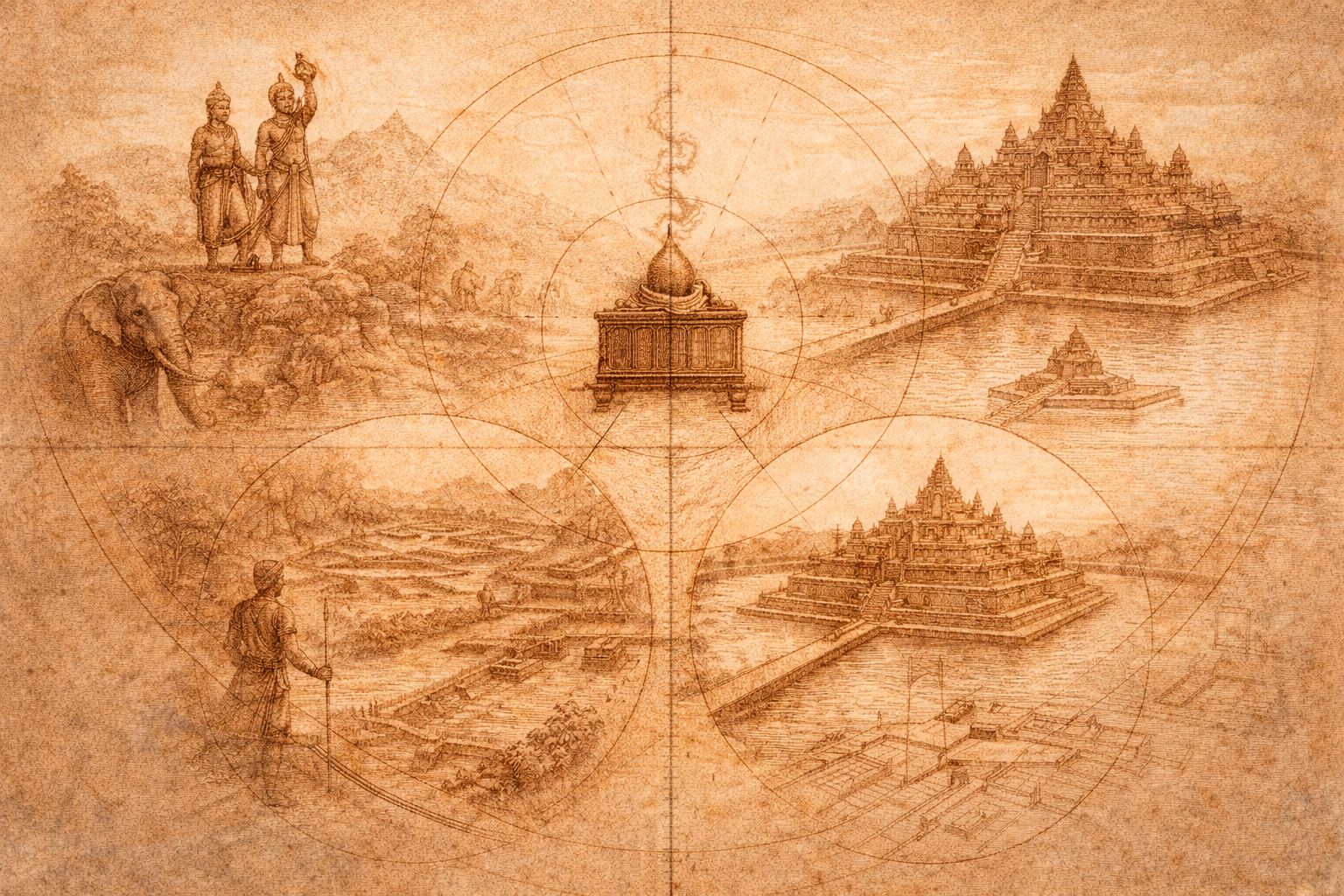

Declaration, Consolidation, Standardisation — The First Angkorian Sequence
Angkor’s first century unfolds as a triad: Jayavarman II declares the sacred centre, Jayavarman III holds it steady, and Indravarman I gives it scale. From ritual to restraint to standard, the Khmer world learned how to turn alignment into empire.

Those Who Keep the Way Open — On the Quiet Guardians of Angkor’s Thresholds
Quiet gestures shape the way into Angkor — a swept stone, a refilled bowl, a hand steadying a guardian lion. This essay reflects on the unseen custodians whose daily care keeps the thresholds open, revealing how sacredness endures not through stone alone, but through those who tend its meaning.
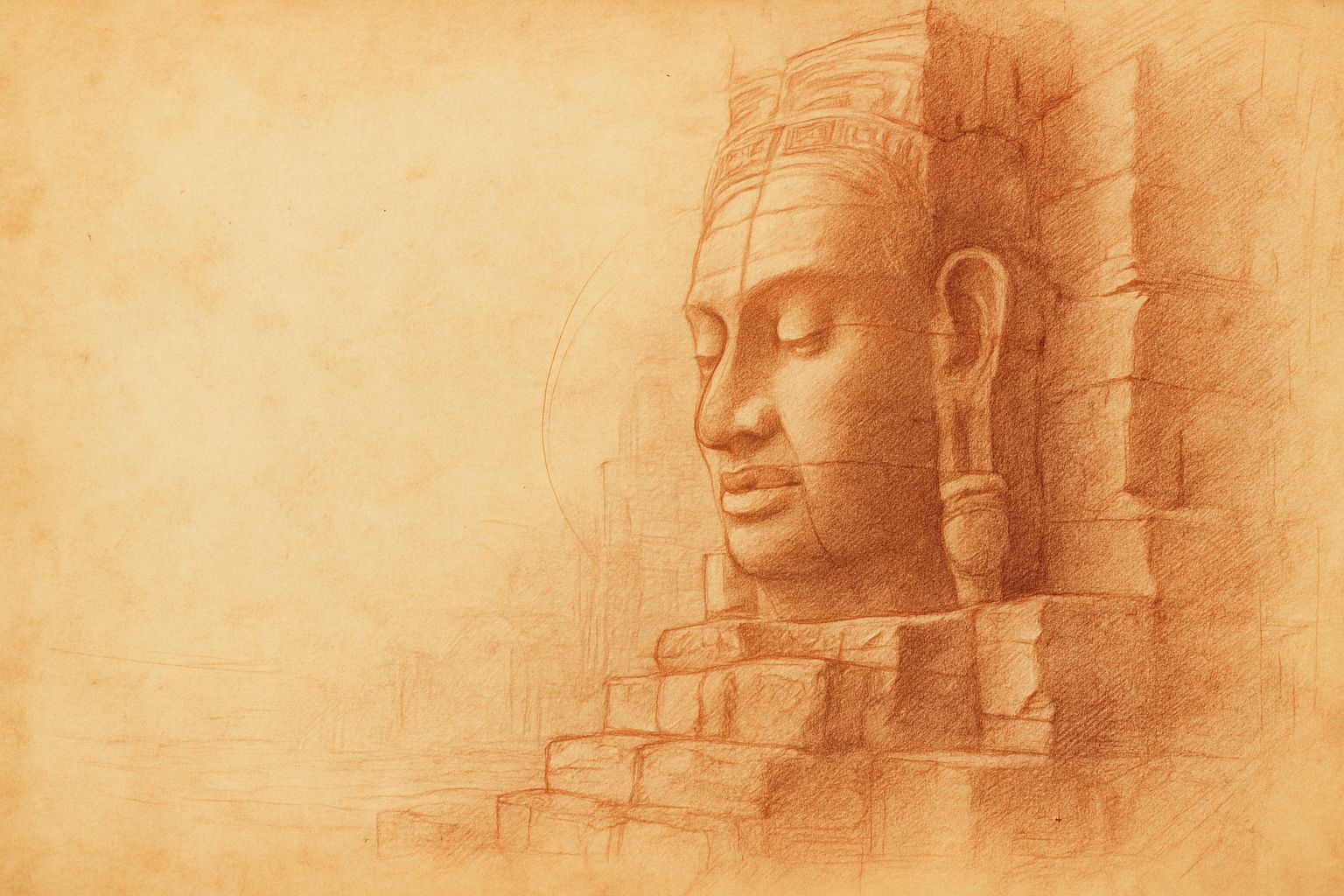

Multiplicity and Mercy — The Face Towers of Jayavarman VII
A new vision of kingship rises at the Bayon: serene faces turned to every horizon, shaping a world where authority is expressed as care. Moving through the terraces, one enters a field of steady, compassionate presence — a landscape where stone, light, and time teach through quiet attention.

The Measure of Silence: A Pilgrim’s Reflection on Kingship at Angkor
Through the ruins of Angkor, a curatorial pilgrim traces the vanished geometry of divine rule. In the silence of the stones, kingship reveals itself as both devotion and decay—an empire of alignment turned elegy, where even ruin retains the measure of sacred order.
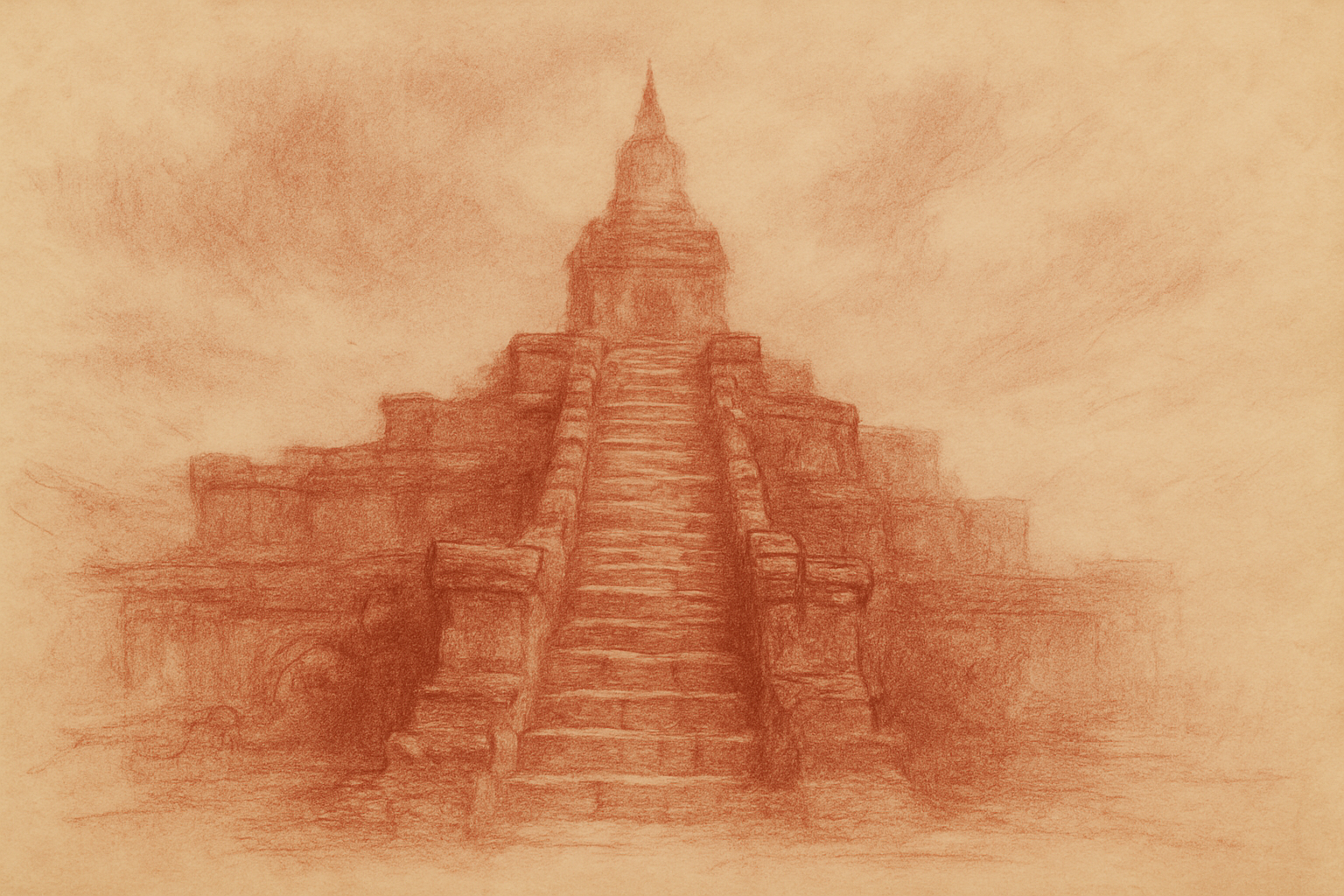

Phimeanakas and the Goddess of Sovereignty
Within the Royal Enclosure of Angkor Thom stands Phimeanakas—the Celestial Palace. More than a monument, it is a myth made stone: where kings bowed to the goddess of the land, and sovereignty meant surrender. A contemplative meditation on sacred architecture, divine right, and the quiet power that still lives between the stones.
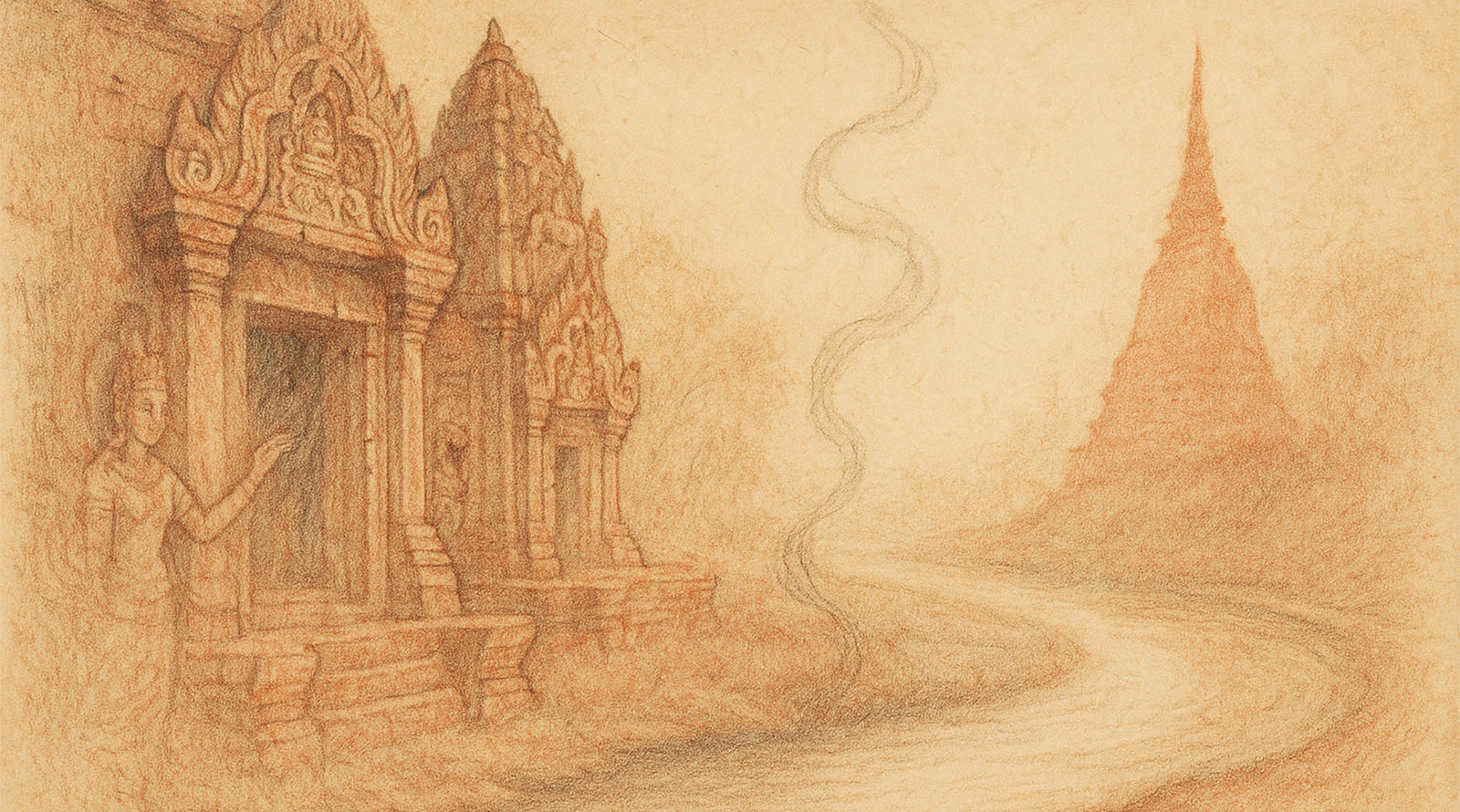

The Shape of a Vanishing Empire
The stones do not mourn.
They whisper the shape of what once was—
of constellations surrendered, of dharma reshaping a world.
Step into the hush between kingdoms,
where breath becomes lineage
and memory walks on river light.
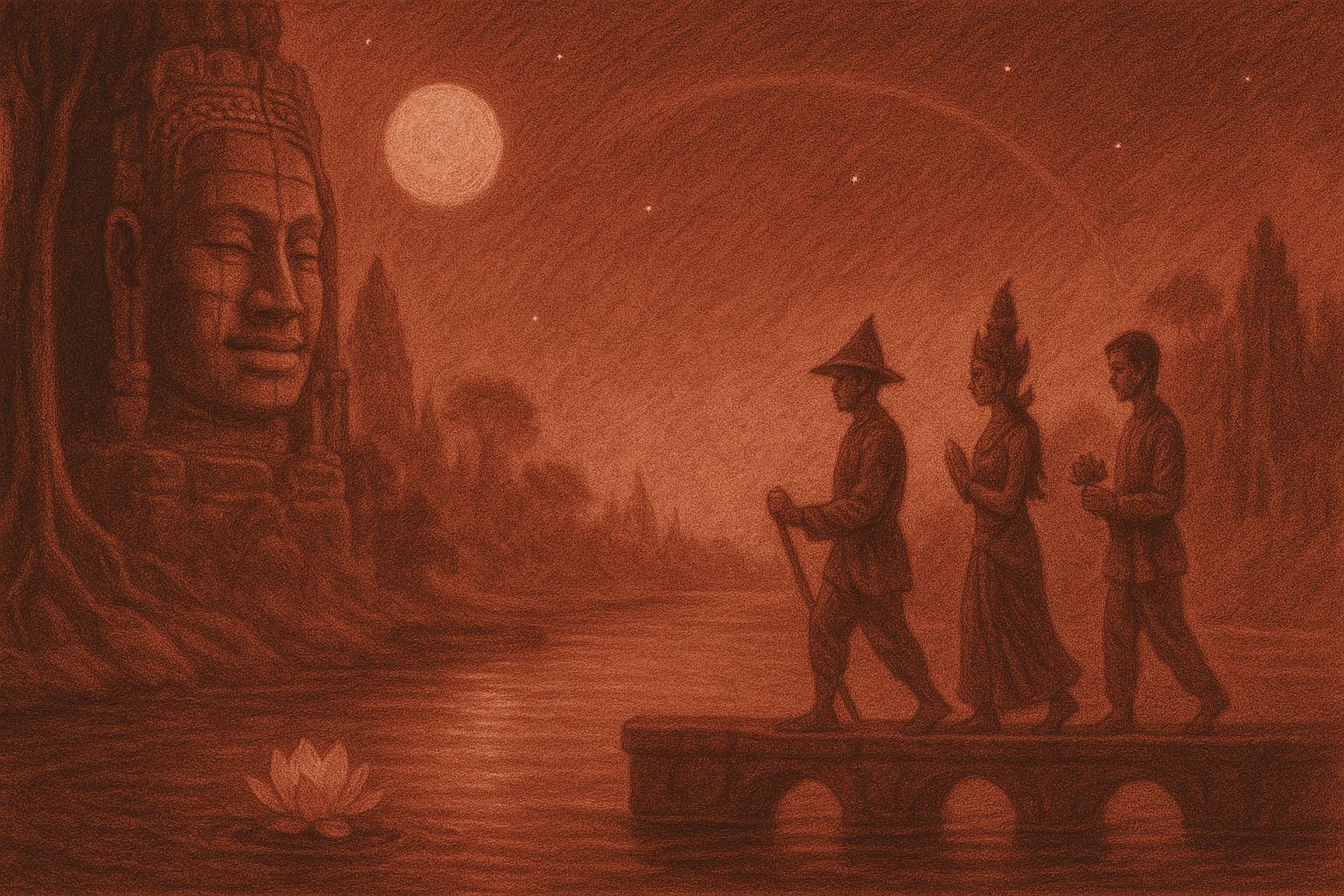

When Two Rivers Become One: The Secret of the Bayon
Beneath the gaze of silent stone, two destinies entwine—Khmer and Cham, land and sea, kingship and yearning. Step softly into the Bayon’s breath, where unity flickers like moonlight on water and the ancient dream still waits, murmuring through corridors carved in shadow and light.
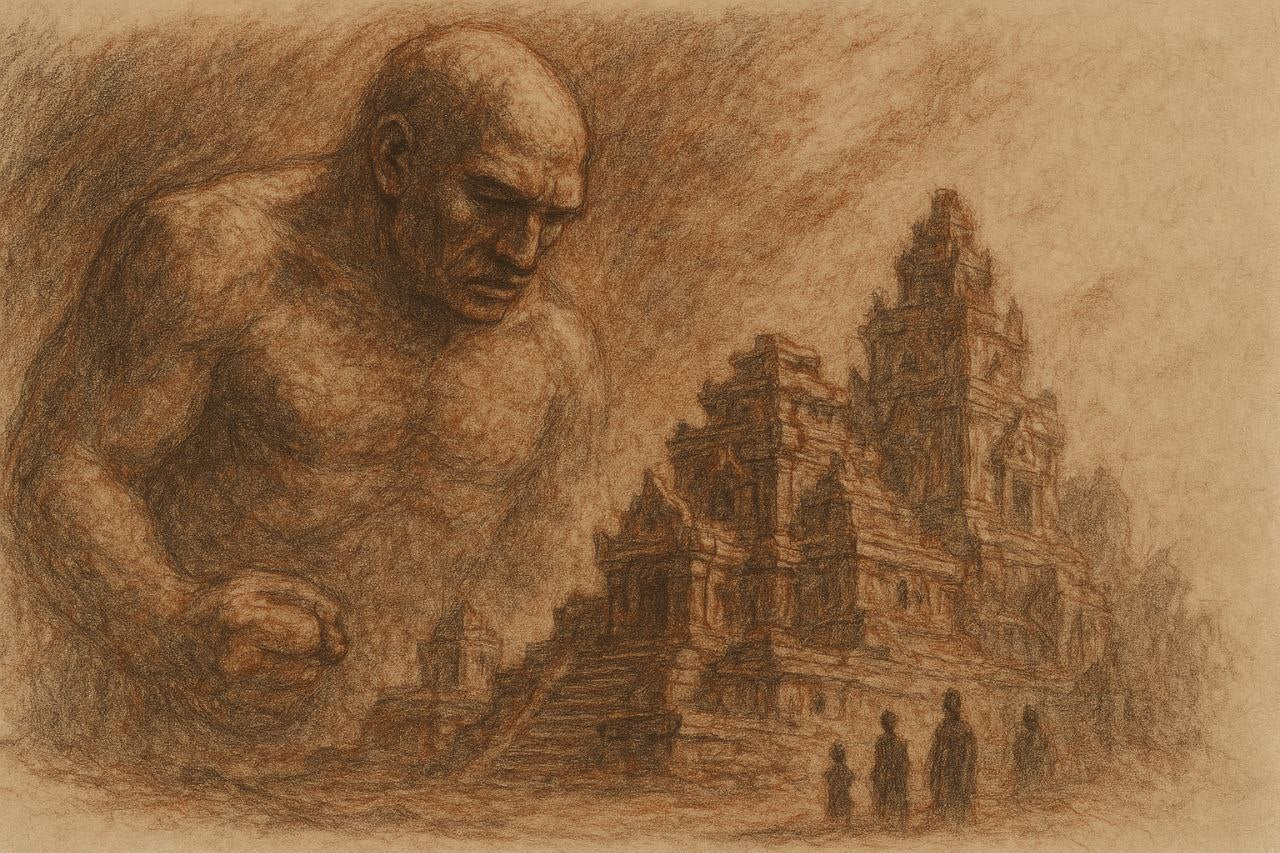

The Giant of Phnom Bakheng: A Legend in Stone and Shadow
High above the jungle canopy, where stone meets sky, a giant stirs beneath Phnom Bakheng. Born of earth and legend, he rises not in fury—but in sorrow—his towering form a silent witness to the ambitions of kings and the turning of stars. Step into the myth where temples breathe and the ancient still remembers.
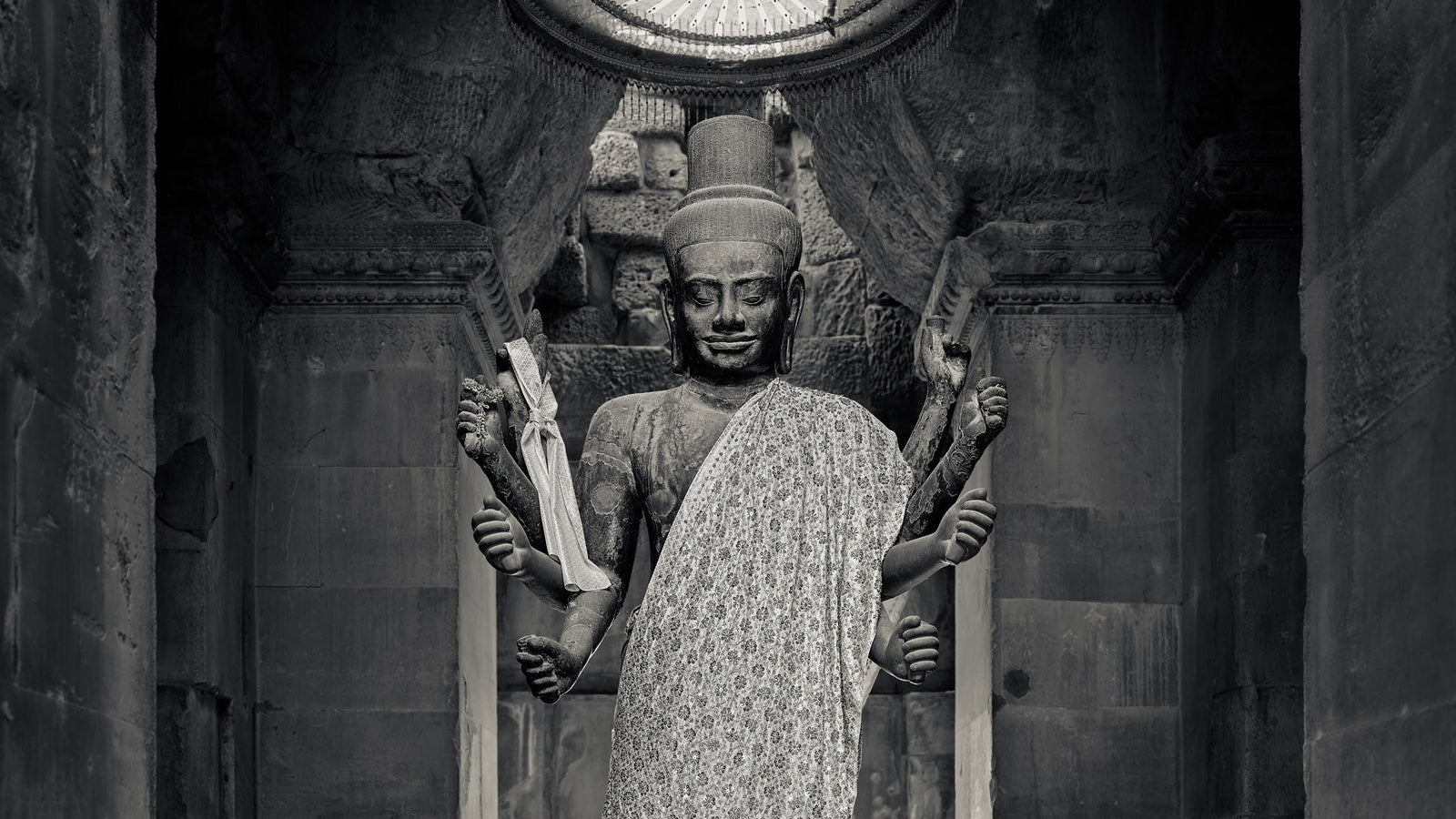

Vishnu, the Lord of Cambodia
Vishnu does not arrive in Cambodia as a stranger. He is recognised rather than invoked, folded into stone, kingship, and horizon. Whether as eight-armed sovereign or ancestral guardian, he endures as a custodian of order—watchful, available, and quietly holding the moral weight of continuity.
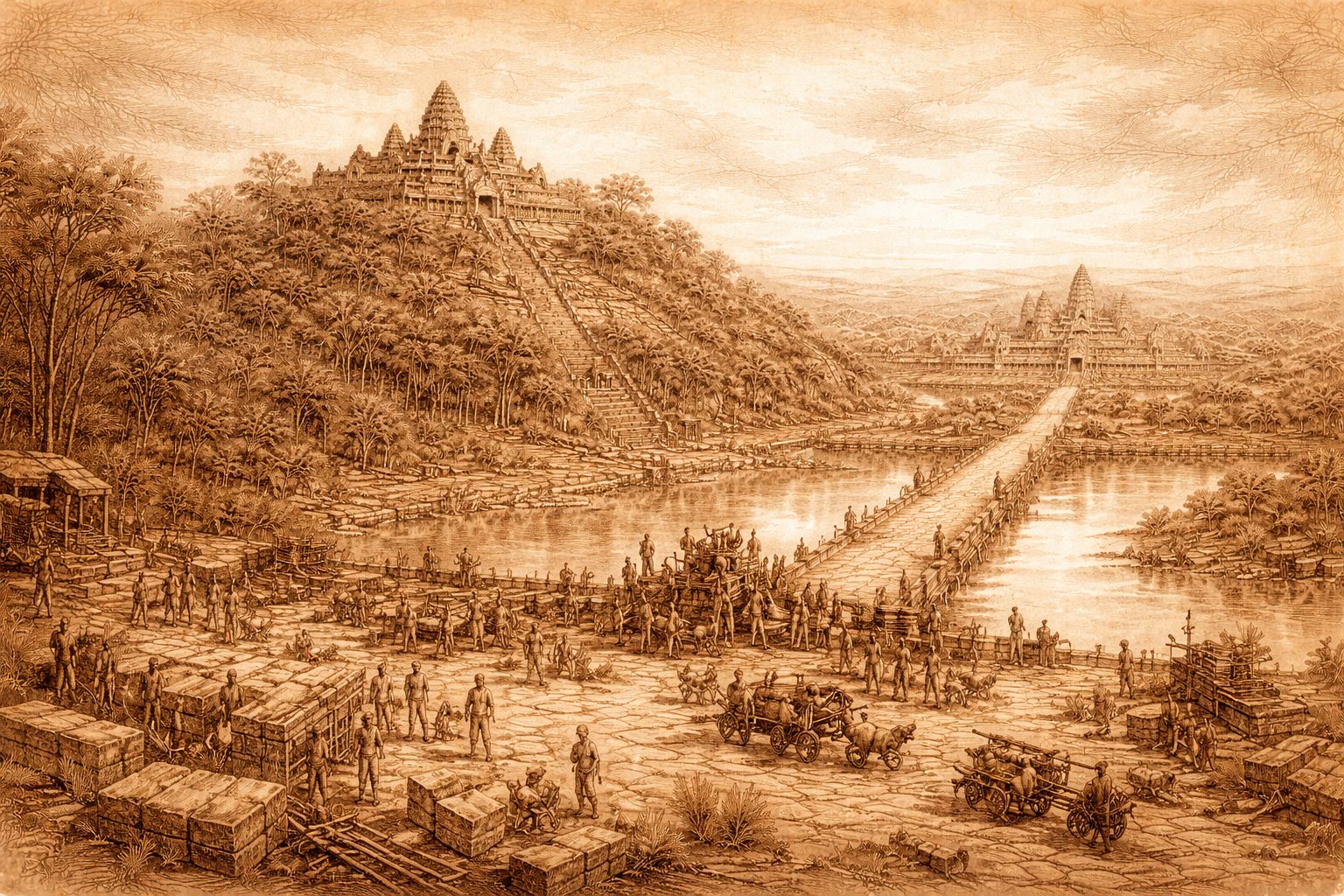

From Template to Territory — Yaśovarman I and the Birth of Angkor Proper
Yaśovarman I completes Angkor’s first cycle by lifting the royal triad from Roluos and fixing it at Angkor proper. With Lolei, the East Baray, and Phnom Bakheng, the Khmer cosmos becomes a city—measured, aligned, and no longer provisional.
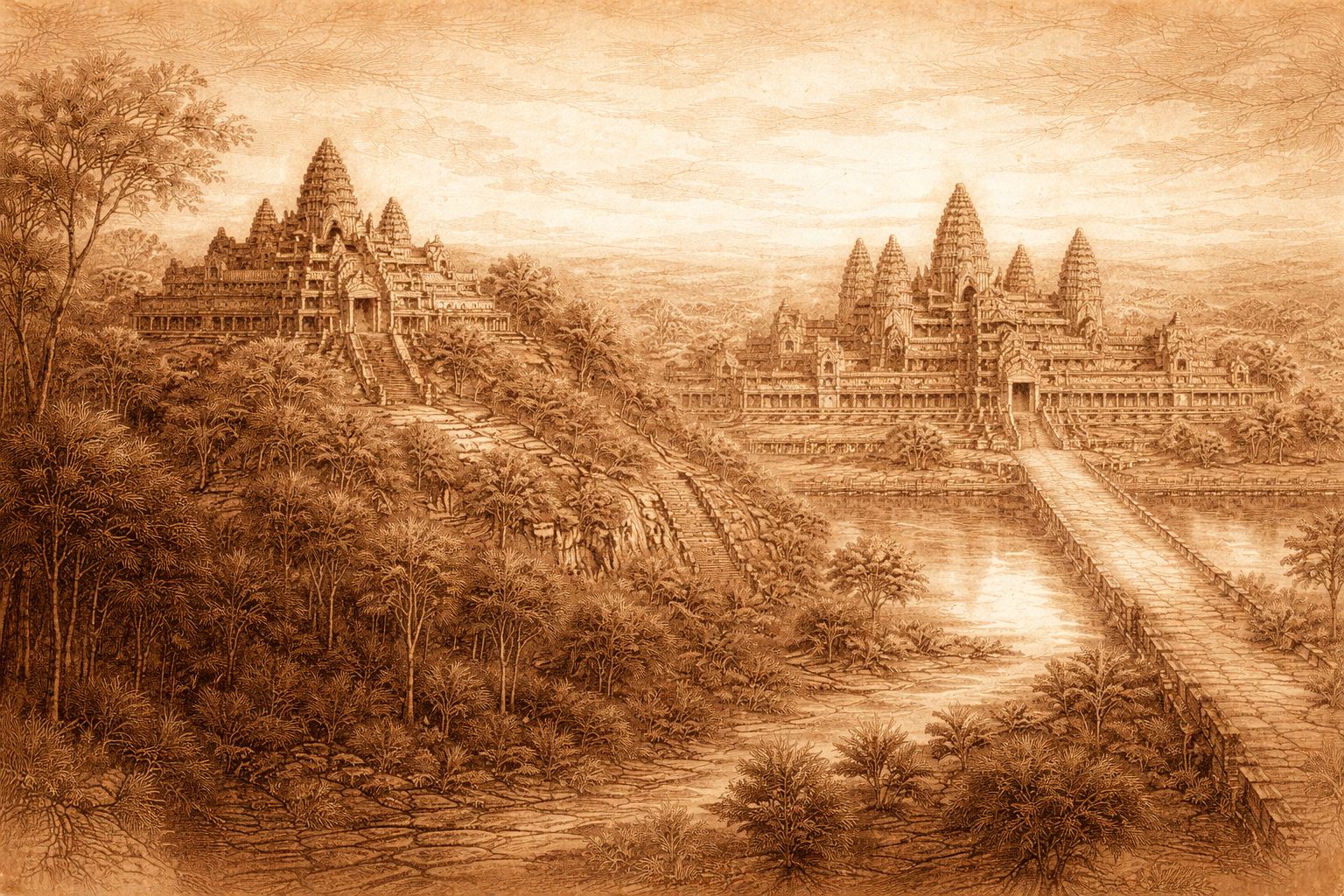

From Hill to Mandala — Phnom Bakheng and Angkor Wat
From Phnom Bakheng’s crowned hill to Angkor Wat’s perfected mandala, the Khmer state temple evolves from reliance on nature to total architectural control. What begins as ascent upon a given mountain culminates in a man-made cosmos, measured, timed, and held in stone.
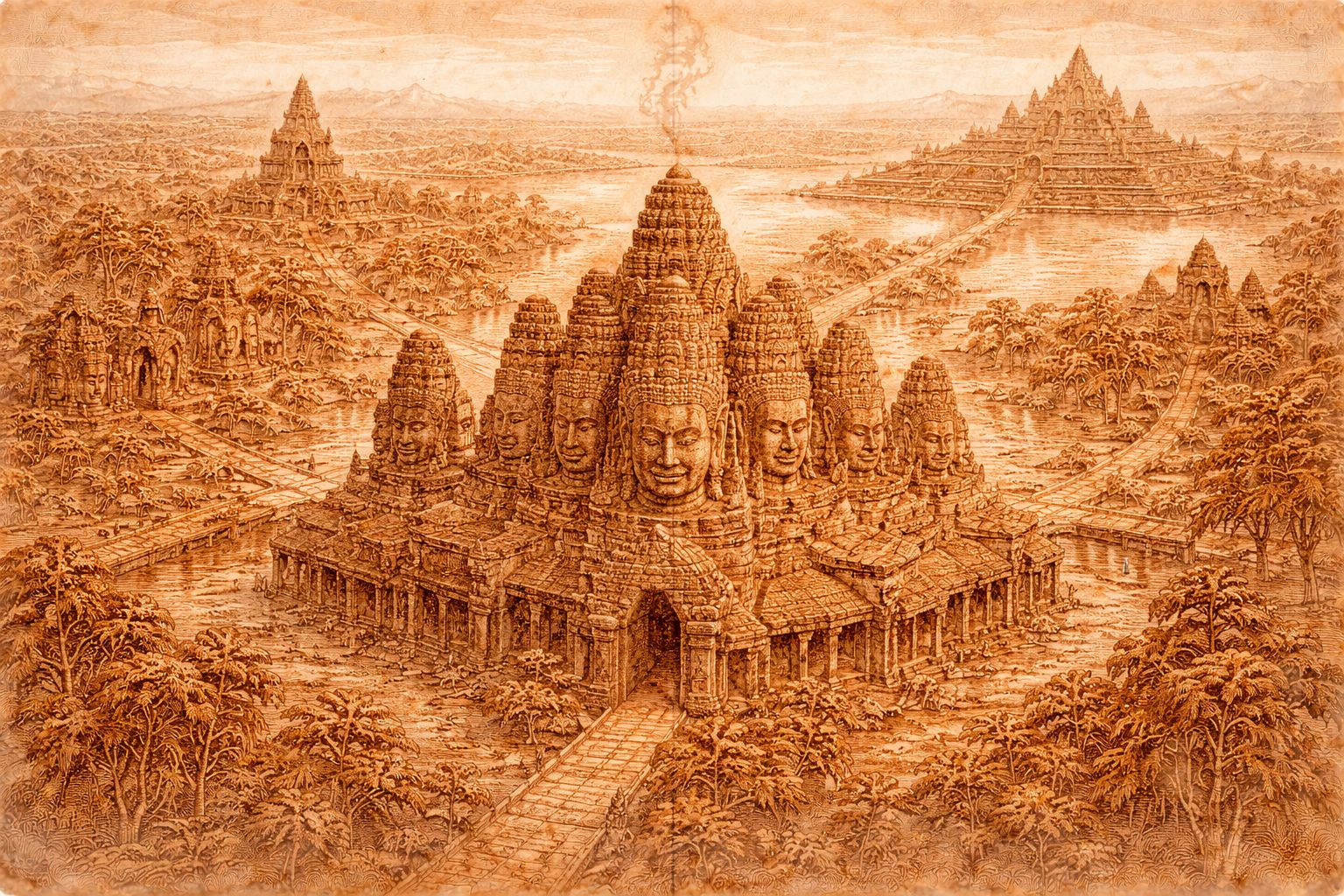

The Mandala Broken Open — Mahayana Buddhism and the Remaking of Angkor
When Angkor fell, the mandala did not shatter—it opened. Under Jayavarman VII, the rigid cosmic square fractured into a living network of faces, roads, and care. Geometry gave way to compassion, and the centre learned to move toward suffering rather than rule from above.
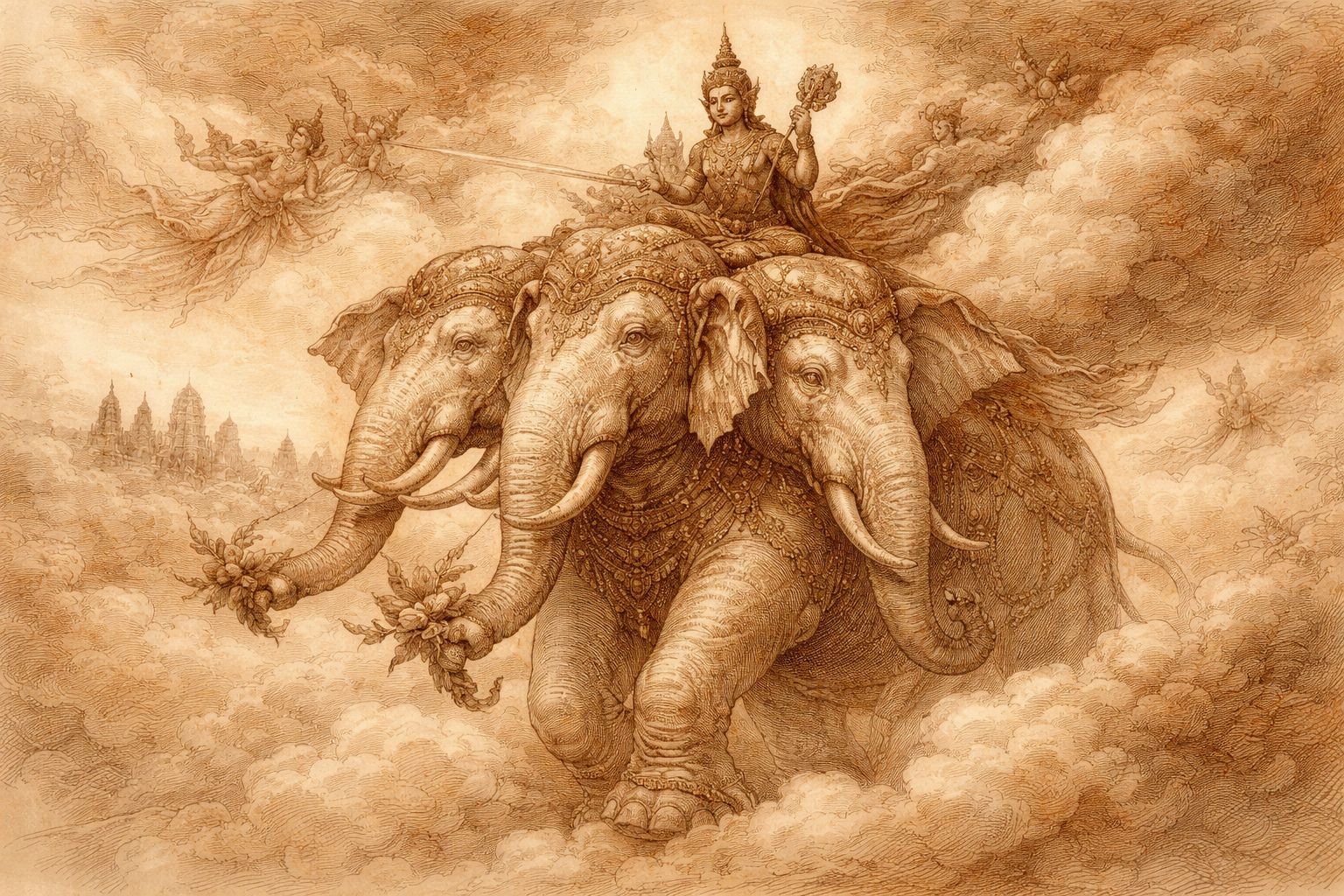

Airavata — The Cloud That Bears the King
Airavata is not merely Indra’s mount, but the sky made patient. In Angkor, he appears where rain is requested and authority restrained—three heads listening in different directions, white as gathered cloud. He teaches that power, like monsoon, must arrive slowly and depart without violence.
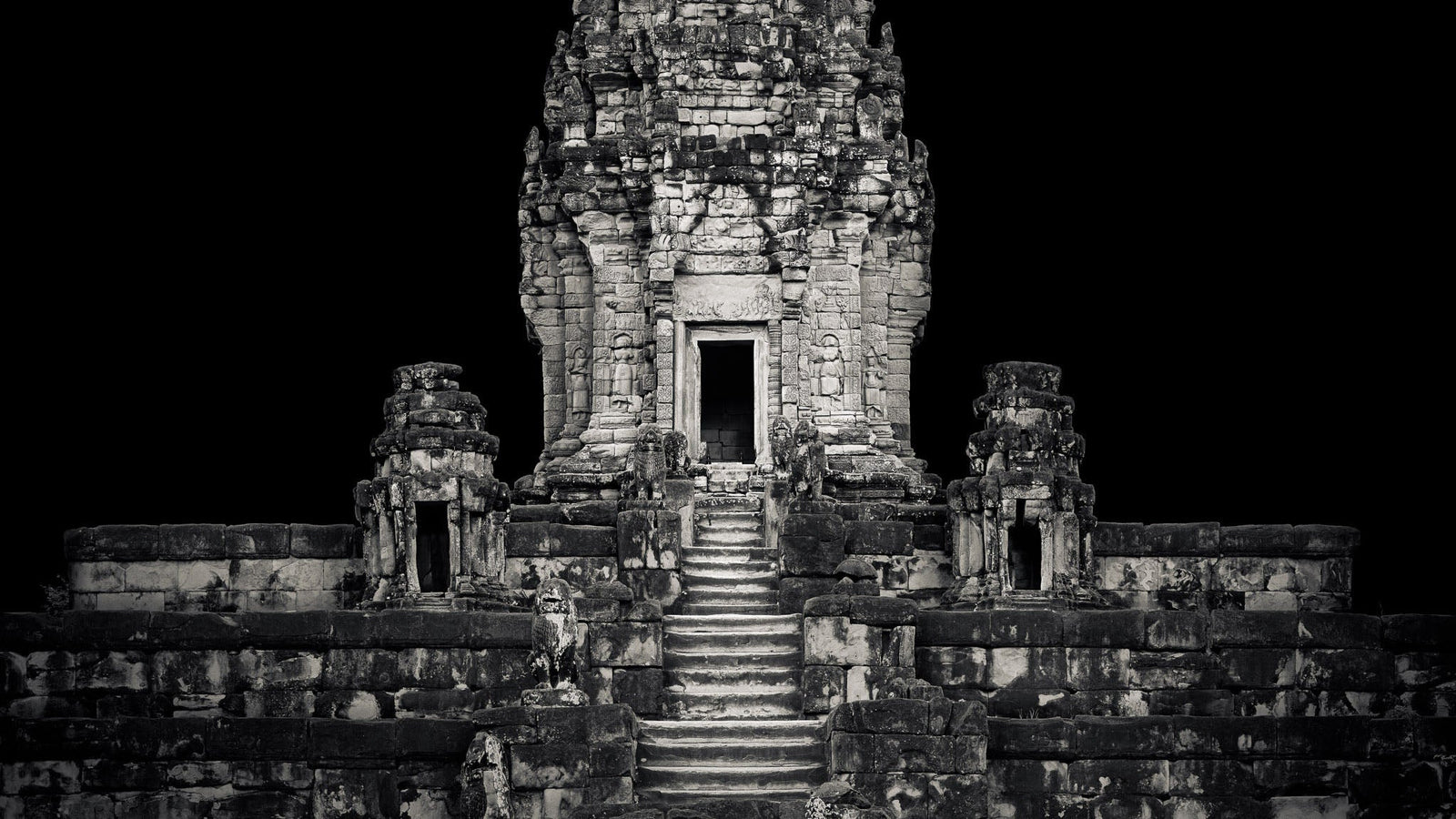

Bakong Temple
Bakong is where Angkor makes its first irreversible choice: to raise stone into a mountain and bind kingship to the cosmos. This sanctuary essay explores Bakong as the Khmer empire’s foundational act—severe, resolved, and essential—where Mount Meru first took permanent form on the Cambodian plain.
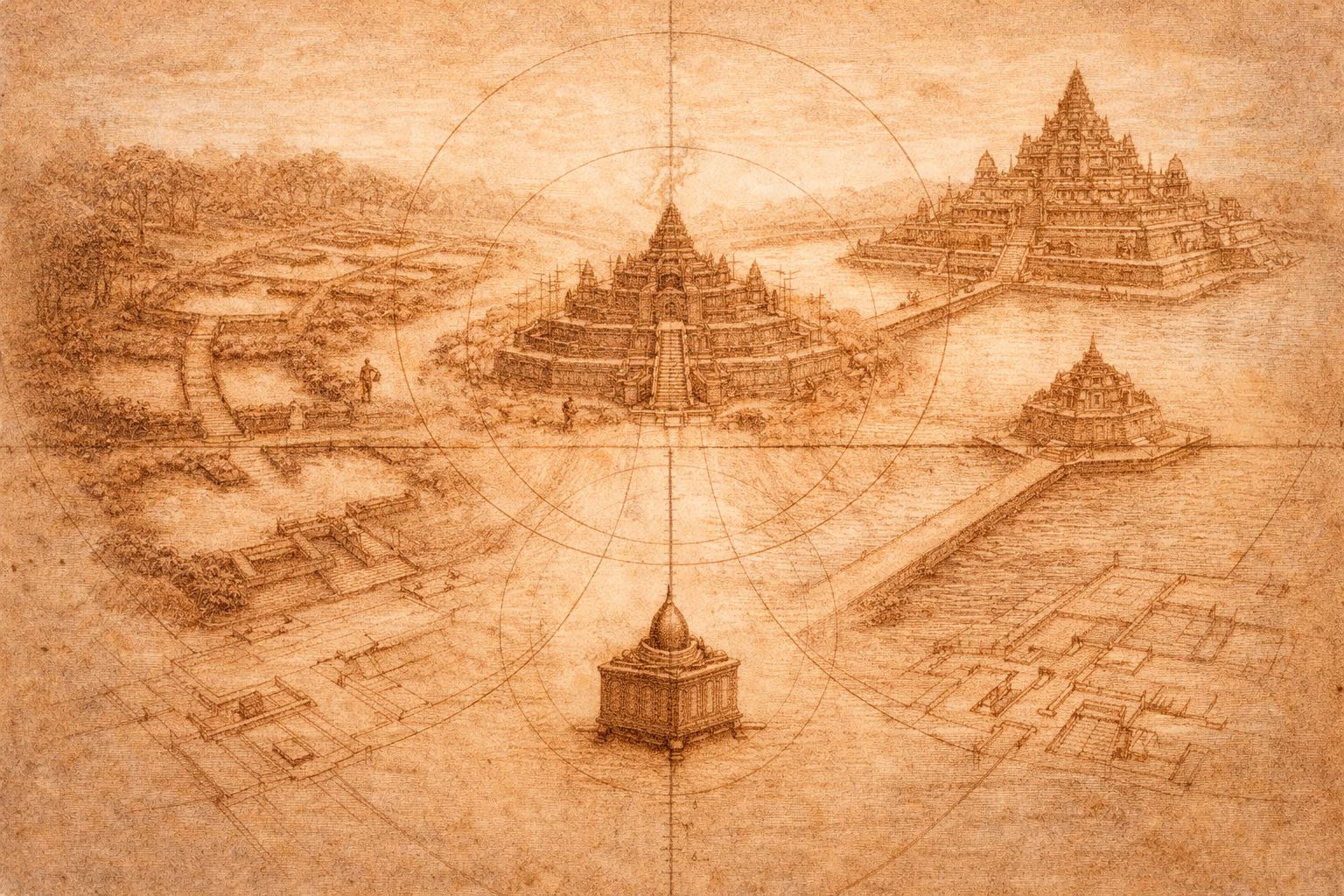

From Quiet to Scale — Jayavarman III and Indravarman I
Jayavarman III kept Angkor steady; Indravarman I made it resound. From quiet continuity at Roluos to the first great baray and sandstone temple-mountain, the transition was not a break but an amplification—foundations tested, then raised into forms that could carry empire.
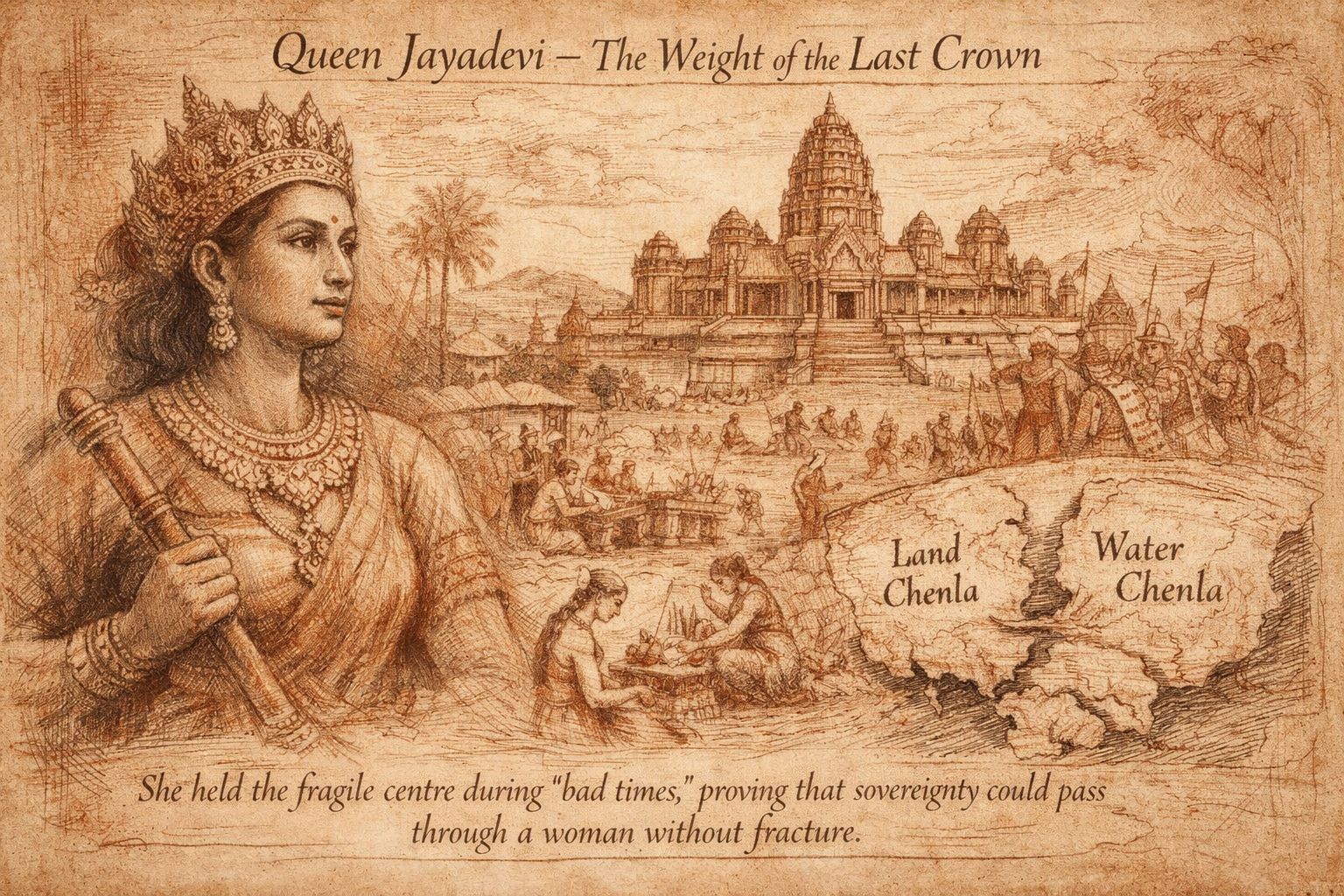

Queen Jayadevi — The Weight of the Last Crown
Queen Jayadevi ruled not in triumph, but in tension. Bearing the full title of Holy Lord, she held together a fragile centre during “bad times,” proving that sovereignty could pass through a woman without fracture. When her reign ended, the kingdom loosened—waiting, quietly, for Angkor to rise.
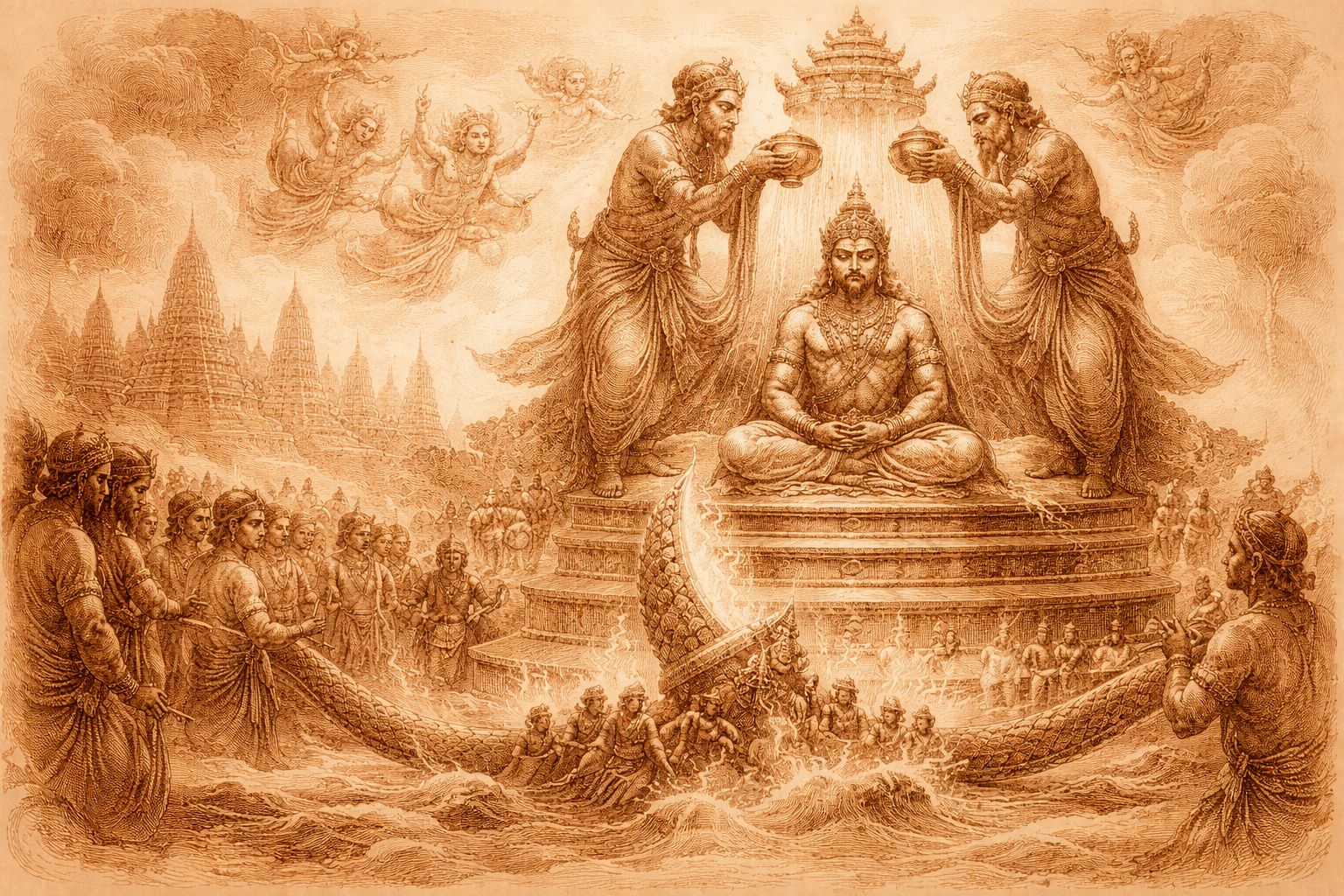

Indrābhiṣeka — The Rite That Restores the World
The Indrābhiṣeka was never merely a coronation. It was a ritual reset of the cosmos itself. By reenacting Indra’s return to power after chaos, Khmer kings submitted their authority to renewal, washing victory into legitimacy and binding sovereignty to balance, restraint, and cosmic order.
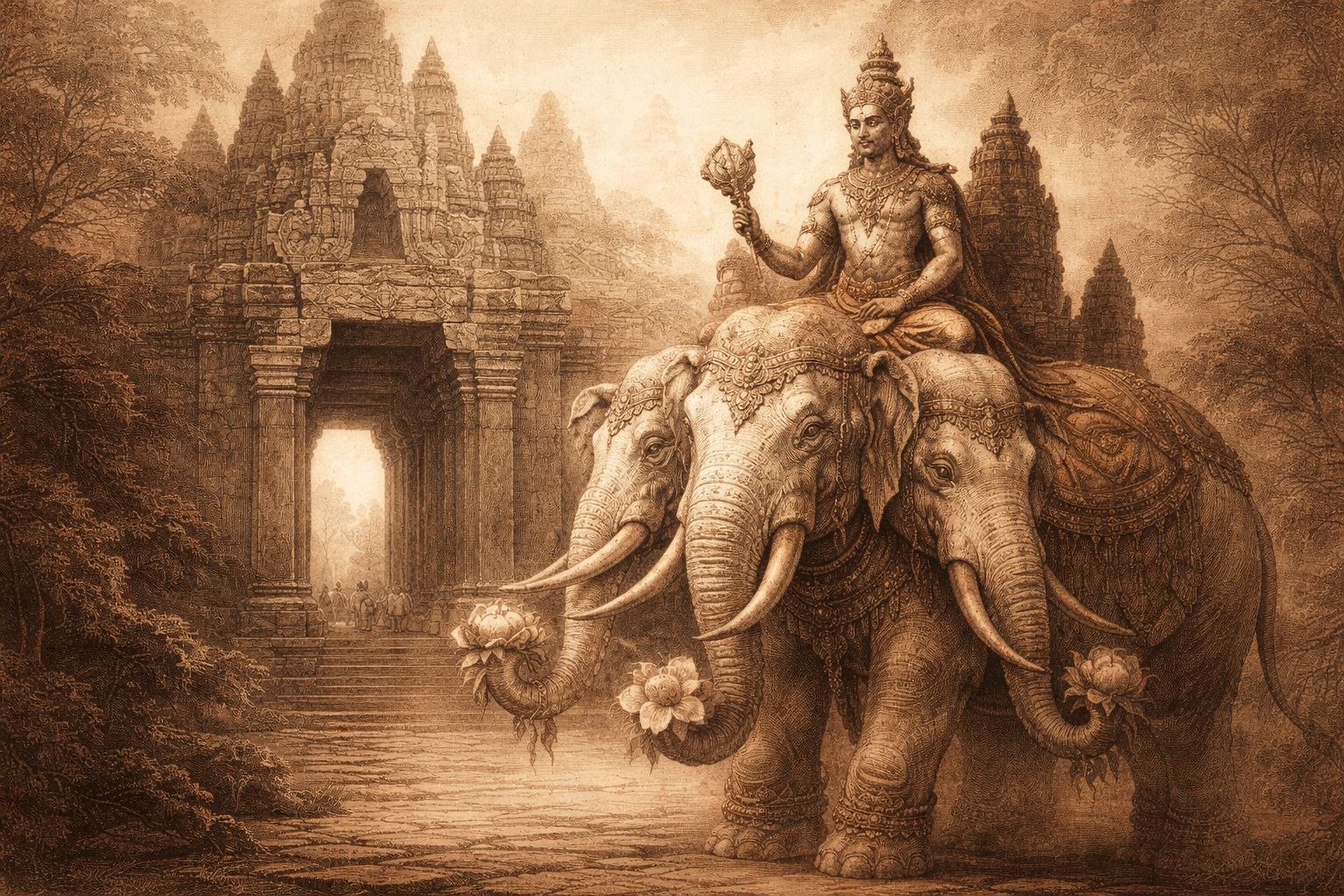

Indra — The East, the Storm, and the Fading Crown
Indra arrives as pressure before belief: cloud-thick air, withheld rain, the breath before release. At Angkor he remains at the eastern gates, mounted on the white elephant, guarding the threshold where force yields to law and storm learns restraint. Kings pass. The weather remembers.
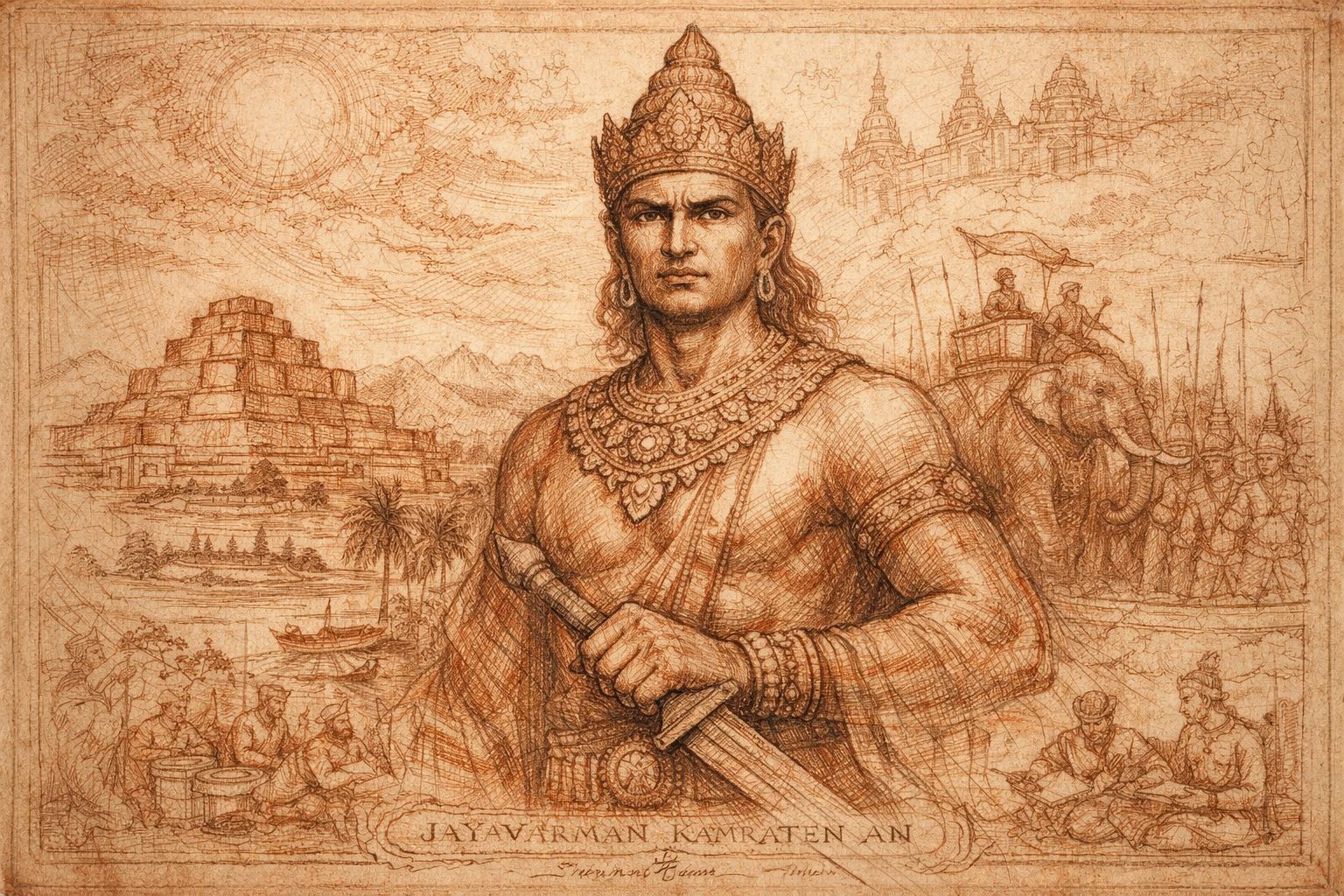

Jayavarman I — Armour of the Centre
Jayavarman I did not rule by monument, but by containment. He gathered fractured lands into a defended centre, replacing inheritance with appointment, custom with decree. The armour he forged did not survive his death, yet it taught Cambodia how authority could be shaped, sanctified, and held.
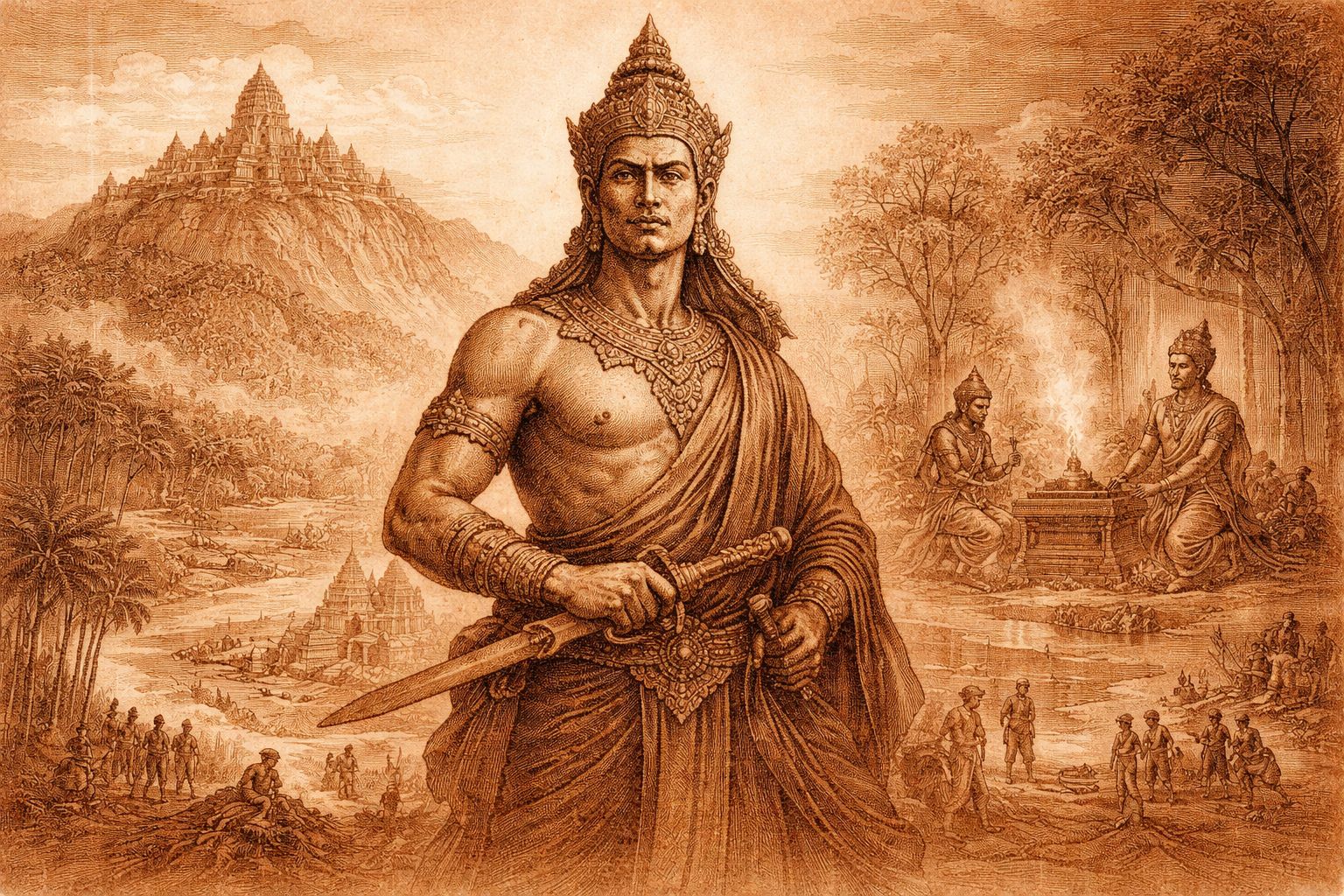

Jayavarman II — The Mountain That Remembered His Name
Jayavarman II did not found Angkor with monuments, but with alignment. On a sacred mountain, he declared a centre strong enough to outlast him. From ritual, sovereignty was born; from measure, empire followed. The towers of Angkor rise because one king first taught the land how to stand.
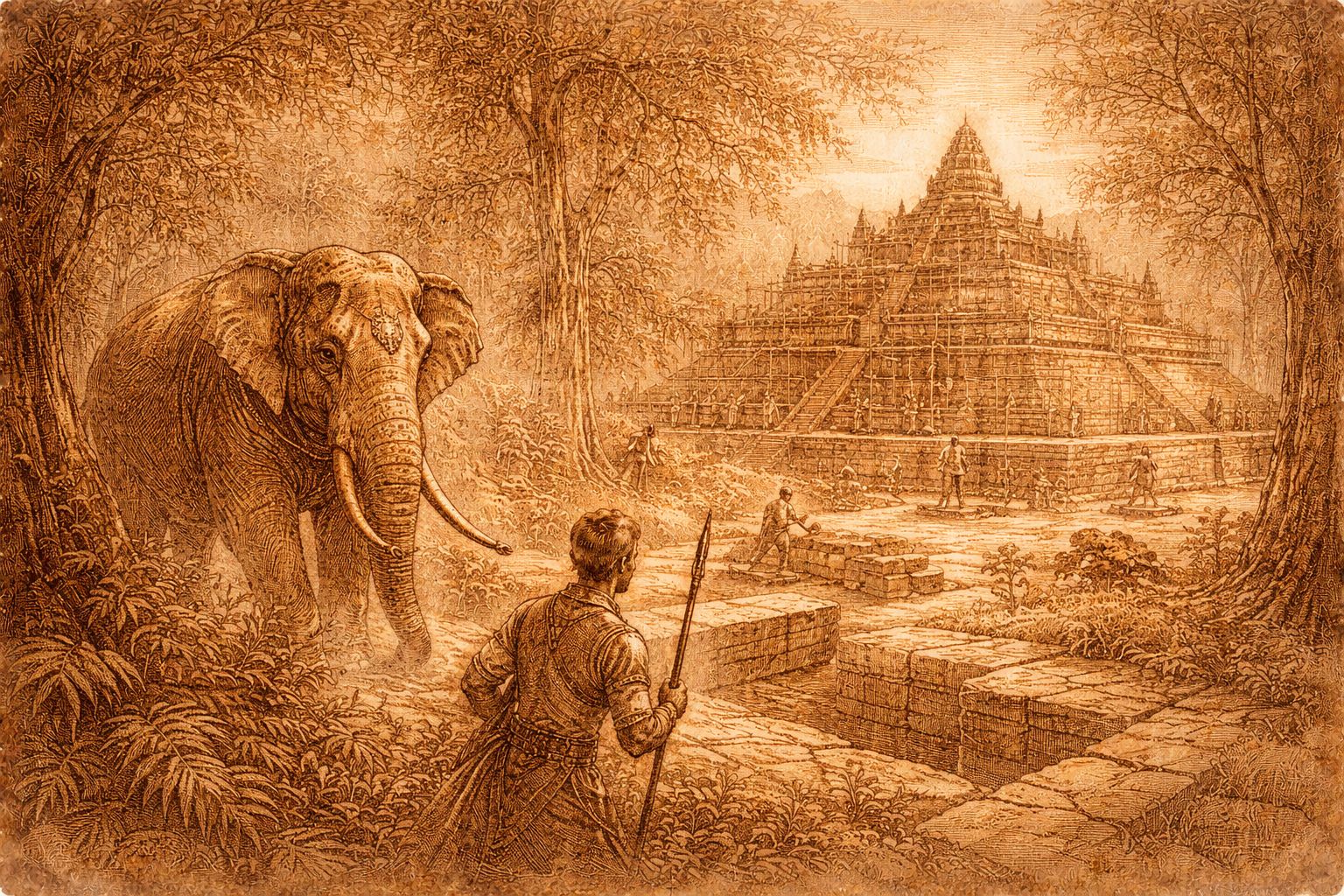

Jayavarman III — The King Who Kept the Centre Quiet
Jayavarman III ruled without spectacle. He left no great inscriptions, only continuity. Under him, the Devarāja remained installed, the capital steady, and the first intimations of water control quietly emerged. Angkor did not grow louder in his reign—but it did not lose its centre.
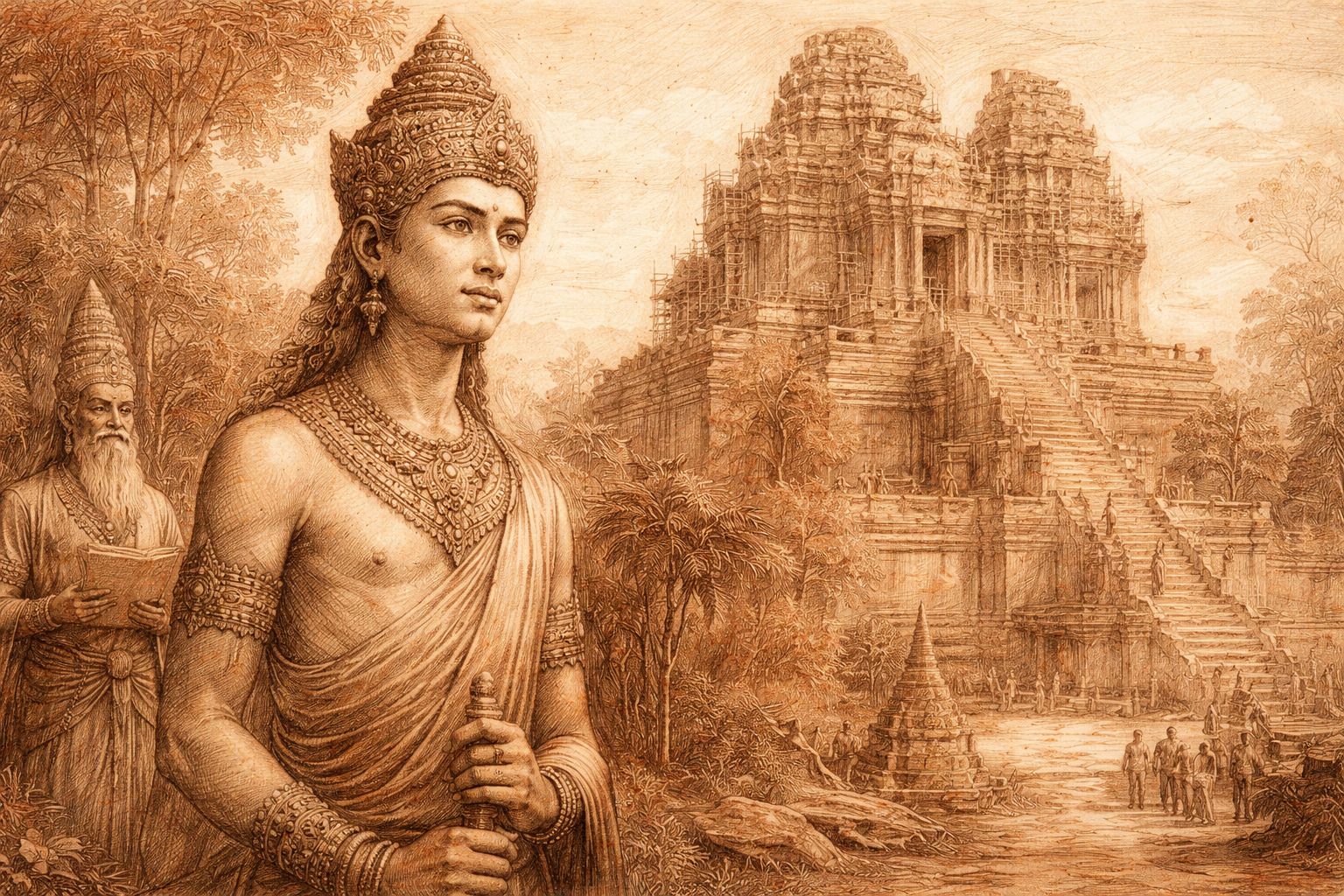

The Quiet Reign — Jayavarman V and the Discipline of Unfinished Stone
Jayavarman V did not rule through conquest or spectacle. He held Angkor steady while others taught, carved, and refined its vision. His unfinished mountain, Ta Keo, stands as a monument to restraint—a golden idea left in bare stone, awaiting a future that did not arrive.
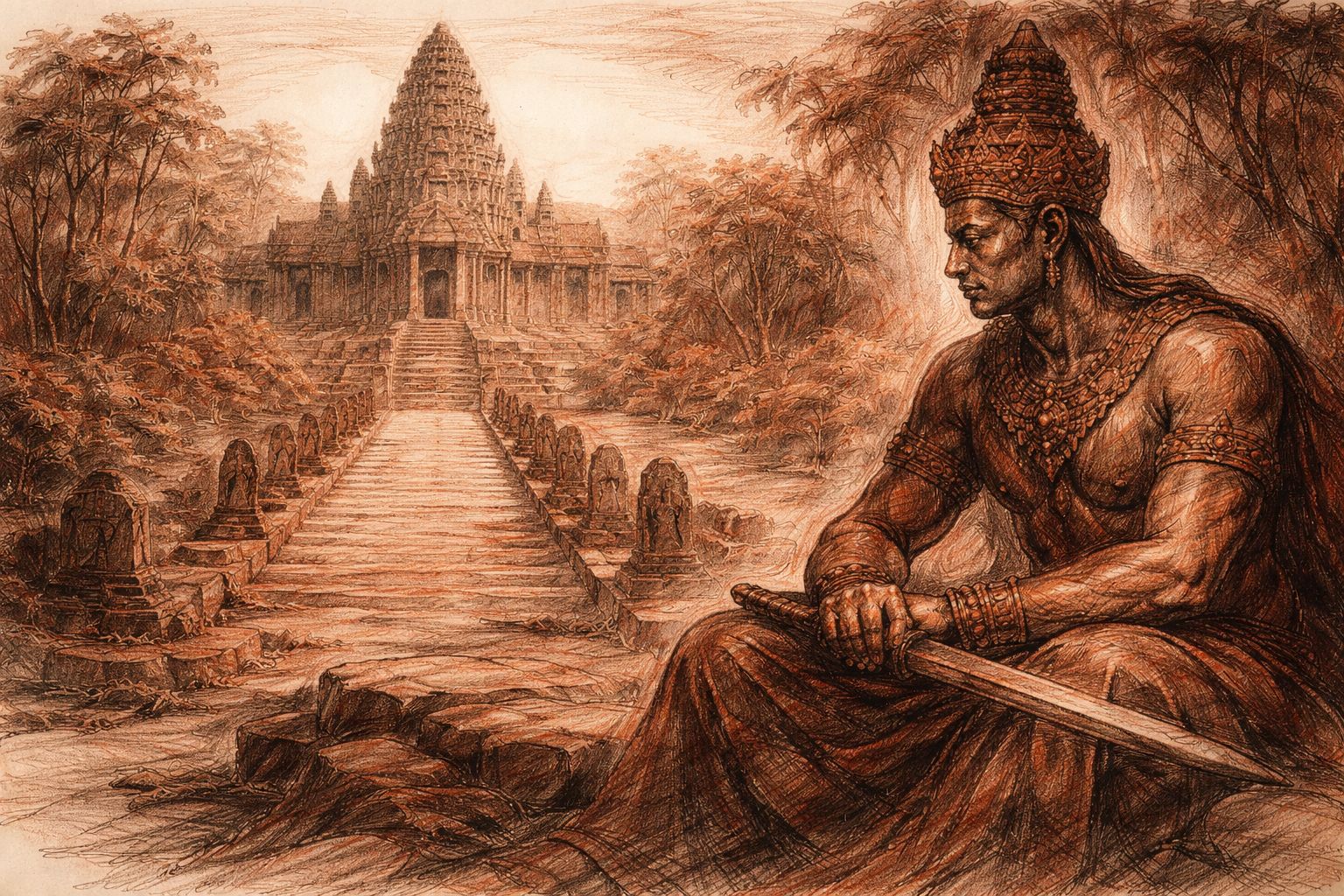

Jayavarman VI — The King Who Ruled from Elsewhere
Jayavarman VI ruled Angkor by shifting its centre of gravity. He left the capital largely untouched, allowing power to gather in the north, where Phimai rehearsed forms the empire had not yet named. His reign was not loud, but foundational—an act of placement rather than display.
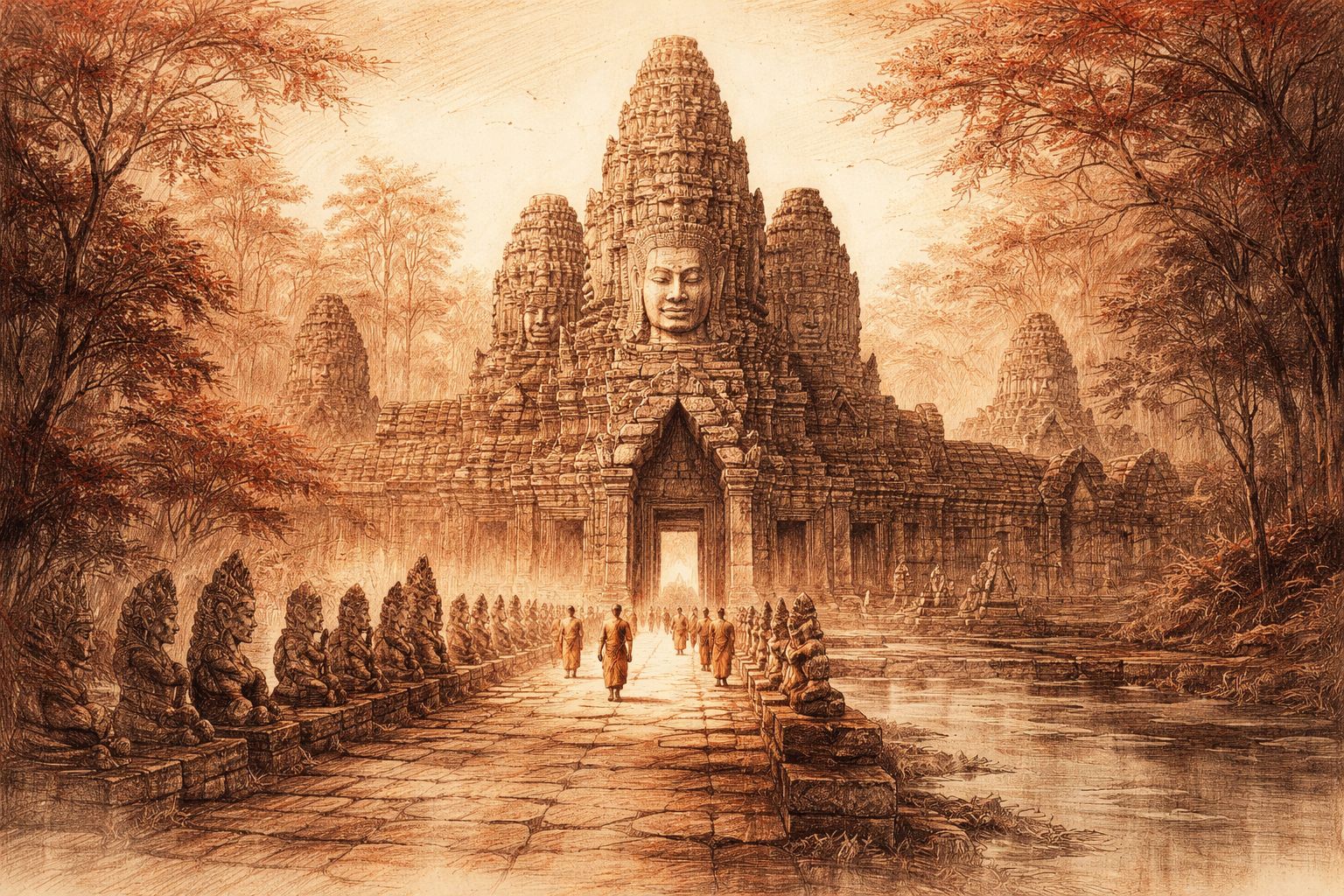

Jayavarman VII — The King Who Chose Compassion as Power
Jayavarman VII ruled not as a god demanding order, but as a bodhisattva absorbing pain. Roads, hospitals, and temples became instruments of care. His reign burned with compassion at imperial scale—brilliant, costly, and unforgettable—leaving Angkor forever marked by the possibility that power might heal.
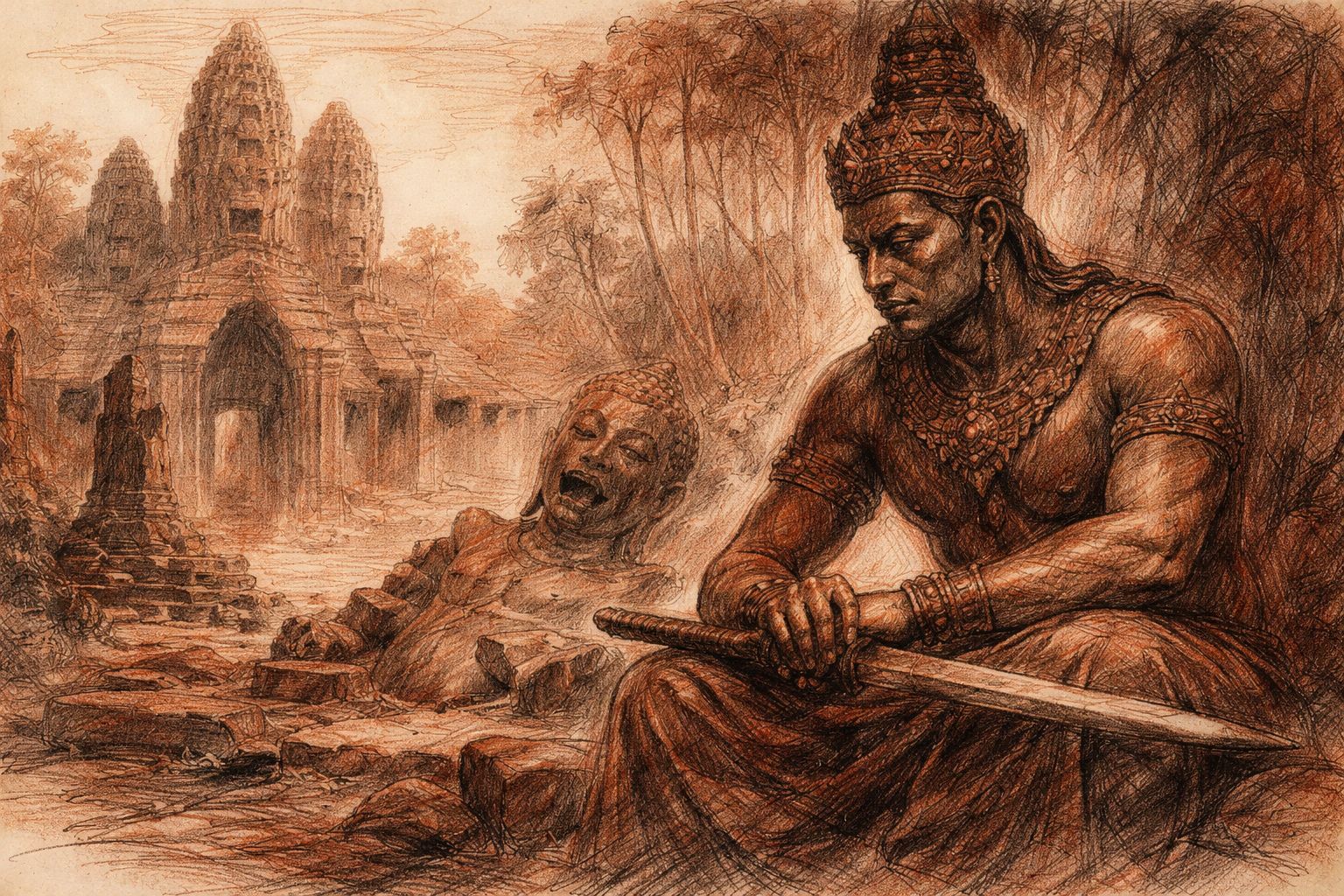

Jayavarman VIII — The King Who Refused Silence
Jayavarman VIII ruled at the moment Angkor hesitated between contraction and release. He erased not from cruelty alone, but from fear of a world growing too plural to command. His final temple stands like a full stop in stone—quiet, deliberate, and already listening for silence.
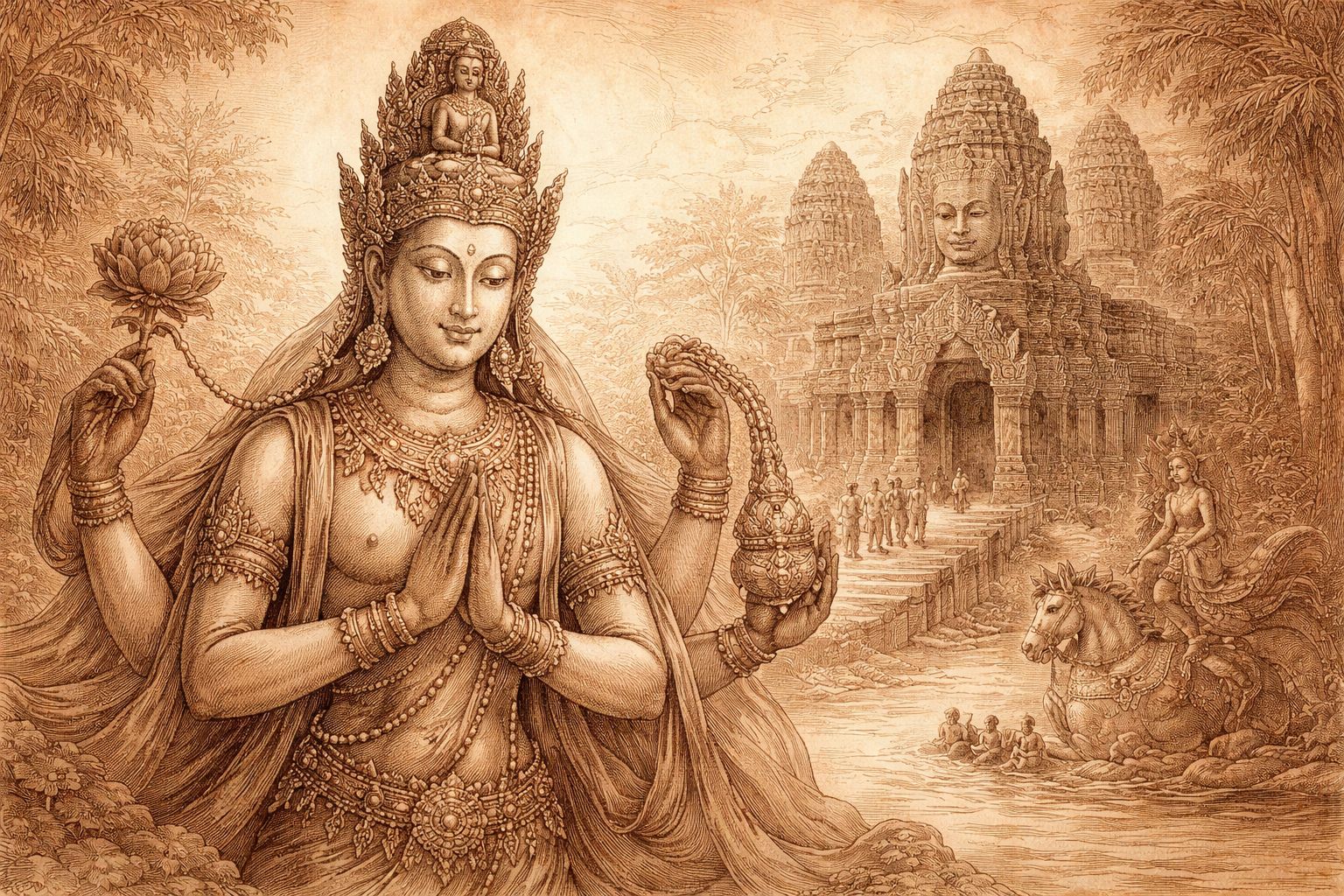

Lokeshvara — The One Who Hears the World
Lokeshvara stands at the edge of release and chooses to remain. With a thousand hands and many listening heads, he does not save the world from afar—he stays within it, bearing its cries. In Angkor, compassion became architecture, policy, and vow, carved into stone and water.