

From Quiet to Scale — Jayavarman III and Indravarman I
Empires are not built in a single gesture.
They are tuned.
Between the reign of Jayavarman III (c. 835–877 CE) and Indravarman I (877–889 CE), Angkor did not change its direction. It changed its volume. What had been held in careful measure was taken up and sounded across the plain.
The continuity is not accidental. Both kings ruled from Hariharalaya, the early Angkorian capital at Roluos. The Devarāja remained installed there. The ritual centre did not move. Even if Indravarman I’s succession involved tension or palace realignment, the deeper order held: sovereignty still derived from alignment, not personality. The axis endured; the hands upon it changed.
Jayavarman III’s reign had been one of keeping still. He maintained the grammar his father had written. Water was tested in small measures. Foundations were begun without proclamation. The laterite body of the Bakong likely rose under him—present, unfinished, unnamed. This was continuity as discipline: the refusal to force growth before the ground could bear it.
Indravarman I entered not as a correction, but as an amplification.
Where Jayavarman III experimented, Indravarman I standardised. Where the earlier reign hinted, the later one declared. He formalised what would become the imperial template of Angkor: waterworks, ancestor cult, and state temple—a triad sketched softly by his predecessor and now set into stone and earth.
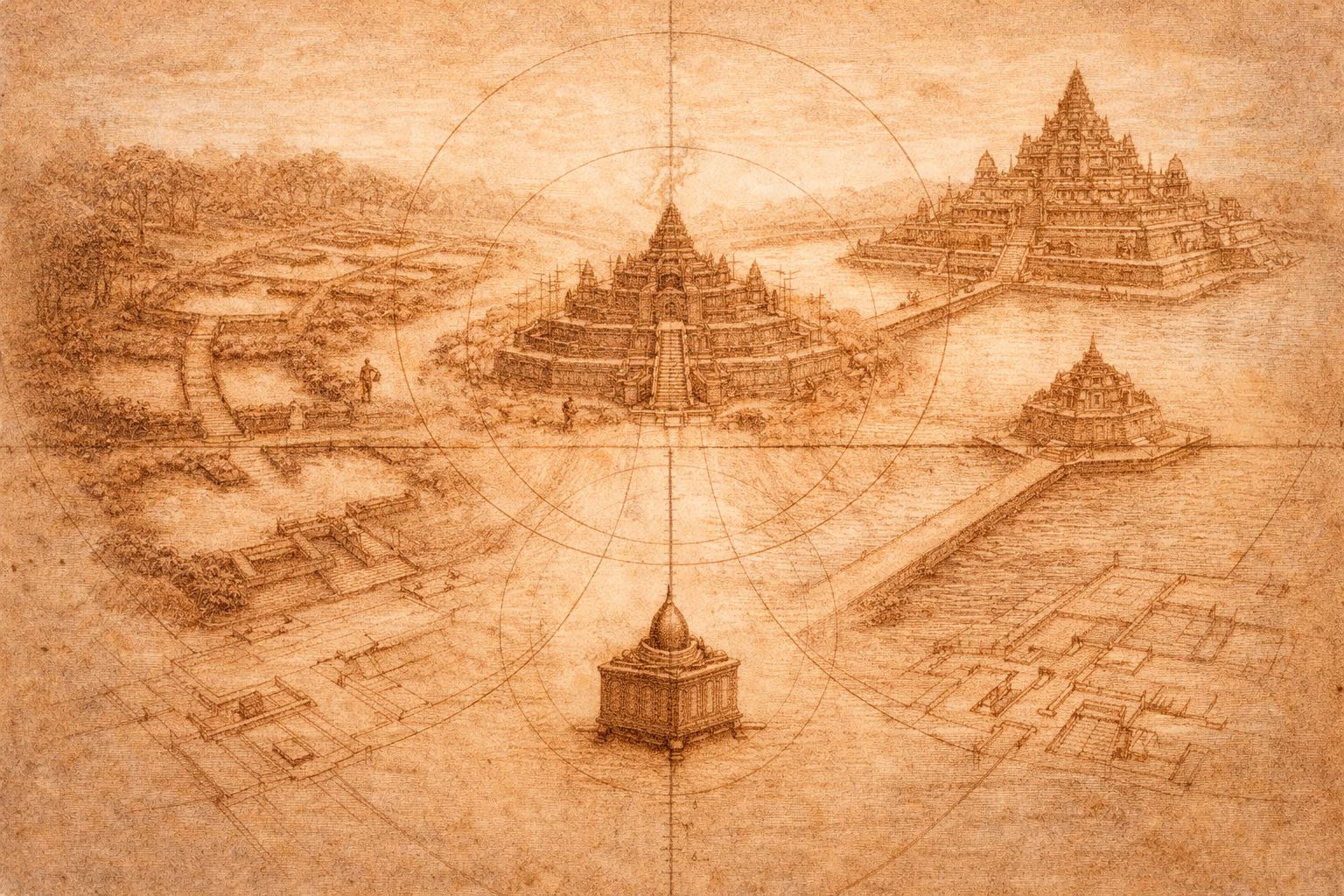
The clearest amplification is hydraulic. Jayavarman III’s tiered trapeang at Roluos were intimate, almost pedagogical—learning how monsoon water could be slowed, held, and released. Indravarman I expanded this knowledge into the Indratataka, the first great Angkorian baray. Its scale was unprecedented. Millions of cubic metres of water were raised and contained, ensuring dry-season rice and proclaiming the king as regulator of life itself. The cosmic ocean had found its earthly basin.
Architecture followed the same arc. The Bakong’s laterite pyramid—functional, severe—was clad by Indravarman I in sandstone, transforming an experimental mass into a luminous mountain. Eight brick towers appeared around it. Stone lions guarded its steps. What had been structural became symbolic; what had been necessary became legible. This was not replacement but revelation: continuity given voice.
Material culture shifted accordingly. Brick and laterite gave way to sandstone. The restrained Kulen style yielded to the more assured Preah Ko style, rich with devatas and dvarapalas. The kingdom learned how to carve its confidence.
Yet Indravarman I’s most astute amplification was not material, but genealogical. At Preah Ko, he deified the founder Jayavarman II as Parameshvara, installing him in the place of honour. This was not piety alone. It was alignment by lineage. By anchoring himself to the founding spirit, Indravarman I converted succession into inevitability. The founder’s silence sanctioned the builder’s scale.
Seen together, the two reigns form a single movement. Jayavarman III ensured that the centre did not drift. Indravarman I ensured that it could be seen. One maintained the rhythm; the other orchestrated it.
Angkor required both.
Without the quiet reign, amplification would have fractured the system. Without amplification, continuity would have remained fragile and forgettable. Empire is not born at full volume. It must first learn how to listen—then how to speak.
Jayavarman III listened.
Indravarman I answered.
—
Receive the next work
Subscribe free to receive new work from the Lucas Varro Library by email.
More from the Library


See Also
A concise and impartial dictionary of absence, promises, quarrels, ordinary objects, and the troublesome instability of words.

The City of Service
The temple we inherit is a building from which almost all necessity has been removed. Nothing must be brought for it to continue being what we call a temple. The sanctuary asks nothing of us. Stone is good at this kind of independence.
A living temple was otherwise.
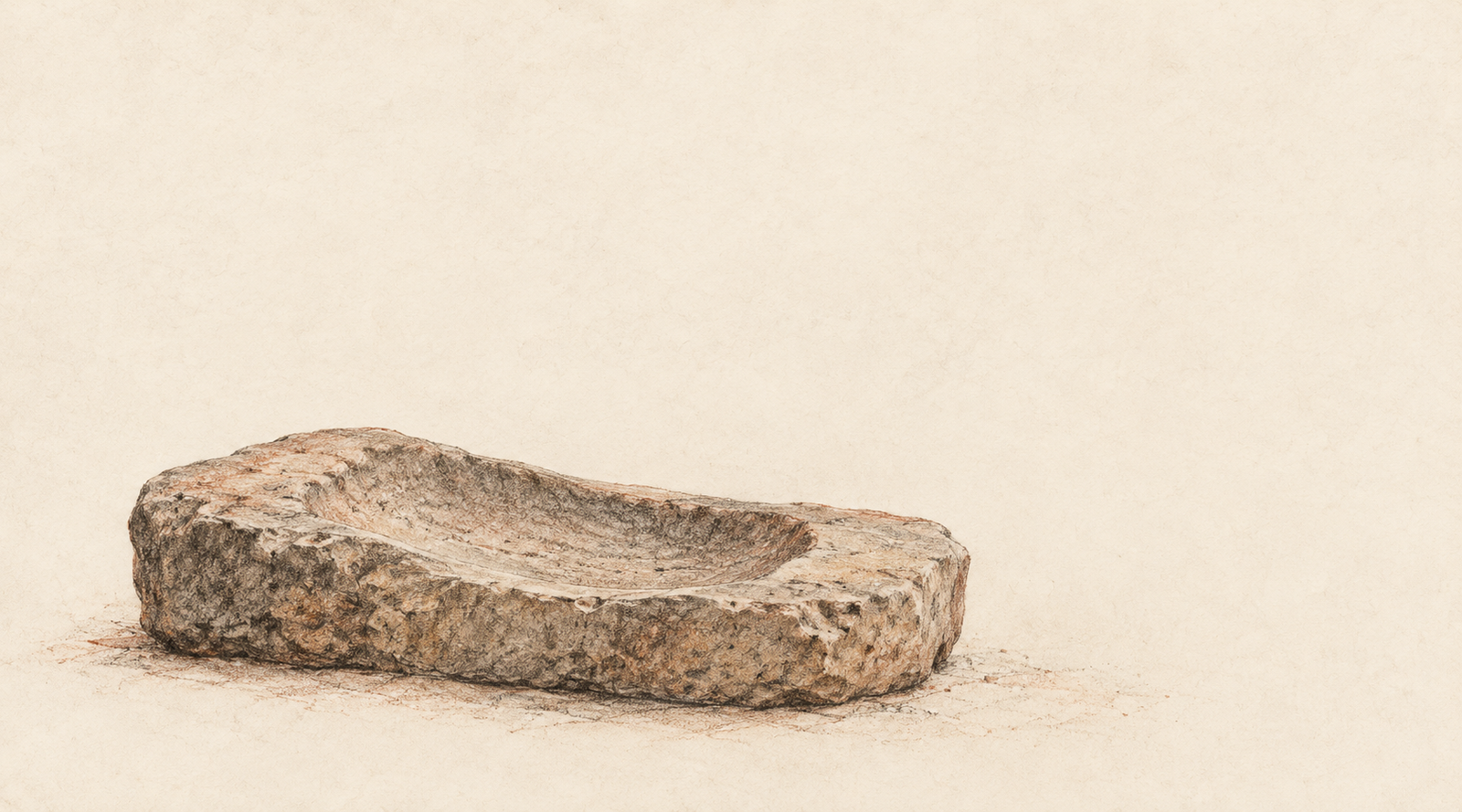
Water had to come in. So did grain, cloth, oil, aromatic substances, fuel. The things required for worship arrived because someone carried them across a threshold.


Houses of Wood, Light, and Smoke
Some of Angkor’s most intimate ruins do not rise above the ground at all. They are postholes, low mounds, hearths and ponds: durable traces of a domestic city built largely from things that decay. To restore that city is to see Angkor not only as stone, but as wood, smoke, water, repair, and people living within calling distance.