
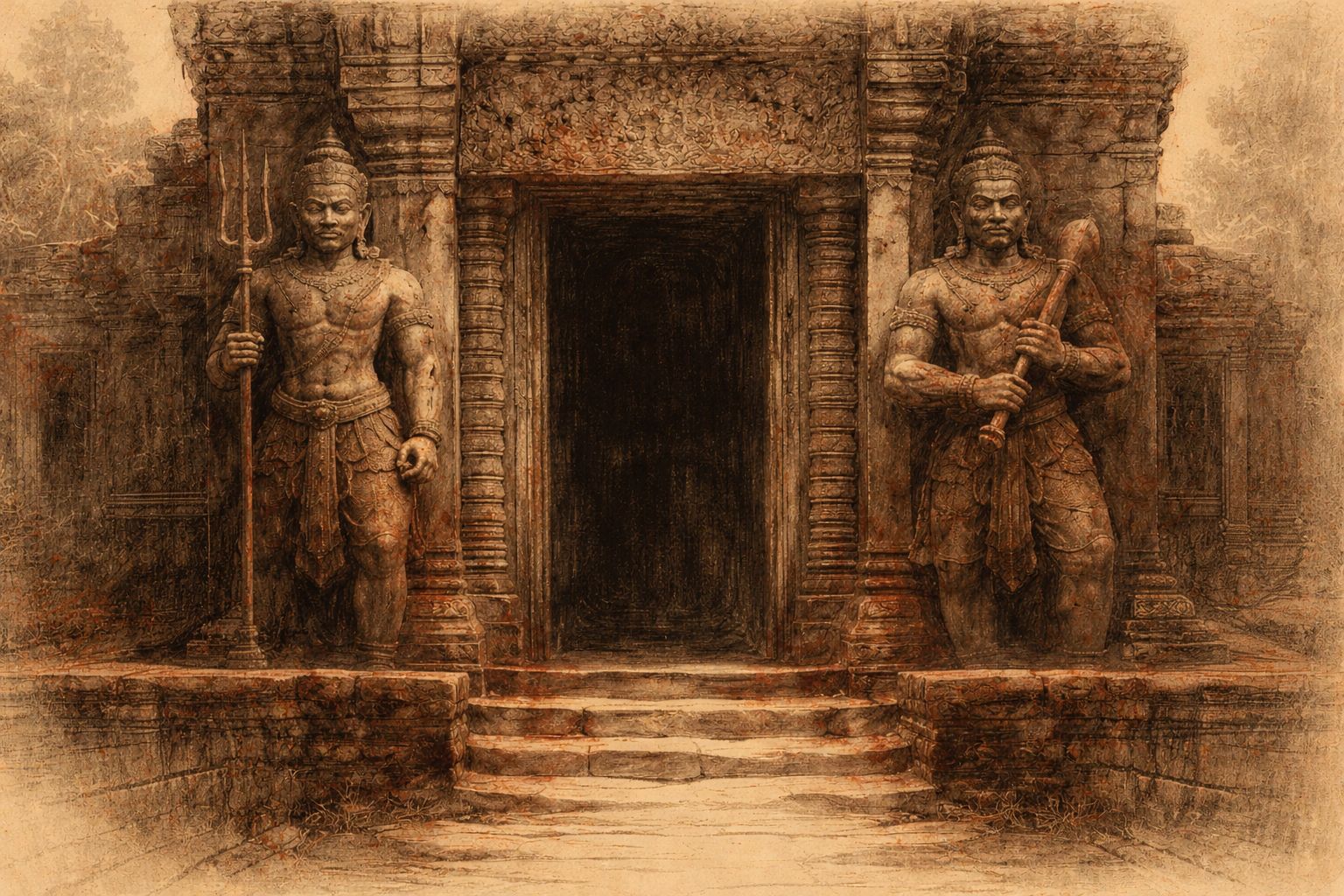

Dvarapalas of Angkor: Guardians of the Threshold
Those Who Decide Passage
They do not inhabit the temple; they confront it. Where the devatas line the walls and settle the space into quiet order, the dvarapalas stand at the point of decision. They occupy the exact place where movement must pause—before entry, before crossing, before permission is assumed. One does not drift past them. One arrives.
Their presence is immediate and physical. Large bodies, planted feet, weapons held not in motion but in readiness. Even when damaged, even when heads are missing or limbs eroded, their stance remains legible. They were carved to interrupt momentum. The temple announces itself through them: this is not open ground; this is a guarded interior.
They almost always appear in pairs. The pairing is not decorative, nor merely symmetrical. It establishes a moral polarity at the threshold. One face is composed, the other severe. One welcomes, the other warns. Entry is not denied, but it is conditioned. To pass between them is to accept scrutiny—not by doctrine, but by posture. The body senses the demand before the mind formulates it.
Weapons clarify the exchange. The trident is upright, orderly, a sign of sanctioned authority. The club hangs heavy, blunt, and unmistakable. These are not instruments of battle but of boundary. They exist to make intention visible. The worthy pass without obstruction; the unprepared feel resistance without being touched.
Their expressions do not change. They do not adapt to the pilgrim. Whether carved with calm features or with bulging eyes and bared fangs, they do not react. This stillness is deliberate. Judgment here is not emotional. It is structural. The temple has rules, and the dvarapalas embody them without speech.
In earlier monuments, they are fitted neatly into niches, framed like presences in a palace façade. Later, they grow monumental. At certain gates they stand free of the wall, occupying space as bodies rather than reliefs. Their scale forces the pilgrim to slow, to adjust stride, to recognise proportion. One does not enter at the same pace one approaches.
Their duality reflects more than protection; it reflects the nature of passage itself. Every threshold contains risk. To enter the sacred without readiness is not neutral—it is dangerous. The dvarapalas acknowledge this without explanation. They do not moralise; they enforce conditions. Their fierceness is not cruelty. It is responsibility.
They are often described as frightening, yet fear is not their purpose. Fear is merely a by-product of clarity. The boundary is real. The interior is different from the exterior. Something is asked of the one who crosses. The dvarapalas make that request unavoidable.
In later periods, their forms soften slightly, their proportions shift, but their function does not dissolve. Even when eroded to near abstraction, their stance continues to register. A missing head does not undo authority. A broken weapon does not cancel guardianship. The threshold remembers its sentries.
Unlike the devatas, they do not beautify the space. They do not multiply across surfaces. Their power lies in concentration. One pair is sufficient. Their presence is dense rather than abundant. They do not transform the temple into a celestial residence; they regulate access to it.
Standing before them, one becomes aware of posture. The shoulders adjust. The breath changes. Attention narrows. This is not reverence taught through instruction, but through encounter. The body learns what the space requires before the mind can resist.
They remain where decision is unavoidable. Long after the rituals have faded and the sanctuaries fallen quiet, the dvarapalas continue to ask the same wordless question: on what terms do you enter? The stone does not answer for you. It waits.
—
Receive the next work
Subscribe free to receive new work from the Lucas Varro Library by email.
More from the Library


See Also
A concise and impartial dictionary of absence, promises, quarrels, ordinary objects, and the troublesome instability of words.

The City of Service
The temple we inherit is a building from which almost all necessity has been removed. Nothing must be brought for it to continue being what we call a temple. The sanctuary asks nothing of us. Stone is good at this kind of independence.
A living temple was otherwise.
Water had to come in. So did grain, cloth, oil, aromatic substances, fuel. The things required for worship arrived because someone carried them across a threshold.

Houses of Wood, Light, and Smoke
Some of Angkor’s most intimate ruins do not rise above the ground at all. They are postholes, low mounds, hearths and ponds: durable traces of a domestic city built largely from things that decay. To restore that city is to see Angkor not only as stone, but as wood, smoke, water, repair, and people living within calling distance.