
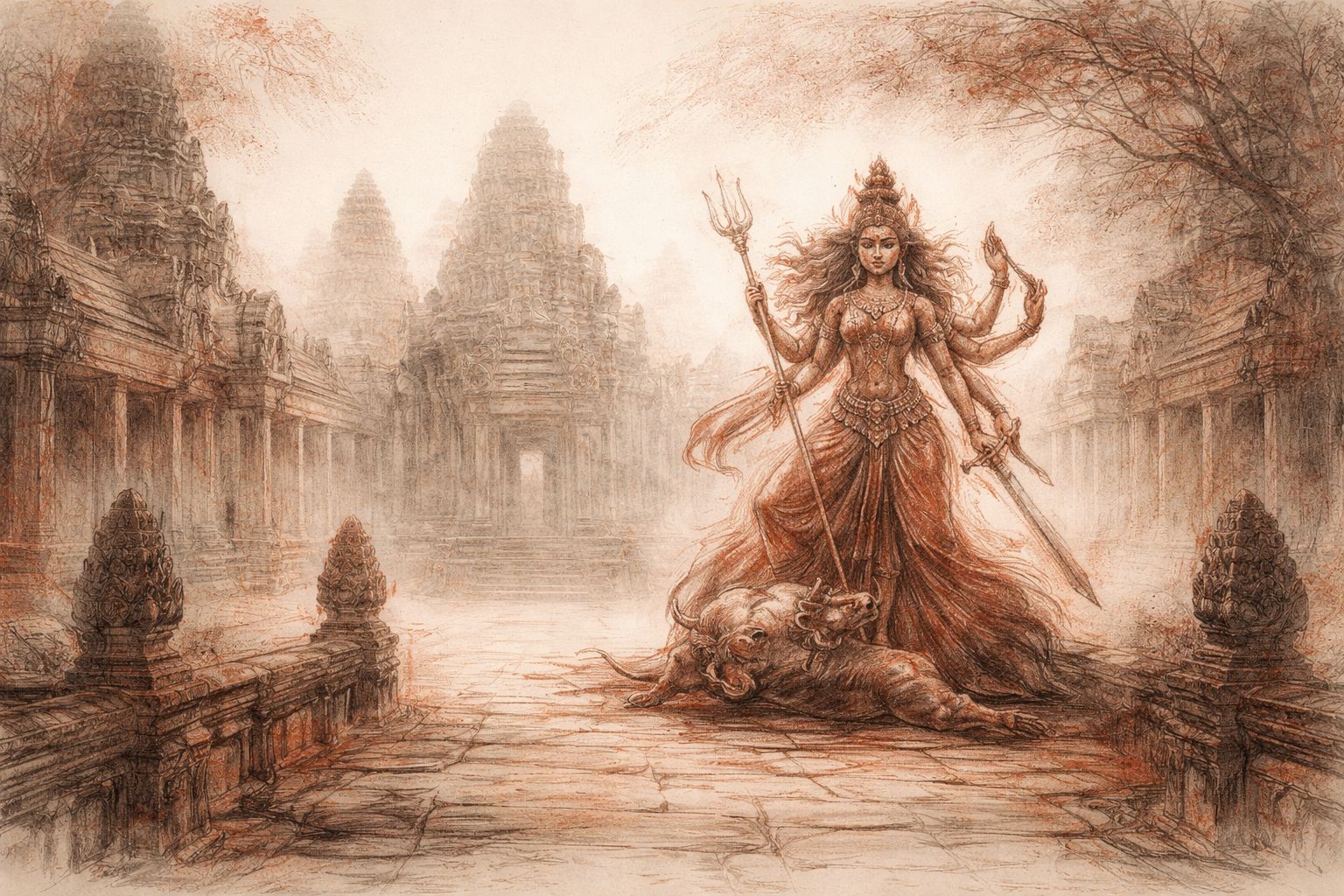

Durga in Angkor: Held Power and Necessary Force
The Weight That Holds
Durga is not encountered as a figure who arrives. She is already present—felt rather than seen—like pressure in the air before a storm that never quite breaks. In Angkor, her presence gathers not in spectacle but in poise: a stillness that carries force without display, a silence that does not recede when approached. She stands where disorder has reached its limit and cannot proceed further.
She is the moment when endurance ceases to be passive. Not the calm of retreat, but the calm of having nothing left to yield. In this sense, Durga belongs naturally to stone. The temples know her. Their walls have learned the discipline of holding weight without complaint, of receiving violence—weather, root, time—and answering it with form. Durga is of this order. She is not mercy first, but necessity.
In her, power is not separated from responsibility. She does not act from impulse, nor from rage alone. Even in her most terrible aspects, there is measure. What must be destroyed is destroyed fully; what may remain is left untouched. The balance is exacting. This is why she appears youthful yet unsoftened, graceful yet unyielding. Beauty here is not invitation but composure—the beauty of something that will not be moved.
Angkorian stone renders her without excess. The body is proportioned, the stance firm, the weapons precise. She does not gesture wildly. Even when the buffalo’s weight presses against her, the composition remains contained. Violence is present, but it does not spill. The scene is held. This restraint is not aesthetic accident; it is recognition. Durga is not chaos opposed by order. She is order reclaiming itself.
She carries the force of shakti not as surge, but as continuity. Energy that does not exhaust itself. Energy that knows where to stop. In this she differs from the frenzy often associated with her names. Here, she is the intelligence of force—the capacity to end what threatens coherence, without becoming what is destroyed.
Durga is sometimes spoken of as consort, sometimes as mother, sometimes as fury given form. In Angkor, she resists these reductions. She is not relational first. She is structural. She belongs to the architecture of meaning itself: that which intervenes when balance has failed, not to restore comfort, but to restore possibility.
There is no appeal made to her. She does not listen in the manner of gentler presences. She is already listening in another way—listening for the moment when restraint must become action. When that moment comes, there is no hesitation. Afterwards, there is no triumph. Only the return of stillness, heavier than before, but intact.
To stand before her image is not to feel protected. It is to feel corrected. Something excessive in the self quiets. Something indulgent falls away. What remains is simpler, narrower, and stronger. Durga does not console. She aligns.
In this, she is not distant from the living. She is exacting with them. She asks not for devotion, but for clarity. Where that clarity is present, she need not appear at all. Where it is absent, she stands already—silent, upright, and unwilling to move aside.
—
Receive the next work
Subscribe free to receive new work from the Lucas Varro Library by email.
More from the Library


See Also
A concise and impartial dictionary of absence, promises, quarrels, ordinary objects, and the troublesome instability of words.
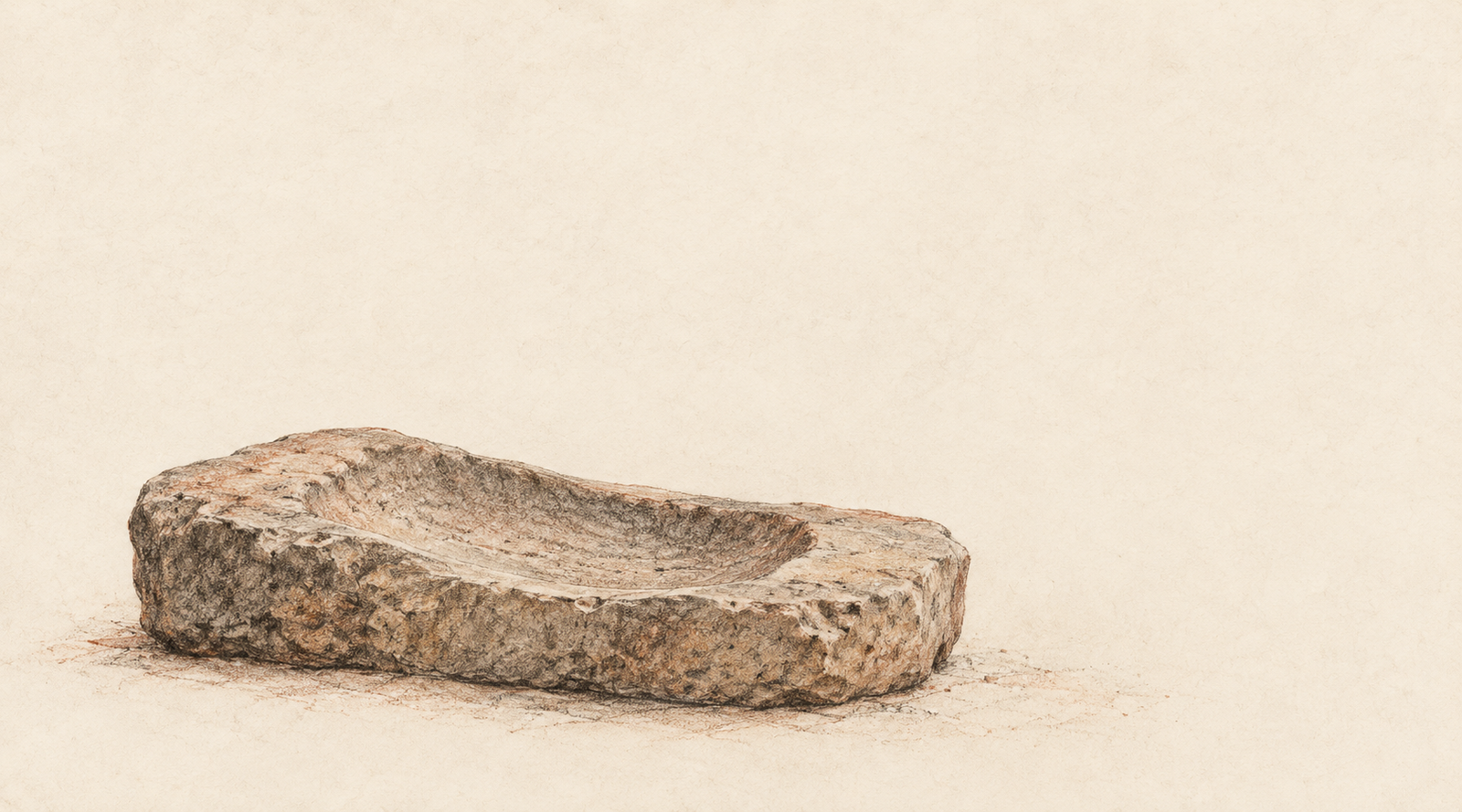

The City of Service
The temple we inherit is a building from which almost all necessity has been removed. Nothing must be brought for it to continue being what we call a temple. The sanctuary asks nothing of us. Stone is good at this kind of independence.
A living temple was otherwise.
Water had to come in. So did grain, cloth, oil, aromatic substances, fuel. The things required for worship arrived because someone carried them across a threshold.


Houses of Wood, Light, and Smoke
Some of Angkor’s most intimate ruins do not rise above the ground at all. They are postholes, low mounds, hearths and ponds: durable traces of a domestic city built largely from things that decay. To restore that city is to see Angkor not only as stone, but as wood, smoke, water, repair, and people living within calling distance.