

Dubhi and the Weight of Power in the Reamker
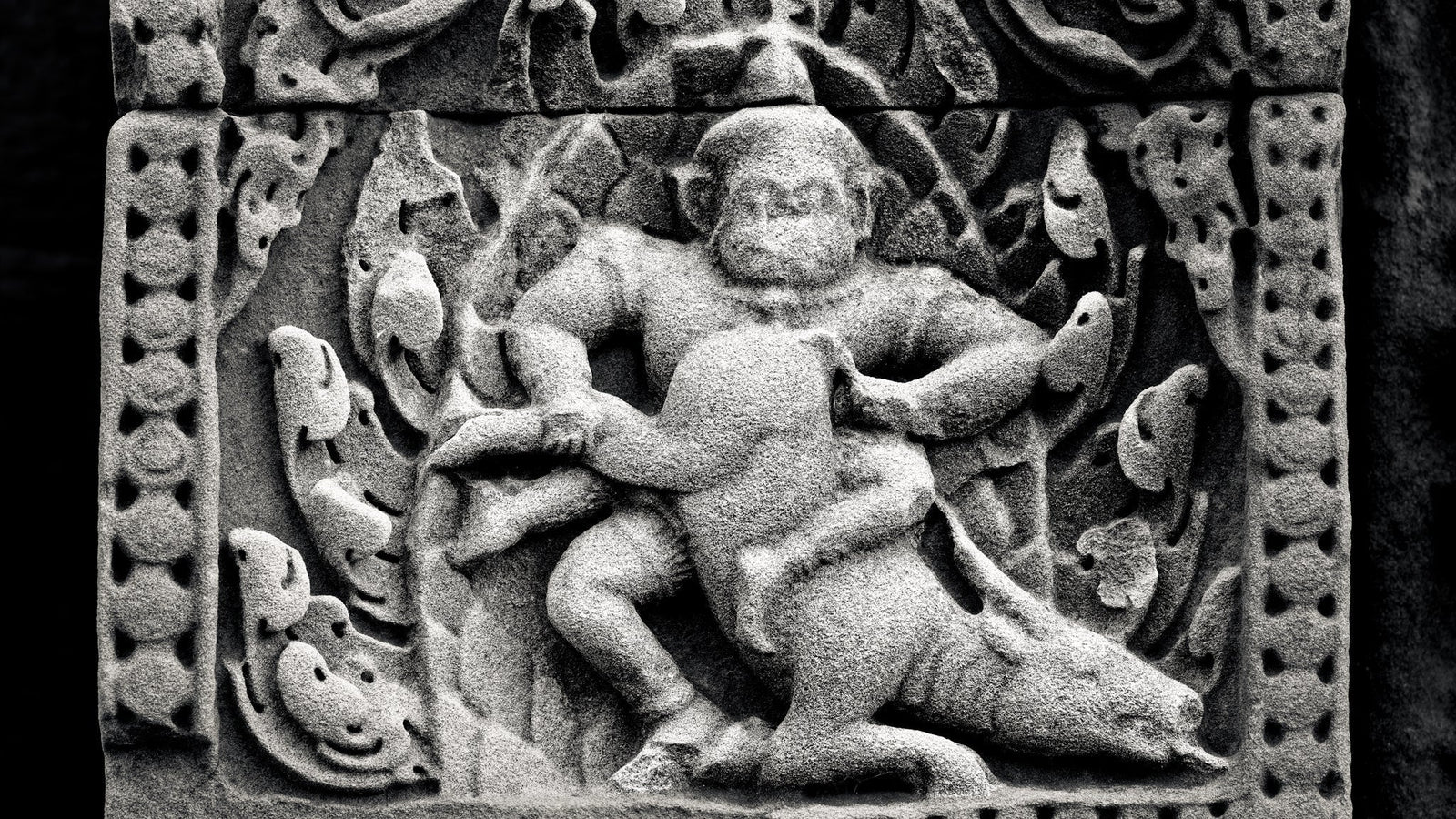
Dubhi enters the field of Angkor not as a villain announced in advance, but as weight. He is mass before meaning, muscle before narrative. The stone does not rush to explain him. It allows his presence to register slowly, like an animal standing just within the edge of sight, testing whether the clearing will hold.
In the Reamker, Dubhi survives a violence that precedes him. His father, fearing succession, attempts to erase his own future. Dubhi lives on as residue, not heir. What follows is not ambition but wandering. He moves through the forest without a throne, without a mandate, carrying strength that has nowhere to settle. Power without direction becomes pressure. It seeks contact.
When Dubhi meets Valin, the encounter is not framed as good against evil. It is a collision of densities. Dubhi’s force is blunt, expansive, difficult to manoeuvre. He does not deceive or strategise. He occupies space. In this, he resembles the earth itself—patient, resistant, unpersuadable. Such power unsettles order not because it plots, but because it refuses to yield.
The relief at Banteay Samre captures Dubhi at the moment when force is seized and turned. His body folds, yet he is not diminished into abstraction. The buffalo remains recognisable, heavy even in defeat. This is important. The stone does not annihilate him. It records the cost of containment. Strength must be handled. It cannot simply be erased.
Dubhi’s fate is often read as proof of another’s superiority, but the carving allows a quieter interpretation. Dubhi is what happens when power is severed from inheritance, when survival produces strength without a place to belong. He is not chaos in motion; he is excess without shelter. The world responds by forcing him down, not because he is wicked, but because he cannot be held otherwise.
Local legend lingers on the physical trace of this moment—the twisted neck, the folds that remain on all buffaloes. Memory enters the body. Myth refuses to stay distant. The land remembers what happened when strength met judgement, and inscribes it not in words, but in flesh.
Dubhi does not return. There is no redemption arc carved into the stone. Yet neither is there triumph. What remains is a moral weight pressed into the ground: that power born only from survival carries no instruction for its own use, and that the world, sooner or later, will intervene to supply one.
—
Receive the next work
Subscribe free to receive new work from the Lucas Varro Library by email.
More from the Library

See Also
A concise and impartial dictionary of absence, promises, quarrels, ordinary objects, and the troublesome instability of words.

The City of Service
The temple we inherit is a building from which almost all necessity has been removed. Nothing must be brought for it to continue being what we call a temple. The sanctuary asks nothing of us. Stone is good at this kind of independence.
A living temple was otherwise.
Water had to come in. So did grain, cloth, oil, aromatic substances, fuel. The things required for worship arrived because someone carried them across a threshold.

Houses of Wood, Light, and Smoke
Some of Angkor’s most intimate ruins do not rise above the ground at all. They are postholes, low mounds, hearths and ponds: durable traces of a domestic city built largely from things that decay. To restore that city is to see Angkor not only as stone, but as wood, smoke, water, repair, and people living within calling distance.

$895
Banteay Samre Temple, Angkor, Cambodia. 2022
Limited Edition Archival Pigment Print
Edition
Strictly limited to 7 prints + 2 Artist’s Proofs
Edition Number
This listing is for the first numbered print from the Large Collector Edition: 1/7
Medium
Hand-toned black-and-white archival pigment print on Hahnemühle Bamboo — a museum-grade fine art paper chosen for its quiet tactility and reverent depth, echoing the spirit of the temples.
Signature & Numbering
Each print is individually signed and numbered by the artist on the border (recto)
Certificate of Authenticity
Accompanies every print
Image Size
25.1 x 31.4 inches (63.8 x 79.8 cm)
This is an exceptional, individually crafted, museum-quality archival print on fine art paper.
It is accompanied by a unique certificate of authenticity to certify and preserve the provenance of your artwork.
Other print sizes and fine art framing services are available on request.
Art is the creation of forms symbolic of human feeling.
– Suzanne Langer (1895-1985) [Feeling and Form]