
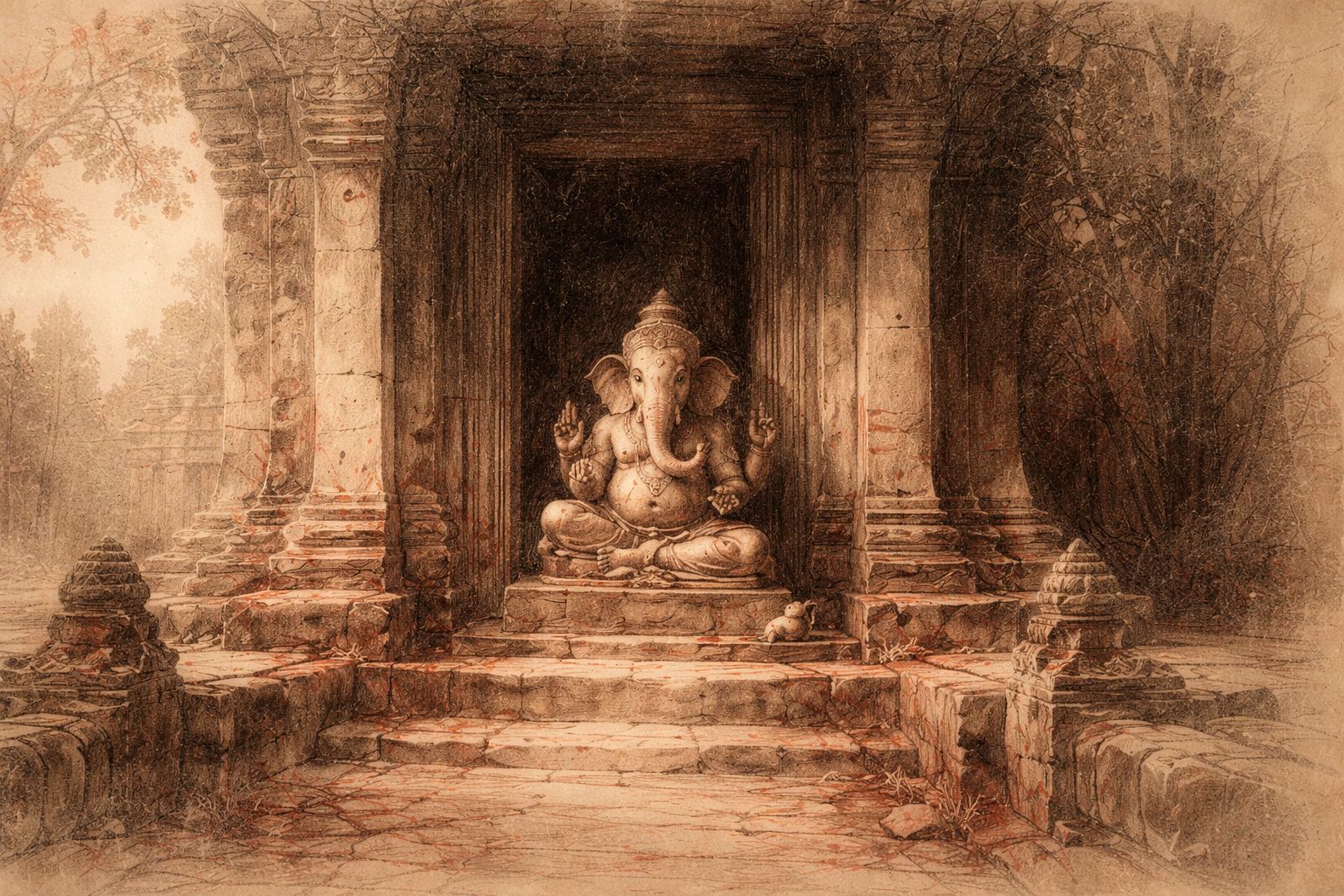

Ganesha in Angkor: The God Who Clears the Threshold
Ganesha is encountered in Angkor not as spectacle, but as a pause built into stone. He stands where movement hesitates—at doorways, at the edge of galleries, at the beginning of paths that ask the body to slow before the mind follows. His presence is quiet, almost domestic, yet it alters the moral temperature of the space. One does not rush past him. One arrives.
The elephant head is not explained here. It is accepted, as the temples accept rain and lichen and the patient return of roots. The story of loss and repair—the severed head, the substituted one—rests beneath the surface like a remembered wound. What matters is not the violence of the moment, but the fact that the world continues afterward, changed yet workable. Ganesha carries that knowledge without display. He is not whole in the way heroes are whole. He is whole in the way survival is whole.
In Angkor’s long corridors, where shadow pools and inscriptions fade, he appears less as a god of triumph than as a custodian of beginnings. To begin, here, is not to surge forward but to consent—to accept the weight of the body, the unevenness of stone, the fact that any passage will ask something in return. Ganesha does not remove difficulty so much as render it passable. The obstruction remains; the panic around it dissolves.
There is a generosity to his form. The rounded belly gathers the world without judgement. The large head listens more than it speaks. Wisdom, in this register, is not brilliance but capacity—the ability to hold contradiction without fracture. If the soul, Atman, must move through the confusions of appearance, Maya, then it helps to have a guide who is neither pure abstraction nor brute force, but something deliberately mismatched, patiently assembled.
In the temples, he is often small, almost incidental, yet his placement is exact. He belongs to thresholds because thresholds belong to him. Before entering a sanctuary, before committing to a direction, before assuming understanding, there is a moment when the body pauses of its own accord. That pause is his domain. It is not empty. It is attended.
Ganesha’s mouse waits at his feet, barely visible, an admission rather than a symbol. Thought will wander. Attention will dart and return. Nothing here demands purity. What is asked instead is proportion—mind scaled to task, desire leashed gently enough to remain alive. The broken tusk, the unevenness of the form, the story that does not resolve cleanly: all of it permits the pilgrim to proceed without pretending to be complete.
In Angkor’s moral field—where devotion and power, care and ambition, have always shared the same stone—Ganesha offers a way to begin without conquest. He stands as assurance that damage does not disqualify, that intelligence may arrive through tenderness, and that the first step is rarely heroic. It is simply taken.
To meet him is to be reminded that entry is an act of humility. One does not cross a threshold by force. One is admitted.
—
Receive the next work
Subscribe free to receive new work from the Lucas Varro Library by email.
More from the Library


See Also
A concise and impartial dictionary of absence, promises, quarrels, ordinary objects, and the troublesome instability of words.
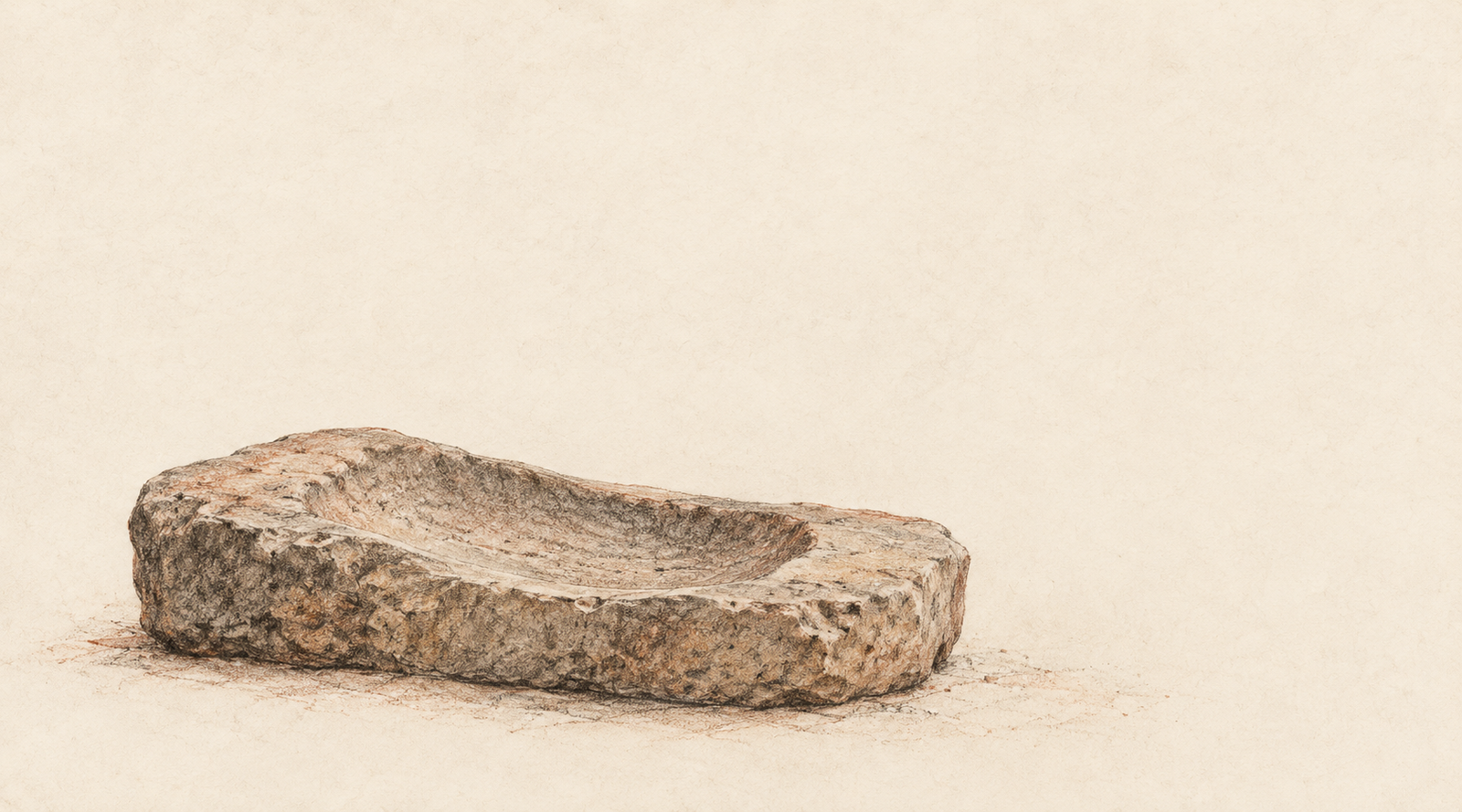

The City of Service
The temple we inherit is a building from which almost all necessity has been removed. Nothing must be brought for it to continue being what we call a temple. The sanctuary asks nothing of us. Stone is good at this kind of independence.
A living temple was otherwise.
Water had to come in. So did grain, cloth, oil, aromatic substances, fuel. The things required for worship arrived because someone carried them across a threshold.


Houses of Wood, Light, and Smoke
Some of Angkor’s most intimate ruins do not rise above the ground at all. They are postholes, low mounds, hearths and ponds: durable traces of a domestic city built largely from things that decay. To restore that city is to see Angkor not only as stone, but as wood, smoke, water, repair, and people living within calling distance.