
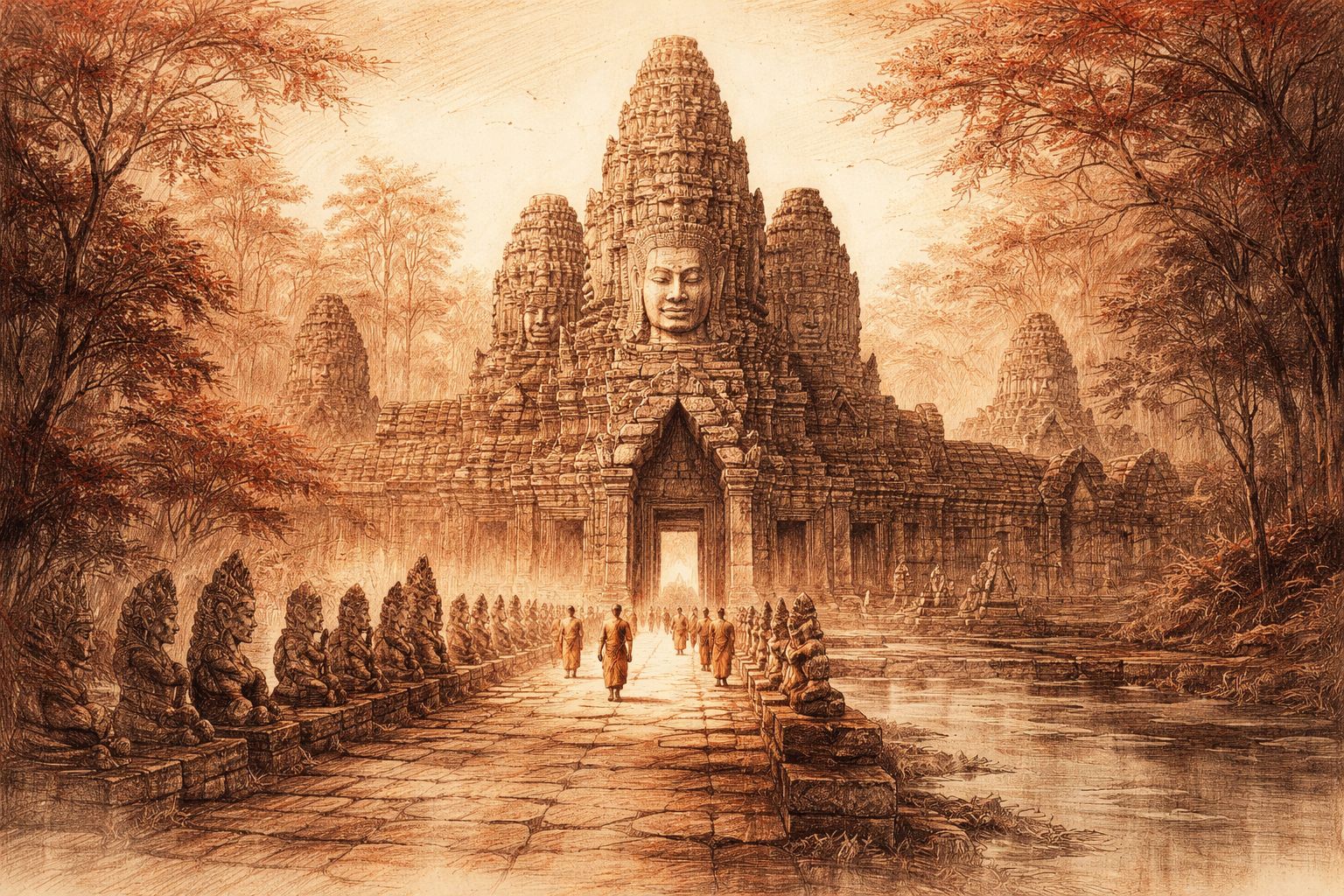

Jayavarman VII — The King Who Chose Compassion as Power
Angkor learned how to suffer before it learned how to heal.
When Jayavarman VII came to power, the empire was wounded. The Cham invasion of 1177 had shattered the old assurance that the capital was inviolable. The wooden city burned. The king was killed. The gods, it seemed, had failed in their duty of protection. What survived—stone temples, reservoirs, causeways—stood intact but mute, unable to explain why the centre had fallen.
Jayavarman VII did not answer this crisis with vengeance alone. He answered it with a redefinition of kingship.
Crowned in 1181, already an older man, he carried into power the memory of exile, loss, and delay. His reign did not begin with monuments but with movement—naval battles on the Tonle Sap, campaigns that expelled the Chams, and the long labour of stitching a traumatised realm back together. Yet what followed was not a return to the old order, but its deliberate transformation.
Jayavarman VII chose Mahayana Buddhism not as ornament, but as method.
Where earlier kings had ruled as gods sustained by cosmic geometry, he ruled as a bodhisattva, bound by compassion to the suffering of others. His inscriptions do not speak of glory; they speak of pain. The illness of his people was his own spiritual wound. This was not metaphor. It became policy.
Across the empire, hospitals rose—102 of them—each dedicated to the Medicine Buddha. Roads were laid like arteries, raised above flood and forest, stitched together by stone bridges and punctuated by houses of fire where travellers could rest. The kingdom became navigable, legible, held together not only by ritual, but by care.
Only later did the great temples appear, and when they did, they spoke the same language.
Ta Prohm and Preah Khan were not merely sanctuaries; they were acts of remembrance. One honoured his mother as Prajnaparamita, the perfection of wisdom. The other honoured his father as Lokeshvara, the embodiment of compassion. Between them, at the heart of Angkor Thom, rose the Bayon—not as a mountain of domination, but as a hall of faces. Calm, innumerable, watching in all directions, they refuse triumph. They watch, they endure, they remain present.
Angkor Thom itself was the final answer to the trauma of invasion. Walled, moated, measured, it enclosed the capital not just physically, but symbolically. The city became a mandala of protection, with the Bayon at its centre acting as both spiritual anchor and moral witness. Power no longer radiated outward from a distant god; it circulated inward, returned, absorbed.
Jayavarman VII expanded the empire further than any ruler before him. Champa was conquered. Roads reached the furthest provinces. Banteay Chhmar rose in the west; Preah Khan of Kompong Svay grew in the east. Yet expansion was no longer the point. The point was cohesion—holding together what had been torn.
There is a cost to this vision, and history does not look away. The scale of construction was immense. Labour, rice, stone, forest—all were consumed at a pace the empire could not long sustain. The kingdom burned bright, and in burning, exhausted itself. After Jayavarman VII, the state would struggle to maintain the systems he created. Compassion, too, demands resources.
And yet, when later kings attempted to erase him—to chisel away the Buddha, to bury his statues, to silence his inscriptions—they failed in the deeper sense. The roads remained. The hospitals lingered in memory. The faces of the Bayon endured, altered but not undone.
Jayavarman VII did not merely rule Angkor. He taught it how to care.
In doing so, he revealed both the strength and the fragility of a civilisation that dared, for a moment, to organise power around mercy.
—
Receive the next work
Subscribe free to receive new work from the Lucas Varro Library by email.
More from the Library

The Leaf and the Pencil
A leaf holds my attention. Then I remember that I can draw. The pencil reveals things I had never noticed, but introduces its own demands: proportion, shading, the desire to make something beautiful. When I try to describe the encounter, language presents another difficulty. An essay about the uncertain distance between looking at something, understanding it, and being present with it.

The Work We Return To
We have become very good at measuring persistence, and less good at asking what deserves it.
A musician begins the same passage again. A writer returns to an unfinished sentence. Someone stands before a familiar face carved in stone, with nothing new to photograph.
What brings us back when enthusiasm has gone? And how do we distinguish devotion from the demands that quietly consume the rest of our lives?

Under the Gallery
Rain, a carved hand, and the small movements of lives separated by centuries. A new literary piece from The Vow.