
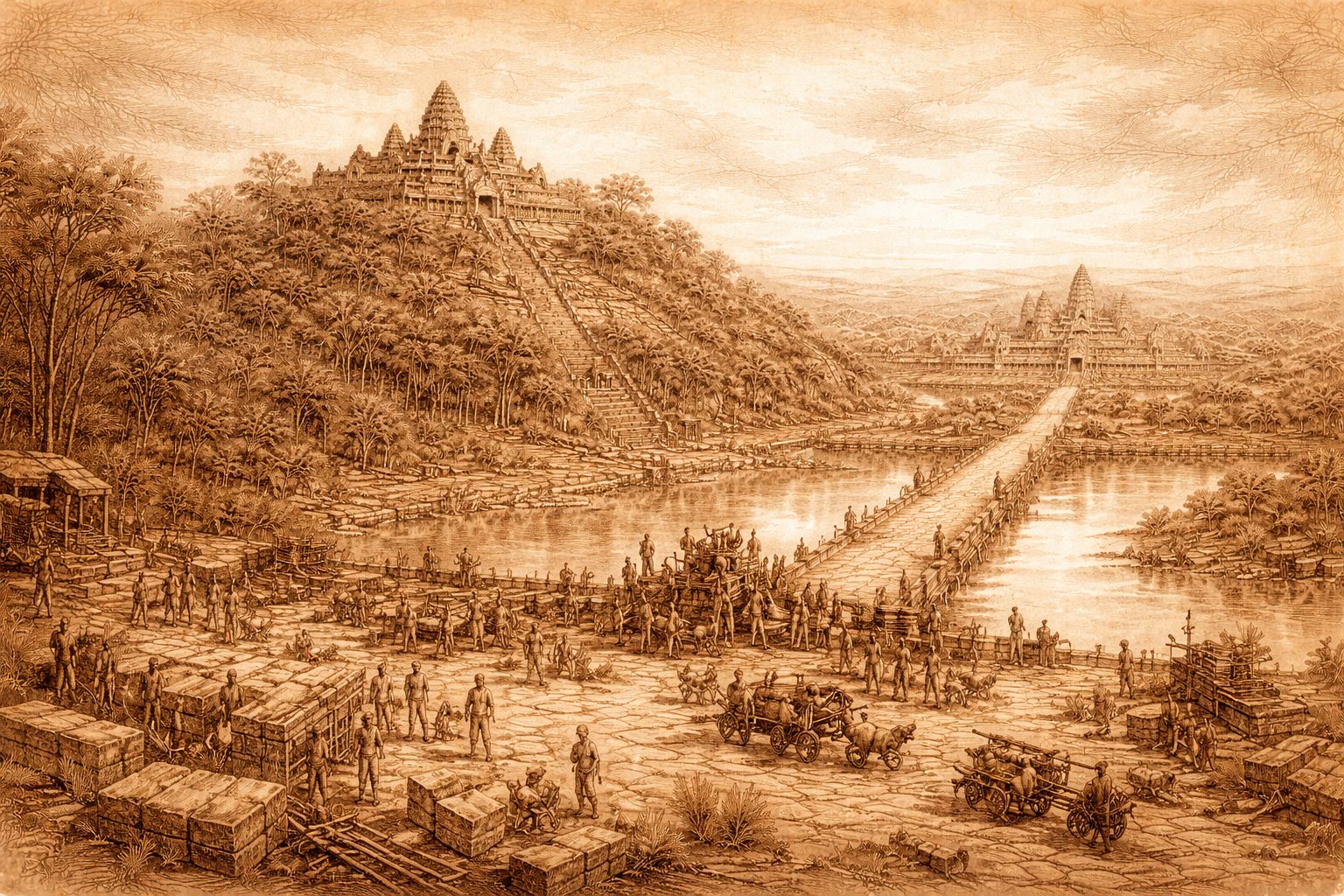

From Template to Territory — Yaśovarman I and the Birth of Angkor Proper
Angkor was not founded once.
It was prepared, then moved, then fixed.
The reigns of Jayavarman II, Jayavarman III, and Indravarman I established the grammar of Khmer kingship: declaration, consolidation, standardisation. What remained was to release this grammar from its first enclosure and allow it to generate a city worthy of its scale.
That act belongs to Yashovarman I.
Roluos as Preparation
The capital at Hariharalaya was never intended as an endpoint. It was an open city, assembled incrementally, where architecture tested ideas rather than enforced them. Here, the triad matured: Indravarman I formalised the obligations of kingship—ancestor temple, state temple-mountain, public works—but these remained clustered, provisional, responsive to circumstance.
Yaśovarman I inherited not a finished capital, but a working model.
Before leaving, he honoured it. In 893 CE, he built Lolei, an ancestor temple placed deliberately on an island in the Indrataṭāka. For the first time, Mount Meru and the Cosmic Ocean were rendered with complete clarity: stone rising from water, genealogy anchored within cosmology. Only after this act of filial alignment did he depart.
Roluos had been fulfilled. It could now be left behind.
The Transposition to Angkor
The move to Angkor was not merely strategic; it was cosmological. Yaśovarman I sought a landscape that could receive the triad without compromise—a place where geometry, elevation, water, and horizon could be brought into strict accord.
At Angkor, he found hills, rivers, and space.
His first act was hydraulic. The East Baray—Yaśodharataṭāka—dwarfed all earlier works. Eight times the scale of his father’s reservoir, it was not simply storage but proclamation: a new Sea of Milk, sanctified under the protection of Ganga, capable of feeding a capital conceived at imperial scale. Water was no longer adjunct to kingship; it was its visible measure.
Next came the mountain.
Phnom Bakheng and the Fixed Centre
At the heart of the new city, Yaśovarman I crowned a natural hill with his state temple, Phnom Bakheng. This decision marked a profound shift. Where earlier kings had built Meru upward from the plain, Yaśovarman chose to recognise Meru where it already stood.
Phnom Bakheng was not only elevated; it was encoded. Its terraces, towers, and numbers mapped the heavens with unprecedented precision—108 subsidiary towers, 33 visible from each axis, cycles of months and planetary time folded into stone. At its centre stood the royal linga, Yaśodhareśvara, binding the king’s essence to Shiva at the exact midpoint of a four-kilometre square city.
For the first time, the Angkorian capital was no longer open or adaptive. It was fixed, aligned, and named: Yaśodharapura.
From Model to Mandate
What Yaśovarman I achieved was not innovation, but completion. He took the triadic system forged at Roluos and transposed it whole into a new geography, free of inherited constraints. In doing so, he transformed a royal obligation into an imperial mandate.
From this point onward, Angkorian kings would not ask whether to build water, ancestors, and mountains. They would ask only how large, how refined, how aligned. The template had become territory.
Angkor proper begins here—not as an idea, but as a city that could no longer be moved.
Empires endure when their centres are no longer portable.
Yaśovarman I understood this—and set the axis in the ground.
—
Receive the next work
Subscribe free to receive new work from the Lucas Varro Library by email.
More from the Library


See Also
A concise and impartial dictionary of absence, promises, quarrels, ordinary objects, and the troublesome instability of words.

The City of Service
The temple we inherit is a building from which almost all necessity has been removed. Nothing must be brought for it to continue being what we call a temple. The sanctuary asks nothing of us. Stone is good at this kind of independence.
A living temple was otherwise.
Water had to come in. So did grain, cloth, oil, aromatic substances, fuel. The things required for worship arrived because someone carried them across a threshold.


Houses of Wood, Light, and Smoke
Some of Angkor’s most intimate ruins do not rise above the ground at all. They are postholes, low mounds, hearths and ponds: durable traces of a domestic city built largely from things that decay. To restore that city is to see Angkor not only as stone, but as wood, smoke, water, repair, and people living within calling distance.