
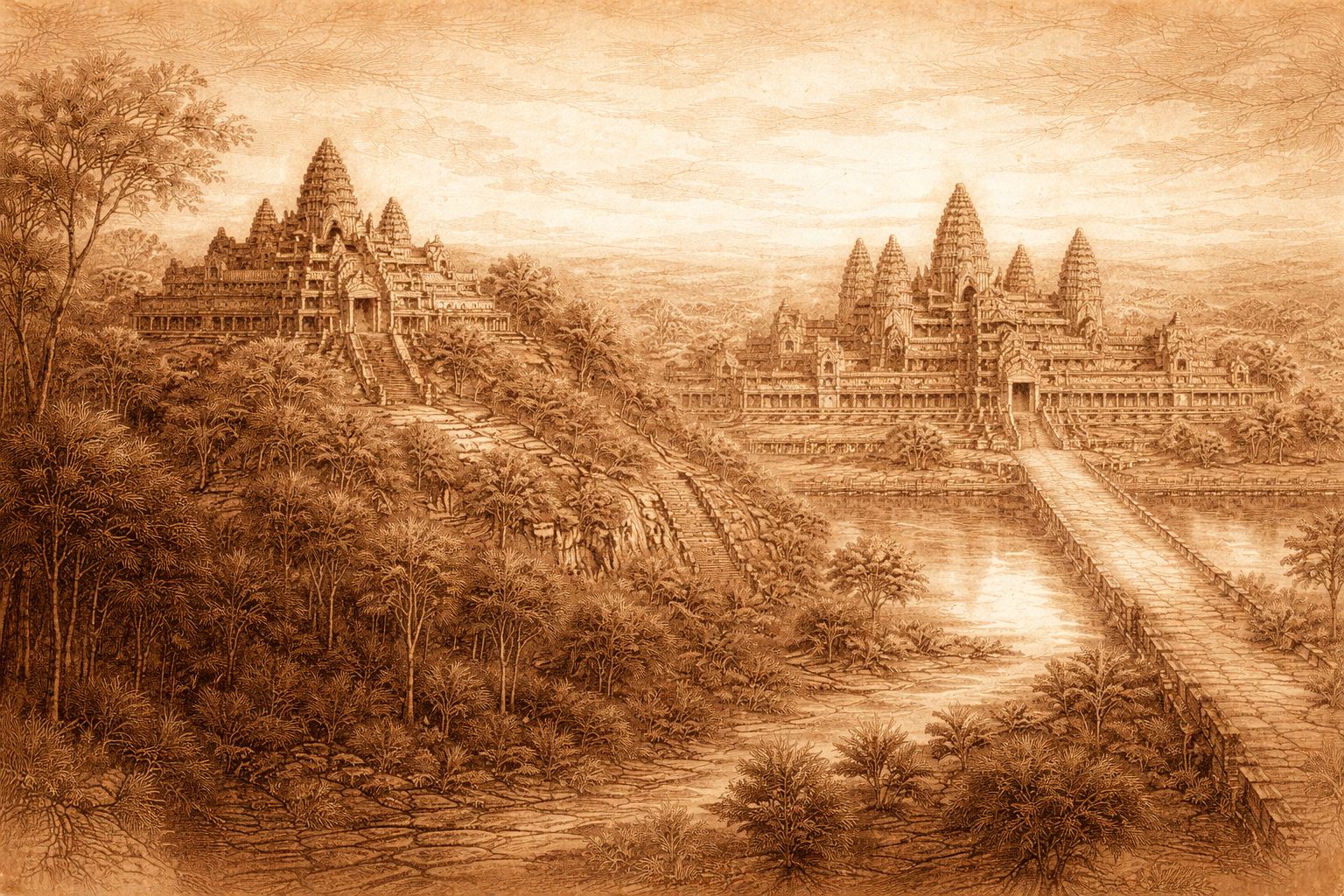

From Hill to Mandala — Phnom Bakheng and Angkor Wat
Khmer architecture did not abandon the mountain.
It learned how to become it.
Between Phnom Bakheng (c. 907 CE) and Angkor Wat (c. 1113–1150 CE), the state temple of Angkor underwent its most profound transformation. What began as an act of recognition—identifying a natural hill as Mount Meru—culminated in an act of mastery: the creation of a fully controlled, mathematically perfected architectural mandala.
The difference is not scale alone. It is authority.
Phnom Bakheng — The Hill as Given Axis
When Yashovarman I crowned Phnom Bakheng with his state temple, he made a decisive gesture: the cosmos could be anchored not only by ritual, but by landform. The sixty-metre hill rising above the Angkor plain became the vnam kantal—the central mountain—around which Yaśodharapura was laid out.
This choice carried power and constraint in equal measure. The hill provided immediate elevation, bringing the king closer to the heavens without the labour of artificial mass. Yet its natural contours imposed limits. Terraces were steep and narrow, unsuited to processional circumambulation. Space was stacked rather than composed. The mountain was present, but not yet fully legible.
Still, Phnom Bakheng was conceptually bold. Its summit quincunx announced the five peaks of Meru. Its 108 subsidiary towers, and the careful arrangement that revealed 33 towers from any cardinal axis, marked one of the earliest Khmer attempts to encode cosmology through countable form. Time and heaven had entered architecture—but tentatively, as numbers placed upon a resistant body.
Phnom Bakheng is thus a temple of ascent. It teaches upward movement, vertical striving, and the difficulty of imposing order upon what is already given.
Learning to Build the Mountain
The century and a half between Bakheng and Angkor Wat was a period of disciplined refinement. Kings did not abandon the temple-mountain; they corrected it.
At Ta Keo, builders committed fully to sandstone, freeing architecture from the compromises of brick and hill. At Baphuon, concentric vaulted galleries replaced piled mass, allowing movement, enclosure, and ritual flow to be designed rather than endured. Space became intentional.
By the early twelfth century, Khmer architects no longer needed a hill to suggest Meru. They had learned how to generate it.
Angkor Wat — The Mandala Perfected
Angkor Wat marks the moment when the mountain ceased to be found and was instead composed.
Built entirely by human design, its three rising platforms achieve symbolic height through proportion rather than topography. Nothing is borrowed. Everything is measured. The moat becomes the Cosmic Ocean with exact breadth; the galleries become mountain ranges through calculated recession; the five towers rise as Meru’s peaks with choreographed symmetry.
Unlike Phnom Bakheng’s reliance on counted towers, Angkor Wat encodes the cosmos through measurement itself. Distances expressed in Khmer cubits correspond to the durations of the Yugas, the great cosmic ages. Movement through the temple becomes movement through time. The structure is not only symbolic; it is chronological.
Astronomy is no longer suggested but enacted. The sun aligns with the central tower at equinox. Light travels across bas-reliefs in rhythms that mirror the year. Architecture becomes a calibrated instrument, a stone cosmogram in continuous operation.
Stylistically, the difference is unmistakable. Where Bakheng piles, Angkor Wat integrates. Where the hill interrupts, the mandala flows. Light, shadow, relief, and void are no longer incidental; they are composed into a single harmonic system. The temple does not gesture toward the universe—it models it.
From Reliance to Sovereignty
Phnom Bakheng and Angkor Wat are not rivals. They are stages of understanding.
The former teaches that sacred order can be revealed through landscape. The latter demonstrates that, once mastered, sacred order can be rebuilt from first principles. Between them lies the maturation of Khmer architectural thought: from alignment with nature to dominion over form.
The hill was sufficient to begin.
The mandala was required to endure.
—
Receive the next work
Subscribe free to receive new work from the Lucas Varro Library by email.
More from the Library


See Also
A concise and impartial dictionary of absence, promises, quarrels, ordinary objects, and the troublesome instability of words.

The City of Service
The temple we inherit is a building from which almost all necessity has been removed. Nothing must be brought for it to continue being what we call a temple. The sanctuary asks nothing of us. Stone is good at this kind of independence.
A living temple was otherwise.
Water had to come in. So did grain, cloth, oil, aromatic substances, fuel. The things required for worship arrived because someone carried them across a threshold.

Houses of Wood, Light, and Smoke
Some of Angkor’s most intimate ruins do not rise above the ground at all. They are postholes, low mounds, hearths and ponds: durable traces of a domestic city built largely from things that decay. To restore that city is to see Angkor not only as stone, but as wood, smoke, water, repair, and people living within calling distance.