
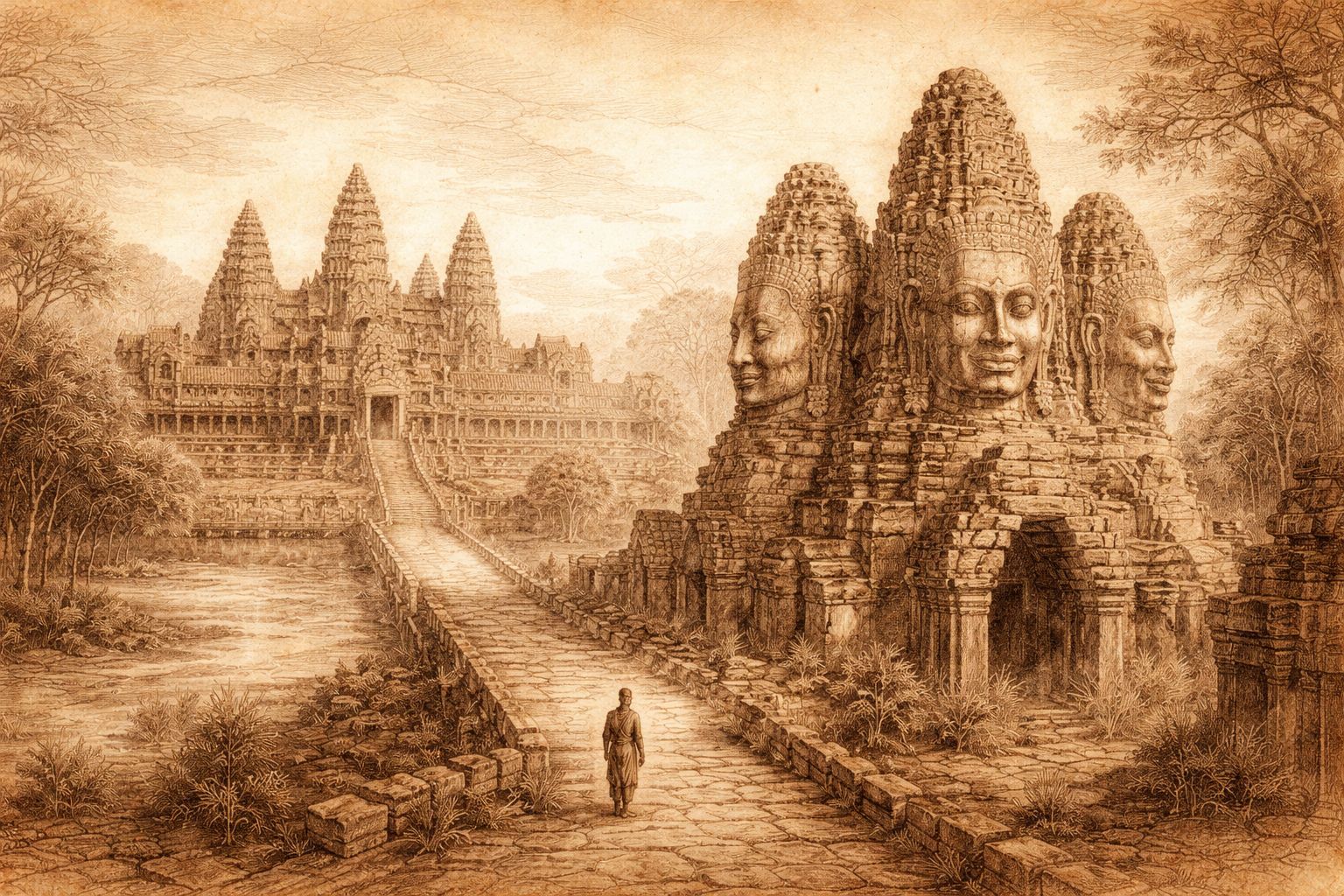

From Order to Presence — Angkor Wat and the Bayon
Angkor Wat perfects the universe.
The Bayon turns to face it.
The transition from Angkor Wat (early 12th century) to the Bayon (late 12th–early 13th century) marks one of the most consequential transformations in the history of Khmer civilisation. It is not a movement from order to disorder, nor from mastery to collapse. It is a shift in what the cosmos is for.
Angkor Wat asks the world to align.
The Bayon asks it to be seen.
Angkor Wat — The Stillness of Cosmic Law
Angkor Wat stands at the apogee of classical Khmer confidence. Conceived under Suryavarman II, it is a temple in which nothing is accidental. Every proportion is measured. Every axis is fixed. Every surface participates in a single, immense logic of correspondence between heaven and earth.
Here, the universe is knowable.
The mandala of Angkor Wat does not move toward the worshipper; it receives him. One crosses the moat—the Cosmic Ocean—leaves profane time behind, and enters a world already complete. The concentric galleries enact the mountain ranges of Meru. The central quincunx rises with serene inevitability. Bas-reliefs unfold the epics in endless procession, illuminated by the sun at appointed seasons.
This is a cosmos governed by dharma as order: hierarchy, proportion, recurrence. Vishnu presides not as an emotional presence, but as the sustainer of balance. The king, identified with Vishnu, rules by perfect alignment with cosmic law. Suffering exists, but it is framed—subsumed into a larger, timeless structure.
Angkor Wat does not ask how the world feels.
It shows how the world works.
The Breaking of Certainty
The century that followed Angkor Wat unsettled this assurance. The Khmer Empire faced invasion, internal conflict, and demographic strain. Certainty did not vanish—but it became insufficient.
Into this altered world stepped Jayavarman VII.
A Mahayana Buddhist king, Jayavarman VII did not reject the mandala. He reinhabited it. Where earlier kings had sought to mirror the cosmos, he sought to enter it as a moral agent. The centre could no longer remain aloof.
The Bayon — The Mandala Made Human
The Bayon rises at the heart of Angkor Thom, not as a mountain of distance, but as a concentration of faces. Where Angkor Wat ascends through empty space, the Bayon gathers inward. Towers multiply. Axes soften. Symmetry gives way to density.
At its summit, the familiar quincunx dissolves into something unprecedented: dozens of serene, smiling faces gazing outward in all directions. They are at once the Bodhisattva Lokeshvara and the king himself. Compassion and sovereignty are no longer separate.
Here, the universe does not merely exist.
It regards.
The Bayon does not organise space through exclusion and distance, but through presence. There is no single privileged approach. Faces meet the pilgrim wherever he stands. The cosmic centre is no longer a point of ascent alone; it is a field of awareness.
From Singularity to Multiplicity
Angkor Wat expresses unity through singularity: one mountain, one axis, one perfect system. The Bayon expresses unity through multiplicity: many towers, many faces, many points of contact.
This is not confusion. It is a different theology.
In Mahayana thought, salvation does not lie in escape from the world’s complexity, but in compassionate engagement with it. The Bodhisattva does not withdraw to a perfected realm; he remains, facing outward, attending to suffering in all directions.
The Bayon is therefore not anti-cosmic. It is post-cosmic. The mandala remains, but it has been turned inside out. Geometry still governs, but it is no longer sufficient on its own. Ethics enters architecture.
A New Measure of Kingship
Under Angkor Wat, kingship is validated by alignment with eternal law. Under the Bayon, it is validated by responsiveness.
Jayavarman VII’s vast programme of hospitals, rest houses, and roads is not an aside to the Bayon—it is its extension into the realm. Compassion leaves the sanctuary and enters daily life. The centre no longer holds by distance, but by care.
The Bayon does not replace Angkor Wat.
It answers it.
Where Angkor Wat asks, Is the universe ordered?
The Bayon asks, Who tends those who suffer within it?
Cosmos with a Face
Seen together, Angkor Wat and the Bayon form a single philosophical arc. The first perfects the world as structure. The second insists that structure must be inhabited by mercy.
The Khmer mandala does not fracture here.
It learns to look back.
Angkor Wat gives the empire its law.
The Bayon gives it a conscience.
And in the silent exchange between these two temples—one still, one watching—the full moral depth of Angkor is finally revealed.
—
Receive the next work
Subscribe free to receive new work from the Lucas Varro Library by email.
More from the Library

See Also
A concise and impartial dictionary of absence, promises, quarrels, ordinary objects, and the troublesome instability of words.

The City of Service
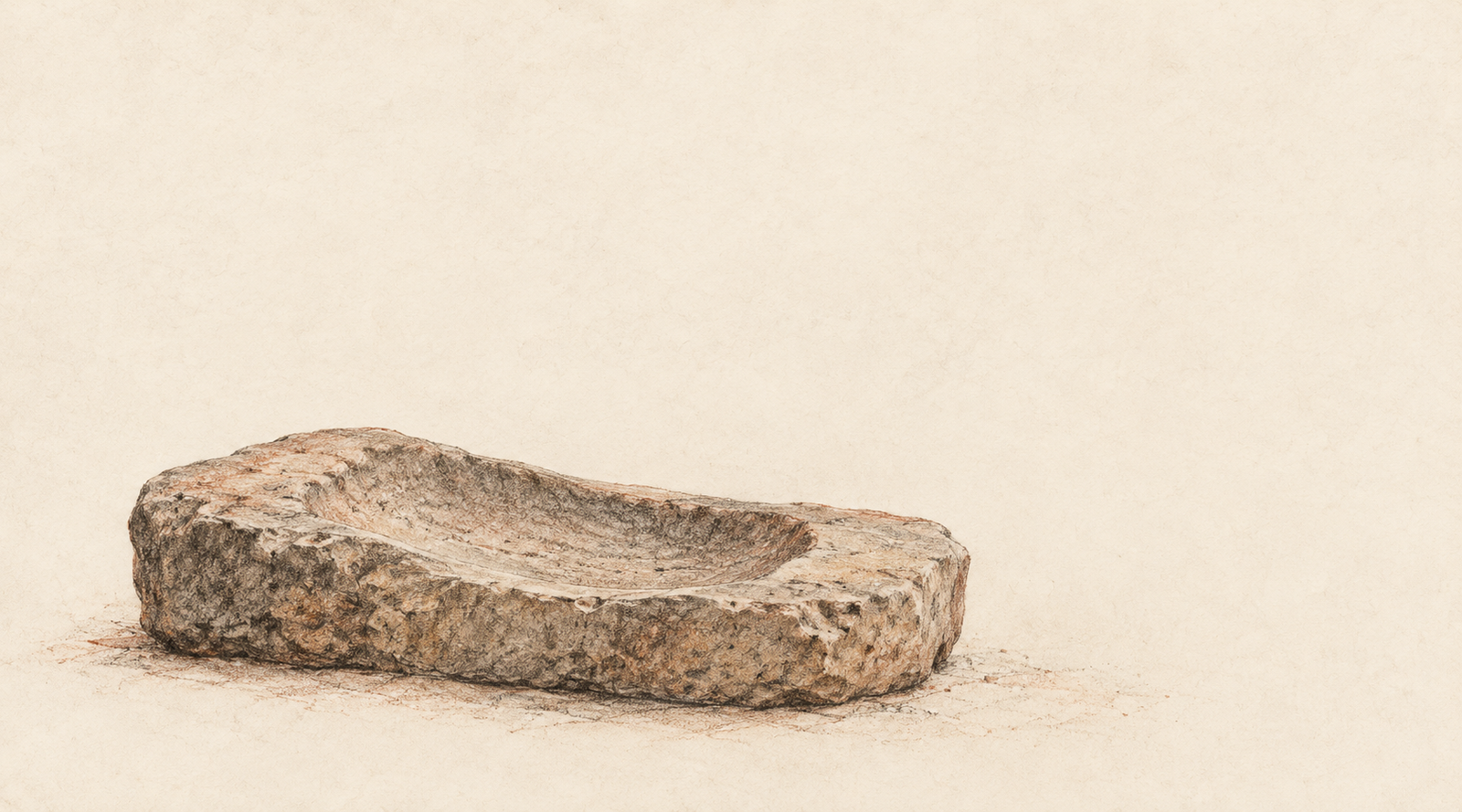
The temple we inherit is a building from which almost all necessity has been removed. Nothing must be brought for it to continue being what we call a temple. The sanctuary asks nothing of us. Stone is good at this kind of independence.
A living temple was otherwise.
Water had to come in. So did grain, cloth, oil, aromatic substances, fuel. The things required for worship arrived because someone carried them across a threshold.

Houses of Wood, Light, and Smoke
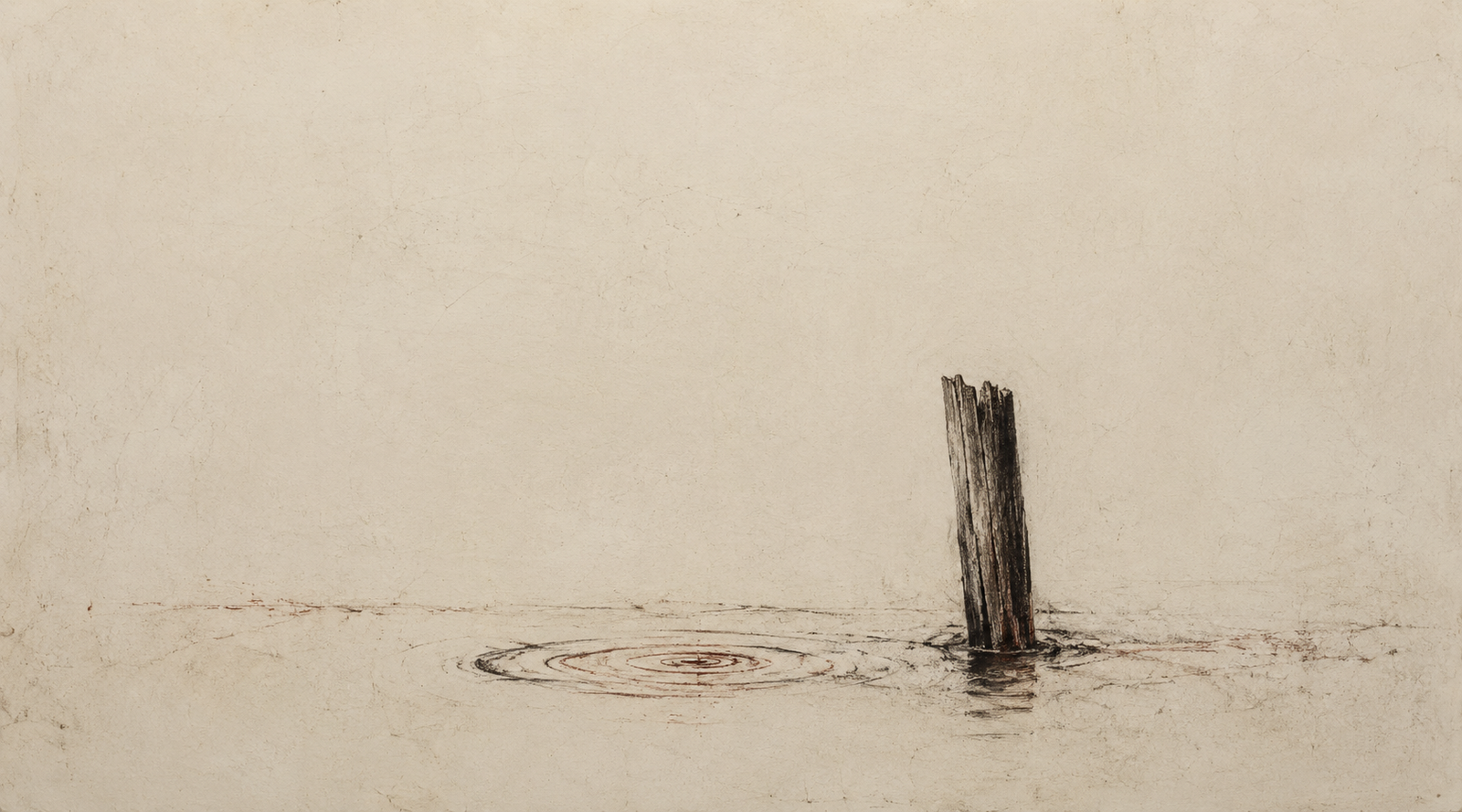
Some of Angkor’s most intimate ruins do not rise above the ground at all. They are postholes, low mounds, hearths and ponds: durable traces of a domestic city built largely from things that decay. To restore that city is to see Angkor not only as stone, but as wood, smoke, water, repair, and people living within calling distance.