
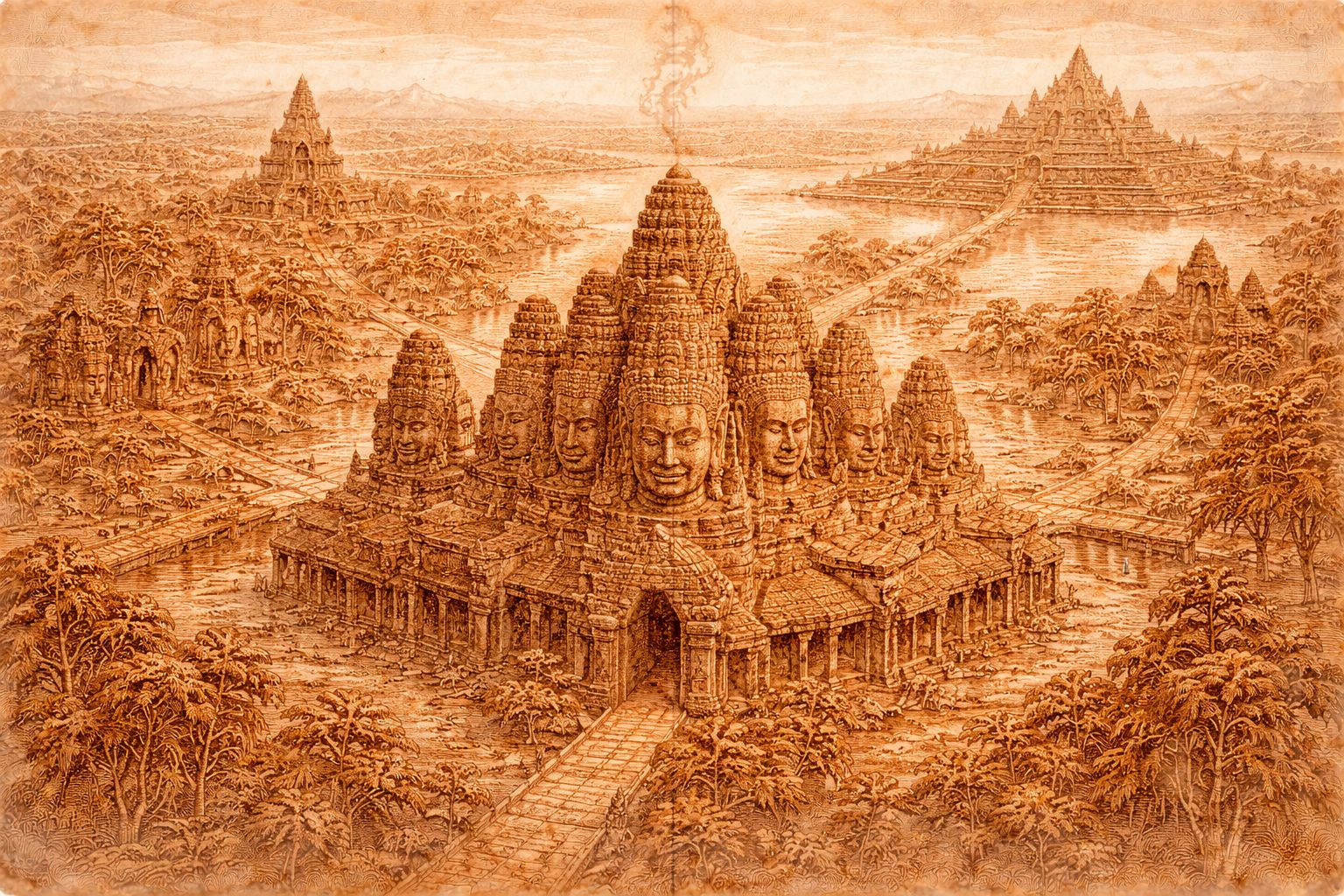

The Mandala Broken Open — Mahayana Buddhism and the Remaking of Angkor
The mandala did not collapse at Angkor.
It opened.
For three centuries, the Khmer world had been held together by a severe and luminous geometry: a square earth, a central mountain, a god anchored at the axis. Kings ruled by alignment. The cosmos endured because it was measured, enclosed, and ritually maintained. This was the Brahmanical mandala—precise, hierarchical, and intact.
Then the centre failed.
The Rigid Square
In its classical form, the Angkorian mandala was a discipline of containment. Derived from Indian Vastu Shastra, it conceived the world as a regulated surface, divided by cardinal axes and stabilised by a single vertical pivot: Mount Meru. The temple-mountain rose as the visible proof of cosmic order, housing the devarāja—the god who guaranteed kingship and, by extension, the safety of the realm.
This universe was not cruel, but it was selective. Order flowed downward. Ritual authority was concentrated. The king mediated between gods and men, but the gods remained distant, enthroned above the world they governed. Equilibrium depended on inviolability: the capital must not fall, the axis must not fracture, the centre must not move.
For a time, this worked.
The Fracture
In 1177, Angkor was sacked by Cham forces. The capital burned. The inviolate centre was breached.
The significance of this moment cannot be overstated. In Brahmanical logic, the fall of the capital was not merely military defeat—it was cosmic failure. If the mandala were intact, such a rupture should have been impossible. The old gods had not protected their house.
Out of this collapse emerged Jayavarman VII.
Rather than repairing the old system, he abandoned its premises. The devarāja—a god secured at the centre—was replaced by a radically different vision of kingship, drawn from Mahayana Buddhism, in which the universe is not saved by hierarchy, but by compassion (karuna).
The mandala would not be restored.
It would be reimagined.
The Living Mandala
Under Jayavarman VII, architecture ceased to be merely symbolic. It became anthropomorphic.
The distinction between structure (vastu) and image (śilpa) dissolved. Temples no longer housed gods; they were gods. Stone acquired faces. Walls learned to look back.
At the Bayon, the old square discipline loosened into a circular, centripetal mass, closer to a Buddhist stupa than a Hindu pyramid. Towers multiplied. Axes blurred. At the summit, the singular peak of Meru was replaced by a field of serenity-smiling faces—at once Lokeshvara, Vajrasattva, and the king himself.
This was no longer a cosmos organised around distance.
It was a cosmos organised around presence.
The mandala fractured spatially and ethically. Instead of one inviolate centre, there were many points of encounter. Instead of vertical ascent alone, there was outward address. The universe no longer ruled from above; it attended.
From Monument to Network
Most radical of all, the mandala escaped the temple.
Jayavarman VII dispersed the sacred centre across the empire, installing Jayabuddhamahanatha images—royal Buddha-forms—at major provincial sites from Angkor to Lopburi and Ratchaburi. The mandala became geographic, no longer confined to a single mountain or city. Power was no longer held; it was circulated.
This was a political theology of distribution. Compassion could not remain centralised if it were to be credible. Hospitals, rest houses, and roads extended the logic of the Bayon into daily life. Suffering was no longer absorbed into cosmic abstraction; it was addressed directly.
The mandala had become a state-wide nervous system, pulsing with the same ethical signal at every node.
Tantric Reconstitution
In its final phase, this system deepened rather than stabilised. Influenced by Vajrayana and the Hevajra Tantra, the mandala entered a more esoteric register—sometimes described as “yoginification.”
Multiplicity replaced singularity. The universe was no longer ordered around one god, but generated through meditative emanation. The Bayon’s faces—216 in number—projected calm in all directions, a visual enactment of the tantric idea that enlightened awareness fills space without centre or edge.
Even lineage was absorbed into this cosmology. Jayavarman VII’s mother was deified as Prajnaparamita (Wisdom), his father as Lokeshvara (Compassion). Their union produced the Buddha-king—not a god enthroned above the world, but a bodhisattva within it.
What Endures
The Mahayana mandala did not reject Angkor’s past.
It answered it.
Where the old system demanded perfection of form, the new demanded perfection of response. Where the old mandala sought to hold the world still, the new accepted movement, fracture, and suffering as conditions of meaning.
Angkor’s final wisdom is not that order is false, but that order alone cannot save.
The mandala survives—broken open, humanised, and re-knit as compassion.
—
Receive the next work
Subscribe free to receive new work from the Lucas Varro Library by email.
More from the Library

See Also
A concise and impartial dictionary of absence, promises, quarrels, ordinary objects, and the troublesome instability of words.

The City of Service
The temple we inherit is a building from which almost all necessity has been removed. Nothing must be brought for it to continue being what we call a temple. The sanctuary asks nothing of us. Stone is good at this kind of independence.
A living temple was otherwise.
Water had to come in. So did grain, cloth, oil, aromatic substances, fuel. The things required for worship arrived because someone carried them across a threshold.

Houses of Wood, Light, and Smoke
Some of Angkor’s most intimate ruins do not rise above the ground at all. They are postholes, low mounds, hearths and ponds: durable traces of a domestic city built largely from things that decay. To restore that city is to see Angkor not only as stone, but as wood, smoke, water, repair, and people living within calling distance.