

Declaration, Consolidation, Standardisation — The First Angkorian Sequence
Angkor did not emerge fully formed.
It arrived in stages, each necessary, none sufficient alone.
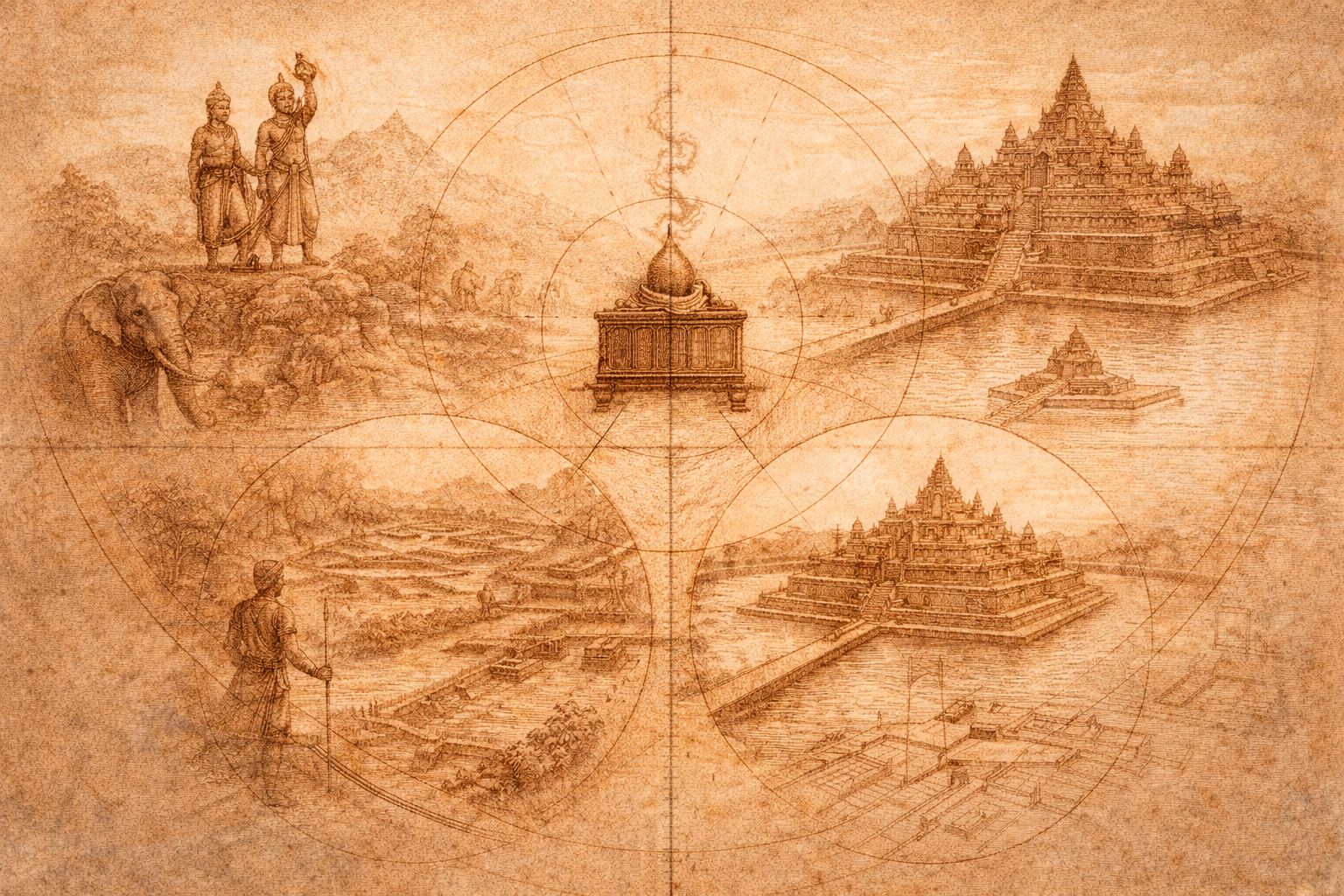
Between the reigns of Jayavarman II, Jayavarman III, and Indravarman I, the Khmer state passed through its essential triad: declaration, consolidation, and standardisation. What followed for the next five centuries would elaborate this sequence, but never replace it.
I. Jayavarman II — Declaration
Jayavarman II’s achievement was not territorial expansion, but reorientation. In a landscape fractured by competing courts and regional loyalties, he introduced a single centre of gravity.
In 802 CE, on Phnom Kulen—ancient Mahendraparvata—he performed the sovereign rites that declared independence from “Javā” and proclaimed himself cakravartin, universal monarch. Assisted by the Brahmin Hiranyadama, he established the devarāja (kamrateṅ jagat ta rāja): not the king as god, but a divine counterpart anchoring sovereignty beyond any single body.
This was the moment of declaration. Cambodia was no longer a loose aggregation of lands, but Kambuja-desa—a realm oriented around a sacred axis. Architecture followed theology. At Prasat Rong Chen, the first temple-mountain rose in laterite: modest, experimental, but decisive. The cosmos had been claimed in stone.
II. Jayavarman III — Consolidation
Declarations do not endure without restraint.
Jayavarman III inherited a system newly articulated but not yet tested. His reign is marked less by inscription than by silence, and that silence proved stabilising. He maintained the capital at Hariharalaya, ensuring that the ritual and political centre did not drift after his father’s death. The Devarāja remained installed. The priestly line continued uninterrupted. The axis held.
This was the work of consolidation. Jayavarman III did not innovate; he preserved. At Roluos, early experiments in water management—the tiered trapeang—suggest a cautious engagement with hydraulic order. These ponds did not yet command the landscape, but they rehearsed the discipline that empire would later require.
Evidence suggests that Jayavarman III also initiated the laterite core of the Bakong. If so, this too is telling: foundations laid without proclamation, structure without finish. His reign provided the bones of Angkorian form without yet clothing it in splendour.
III. Indravarman I — Standardisation
Where consolidation secures, standardisation multiplies.
Indravarman I inherited a kingdom that was stable enough to be amplified. His achievement was to codify what his predecessors had declared and preserved, establishing the template that future kings would be expected to follow.
First came water. Within days of his accession, he vowed to dig, and from this promise emerged the Indratataka—the first monumental baray. This was not merely infrastructure. It set the standard for Angkor as a hydraulic state, capable of regulating monsoon abundance into year-round fertility. Water became proof of kingship.
Next came ancestry. At Preah Ko, Indravarman I deified his predecessors, placing Jayavarman II—as Parameshvara—in the position of honour. This act transformed lineage into legitimacy. Kingship was no longer only ritual alignment; it was dynastic continuity rendered visible.
Finally came stone. Indravarman I completed the Bakong, cladding its earlier laterite pyramid in sandstone and installing the royal liṅga, Indreshvara. With this act, the temple-mountain became standardised as the imperial centre: monumental, legible, repeatable. What had been prototype became model.
The Completed Sequence
Together, these reigns form a single architectural theology:
-
Declaration established the sacred axis.
-
Consolidation ensured it did not wander.
-
Standardisation made it reproducible across space and time.
Every later Angkorian king would inherit this sequence as obligation rather than choice. Build water. Honour ancestors. Raise the mountain. Install the centre. Angkor’s longevity lay not in novelty, but in fidelity to this early grammar.
Empires do not last because they are bold at birth.
They last because their beginnings were measured.
—
Receive the next work
Subscribe free to receive new work from the Lucas Varro Library by email.
More from the Library


See Also
A concise and impartial dictionary of absence, promises, quarrels, ordinary objects, and the troublesome instability of words.

The City of Service
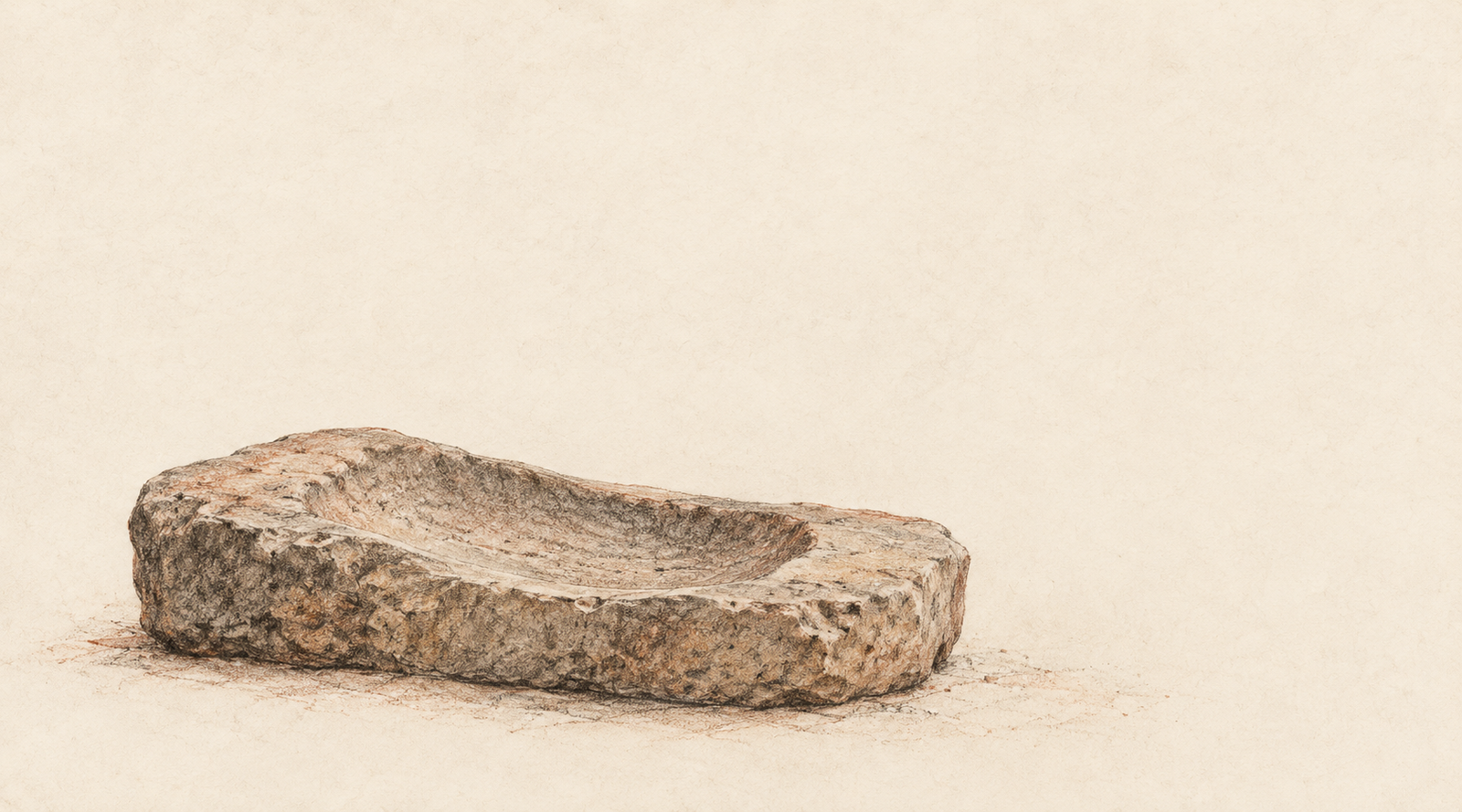
The temple we inherit is a building from which almost all necessity has been removed. Nothing must be brought for it to continue being what we call a temple. The sanctuary asks nothing of us. Stone is good at this kind of independence.
A living temple was otherwise.
Water had to come in. So did grain, cloth, oil, aromatic substances, fuel. The things required for worship arrived because someone carried them across a threshold.


Houses of Wood, Light, and Smoke
Some of Angkor’s most intimate ruins do not rise above the ground at all. They are postholes, low mounds, hearths and ponds: durable traces of a domestic city built largely from things that decay. To restore that city is to see Angkor not only as stone, but as wood, smoke, water, repair, and people living within calling distance.